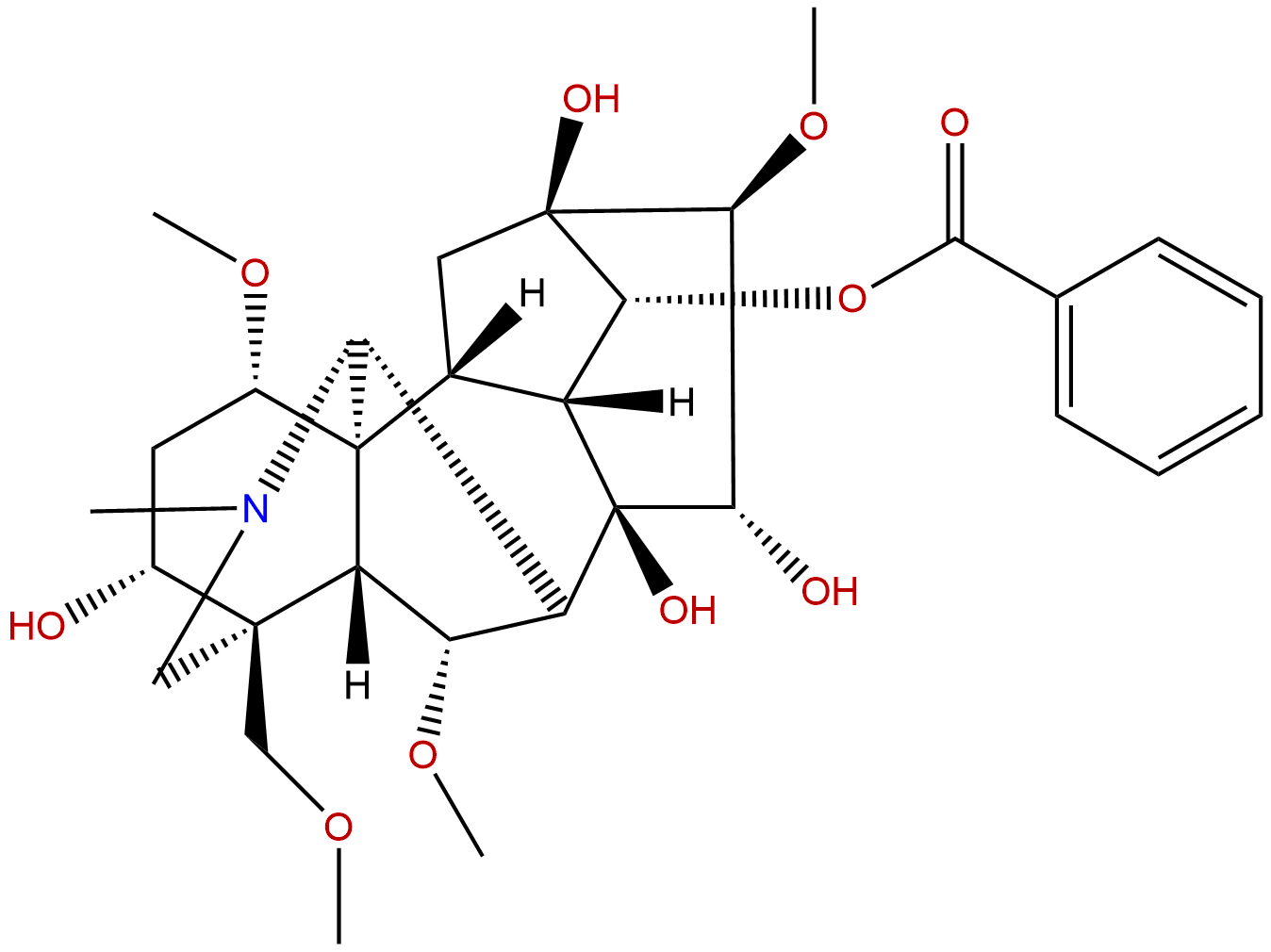


Product name: Benzoylmesaconine
Synonym name:
Catalogue No.: BP0246
Cas No.: 63238-67-5
Formula: C31H43NO10
Mol Weight: 589.682
Botanical Source:
Physical Description: Powder
Type of Compound: Alkaloids
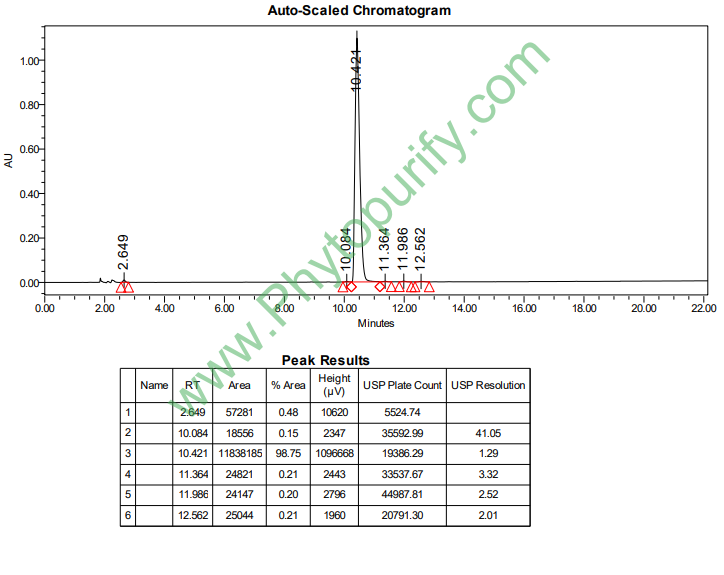
Purity: 95%~99%
Analysis Method: HPLC-DAD or/and HPLC-ELSD
Identification Method: Mass, NMR
Packing: Brown vial or HDPE plastic bottle
Storage: Store in a well closed container, protected from air and light. Put into refrigerate or freeze for long term storage.
Whenever possible, you should prepare and use solutions on the same day. However, if you need to make up stock solutions in advance, we recommend that you store the solution as aliquots in tightly sealed vials at -20℃. Generally, these will be useable for up to two weeks.
The product could be supplied from milligrams to grams, up to kilograms
Inquire for bulk scale.
Descriptions:
Benzoylmesaconine (BEN, an aconitine derivative extracted from heated-Aconiti tuber) induces the generation of CD4+ T cells antagonistic to type 2 T cells (BEN-CD4+ T cells), the combination therapy of IL-12 (an inducer of type 1 T cell responses) and BEN (an inhibitor of type 2 T cell responses) may protect TI-mice from severe HSV-1 infection.
Benzoylmesaconine has antinociceptive effects.[1]
Benzoylmesaconine has inhibition effects on opportunistic herpesvirus infections in mice with acquired immunodeficiency syndrome.[2]
References:
[1] Kobayashi M, Takahashi H, Herndon D N, et al. Burns, 2003, 29(1):37-42.
[2] Suzuki Y, Oyama T, Ishige A, et al. Planta Med, 1994, 60(5):391-4.
[3] Ball Ma, Kobayashi, Polland R B, et al. J Immunother, 1995, 17(2):127.
[4] Nie J, Zhang L, Tian S. China Pharmacist, 2003, 6(01):38-9.
HPLC of Benzoylmesaconine
Storage conditions:Short-term storage at 2~8℃, long-term storage at -20 ~ -80℃
Benzoylmesaconine (CAS number: 63238-67-5) is a monoester alkaloid derived from the traditional Chinese medicine compound Aconitum Decoction. As a traditional Chinese medicine formula, Aconitum Decoction has a long history and is mainly used to treat inflammatory diseases such as rheumatoid arthritis. Benzoyl neoaconitine, as the most abundant active ingredient in Aconitum Decoction, has received widespread attention in recent years due to its significant anti-inflammatory and immunomodulatory effects. Modern pharmacological studies have shown that benzoyl neoaconitine can regulate inflammatory responses through multiple targets and pathways, particularly exhibiting potent activity in inhibiting the NF - κ B signaling pathway and NLRP3 inflammasome activation. In addition, the potential role of benzoyl neoaconitine in metabolic diseases such as insulin resistance has gradually been revealed, providing new directions for its clinical application. This article will systematically review the chemical structure, plant origin, pharmacological activity, mechanism of action, and pharmacological evaluation of benzoyl neoaconitine, and explore its future clinical application prospects.
Benzoyl neoaconitine belongs to the aconitine alkaloid class and is a benzoylated derivative of neoaconitine. Its molecular formula is C31H41NO10 and its molecular weight is 589.6800. This compound contains multiple ester bonds and hydroxyl groups in its structure, with high polarity. Its topological polar surface area (TPSA) is 165.71 Å ² and the number of hydrogen bond acceptors is 10, indicating its strong hydration ability. The LogP value is 1.5, indicating moderate lipid solubility that facilitates membrane penetration but does not result in excessive lipid solubility, which may affect its bioavailability and distribution characteristics. The introduction of benzoyl groups in the chemical structure of benzoyl neoaconitine not only affects its physicochemical properties, but may also enhance its binding affinity with target proteins, thereby enhancing pharmacological activity. Its blood-brain barrier permeability is low, indicating limited function in the central nervous system. There is currently no clear data on its safety indicators such as liver toxicity, cardiac toxicity (including hERG channel inhibition), and mutagenicity (Ames test), and further research is needed.
Benzoyl neoaconitine is mainly found in plants of the Aconitum genus, especially Aconitum carmichaelii Debx. and its compound preparation Aconitum decoction, which are abundant in content. Fuzi, as a traditional Chinese medicinal herb, is widely used in clinical Chinese medicine after processing. The extraction of benzoyl aconitine is usually carried out using solvent extraction combined with chromatographic separation techniques. Traditional extraction methods often use alcohols (such as ethanol, methanol) or water alcohol mixed solvents to obtain crude extracts through reflux extraction or ultrasound assisted extraction. Subsequently, separation and purification were performed using column chromatography (silica gel, C18 reverse phase column) or high-performance liquid chromatography (HPLC). In recent years, supercritical fluid extraction and membrane separation technologies have also been applied to improve extraction efficiency and purity. The optimization of extraction process not only affects the yield of benzoyl neoaconitine, but also relates to the stability of its active ingredients and the accuracy of subsequent pharmacological research.
The pharmacological activities of benzoyl neoaconitine mainly focus on anti-inflammatory, immune regulation, and metabolic regulation. A large number of in vitro cell experiments and animal model studies have shown that benzoyl neoaconitine has significant anti-inflammatory effects, especially showing good therapeutic potential in rheumatoid arthritis models. It reduces inflammation, joint swelling, and pain by inhibiting the secretion of pro-inflammatory factors such as IL-1 β. Meanwhile, benzoyl neoaconitine can inhibit the activation of inflammasome NLRP3, reduce the efflux of intracellular potassium ions (K ^+), block the GSDMD-N protein mediated cell pyroptosis pathway, and protect tissues from inflammatory damage.
In addition, the role of benzoyl neoaconitine in metabolic diseases is receiving increasing attention. As the core pathological mechanism of type 2 diabetes and metabolic syndrome, insulin resistance is closely related to chronic low-grade inflammation. Benzoyl neoaconitine can improve insulin signal transduction and enhance insulin sensitivity by regulating a variety of signal pathways and targets (such as CDC25B, PTPN1, STAT3, SIRT1, etc.), showing potential anti diabetes effects. Its antioxidant and cell protective functions also help alleviate metabolic stress and maintain cellular homeostasis.
The anti-inflammatory mechanism of benzoyl neoaconitine mainly relies on the inhibition of the NF - κ B signaling pathway. NF - κ B, as a core transcription factor in inflammatory response, activation leads to the expression of various pro-inflammatory factors such as TNF - α, IL-1 β, IL-6. Benzoyl neoaconitine inhibits the transcription activity of inflammatory genes by blocking the degradation of I κ B α and suppressing NF - κ B nuclear translocation.
In terms of inflammasome regulation, benzoyl neoaconitine reduces intracellular K ^+efflux, disrupts the assembly of NLRP3 inflammasomes, and inhibits their activation. The activation of NLRP3 inflammasome is usually accompanied by the cleavage of GSDMD-N protein and cell pyroptosis. Benzoyl neoaconitine can inhibit the expression of GSDMD-N, slow down the process of cell pyroptosis, and reduce the inflammatory cascade reaction.
Targeting insulin resistance related targets, benzoyl neoaconitine regulates the activity of proteins such as CDC25B and PTPN1, promoting the normal operation of the insulin signaling pathway. STAT3, as a key factor in the cross regulation of inflammation and metabolism, its activity is regulated by benzoyl neoaconitine, which helps alleviate inflammation mediated insulin resistance. SIRT1, as an important regulatory factor for cellular energy metabolism and anti-inflammatory effects, is also activated by benzoyl neoaconitine, promoting mitochondrial function and cellular metabolic homeostasis.
In addition, benzoyl neoaconitine has a regulatory effect on NFE2L2 (nuclear factor erythroid 2-related factor 2), enhances cellular antioxidant capacity, and reduces oxidative stress damage. Its regulation of protein kinases such as PRKCA and PRKCD further affects cellular signaling and metabolic functions.
The pharmacological indicators of benzoyl neoaconitine indicate that it has certain potential for drug development. Although the molecular weight of 589.68 is slightly higher than the ideal range of traditional oral drugs, a moderate LogP value (1.5) and high polarity (TPSA 165.71) are beneficial for its distribution and targeting in vivo. However, higher polarity and number of hydrogen bond receptors may limit their membrane permeability and affect oral bioavailability.
The low permeability of the blood-brain barrier suggests that benzoyl neoaconitine mainly acts on peripheral tissues, reducing the risk of central nervous system toxicity and side effects. There is currently no systematic review on its hepatotoxicity, cardiotoxicity (especially hERG channel inhibition), and mutagenicity, and relevant safety studies need to be conducted.
In terms of pharmacokinetics, the absorption, distribution, metabolism, and excretion (ADME) characteristics of benzoyl neoaconitine are not fully understood. Preliminary studies have shown that its metabolism in the body is relatively complex and may involve multi-step metabolism of liver enzymes. The activity and safety of metabolites need further evaluation. Future research should focus on its oral bioavailability, half-life, tissue distribution, and excretion pathways to guide dosage form design and clinical medication regimens.
Benzoyl neoaconitine, as the main active ingredient of Aconitum Decoction, has shown promising application prospects in the treatment of inflammatory diseases such as rheumatoid arthritis due to its significant anti-inflammatory and immune regulatory effects. Through the synergistic effect of multiple targets and mechanisms, it can effectively inhibit inflammatory reactions, reduce tissue damage, and improve patient symptoms.
In addition, the potential role of benzoyl neoaconitine in insulin resistance and metabolic diseases has expanded its clinical application to new fields. By regulating key metabolic signaling pathways, benzoylneoaconitine is expected to become an adjuvant drug for the treatment of diabetes and related metabolic syndrome.
Future research should focus on the following aspects: firstly, systematically evaluating its safety, especially liver, kidney, and cardiac toxicity; Secondly, optimize the extraction and preparation processes to improve purity and stability; Thirdly, conduct pharmacokinetic and pharmacodynamic studies to clarify the dose-response relationship; The fourth is to verify its efficacy and safety through clinical trials, and promote its clinical translation.
With the development of modern drug research and development technology, combined with molecular docking, network pharmacology, and multi omics analysis, the mechanism of action of benzoyl neoaconitine will be further elucidated, providing scientific basis for the development of its new indications. Taking into account its unique pharmacological properties and traditional medical value, benzoyl neoaconitine is expected to become an important candidate molecule for the development of natural product drugs.
Benzoyl neoaconitine, as the most abundant monoester alkaloid in Aconitum Decoction, has significant anti-inflammatory and immunomodulatory activities, especially in inhibiting the NF - κ B signaling pathway and NLRP3 inflammasome activation. Its potential therapeutic value in diseases such as rheumatoid arthritis and insulin resistance demonstrates the important role of natural products in modern drug development. Although further systematic research is needed on its pharmacological properties and safety, benzoyl neoaconitine undoubtedly provides valuable research materials and clinical application prospects for the field of natural product pharmacology. In the future, through interdisciplinary cooperation, benzoyl neoaconitine is expected to achieve the transformation from traditional medicinal ingredients to modern innovative drugs, benefiting more patients.
