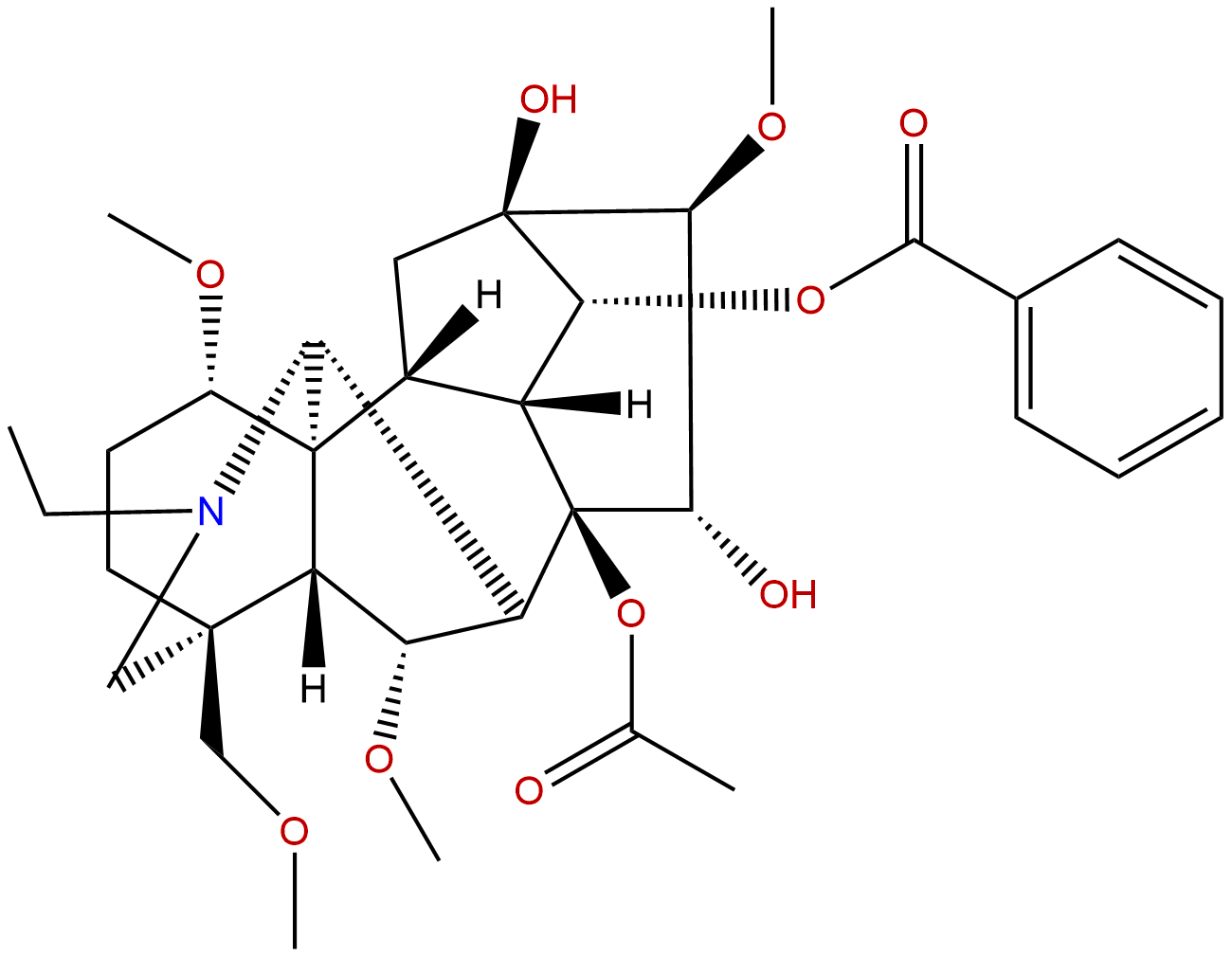


Product name: 3-Deoxyaconitine
Synonym name:
Catalogue No.: BP1567
Cas No.: 3175-95-9
Formula: C34H47NO10
Mol Weight: 629.747
Botanical Source: Alkaloid from numerous Aconitum spp. (Ranunculaceae); contaminant in crude aconitine
Physical Description: Powder
Type of Compound: Alkaloids
Purity: 95%~99%
Analysis Method: HPLC-DAD or/and HPLC-ELSD
Identification Method: Mass, NMR
Packing: Brown vial or HDPE plastic bottle
The product could be supplied from milligrams to grams. Inquire for bulk scale.
We provide solution to improve the water-solubility of compounds, thereby facilitating the variety of activity tests and clinic uses.
For Reference Standard and R&D, Not for Human Use Directly.
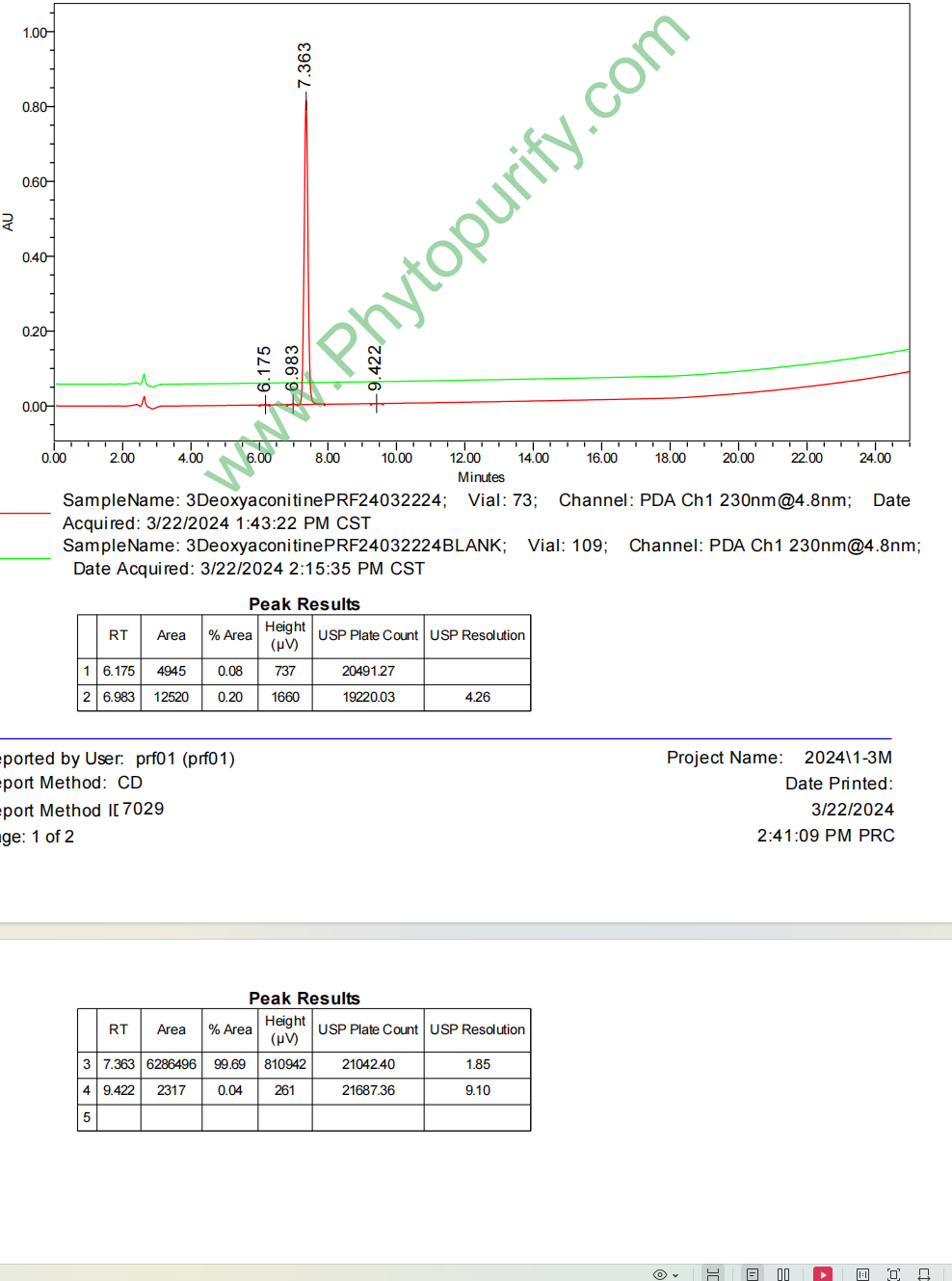
HPLC of 3-Deoxyaconitine
Storage conditions:Short-term storage at 2~8℃, long-term storage at -20 ~ -80℃
133.2200
2.5413
2.3917
.0956
1.0610
6.3869
Low
73.9652
7.1503
No
No
Yes
No
No
No
0.6
Yes
No
Yes
Yes
Aconitum plants have a long history of application in traditional medicine, especially in the medical system of Asia, and are commonly used to treat diseases such as pain, rheumatism, and inflammation. Its potent biological activity is mainly attributed to a class of diterpenoid alkaloids with complex structures and unique pharmacological effects, namely aconitine alkaloids. 3-Deoxyaconitine (CAS: 3175-95-9) is one of the important natural active ingredients. Compared with the classic aconitine, its C-3 position lacks a hydroxyl group, which results in significant differences in its pharmacological activity and toxicity due to this subtle structural difference. Traditionally, aconitine compounds have been known for their potent activation of voltage-gated sodium ion channels (VGSCs), which can produce analgesic effects at low doses but lead to severe cardiac and neurotoxicity at high doses, limiting their direct clinical application. In recent years, with the deepening understanding of pain mechanisms and the development of molecular pharmacology techniques, researchers have begun to re-examine the therapeutic potential of these "toxic" natural products, attempting to isolate or modify derivatives that separate activity and toxicity by elucidating their precise targets and mechanisms of action. As a key research object, the analgesic activity of 3-deoxyaconitine is not only related to sodium channels, but has also been found to involve multiple targets such as transient receptor potential vanillic acid subtype 1 (TRPV1), cannabinoid receptor 1 (CNR1), opioid receptors (OPRD1, OPRM1, OPRK1), and cyclooxygenase (PTGS1/2), exhibiting complex characteristics of multi-target and multi pathway synergistic effects. This article aims to systematically review the chemical properties, plant sources, pharmacological activities, molecular mechanisms of action, pharmacological evaluation, and clinical translation prospects of 3-deoxyaconitine, in order to provide comprehensive scientific references for the development of new analgesic drugs based on this compound.
3-Deoxyaconitine is a C19-diterpenoid alkaloid belonging to the aconitine alkaloid family. Its molecular formula is C34H47NO10, with a molecular weight of 629.7470 g/mol. Its core structure consists of a highly modified six ring skeleton, including a diterpene parent nucleus and a morpholine ring (amino alcohol moiety) connected by a nitrogen atom. Its most prominent structural feature is that the C-3 position is a hydrogen atom, rather than the hydroxyl group (- OH) found in most homologs such as Aconitine or Mesaconitine. This' deoxygenation 'modification greatly affects the polarity and spatial conformation of the molecule, thereby altering its interaction mode with biological targets.
Acetyloxy (- OCOCH3) groups are usually attached to positions C-8 and C-14, while methoxy or hydroxyl groups are often attached to positions C-16. These substituents are crucial for their activity and toxicity. Its complex stereochemistry, including multiple chiral centers, determines its specific three-dimensional configuration, which is the basis for its highly selective binding with target proteins such as ion channels.
From the analysis of physical and chemical properties, the calculated lipid water partition coefficient (LogP) is 2.5413, indicating that the compound has moderate lipophilicity, which is beneficial for its penetration of cell membranes. However, excessive lipid solubility may also lead to non-specific binding and tissue accumulation. Its topological polar surface area (TPSA) is 133.2200 Å ², reflecting the presence of multiple hydrogen bond acceptors and donors (such as ester groups, ether bonds, and tertiary amine nitrogen atoms) in the molecule. The low water solubility value (about 0.0956 mg/mL) makes it a difficult to dissolve compound, which poses a challenge for its formulation development. These basic physicochemical parameters are the starting point for its subsequent pharmacokinetic behavior and drug efficacy evaluation.
3-Deoxyaconitine mainly comes from various plants in the Aconitum genus of the Ranunculaceae family, and is commonly found in Aconitum carmichaelii Debx., also known as Aconitum carmichaelii Debx., is the source plant of Aconitum carmichaelii and Aconitum carmichaelii Debx、Aconitum kusnezofii Reichb. (the main source of Aconitum kusnezofii) and Aconitum coreanum Wait. There are significant differences in its content among different species, medicinal parts (such as main roots, lateral roots), and processing methods. The content of aconitine alkaloids in raw Aconitum is high, and their toxicity is severe; Through traditional processing techniques such as soaking, steaming, and making licorice black beans, highly toxic diester alkaloids (such as aconitine, aconitine, and aconitine) can be hydrolyzed into less toxic monoester or amine alcohol alkaloids. As a member of the diester alkaloids, the content of 3-deoxyaconitine also decreases during the processing.
The extraction of 3-deoxyaconitine from plant materials usually follows the conventional process of natural product chemistry. Firstly, the dried Aconitum root powder is subjected to percolation, reflux, or ultrasound assisted extraction using polar organic solvents such as methanol, ethanol, or acidified alcohol water mixtures. After vacuum concentration, the crude extract is dissolved in dilute acidic aqueous solution (such as hydrochloric acid, sulfuric acid), alkalized (such as ammonia water, sodium bicarbonate), and repeatedly extracted with organic solvents such as chloroform, dichloromethane, or ethyl acetate to enrich total alkaloids. Subsequently, various chromatographic techniques were used for separation and purification, including but not limited to:
1. Silica gel column chromatography Preliminary separation is often carried out using gradient elution systems such as chloroform methanol ammonia water.
2. Alumina column chromatography Has good adsorption and separation effects on alkaloids.
3. High performance liquid chromatography Especially reverse phase HPLC (C18 column, acetonitrile water or methanol water buffer system) is a key step in obtaining high-purity 3-deoxyaconitine. Preparative HPLC is widely used for purification at the milligram to gram scale.
4. High-speed countercurrent chromatography As a liquid-liquid distribution chromatography, it does not require a solid phase carrier and has unique advantages in separating isomers of natural products.
Strict control is required during the extraction and separation process, as aconitine compounds are highly toxic and easily absorbed through the skin or mucous membranes. The structure of the final compound was confirmed by techniques such as mass spectrometry (MS), nuclear magnetic resonance (NMR, especially 1H-NMR and 13C-NMR), and X-ray single crystal diffraction.
The core pharmacological activity of 3-deoxyaconitine is Analgesic effect Numerous in vivo experiments, such as mouse hot plate test, tail flick test, acetic acid writhing test, formalin test, chronic neuropathic pain model, etc., have confirmed that intraperitoneal injection or oral administration can significantly increase pain threshold and alleviate chemical, thermal, and inflammatory pain. Its analgesic intensity is comparable to classical opioid drugs (such as morphine) in some models, but its mechanism of action is more complex.
In addition to central and peripheral analgesia, studies also suggest that it may have:
- anti-inflammatory activity It exhibits inhibitory effects in acute inflammation models such as carrageenan induced rat foot swelling, which may be related to its impact on the prostaglandin pathway (PTGS1/2).
- Local anesthesia effect Due to its sodium channel activation properties, it can interfere with the transmission of nerve impulses at specific concentrations, but its relationship with analgesia is complex, and high concentrations may lead to excitotoxicity.
- The bidirectional effect on the heart and nervous system Extremely low doses may exhibit certain cardiac or neural regulatory effects, but the treatment window is extremely narrow and can easily lead to toxic reactions that cause arrhythmia and neural excitation. This is also the main manifestation of aconite poisoning.
It is worth noting that compared to the parent compound aconitine, 3-deoxyaconitine Acute toxicity is usually relatively low Animal experiments (such as LD50 determination in mice) have shown that its median lethal dose is higher than that of aconitine. This is mainly attributed to the absence of the C-3 hydroxyl group, which weakens the molecule's excessive affinity for certain toxicity related targets (such as certain sodium channel subtypes), but does not eliminate its pharmacological activity. This partial separation of activity and toxicity makes it an ideal lead compound for structural optimization and mechanism research.
The analgesic mechanism of 3-deoxyaconitine is significantly improved Multi target collaborative features Breaking through the traditional single understanding that it is only used as a "sodium channel activator".
Activation of voltage-gated sodium ion channels This is its most classic function. It can bind to site 2 of VGSCs (similar to neurotoxins verapamil and aconitine), inhibiting channel inactivation, resulting in sustained sodium channel opening and prolonged sodium ion influx. At low doses, sustained depolarization in primary sensory neurons (such as dorsal root ganglion neurons) may selectively block pain signal transduction or cause neurons to enter refractory phase through depolarization inhibition; At the same time, it may promote the release of pain neurotransmitters (such as substance P) at the spinal cord level, activate the descending inhibitory system, and produce analgesia. However, this mechanism is also the root cause of its cardiac toxicity (acting on myocardial Nav1.5) and neurotoxicity (acting on central nervous system Nav1.1-1.3).
Transient receptor potential channel regulation:
Opioid receptor system Pharmacological antagonistic experiments suggest that its analgesic effect can be partially blocked by the non selective opioid receptor antagonist naloxone. Further research has shown that it has a certain affinity for μ - (OPRM1), δ - (OPRD1), and κ - (OPRK1) opioid receptors, which may serve as Partial agonists or allosteric modulators Make an impact. This provides the possibility of addiction and respiratory depression risks that differ from traditional opioid drugs (further validation is needed), and explains its effectiveness in some neuropathic pain models.
Endogenous cannabinoid system The effect on CNR1 (CB1 receptor) is a new discovery in recent years. By activating central and peripheral CB1 receptors, regulating G protein signaling, and inhibiting neurotransmitter release, it may play a role in central analgesia and anti-inflammatory effects. There is extensive cross-talk between the opioid system and the cannabinoid system, and 3-deoxyaconitine may regulate both pathways simultaneously, resulting in synergistic effects.
Monoamine neurotransmitter system Its potential impact on serotonin transporter (SLC6A4) and dopamine D2 receptor (DRD2) suggests that it may affect pain emotion components by regulating the descending inhibitory system (such as the 5-HT pathway) and reward/motivation loop.
Cyclooxygenase inhibition The inhibitory effect on PTGS1 and PTGS2 (COX-1/2) directly reduces the synthesis of prostaglandins (such as PGE2) that cause pain and inflammation, providing a classic antipyretic and analgesic like basis for its anti-inflammatory and analgesic effects.
In summary, 3-deoxyaconitine forms a three-dimensional and multi-level analgesic network by simultaneously acting on ion channels of peripheral nociceptors (Nav, TRPV1/TRPA1), central and peripheral G protein coupled receptors (opioid receptors, cannabinoid receptors), and inflammatory mediator synthase (COX). This multi-target effect may lead to a wider range of pain spectrum coverage and potentially reduce the required dose of each individual target through synergistic effects, thereby potentially reducing the side effects caused by excessive single target effects.
Despite the remarkable multi-target pharmacological activity of 3-deoxyaconitine, its drug affinity faces a series of challenges, mainly based on its calculated and experimentally obtained ADMET (absorption, distribution, metabolism, excretion, toxicity) properties.
Absorption and distribution A moderate LogP value (2.54) suggests that oral absorption may be acceptable, but lower water solubility and larger molecular weight may limit its dissolution and transmembrane passive diffusion rate. Its TPSA value (133 Å ²) is slightly higher than the threshold of compounds commonly believed to be easily able to penetrate the blood-brain barrier (BBB) (about 60-70 Å ²). Combined with its larger molecular structure, it is predicted that Low blood-brain barrier permeability This means that its analgesic effect may be more derived from peripheral and spinal cord levels rather than directly acting on the higher central nervous system of the brain, which may help reduce the risk of central neurotoxicity, but may also limit its efficacy for certain central pains.
Metabolism As an ester alkaloid, it is likely to be a substrate for cytochrome P450 enzymes (especially CYP3A4) and esterases. The acetyl ester bonds at positions C-8 and C-14 are the main sites for metabolic hydrolysis in the body, which may generate monoester or amino alcohol metabolites with significantly reduced activity and toxicity. Predict that its metabolism is fast and its half-life may be short.
excretion The prototype drug and its metabolites may be mainly excreted through the kidneys.
toxicity This is the core obstacle to its pharmacological evaluation.
Pharmacokinetic study At present, there is still a relative lack of pharmacokinetic studies on the 3-deoxyaconitine system, such as absolute bioavailability, tissue distribution, plasma protein binding rate, and major metabolic pathways in rats or dogs. Limited literature suggests incomplete oral absorption, widespread distribution in the body, and rapid elimination. A thorough PK study is a necessary prerequisite for evaluating its clinical feasibility.
Overall, 3-Deoxyaconitine itself is not an ideal direct drug molecule, but it serves as Lead Compound The value is extremely high. Future research directions should focus on utilizing Structural modification While retaining its multi-target analgesic activity, it reduces sodium channel related toxicity. For example, by modifying the ester groups at positions C-8 and C-14, or introducing other polar groups, to alter their selectivity towards different sodium channel subtypes (biased towards peripheral neural Nav1.7 and 1.8 rather than cardiac Nav1.5), or to enhance their selectivity towards GPCR targets.
The clinical application prospects of 3-deoxyaconitine depend on whether it can successfully solve its toxicity problem and clarify its optimal indications. Its potential development directions include:
New multi-target analgesic lead compounds In the field of chronic pain treatment (such as neuropathic pain, inflammatory arthritis, cancer pain), single target drugs often have insufficient efficacy or significant side effects. The inherent multi-target properties of 3-deoxyaconitine provide a unique chemical template for the development of new analgesics that can kill multiple birds with one stone. Through rational drug design, it is expected to obtain new molecular entities with strong analgesic efficacy but lower risks of addiction (compared to pure opioid drugs), gastrointestinal injury (compared to traditional NSAIDs), and cardiac toxicity.
Development of topical analgesic preparations: In view of its low permeability of blood brain barrier and potential peripheral mechanism of action, the development of local topical preparations (such as gel, patch) for the treatment of local pain such as osteoarthritis, muscle pain, post herpetic neuralgia, is a low risk and feasible transformation path. Local administration can maximize the concentration of drugs at the target site while minimizing systemic exposure and toxicity.
Combination therapy strategy Low dose 3-deoxyaconitine or its derivatives may be used in combination with low-dose other types of analgesics (such as gabapentin and SNRI antidepressants) to achieve synergistic effects and reduce toxicity through multiple mechanisms. This requires rigorous preclinical and clinical interaction studies.
Examples of Modernization Research on Traditional Chinese Medicine In depth research on 3-deoxyaconitine can help clarify the scientific connotations of "processing to reduce toxicity and preserve efficacy" and "compatibility to reduce toxicity and increase efficacy" of toxic traditional Chinese medicines such as aconite and aconite at the molecular level. Clarifying the differences between its active and toxic targets can provide precise guidance for the safe and controllable use of such traditional drugs.
Challenges and future research directions:
- Research on Structural Optimization and Structure Performance Relationship Systematically study the contributions of various functional groups in its chemical structure to the activity and selectivity of various targets (Nav subtypes, opioid receptor subtypes, TRPV1, etc.) to guide rational design.
- In depth toxicology research Conduct comprehensive preclinical safety pharmacological and toxicological evaluations, particularly assessing cardiac safety (such as hERG experiments, ex vivo cardiac perfusion, and awake animal telemetry).
- Refinement of target action mechanism Using techniques such as molecular docking, site directed mutagenesis, and photoaffinity labeling, elucidate the exact binding sites and patterns with various target proteins.
- Exploration of a new drug delivery system Using preparation technologies such as nanocrystals, liposomes, and polymer micelles to improve their solubility and achieve targeted delivery (such as targeting inflammatory sites or peripheral nerves), further enhancing the therapeutic index.
As a natural diterpenoid alkaloid derived from traditional toxic Chinese medicine, the value of 3-deoxyaconitine has far exceeded the simple understanding as a toxic ingredient. Modern pharmacological research has revealed its unique mechanism of forming a complex analgesic network by acting on multiple targets such as sodium ion channels, TRP channels, opioid receptors, cannabinoid receptors, and cyclooxygenase. Although its inherent cardiac and neurotoxic properties, as well as poor pharmacokinetic parameters, pose significant obstacles to its direct clinical translation, these challenges precisely point to breakthroughs in future research. It will not only be a potential drug candidate molecule, but also a bridge connecting traditional medical wisdom with modern multi-target drug design concepts. Through in-depth structure-activity relationship research, rational structural modifications, and innovative drug delivery strategies, it is expected to derive a new generation of analgesic drugs that are both efficient and safe from this ancient and complex natural molecule, providing new solutions to address the global chronic pain problem. Continuous research on it will also promote the development of natural product pharmacology towards a more precise and systematic direction.
