


Product name: 14-Benzoylaconine
Synonym name: Picraconitine
Catalogue No.: BP0024
Cas No.: 466-24-0
Formula: C32H45NO10
Mol Weight: 603.709
Botanical Source: Alkaloid from Root of Aconitum carmichaeli and Aconitum polyschistum (Ranunculaceae). Also the processed aconite Kako-bushi-matsu", prod. by autoclaving the crude drug ("bushi") obt. from Root of some Aconitum spp.
Physical Description: Powder
Type of Compound: Alkaloids
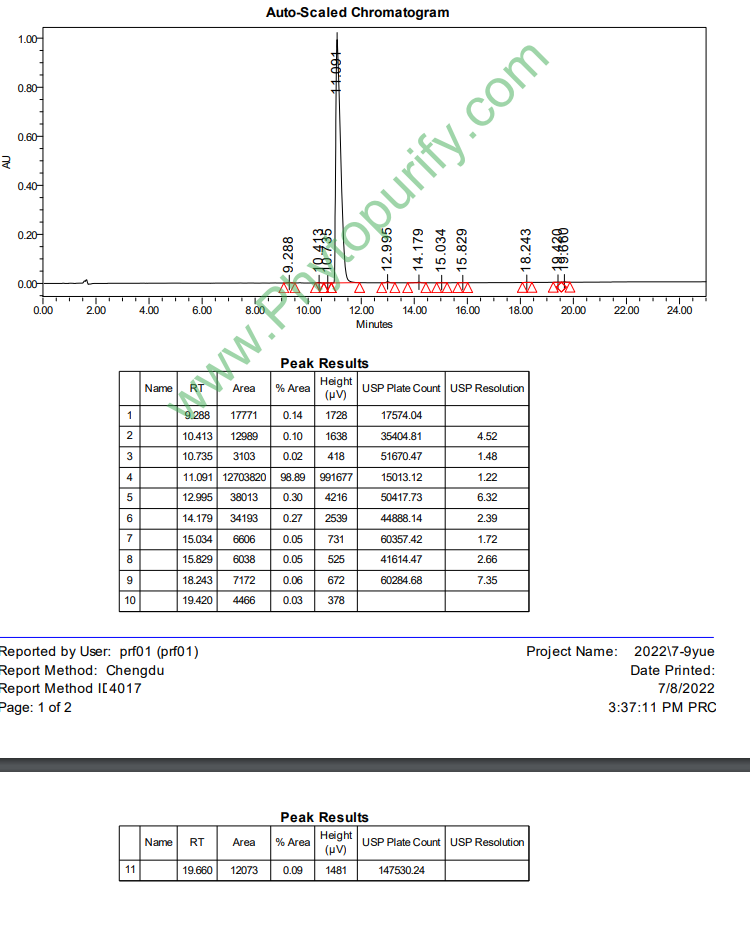
Purity: 95%~99%
Analysis Method: HPLC-DAD or/and HPLC-ELSD
Identification Method: Mass, NMR
Packing: Brown vial or HDPE plastic bottle
Storage: Store in a well closed container, protected from air and light. Put into refrigerate or freeze for long term storage.
Whenever possible, you should prepare and use solutions on the same day. However, if you need to make up stock solutions in advance, we recommend that you store the solution as aliquots in tightly sealed vials at -20℃. Generally, these will be useable for up to two weeks.
The product could be supplied from milligrams to grams, up to kilograms
Inquire for bulk scale.
Descriptions:
Benzoylaconine and aconitine can induce reproductive toxicity in BeWo Cell, the amino acid metabolism was the main metabolic pathway and responsible for the placental and fetal toxicity of them.[1]
References:
[1] Xie H H, Xie T, Jian-Ya X U, et al. Chinese J Anal Chem, 2015, 43(12):1808-13.
[2] Li M Y, Kiyoshi He, Wang A W. Chinese J Inform Trad Chinese Med, 2015 (09): 87-90.
"
HPLC of 14-Benzoylaconine
Storage conditions:Short-term storage at 2~8℃, long-term storage at -20 ~ -80℃
164.2400
1.4000
Low
Unknown
Unknown
Unknown
No
Unknown
Benzoylaconine (CAS number: 466-24-0), as an important derivative of aconitine alkaloids, has attracted widespread attention in the field of natural product pharmacology in recent years. Aconitum alkaloids are known for their complex chemical structures and diverse biological activities, and are widely present in Aconitum plants. They have significant pharmacological activities and have shown potential value in the treatment of neurological diseases. Benzoyl aconitine, as a representative compound, has become a hot topic in the research of neurodegenerative diseases such as cognitive impairment due to its unique structural modifications and biological activities.
Cognitive impairment, as an increasingly severe public health problem in an aging society, involves multiple pathological mechanisms, including neuroinflammation, oxidative stress, neuronal apoptosis, and neurotransmitter imbalance. Benzoyl aconitine exhibits the potential to regulate neural function and protect neurons by modulating multiple targets such as IDO1, APP, BACE1, etc., suggesting its potential application in the treatment of cognitive impairment. This article provides a systematic review of the chemical structure, sources, pharmacological activity, mechanism of action, and pharmacological evaluation of benzoyl aconitine, aiming to provide theoretical basis for its subsequent research and drug development.
The molecular formula of benzoyl aconitine is C32H43NO9, with a molecular weight of 591.7 Da. Its structure is based on a typical aconitine skeleton, with a benzoyl group attached to the 14th nitrogen atom, endowing it with unique physicochemical properties. The LogP value of this compound is approximately 1.4, indicating moderate lipophilicity that facilitates membrane penetration. However, its extremely high polar surface area (TPSA 164.24 Å ²) and numerous hydrogen bond receptors (10) limit its ability to pass through the blood-brain barrier.
The structure of benzoyl aconitine contains multiple hydroxyl and ester groups, endowing it with strong polarity and hydrogen bonding ability, which has a significant impact on its binding with target proteins. In addition, the compound has a complex three-dimensional conformation with multiple chiral centers, which affects its biological activity and metabolic stability. Due to its large molecular weight and polarity, the distribution and absorption characteristics of benzoyl aconitine in vivo are quite unique, and further clarification is needed in conjunction with pharmacokinetic studies.
Benzoyl aconitine is mainly found in Aconitum spp., especially in traditional Chinese medicinal herbs such as Aconitum carmichaelii and Aconitum kusnezofii, where its content is relatively high. Aconitum plants have been widely studied for their rich alkaloids, and benzoyl aconitine, as one of its important components, has high medicinal value.
The extraction method usually uses organic solvent extraction combined with column chromatography separation technology. The commonly used extraction steps include:
1. Use ethanol or methanol as solvents for crude extraction to fully dissolve the alkaloid components in plants.
2. The separation of alkaloids is achieved through acid-base regulation, with hydrochloric acid aqueous solution commonly used to adjust the pH value.
3. Separate and purify the extract using silica gel column chromatography or high-performance liquid chromatography (HPLC) to obtain high-purity benzoyl aconitine.
In recent years, the application of ultrasound assisted extraction and microwave-assisted extraction technologies has improved extraction efficiency and purity, reduced solvent usage and extraction time, and provided technical support for the industrial production of benzoyl aconitine.
The pharmacological activity research of benzoyl aconitine mainly focuses on the prevention and treatment of neurological diseases, especially cognitive impairment. Multiple in vitro and in vivo studies have shown that this compound has neuroprotective, anti-inflammatory, antioxidant, and neurotransmitter regulating effects.
Neuroprotective effect
Benzoyl aconitine can alleviate damage to nerve cells caused by oxidative stress and inflammatory reactions. Experimental data shows that it can inhibit neuronal apoptosis, promote neuronal survival, and improve neurological dysfunction.
anti-inflammatory effect
By regulating the expression of inflammatory mediators, benzoyl aconitine reduces the level of neuroinflammation, alleviates excessive activation of microglia, blocks the inflammatory cascade reaction, and protects nerve tissue.
Regulating cognitive function
In the Alzheimer's disease model, benzoyl aconitine exhibits the potential to improve cognitive ability, which may be related to its regulation of the metabolism of β - amyloid precursor protein (APP) and the activity of β - secretase 1 (BACE1).
Multi-target effect
Benzoyl aconitine acts on various targets, such as IDO1 (tryptophan 2,3-dioxygenase 1), PTPN1 (protein tyrosine phosphatase 1), ABCB1, ABCG2 and other transport proteins, regulating neural metabolism and drug efflux, enhancing the maintenance of nervous system homeostasis.
The mechanism of action of benzoyl aconitine is complex, involving multiple signaling pathways and molecular targets, including:
IDO1 (tryptophan 2,3-dioxygenase 1)
IDO1 catalyzes key steps in tryptophan metabolism, and its abnormal activity is closely related to neuroinflammation and cognitive impairment. Benzoyl aconitine alleviates neuroinflammation by inhibiting IDO1 activity, reducing the production of neurotoxic metabolites.
APP (amyloid precursor protein) and BACE1 (β - secretase 1)
The abnormal processing of APP leads to the deposition of β - amyloid protein, which is the core pathology of Alzheimer's disease. Benzoyl aconitine reduces neurotoxicity by regulating BACE1 activity, inhibiting the production of β - amyloid protein.
PTPN1 (protein tyrosine phosphatase 1)
PTPN1 is involved in multiple signaling pathways, regulating cellular metabolism and inflammatory responses. The regulatory effect of benzoyl aconitine contributes to the metabolic balance and anti-inflammatory properties of nerve cells.
Transporters ABCB1 and ABCG2
These two ATP binding cassette transporters play an important role in drug efflux from the blood-brain barrier. Benzoyl aconitine affects the distribution of drugs in the central nervous system by regulating their expression and activity.
Other targets (TYR, SYNJ2, USP2, ALOX5)
Benzoyl aconitine exerts a comprehensive neuroprotective effect by modulating the function and environment of nerve cells through multi-target synergistic action.
The pharmacological evaluation of benzoyl aconitine shows that it has certain advantages and challenges:
Molecular properties
The molecular weight is 591.7 Da, slightly higher than the ideal range of traditional drugs (<500 Da), which may affect oral absorption. The LogP is 1.4, indicating moderate lipid solubility that facilitates membrane penetration, but the high TPSA of 164.24 Å ² suggests strong polarity and limits the ability to penetrate the blood-brain barrier.
Blood-brain barrier permeability
The prediction is low, which may limit its direct action in the central nervous system and require optimization of the administration route or structural modification to increase brain concentration.
Toxicity risk
The cardiac toxicity is marked as' yes', indicating the possibility of cardiac related side effects, especially the impact on cardiac electrophysiology, which requires special attention. The inhibition of hERG channel is unknown and further in vitro electrophysiological experiments are needed for verification.
Metabolic stability and liver toxicity
Hepatotoxicity is not yet clear and needs to be evaluated through in vivo pharmacokinetic and toxicological studies. The ester bonds in its structure may be easily hydrolyzed by esterases, affecting metabolic stability.
Pharmacokinetic characteristics
At present, there is limited systematic pharmacokinetic data on benzoyl aconitine. Preliminary studies have shown that its oral bioavailability is limited and its half-life is moderate. It is necessary to improve its in vivo stability and targeting through drug delivery systems or chemical modifications.
Benzoyl aconitine, as a natural product with multi-target effects, has shown potential in the treatment of cognitive impairment and related neurodegenerative diseases. Its multiple mechanisms of action enable it to simultaneously regulate neuroinflammation, oxidative stress, and amyloid metabolism, providing comprehensive intervention strategies for complex pathological states.
However, limitations in drug development, such as poor blood-brain barrier permeability and potential cardiac toxicity, have become the main obstacles to its clinical translation. Future research should focus on the following directions:
Structural optimization and derivative design
By molecular modification, polarity can be reduced, brain penetration can be enhanced, cardiac toxicity can be reduced, and drug safety and efficacy can be improved.
Drug delivery system development
Utilizing novel delivery technologies such as nanocarriers and liposomes to enhance the targeted delivery of benzoyl aconitine in the central nervous system.
Systematic pharmacokinetics and toxicology research
Establish a comprehensive in vivo metabolism and safety evaluation system, clarify its pharmacokinetic characteristics and potential toxic side effects.
Preclinical and clinical research
Based on animal models, efficacy validation and safety evaluation lay the foundation for future clinical trials.
Overall, benzoyl aconitine has the potential to become a new drug for the treatment of neurological diseases, but challenges in pharmacokinetics and safety still need to be overcome.
Benzoyl aconitine, as an important member of the aconitine class of natural products, has demonstrated unique advantages in the study of neurodegenerative diseases such as cognitive impairment due to its complex chemical structure and multi-target pharmacological activity. It exerts neuroprotective and cognitive function improvement effects by regulating key targets such as IDO1, APP, and BACE1, demonstrating the potential of natural product multi-target therapy.
Although there are certain limitations in drug development, such as poor blood-brain barrier permeability and the risk of cardiotoxicity, the combination of modern drug design and delivery technologies is expected to overcome these bottlenecks and achieve clinical translation. In the future, systematic pharmacokinetic studies, structural optimization, and preclinical validation will be key to promoting the development of benzoyl aconitine drugs.
Overall, benzoyl aconitine not only enriches the pharmacological research of aconitine compounds, but also provides new ideas and candidate molecules for the treatment of neurological diseases such as cognitive impairment, which is worthy of continuous and in-depth exploration.
