


Synonym name: Aconitine 3-acetate; Aconitine 3-monoacetate; Flaconitine
Catalogue No.: BP0058
Cas No.: 77181-26-1
Formula: C36H49NO12
Mol Weight: 687.783
Botanical Source: Alkaloid from Root of Aconitum flavum and Aconitum pendulum (Ranunculaceae)
Purity: 95%~99%
Analysis Method: HPLC-DAD or/and HPLC-ELSD
Identification Method: Mass, NMR
Packing: Brown vial or HDPE plastic bottle
Can be supplied from milligrams to grams.
For Reference Standard and R&D, Not for Human Use Directly.
Inquire for bulk scale.
HPLC of 3-Acetylaconitine
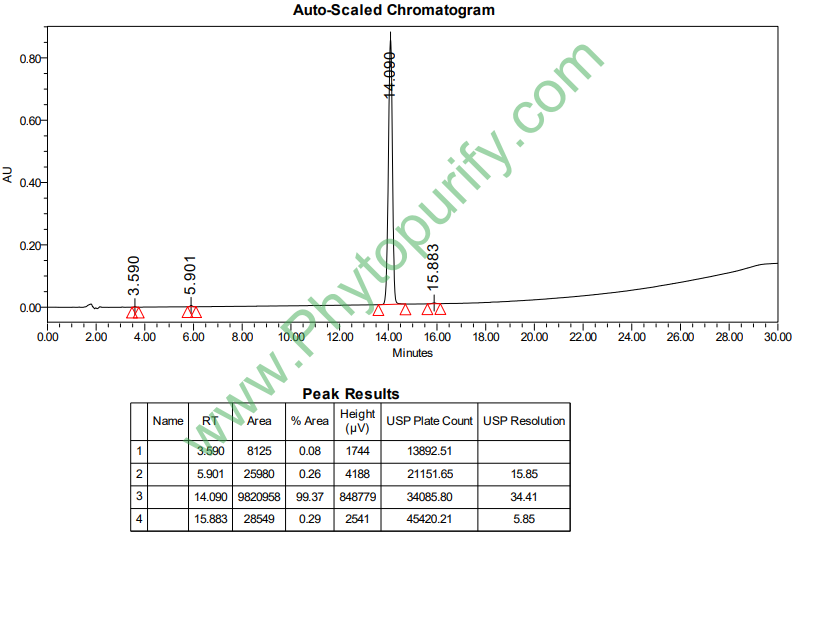
Storage conditions:Short-term storage at 2~8℃, long-term storage at -20 ~ -80℃
173.8100
1.3000
Yes
No
3-acetylaconitine is a natural alkaloid derived from plants of the Aconitum genus, and is an important member of the aconitine class of compounds. Aconitine compounds play an important role in both traditional medicine and modern pharmacological research due to their unique structure and significant biological activity. 3-acetylaconitine, as a natural product with a complex structure, has received widespread attention in recent years due to its potential neuroprotective effects and regulatory ability on cognitive impairment related targets. Cognitive impairment, as a core symptom of various neurodegenerative diseases such as Alzheimer's disease and Parkinson's disease, seriously affects the quality of life of patients and urgently requires the development of new and effective therapeutic drugs. 3-acetylaconitine has shown potential in regulating neurological function and slowing down cognitive decline through a multi-target mechanism, making it a research hotspot in the field of natural product pharmacology.
This article will provide a systematic review of the chemical structure and physicochemical properties, plant sources and extraction methods, pharmacological activity and mechanism of action, pharmacological evaluation and pharmacokinetic characteristics of 3-acetylaconitine. Combined with current research progress, it will explore its application prospects and development directions in the treatment of cognitive impairment, aiming to provide theoretical basis and reference for related research.
The molecular formula of 3-acetylaconitine is C38H51NO11, with a molecular weight of 691.78 and a CAS number of 77181-26-1. Its chemical structure is based on a typical aconitine skeleton, containing multiple cyclic structures and functional groups, with the most significant being the acetyl substitution at position 3. This structure endows it with high molecular complexity and diverse chemical reactivity.
In terms of physicochemical properties, the LogP value of 3-acetylaconitine is 1.3, indicating its moderate lipophilicity, which is beneficial for penetrating cell membranes and the blood-brain barrier. Its topological polar surface area (TPSA) is 173.81 Å ², indicating that the molecule has a large number of polar groups, especially with a hydrogen bond acceptor count of up to 12, which is of great significance for its binding to biomolecule targets. A high TPSA value usually indicates that the molecule may be limited in oral absorption and bioavailability.
However, the structure of 3-acetylaconitine contains multiple ester bonds and complex ring systems, which may lead to poor metabolic stability in vivo. In addition, the potential risks of cardiac toxicity and hERG channel inhibition suggest that its safety evaluation needs to be particularly cautious, which is also a common challenge faced by aconitine compounds.
3-acetylaconitine is mainly found in Aconitum spp., especially in traditional Chinese medicinal herbs such as Aconitum carmichaelii and Aconitum kusnezofii. Aconitum plants are widely distributed in East Asia, including China, Japan, and South Korea, and have been used for the treatment of rheumatism, neuralgia, and cold dampness syndrome.
Traditional extraction methods usually use organic solvent extraction combined with acid-base separation technology. The specific process includes: first, reflux extraction of dried plant roots and stems with ethanol or methanol, and then separation and purification through liquid-liquid distribution, column chromatography, and other methods. In order to improve the yield and purity of 3-acetylaconitine, modern research has introduced ultrasound assisted extraction, microwave-assisted extraction, and high-performance liquid chromatography (HPLC) separation techniques.
In recent years, with the development of analytical techniques, liquid chromatography-mass spectrometry (LC-MS/MS) has been widely used for qualitative and quantitative analysis of 3-acetylaconitine, promoting its detection and research in complex plant matrices.
The pharmacological activity research of 3-acetylaconitine mainly focuses on its effects on the nervous system, especially the regulation of cognitive function. Multiple in vitro and in vivo experiments have shown that 3-acetylaconitine has multiple biological effects such as neuroprotection, anti-inflammatory, and antioxidant properties.
Neuroprotective effect
3-acetylaconitine can alleviate oxidative stress damage in nerve cells and inhibit neuronal apoptosis. Related studies have shown that it can protect neurons from damage by regulating mitochondrial function and inhibiting the generation of reactive oxygen species (ROS). In addition, 3-acetylaconitine has shown improvement in learning and memory abilities in model animals, suggesting its potential therapeutic value for cognitive impairment.
anti-inflammatory effect
The occurrence of cognitive impairment is closely related to the inflammatory response of the central nervous system. 3-acetylaconitine can inhibit the expression of inflammatory factors such as TNF - α and IL-1 β, and alleviate inflammation mediated nerve damage. This effect may be achieved by regulating the nuclear factor kappa B (NF - κ B) signaling pathway.
Antioxidant effect
3-acetylaconitine enhances intracellular antioxidant enzyme activity, such as superoxide dismutase (SOD) and glutathione peroxidase (GPx), reduces lipid peroxidation levels, and slows down nerve damage caused by oxidative stress.
Improvement of cognitive function
In animal models of Alzheimer's disease and other cognitive disorders, 3-acetylaconitine improves cognitive function and memory impairment through multi-target regulation, exhibiting good pharmacological characteristics.
The mechanism of action of 3-acetylaconitine involves multiple molecular targets, reflecting its characteristics of multi-target and multi pathway synergistic regulation. The targets related to cognitive impairment mainly include:
IDO1 (Indoleamine 2,3-dioxygenase 1)
IDO1 is involved in tryptophan metabolism, regulating neuroinflammation and immune response. The inhibitory effect of 3-acetylaconitine on IDO1 helps alleviate neuroinflammation and improve cognitive function.
APP (amyloid precursor protein) and BACE1 (β - amyloid precursor protein lyase 1)
The abnormal metabolism of APP and excessive activation of BACE1 lead to the deposition of β - amyloid protein (A β), which is the core pathology of Alzheimer's disease. 3-acetylaconitine reduces A β production and mitigates neurotoxicity by regulating APP expression and inhibiting BACE1 activity.
PTPN1 (protein tyrosine phosphatase 1)
PTPN1 participates in the insulin signaling pathway, affecting neuronal metabolism and function. The regulation of PTPN1 by 3-acetylaconitine may improve the metabolic status of neurons and promote cognitive recovery.
TYR (Tyrosinase)
TYR plays a role in neurotransmitter synthesis, and 3-acetylaconitine may affect the balance of neurotransmitters such as dopamine by regulating TYR activity.
ABCB1 and ABCG2 (ATP binding cassette transporter family)
These two transporters are involved in drug efflux through the blood-brain barrier, and 3-acetylaconitine may regulate the concentration of drugs and metabolites in the brain by affecting its expression or function.
SYNJ2 (Phosphatidylinositol Phosphatase)
Participate in membrane lipid metabolism and signal transduction, regulate neuronal membrane dynamics and synaptic function.
USP2 (Ubiquitin Specific Protease 2)
Regulating protein ubiquitination process and affecting neuronal protein homeostasis.
ALOX5 (Lipoxygenase 5)
Participating in the generation of inflammatory mediators, the inhibition of ALOX5 by 3-acetylaconitine helps alleviate neuroinflammation.
In summary, 3-acetylaconitine exerts a synergistic effect on neuroprotection, anti-inflammatory, antioxidant, and cognitive function improvement by regulating the aforementioned multiple targets, demonstrating its multidimensional mechanism as a potential therapeutic drug for cognitive impairment.
Although 3-acetylaconitine has shown great potential in pharmacological activity, its pharmacological evaluation reveals several challenges:
Molecular properties
The molecular weight of 691.78 is relatively large, with a TPSA of 173.81 Å ² and up to 12 hydrogen bond receptors, indicating that its oral bioavailability may be limited and its ability to penetrate the blood-brain barrier needs further verification.
Cardiotoxicity and hERG inhibition
3-acetylaconitine poses a risk of cardiac toxicity, especially its inhibitory effect on hERG (human cardiac potassium channel), which may cause arrhythmia and limit its clinical application. This type of toxicity is a common problem with aconitine compounds and needs to be addressed through structural modification or formulation optimization.
Pharmacokinetic characteristics
At present, there is limited pharmacokinetic data on the in vivo metabolism, distribution, and excretion of 3-acetylaconitine. Previous studies have shown that it may undergo metabolic processes such as ester hydrolysis and oxidation-reduction in the body, and the activity and safety of metabolites still need to be further explored.
Dosage form and administration route
Due to its physicochemical properties and toxicity issues, the development of dosage forms for 3-acetylaconitine needs to focus on sustained-release, targeted delivery, and toxicity reduction strategies, such as novel drug delivery systems such as nanocarriers and liposomes.
3-acetylaconitine, as a natural product, has good clinical application prospects due to its potential for multi-target regulation of cognitive impairment related pathological processes. Its application value in cognitive impairment, especially in neurodegenerative diseases such as Alzheimer's disease, is gradually emerging, but it still faces many challenges.
Future research should focus on:
Security optimization
Reduce cardiac toxicity and hERG inhibition risk through chemical modification, and improve drug safety.
Pharmacokinetic improvement
Optimize molecular structure and dosage form design, improve bioavailability and brain concentration, and ensure drug efficacy.
In depth analysis of the mechanism
Using multi omics techniques and molecular simulations to further clarify its target and signaling pathways, and guide precise treatment strategies.
Preclinical and clinical research
Strengthen animal model validation, conduct systematic toxicological evaluation and pharmacological research, and lay the foundation for clinical trials.
Combination therapy strategy
Explore synergistic effects with other cognitive impairment treatment drugs to enhance treatment efficacy, reduce monotherapy dosage and toxic side effects.
In summary, 3-acetylaconitine, as a new candidate drug for the treatment of cognitive impairment, has broad development space, but it needs to systematically solve its drug development bottleneck and promote its clinical application.
3-acetylaconitine, as an important member of aconitine natural products, has shown unique pharmacological potential in the field of cognitive impairment treatment due to its complex chemical structure and multi-target regulatory ability. Its neuroprotective, anti-inflammatory, and antioxidant effects provide a theoretical basis for improving cognitive function. However, issues such as high molecular weight, high polarity, and cardiotoxicity have become the main obstacles to its clinical development. In the future, through structural optimization, dosage form innovation, and in-depth mechanism research, it is expected to overcome existing bottlenecks and achieve the clinical application of 3-acetylaconitine in the treatment of cognitive impairment. As an important direction in the pharmacological research of natural products, the development of 3-acetylaconitine not only enriches natural drug resources, but also provides new ideas and strategies for the treatment of neurodegenerative diseases.
