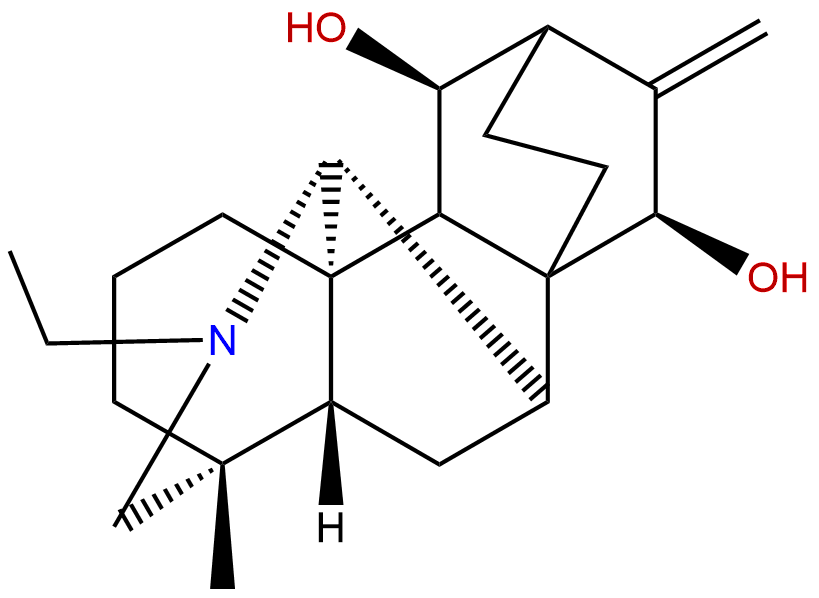


Synonym name:
Catalogue No.: BP0291
Cas No.: 1354-84-3
Formula: C22H35NO2
Mol Weight: 345.527
Botanical Source: Alkaloid from the Chinese drug Hye-shang-yi-zhi-hao (Aconitum bullatifolium var. homotrichum, Ranunculaceae)
Purity: 95%~99%
Analysis Method: HPLC-DAD or/and HPLC-ELSD
Identification Method: Mass, NMR
Packing: Brown vial or HDPE plastic bottle
Can be supplied from milligrams to grams.
For Reference Standard and R&D, Not for Human Use Directly.
Inquire for bulk scale.
Storage conditions:Short-term storage at 2~8℃, long-term storage at -20 ~ -80℃
Bullatine A (CAS number: 1354-84-3) is a diterpenoid alkaloid derived from the traditional Chinese medicine plant Aconitum bullatum Hand. - Mazz. In recent years, with the in-depth study of the molecular mechanisms of neuroinflammation and related diseases, Artemisia scoparia has gradually become a research hotspot in the field of natural product pharmacology due to its unique pharmacological activity and multi-target mechanism of action. This compound exhibits significant anti rheumatic, anti-inflammatory, analgesic, and anti-tumor activities, especially in central nervous system diseases and inflammation regulation, demonstrating good potential for application. This article provides a systematic review of the chemical structure and physicochemical properties, plant sources and extraction methods, pharmacological activity, mechanism of action, evaluation of drug properties, and clinical application prospects of Artemisia scoparia, aiming to provide a theoretical basis and research direction for the further development and clinical translation of this natural product.
Xueshang Yizhihao Jia Su belongs to the diterpenoid alkaloid class, with a molecular formula of C2H29NO3 and a molecular weight of 343.50. Its molecular structure contains a typical diterpene skeleton, with multiple cyclic structures and nitrogen-containing groups, endowing it with unique biological activity. In terms of physical and chemical properties, the LogP value of Artemisia scoparia A is about 3.0, indicating moderate hydrophobicity, which is conducive to its penetration of cell membranes and the blood-brain barrier (BBB). Its topological polar surface area (TPSA) is 38.77 Å ², with 3 hydrogen bond acceptors, further supporting its excellent membrane permeability and potential central nervous system activity. According to pharmacokinetic predictions, Artemisia scoparia has high blood-brain barrier permeability, but there is a potential risk of cardiac toxicity and hERG channel inhibition, suggesting that its safety evaluation should be given special attention in clinical development.
Snow Artemisia annua is mainly isolated from the rhizomes of the Ranunculaceae plant. A branch of Artemisia annua on snow is distributed in southwestern China and has always been used in traditional Chinese medicine to treat rheumatism, inflammation, and neurological diseases. During the extraction process, alcohols (such as ethanol or methanol) are usually used for reflux extraction of dried plant rhizomes, followed by separation and purification through liquid-liquid distribution, column chromatography, and other methods. In modern research, a combination of high-performance liquid chromatography (HPLC) and mass spectrometry (MS) techniques has been used to achieve efficient separation and quantitative analysis of artemisinin from Artemisia scoparia. Some studies have also explored green and efficient extraction techniques such as supercritical CO2 extraction and microwave-assisted extraction to improve yield and purity, reduce solvent usage, and promote the feasibility of industrial production.
As a potent P2X7 receptor antagonist, Xueshang Yizhihao Jia significantly inhibits ATP induced BV-2 microglial cell death and apoptosis, and alleviates P2X7 mediated inflammatory response. The P2X7 receptor plays a key role in inflammation and immune regulation, and its activation can promote the release of inflammatory factors and cell apoptosis. Artemisia scoparia methyl inhibits the inflammatory cascade by antagonizing this receptor, demonstrating good anti-inflammatory effects. In addition, Artemisia scoparia A effectively reduced systemic inflammatory response induced by LPS in mice in vivo experiments, involving inhibition of the ROS/JNK/NF - κ B signaling pathway, further verifying its anti-inflammatory potential. Its anti rheumatic effect is closely related to its inhibition of the release of inflammatory mediators and activation of immune cells.
Snow Artemisia annua has shown significant analgesic effects in various animal models, especially in the hyperalgesia model, which can specifically alleviate the hyperalgesia response in rats. Its analgesic mechanism involves multi-target regulation, including receptors and enzymes such as TRPV1, TRPA1, CNR1, OPRD1, OPRM1, OPRK1, PTGS1, PTGS2, SLC6A4, and DRD2, reflecting its ability to regulate pain signal transduction in a complex manner. By regulating these targets, Artemisia scoparia not only alleviates acute pain, but also has potential therapeutic effects on chronic pain and neuropathic pain.
In recent years, Artemisia scoparia A has attracted attention in the study of glioblastoma (GBM). Research has shown that Artemisia scoparia A inhibits the proliferation and growth of glioma cells, induces cell cycle arrest and apoptosis by targeting SIRT6 (a deacetylase), suggesting its potential as an anti-tumor candidate drug. SIRT6 plays an important role in tumor metabolism and DNA repair, and its regulation has a critical impact on the survival and drug resistance of tumor cells. Through this target, Artemisia scoparia inhibits GBM, providing new ideas for tumor treatment.
In the chronic social frustration stress (CSDS) mouse model, Artemisia scoparia significantly improved the desperate behavior of mice and exhibited antidepressant activity. Its mechanism of action may involve the alleviation of inflammatory response and regulation of neurotransmitter system, especially by inhibiting neuroinflammation and oxidative stress pathways, improving neuronal function and emotional regulation. This discovery provides a new research direction for the application of natural products in the treatment of mental and neurological disorders.
The pharmacological activity of Artemisia scoparia on snow depends on its multi-target and multi pathway regulatory characteristics. The main mechanisms of action include:
P2X7 receptor antagonism
P2X7 receptor is an ATP dependent ion channel involved in inflammatory response and cell death. As a potent P2X7 antagonist, Xueshang Yizhihao Jia blocks its activation, inhibits the release of inflammatory factors and apoptosis of microglia, and alleviates neuroinflammation.
Inhibition of ROS/JNK/NF - κ B signaling pathway
Xueshang Yizhihao Jia Su exerts anti-inflammatory and neuroprotective effects by inhibiting reactive oxygen species (ROS) generation, blocking the activation of JNK and NF - κ B signaling pathways, reducing the expression of pro-inflammatory factors.
SIRT6 regulation
By targeting SIRT6, Artemisia scoparia affects the proliferation and apoptosis of glioma cells, regulates cell metabolism and DNA repair, and exerts anti-tumor effects.
Multi target analgesia mechanism
By regulating the TRPV1 and TRPA1 plasma channels, as well as neurotransmitter receptors such as CNR1 (cannabinoid receptor) and OPRD1/OPRM1/OPRK1 (opioid receptor), Artemisia annua regulates pain conduction and sensation, alleviating hyperalgesia.
Neuropsychiatric regulation
It may improve depression related behavior by affecting neurotransmitter systems such as SLC6A4 (serotonin transporter) and DRD2 (dopamine receptor).
In summary, the synergistic effect of Artemisia scoparia A on multiple molecular targets enables its broad pharmacological effects.
The pharmacological evaluation of Artemisia scoparia on the snow shows that it has good pharmacokinetic characteristics. Moderate hydrophobicity (LogP=3.0) and low polarity (TPSA=38.77) are beneficial for its oral absorption and blood-brain barrier penetration, supporting its application in central nervous system diseases. Pharmacokinetic studies in vivo have shown that Artemisia scoparia can effectively distribute in brain tissue, exerting neuroprotective and analgesic effects.
However, in terms of safety, attention should be paid to its potential cardiac toxicity and hERG channel inhibition risks, which may limit its clinical dosage and application scope. Further toxicology research and structural optimization will be the focus of future development. In addition, the metabolic pathway of artemisinin A in the snow branch is not fully understood, and it is necessary to systematically study the role of its liver metabolic enzymes and the activity and toxicity of its metabolites.
Xueshang Yizhihao Jia Su has shown broad clinical application prospects due to its significant anti-inflammatory, analgesic, anti-tumor, and antidepressant effects. Its unique advantage as a P2X7 receptor antagonist makes it potentially therapeutic in neuroinflammatory diseases such as rheumatoid arthritis, neuropathic pain, multiple sclerosis, etc. Meanwhile, the anti-tumor activity against glioblastoma provides new drug candidates for the treatment of refractory brain tumors.
The discovery of antidepressant effects has further expanded its indications, especially in the treatment of inflammation related depression, and artemisinin may become an emerging choice for natural medicine. In the future, combining modern drug design and delivery technologies such as nanocarriers and targeted drug delivery is expected to enhance its bioavailability and safety.
However, the clinical translation of Artemisia scoparia A still faces multiple challenges, including systematic toxicological evaluation, dose optimization, long-term safety validation, and clinical trial design. Multidisciplinary collaboration and in-depth research on mechanisms will be key to promoting its clinical application.
As a natural diterpenoid alkaloid with multiple targets and functions, Artemisia scoparia has demonstrated rich pharmacological activity and good potential for drug development. Its research progress in anti-inflammatory, analgesic, anti-tumor, and antidepressant fields provides valuable examples for natural product pharmacology. In the future, with the deep integration of medicinal chemistry, molecular biology, and clinical medicine, Artemisia scoparia is expected to become an important drug for treating various complex diseases. Continuous mechanism research, safety evaluation, and clinical validation will lay a solid foundation for its translational application and promote the innovative development of natural products in modern medicine.
