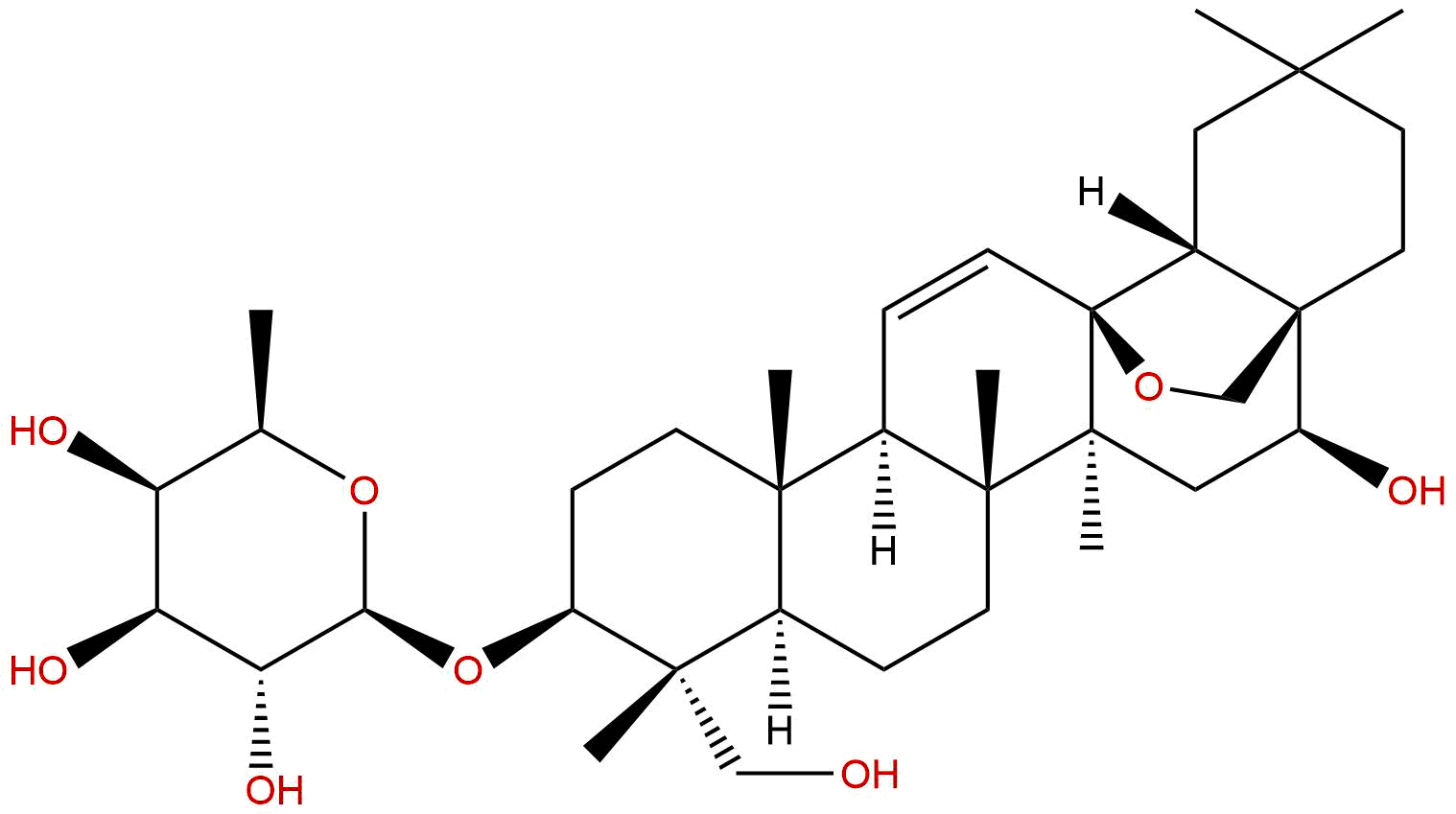


Product name: Prosaikogenin F
Synonym name: Prosapogenin F;Prosaikosaponin F
Catalogue No.: BP2118
Cas No.: 99365-20-5
Formula: C36H58O8
Mol Weight: 618.852
Botanical Source: Bupleuri Radix
Type of Compound: Triterpenoids
Purity: 95%~99%
Analysis Method: HPLC-DAD or/and HPLC-ELSD
Identification Method: Mass, NMR
Packing: Brown vial or HDPE plastic bottle
Storage: Store in a well closed container, protected from air and light. Put into refrigerate or freeze for long term storage.
Whenever possible, you should prepare and use solutions on the same day. However, if you need to make up stock solutions in advance, we recommend that you store the solution as aliquots in tightly sealed vials at -20℃. Generally, these will be useable for up to two weeks.
The product could be supplied from milligrams to grams
Inquire for bulk scale.
For Reference Standard and R&D, Not for Human Use Directly.
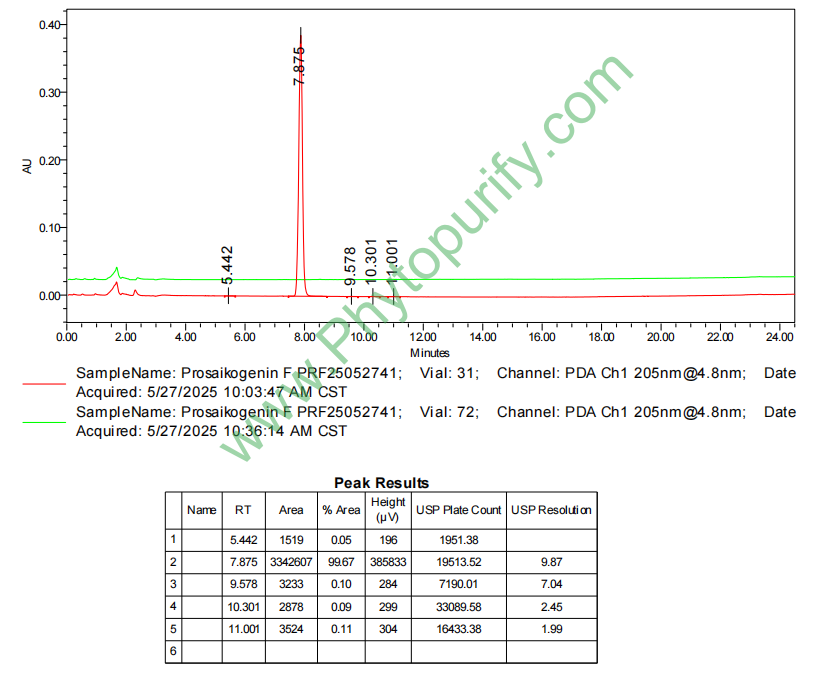
HPLC of Prosaikogenin F
Storage conditions:Short-term storage at 2~8℃, long-term storage at -20 ~ -80℃
128.8400
4.2377
4.2379
.0044
.8032
2.3913
Low
82.1474
6.8272
No
No
No
No
No
No
0.0
Yes
No
No
No
Prosaikogenin F, as an important natural glycoside in Bupleurum spp., has attracted widespread attention in recent years due to its diverse biological activities. Chaihu, as a traditional Chinese medicinal herb, has always been used to soothe the liver, relieve depression, and harmonize the body and defense. Modern pharmacological research has found that its main active ingredients include various saponins, among which Chaihu saponin F exhibits significant anti-cancer and hemolytic properties. In addition, the therapeutic potential of saikosaponin F in neurological and psychiatric disorders, especially depression, is gradually being revealed, with related targets including neurotransmitter metabolic enzymes, receptors, and signal transduction molecules. This article aims to systematically review the chemical structure, sources, pharmacological activity, mechanism of action, and pharmacological evaluation of saikosaponin F, and explore its clinical application prospects as a new natural medicine candidate molecule.
The molecular formula of saikosaponin F is C33H-54O11, with a molecular weight of 618.8520, and it belongs to the triterpenoid saponin class. Its structural characteristic is to use pentacyclic triterpenes as the mother nucleus, connect single glycosidic residues, and form single glycosidic saponins. In terms of physicochemical properties, the LogP value of saikosaponin F is 4.2377, indicating its strong hydrophobicity and extremely low water solubility (0.0044 mg/mL), which poses challenges to its bioavailability and drug delivery. The topological polar surface area (TPSA) is 128.8400, indicating its high polarity, which may limit its ability to penetrate cell membranes and the blood-brain barrier. In terms of drug safety, saikosaponin F did not exhibit hERG channel inhibitory activity, and the Ames mutagenicity test result was 0, indicating a low risk of genetic toxicity.
Chaihu saponins F mainly exist in plants of the Chaihu genus, especially in the roots of Bupleurum chinense DC. and Bupleurum scorzonerifolium Willd. In the traditional Chinese medicine processing, Chaihu root is widely used, and its saponin components are obtained through water decoction or alcohol extraction.
Modern extraction techniques often use alcohol water mixed solvents (such as 70% ethanol) for extraction, followed by liquid-liquid partitioning, column chromatography (such as silica gel column, C18 reverse phase column), and high performance liquid chromatography (HPLC) for separation and purification. The application of ultrasound assisted extraction and microwave-assisted extraction techniques has improved extraction efficiency and purity. The purified saikosaponin F was structurally identified by mass spectrometry (MS) and nuclear magnetic resonance (NMR) techniques to ensure its purity and structural accuracy.
Chaihu saponin F exhibits significant cytotoxicity and tumor growth inhibition in various cancer cell lines. In vitro experiments have shown that it can induce apoptosis of cancer cells, inhibit cell proliferation and migration. The mechanism involves regulating cell cycle related proteins, activating mitochondrial dependent apoptosis pathways, and inhibiting the NF - κ B signaling pathway. Some studies have indicated that saikosaponin F promotes cancer cell apoptosis by upregulating the expression of p53 and Bax proteins, while downregulating the anti apoptotic protein Bcl-2, enhancing the sensitivity of chemotherapy drugs.
Chaihu saponins F have certain hemolytic activity, which can affect the stability of red blood cell membranes and promote red blood cell rupture. This characteristic may have the potential to regulate hemorheology in certain pathological states, but it also suggests that its dose-dependent safety issues need to be considered in clinical applications. The hemolysis mechanism may be related to the surface activity of saponins and membrane lipid interactions.
The research on saikosaponin F in the field of neurological and psychiatric disorders is gradually deepening, especially in terms of its antidepressant effects, showing great potential. Its target proteins include monoamine oxidase A (MAOA), monoamine oxidase B (MAOB), glycogen synthase kinase 3 β (GSK3B), serotonin transporter (SLC6A4), 5-hydroxytryptamine 1A receptor (HTR1A), gamma aminobutyric acid A receptor subunit 1 (GABRA1), cAMP response element binding protein 1 (CREB1), brain-derived neurotrophic factor (BDNF), and catechol-O-methyltransferase (COMT), among other key molecules. Chaihu saponins F improve neurotransmitter metabolism, promote neuroplasticity, and exert antidepressant effects by regulating these targets.
The multi-target mechanism of action of saikosaponin F reflects its complex pharmacological properties. The anti-cancer effect mainly promotes programmed cell death of cancer cells by regulating apoptosis related signaling pathways, including p53, NF - κ B, and mitochondrial pathways. Its hemolytic effect interacts with the surface activity of saponin molecules and membrane lipids, leading to the rupture of red blood cell membranes.
In terms of antidepressant mechanisms, saikosaponin F inhibits MAOA and MAOB activity, reduces the degradation of neurotransmitters such as serotonin, norepinephrine, and dopamine, and enhances the effective concentration of neurotransmitters. Its inhibitory effect on GSK3B helps regulate neuronal signaling and cell survival. By activating HTR1A receptors and regulating SLC6A4 transporters, saikosaponin F improves neurotransmitter balance. In addition, saikosaponin F promotes the expression of CREB1 and BDNF, enhances neuroplasticity and neuroprotective effects. Its regulation of GABRA1 may alleviate anxiety and improve emotional stability.
The high molecular weight (618.8520 Da) and polarity (TPSA 128.84) of saikosaponin F limit its oral bioavailability and ability to cross the blood-brain barrier (low blood-brain barrier permeability). The LogP value is 4.2377, indicating that it has a certain degree of lipid solubility, which is beneficial for cell membrane penetration, but its water solubility is extremely low (0.0044 mg/mL), which may affect its in vivo distribution and absorption.
In terms of safety, saikosaponin F did not exhibit hERG channel inhibition, reducing the risk of cardiac toxicity; The Ames test is negative, indicating a low risk of genetic toxicity. The pharmacokinetic data is not yet complete, but based on its physicochemical properties, Chaihu saponins F may require special formulation design (such as nanocarriers, liposomes) to improve bioavailability and targeting.
Chaihu saponin F, as a multifunctional natural product, has multiple pharmacological activities such as anti-cancer, hemolytic, and antidepressant effects, demonstrating broad clinical application potential. In the field of tumor treatment, its ability to induce cancer cell apoptosis and enhance chemotherapy sensitivity deserves further clinical validation. The hemolytic characteristics suggest that it may have practical value in regulating blood diseases, but safety needs to be carefully evaluated.
The multi-target mechanism of antidepressant action provides a theoretical basis for the development of new antidepressant drugs. Given the delayed efficacy and side effects of current antidepressants, saikosaponin F is expected to become a natural alternative or adjuvant treatment option. However, its low blood-brain barrier permeability and poor water solubility limit the efficacy of the central nervous system, and in the future, its pharmacokinetic properties need to be optimized through drug chemical modification or carrier systems.
In addition, the safety of saikosaponin F is good, providing favorable conditions for its clinical development. In the future, efforts should be made to strengthen in vivo pharmacokinetic research, toxicological evaluation, and preclinical model validation, in order to advance it towards the clinical trial stage.
As an important active ingredient in the saikosaponin class, saikosaponin F exhibits various therapeutic potentials such as anti-cancer, hemolytic, and antidepressant effects due to its unique chemical structure and multiple pharmacological activities. Its multi-target mechanism of action provides rich scientific basis for the development of natural product drugs. Despite the challenges of low water solubility and poor blood-brain barrier permeability in drug development, rational drug design and formulation improvement are expected to overcome these limitations. In the future, saikosaponin F is expected to become an innovative molecule in the field of natural medicine, opening up new avenues for the treatment of tumors and neurological and psychiatric disorders. The pharmacokinetic study and preclinical evaluation of the system will be the key to promoting its clinical translation. In summary, saikosaponin F has the potential to become a multifunctional natural medicine and is worthy of further exploration and development.
