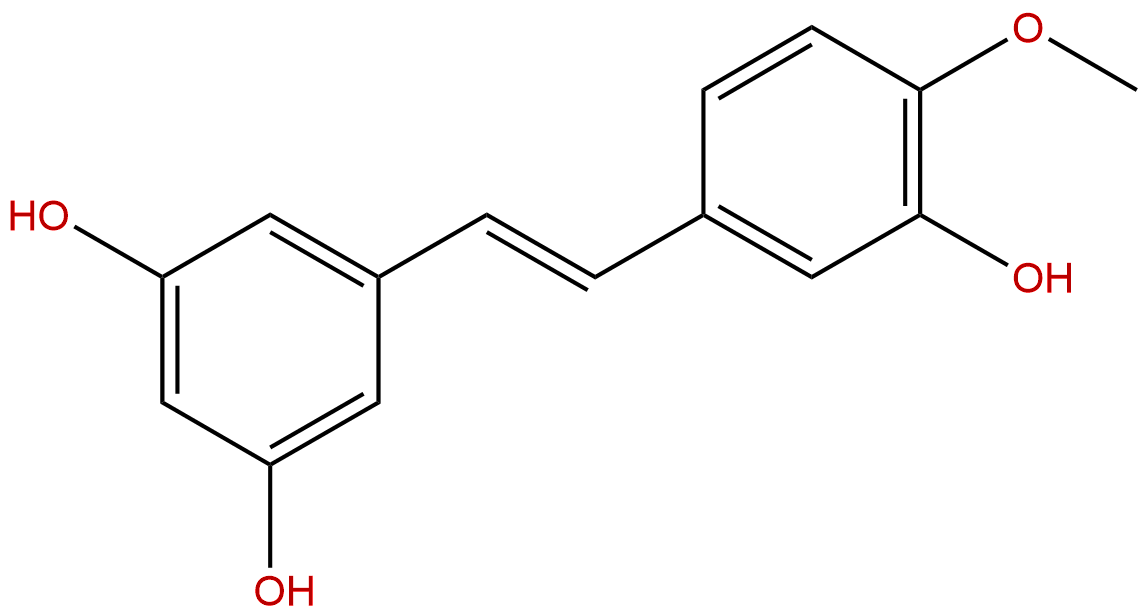


Product name: Rhapontigenin
Synonym name:
Catalogue No.: BP1671
Cas No.: 500-65-2
Formula: C15H14O4
Mol Weight: 258.273
Botanical Source:
Physical Description: Cryst.
Type of Compound: Phenols
Purity: 95%~99%
Analysis Method: HPLC-DAD or/and HPLC-ELSD
Identification Method: Mass, NMR
Packing: Brown vial or HDPE plastic bottle
The product could be supplied from milligrams to grams. Inquire for bulk scale.
We provide solution to improve the water-solubility of compounds, thereby facilitating the variety of activity tests and clinic uses.
For Reference Standard and R&D, Not for Human Use Directly.
Description:
Rhapontigenin has antioxidative, antihyperlipidemic, antifungal and anticancer activities. Rhapontigenin inhibits HIF-1α accumulation and angiogenesis in PC-3 prostate cancer cells, suppresses breast cancer cell migration and invasion, which is involved in inhibiting the PI3K-dependent Rac1 signaling pathway. Rhapontigenin exhibits dose-dependent inhibition of tyrosinase activity and melanin synthesis in B16F10 melanoma cells.
References:
Antihyperlipidemic effects of rhapontin and rhapontigenin from rheum undulatum in rats fed a high-cholesterol diet.
Rhapontin was purified from a methanol extract from the roots of Rheum undulatum, and Rhapontigenin was produced by an enzymatic transformation of rhapontin. Rats were fed a high-cholesterol diet to induce hyperlipidemia, followed by oral treatment with rhapontin or Rhapontigenin (1-5 mg/kg/day). Rhapontin and Rhapontigenin treatment resulted in a significant (p<0.05) dose-dependent decrease in the serum lipid level, while the high-density lipoprotein cholesterol level increased slightly compared with the experimental control. Furthermore, rhapontin and Rhapontigenin treatment improved the pathological characteristics of the degenerating fatty liver in high-cholesterol diet-induced hyperlipidemic rats dose-dependently. Aspartate aminotransferase and alanine aminotransferase levels in rhapontin- and Rhapontigenin-treated hyperlipidemic rats were not significantly different from those in the control. These results indicate that rhapontin and Rhapontigenin can be used as potent antihyperlipidemic agents.
The possible mechanism of rhapontigenin influencing antifungal activity on Candida albicans.
Rhapontigenin, an aglycone of rhapontin, was produced by biotransformation and we investigated its antifungal activity against Candida albicans, one of the most important opportunistic fungal pathogens. Rhapontigenin is found to have, in vitro, inhibitory activity with a minimal inhibitory concentration (MIC) value against all test isolates of 128-256 μg/ml. We detected increased reactive oxygen species (ROS) levels in yeast cultures treated with Rhapontigenin at the MIC. Rhapontigenin inhibited DNA, RNA, and protein synthesis, especially RNA synthesis, and induced morphological changes and apoptosis of C. albicans. The apoptotic effect of Rhapontigenin on C. albicans at subinhibitory concentrations was higher in the stationary growth phase than in the exponential phase, while the opposite results were noted with amphotericin B. The mechanism of antifungal activity of Rhapontigenin may be associated with the generation of ROS that might induce apoptosis and it may also involve the inhibition of ergosterol biosynthesis.
Rhapontigenin suppresses cell migration and invasion by inhibiting the PI3K-dependent Rac1 signaling pathway in MDA-MB-231 human breast cancer cells.
Rhapontigenin (1) has various biological activities including anticancer activities. However, whether and how Rhapontigenin affects cancer invasion has never been explored. Here, we examined the anti-invasive effects of Rhapontigenin and its underlying molecular mechanisms in the highly invasive human breast cancer cell line designated MDA-MB-231. At noncytotoxic concentrations, Rhapontigenin strongly suppressed serum-induced cell migration and invasion as judged by Boyden chamber analysis and wound-healing assays, respectively. Rhapontigenin strikingly reduced Rac1 activity as judged by both absorbance-based and pull-down assays. In addition, its downstream effectors such as WASP-family verprolin homologous proteins 2 (WAVE-2) and p21-activated kinase Rhapontigenin (PAK1) signaling cascades were attenuated after treatment with Rhapontigenin. Immunofluorescence staining showed that Rhapontigenin diminished lamellipodia formation at the leading edge of cells. Finally, Rhapontigenin decreased the phosphorylation of phosphoinisitide-3-kinase (PI3K) and AKT. Rac1 activity was inhibited by the PI3K inhibitor wortmannin. Taken together, these results suggest that Rhapontigenin suppresses breast cancer cell migration and invasion, which is involved in inhibiting the PI3K-dependent Rac1 signaling pathway.
Rhapontigenin converted from rhapontin purified from Rheum undulatum enhances the inhibition of melanin synthesis.
Rhapontigenin was produced from rhapontin isolated from a methanol extract of Rheum undulatum roots by enzymatic transformation. Rhapontin and Rhapontigenin exhibited dose-dependent inhibition of tyrosinase activity and melanin synthesis in B16F10 melanoma cells, but the inhibitory activity of Rhapontigenin was greater than that of rhapontin. Thus the bioconversion of rhapontin enhanced its ability to inhibit cellular tyrosinase activity and melanin synthesis.
Rhapontigenin inhibited hypoxia inducible factor 1 alpha accumulation and angiogenesis in hypoxic PC-3 prostate cancer cells.
The inhibitory mechanism of Rhapontigenin isolated from Vitis coignetiae was investigated on HIF-1α stability and angiogenesis in human prostate cancer PC-3 cells. Rhapontigeninsignificantly suppressed HIF-1α accumulation at protein level but not at mRNA level in PC-3 cells under hypoxia. Also, Rhapontigenin suppressed hypoxia-induced HIF-1α activation in various cancer cells, such as colorectal adenocarcinoma (SW620), breast adenocarcinoma (MCF-7), fibrosarcoma (HT-1080) and prostate carcinoma (LNCaP). Interestingly, Rhapontigenin had more potency in inhibition of hypoxia-induced HIF-1α expression than that of resveratrol, a known HIF-1α inhibitor. In addition, Rhapontigenin promoted hypoxia-induced HIF-1α degradation and cycloheximide (CHX) blocked protein synthesis. A prolyl hydroxylase (PHD) inhibitor dimethyloxalylglycine (DMOG) is usually utilized to examine whether prolyl hydroxylation is involved in inhibition of HIF-1α accumulation. Here, DMOG recovered HIF-1α accumulation inhibited by Rhapontigenin. Immunoprecipitation assay also revealed that rhapotigenin enhanced the binding of hydroxylated HIF-1α to von Hippel-Lindau (VHL) tumor suppressor protein. Furthermore, Rhapontigenin reduced vascular endothelial growth factor (VEGF) secretion in hypoxic PC-3 cells as well as suppressed tube formation in human umbilical vein endothelial cells (HUVECs) treated by the conditioned media of hypoxic PC-3 cells. However, anti-angiogenic effect of Rhapontigenin in hypoxic PC-3 cells was reversed by DMOG. Taken together, these findings suggest that Rhapontigenin inhibits HIF-1α accumulation and angiogenesis in PC-3 prostate cancer cells.
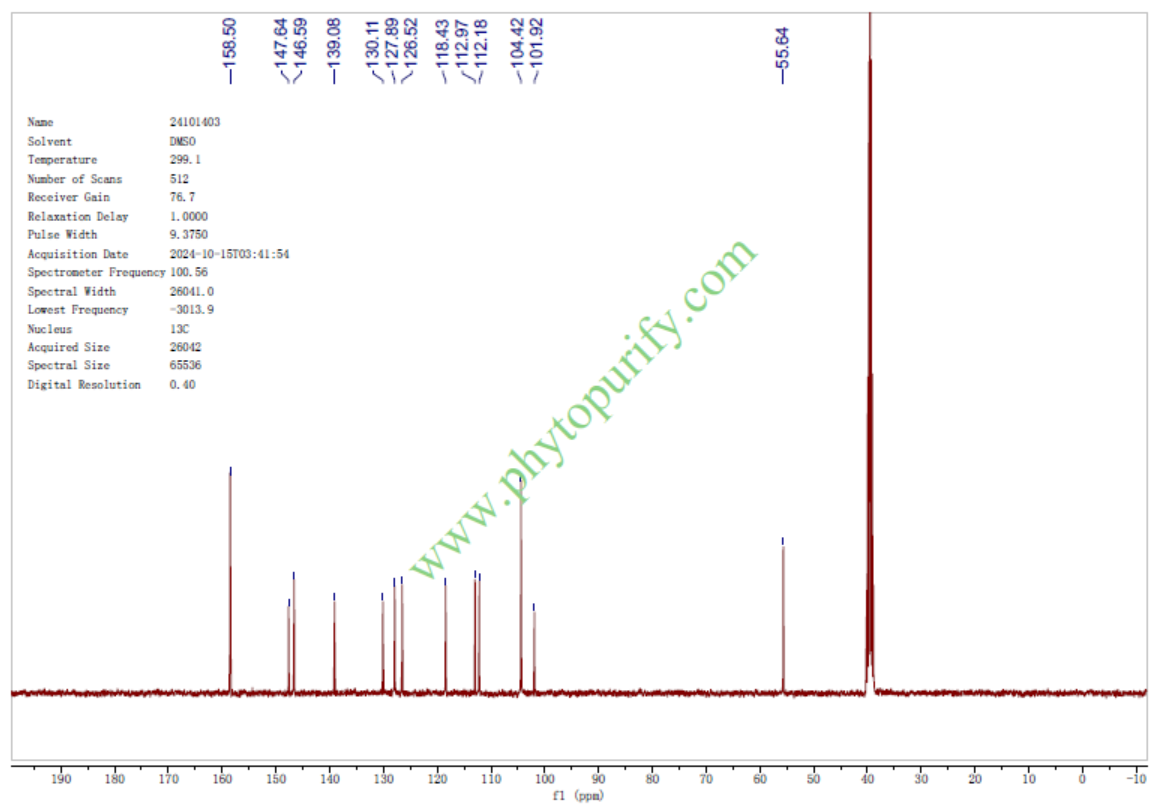
NMR of Rhapontigenin
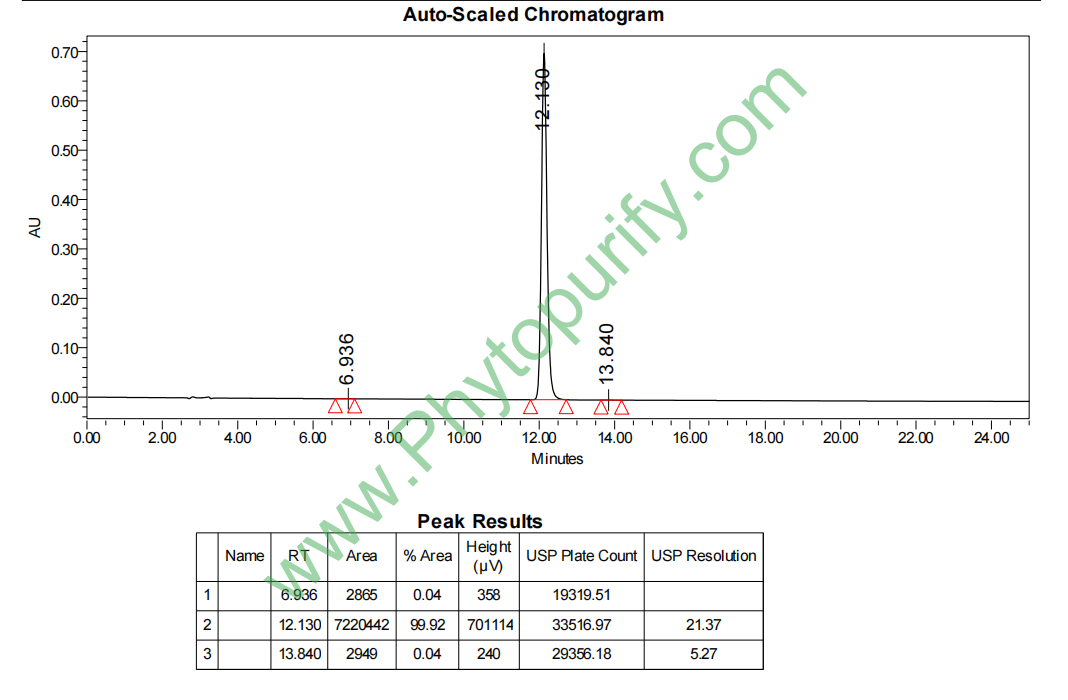
HPLC of Rhapontigenin
Storage conditions:Short-term storage at 2~8℃, long-term storage at -20 ~ -80℃
69.9200
2.8102
2.8013
.1789
5.5168
10.1690
Low
90.4380
2.2029
Yes
Yes
Yes
No
Yes
No
0.6
No
Yes
Yes
Yes
Natural products, as an important source of drug discovery, play an irreplaceable role in the history of human disease prevention and treatment. Resveratrol, as a star molecule of polyphenolic compounds, has been extensively studied for its wide range of biological activities. However, its natural analogue, Rhapontigenin (also known as emodin), has gradually emerged from the halo of resveratrol in recent years, demonstrating unique and highly promising pharmacological properties. Dan Ye Da Huang is a stilbene monomer compound with a chemical structure highly similar to resveratrol, with the main difference being the presence of a methoxy substituent on its B ring. This subtle structural difference endows Dan Ye Emodin with distinct biological activities and target selectivity.
Dan Ye Da Huang was initially focused on due to its presence in traditional medicinal plants, but modern pharmacological research has revealed that its effects go far beyond that. It has been proven to have significant multiple biological activities such as anti-cancer, antioxidant, anti-inflammatory, antifungal, and antibacterial. Of particular note is that Dan Ye Da Huang is a potent and highly selective cytochrome P450 1A1 (CYP1A1) inhibitor, which selectively inhibits specific metabolic enzymes and opens up new pathways for its use in cancer chemoprevention and treatment of certain metabolic related diseases. In recent years, its protective role in inflammatory bowel diseases such as colitis and the continuous elucidation of related molecular targets have made it a research hotspot in the field of natural product pharmacology. This article aims to provide a systematic review of the chemical properties, plant sources, pharmacological activities, mechanisms of action, medicinal properties, and clinical application prospects of Dan Ye Da Huang, in order to provide comprehensive academic references for the in-depth research and development of this compound.
The chemical name of Dan Ye Da Huang is 3,5,3 '- trihydroxy-4' - methoxy styrene, with a molecular formula of C15H14O4 and a molecular weight of 258.2730. Its chemical structure belongs to the class of stilbenes, consisting of two benzene rings (ring A and ring B) connected by an vinyl bridge. Compared with resveratrol (3,5,4 '- trihydroxystilbene), Danshen is methoxy (- OCH3) rather than hydroxyl (- OH) at the 4' position of the B ring. This structural modification significantly affects its physicochemical properties and biological activity.
From the analysis of physicochemical properties, the lipid water partition coefficient (LogP) of Dan Ye Emodin is 2.8102, indicating that it has a certain lipophilicity, but still within the ideal range of the Rule of Five (LogP<5), which is conducive to its transmembrane absorption and distribution. Its topological polar surface area (TPSA) is 69.92 Å ², which is relatively small and meets the typical permeability requirements for oral medications. The water solubility data shows that its solubility is about 0.1789 mg/mL, which belongs to the category of slightly soluble to poorly soluble. This may be a limiting factor for its oral bioavailability and needs to be improved through formulation methods such as making nanocrystals, cyclodextrin inclusion complexes, or prodrugs. Its molecular weight is moderate and meets the standards of small molecule drugs.
Studies on the structure-activity relationship have shown that the methoxy group on the B ring is a key functional group for the highly selective CYP1A1 inhibitory activity of Danshen. This group may bind more specifically and tightly to the active pocket of CYP1A1 enzyme through steric hindrance and electronic effects, thereby achieving significant selectivity towards CYP1A2 and CYP1B1 equivalent enzymes (up to 400 fold and 23 fold, respectively). In addition, its phenolic hydroxyl structure is the material basis of its antioxidant activity, which can effectively eliminate free radicals and participate in regulating various cellular signaling pathways.
Dan Ye Da Huang is relatively widely distributed in nature, mainly found in various plants such as Polygonaceae and Euphorbiaceae. The name "Rhubarb Glycoside Element" reveals one of its main sources - the rhizome of the Polygonaceae plant Rheum rhaponticum L., which often exists in its glycosidic form (Rhaponticin) in this plant. In addition, it is also one of the active ingredients of traditional Chinese medicine Polygonum cuspidatum Sieb. et Zucc., coexisting with resveratrol. It has also been detected in other medicinal plants such as Gnetum montanum and some grape varieties.
Organic solvent extraction is commonly used to extract emodin from plant materials. Due to the presence of emodin and its glycosides in plant roots, stems, and other parts, it is usually necessary to dry and crush the raw materials, and then use polar solvents such as methanol, ethanol, or acetone for reflux extraction or ultrasound assisted extraction. The extraction solution often contains a large amount of impurities, so further separation and purification steps are required. Common purification methods include:
1. Solvent extraction and column chromatography Preliminary enrichment was carried out by utilizing the distribution differences of Dan Ye Da Huang in different polar solvents, followed by separation using silica gel column chromatography, macroporous adsorption resin (such as AB-8, D101) or polyamide column chromatography, and gradient washing with chloroform methanol or petroleum ether ethyl acetate in different ratios.
2. Enzymatic hydrolysis If the glycoside form (emodin) extracted from plants is its glycoside form, β - glucosidase can be used for hydrolysis to convert the glycoside into aglycone (emodin), which can then be extracted and purified to improve the yield of the target product.
3. Modern Separation Technology Technologies such as high-performance liquid chromatography (HPLC) and high-speed countercurrent chromatography (HSCCC) have been successfully applied to the high-purity preparation of Dan Ye Da Huang, especially suitable for laboratory scale standardized sample acquisition.
With the development of synthetic biology, the use of microorganisms (such as yeast) for heterologous synthesis of emodin has become a research hotspot, providing a potential pathway for large-scale and sustainable production.
Numerous in vitro and in vivo studies have confirmed that Dan Ye Da Huang has diverse pharmacological activities, and its potential for application far exceeds its initial understanding as a resveratrol analogue.
The pharmacological effects of Dan Ye Da Huang depend on its interactions with multiple key molecular targets, forming a complex regulatory network.
Based on the provided pharmacological parameters and existing research, a preliminary evaluation of the pharmacological potential of Dan Ye Da Huang is conducted
Absorption, distribution, metabolism, excretion (ADME) characteristics:
Preliminary evaluation of safety:
Challenges and optimization strategies for drug development:
The multi-target and multifunctional properties of Dan Ye Da Huang have brought broad application prospects in multiple therapeutic fields.
Dan Ye Da Huang, a natural compound of stilbene derived from traditional medicinal plants, is emerging in modern pharmacological research due to its unique chemical structure, highly selective enzyme inhibitory activity, and extensive pharmacological effects. From its original role as the "supporting role" of resveratrol to its present independent and prominent application potential in anti-inflammatory (especially colitis), anticancer chemoprevention and other fields, its research process reflects the scientific charm of constantly mining new values from natural products. Although still facing challenges such as water solubility and bioavailability on the path of traditional Chinese medicine, with the in-depth analysis of its multi-target mechanism of action, the promotion of structural optimization strategies, and the application of new drug delivery technologies, Danye Dahuang Su is highly likely to move from the laboratory to clinical practice, providing a new, naturally derived candidate solution for the prevention and treatment of various human diseases such as inflammatory bowel disease and cancer. Future research should focus on translational medicine, bridging the gap between bench and bedside, and ultimately realizing the new value of this ancient molecule in modern medicine.
