Introduction/Overview
Flavonoids, as a widely present class of secondary metabolites in nature, have always been an important source of drug development due to their diverse chemical structures and extensive biological activities. Alpha naphthoflavone (ANF), also known as 7,8-benzoflavone, is an artificially synthesized flavonoid derivative characterized by a naphthalene ring fused to the flavonoid core. Since its discovery, ANF has attracted much attention due to its significant inhibitory activity on the cytochrome P450 enzyme system, particularly aromatase (CYP19A1). Aromatase is a key rate limiting enzyme that catalyzes the transformation of androgen into estrogen, and its overexpression is closely related to the occurrence and development of estrogen dependent breast cancer. Therefore, as an effective competitive aromatase inhibitor (IC50=0.5 μ M, Ki=0.2 μ M), ANF shows potential research value in the field of breast cancer treatment.
With the deepening of research, the pharmacological activity spectrum of ANF continues to expand. Research has shown that it can not only inhibit tumor cell proliferation and induce apoptosis, but also regulate various key signaling pathways and molecular targets, such as AMPK, STAT3, BCL2 family, etc. In addition, the regulatory effect of ANF on multidrug resistance related proteins such as ABCB1 and ABCG2 provides a new approach for overcoming tumor resistance. Although ANF is currently mainly used as a research tool drug, its multi target action characteristics make it a leading compound for developing new anti-tumor drugs, especially for hormone dependent and drug resistant breast cancer. This article aims to provide a systematic review of the chemical properties, pharmacological activities, mechanisms of action, pharmacological properties, and clinical application prospects of alpha naphthoflavonoids, in order to provide reference for further research in related fields.
Chemical structure and physicochemical properties
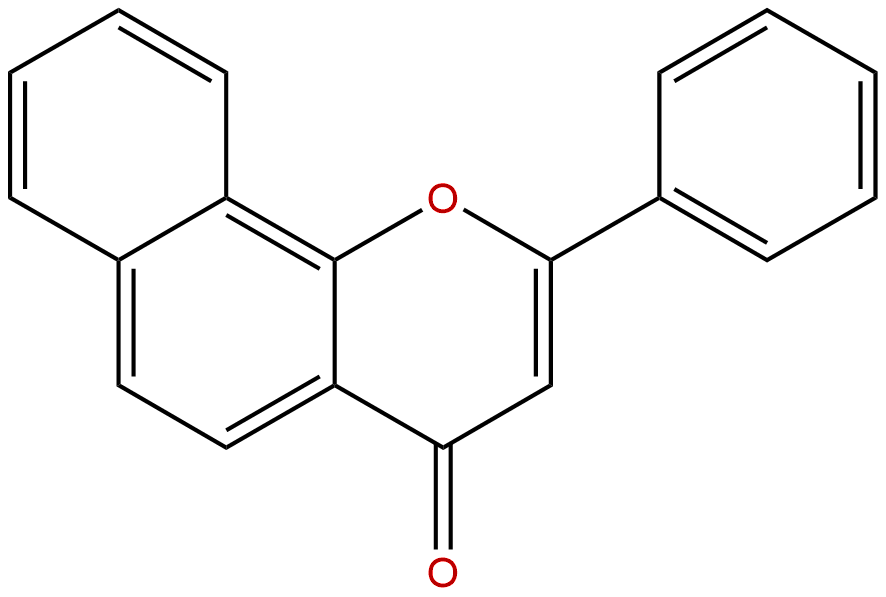
The chemical name of α - naphthoflavone is 7,8-benzoflavone, with a CAS number of 604-59-1, a molecular formula of C19H12O2, and a molecular weight of 272.3030 g/mol. Its core structure is composed of flavonoids (2-phenyl-1-benzopyran-4-one) fused with a naphthalene ring at positions 7 and 8, which significantly enhances the planarity and hydrophobicity of the molecule.
From the analysis of physical and chemical properties, the lipid water partition coefficient (LogP) of ANF is 4.3896, indicating its high lipophilicity. Its topological polar surface area (TPSA) is relatively low, only 30.21 Å ². These parameters collectively determine the extremely low water solubility of ANF (often recorded as insoluble or slightly soluble), while it is easily soluble in most organic solvents such as dimethyl sulfoxide (DMSO), ethanol, and acetone. High lipophilicity and low TPSA also indicate high cell membrane permeability. Both computational and experimental data support its excellent blood-brain barrier (BBB) penetration ability, which provides potential applications related to the central nervous system, such as research on certain brain tumors or neurodegenerative diseases.
In the preliminary safety screening, the Ames test result of ANF is 1.5 (usually considered negative if the ratio is less than 2), indicating that it has no significant mutagenicity under the test conditions. At the same time, existing data shows that it has no significant hERG potassium channel inhibitory activity, reducing the potential risk of causing QT interval prolongation in the heart, which is a positive signal for early drug development. However, its complete synthetic source also means that there are no direct plant precursors in nature, and its acquisition relies entirely on chemical synthesis.
Plant sources and extraction methods
It should be clearly pointed out that alpha naphthoflavone is not a natural flavonoid extracted directly from plants. It is a fully synthetic flavonoid derivative, inspired by the structure of natural flavonoids. In nature, there are many flavonoids with structures similar to benzopyranone, such as flavonoids from plants such as licorice and Scutellaria baicalensis. However, the structure fused with naphthalene rings at positions 7 and 8 is a product of artificial modification.
Therefore, the acquisition of alpha naphthoflavonoids does not involve traditional plant extraction and separation processes, but is prepared through organic synthesis methods. The classic synthetic route usually starts from β - naphthol and benzoyl chloride derivatives, undergoes Friedel Crafts acylation reaction to form the corresponding ketone, and then constructs the flavonoid core structure through Baker Venkataraman rearrangement, cyclization and other steps. Modern synthesis methods are constantly optimized with the aim of increasing yield, reducing steps, and using more environmentally friendly catalysts. The laboratory scale synthesis is sufficient to meet its needs as a biochemical reagent and tool drug. Its high-purity samples can be purchased through commercial channels from multiple chemical suppliers for pharmacological activity and mechanism research.
Pharmacological activity research
α - naphthoflavone shows a variety of pharmacological activities, the most prominent of which is its anti-tumor effect, especially in the breast cancer model has been widely studied.
1. Antitumor activity
* Inhibition of cell proliferation and induction of apoptosis ANF showed significant proliferation inhibitory activity on a variety of breast cancer cell lines (such as MCF-7, T47D, etc.). Its effect is not limited to estrogen receptor positive (ER+) cells, but also has inhibitory effect on some triple negative breast cancer cells. Research has shown that ANF treatment can induce cell cycle arrest (such as G1 phase or G2/M phase) and activate endogenous apoptotic pathways, manifested as a decrease in mitochondrial membrane potential, activation of caspase-3/7, and an increase in the proportion of apoptotic cells.
* Inhibit invasion and metastasis Tumor metastasis is the main cause of treatment failure. ANF has been shown to downregulate the expression and activity of matrix metalloproteinase-2 (MMP-2). MMP-2 is a key enzyme that degrades extracellular matrix and promotes tumor cell invasion and metastasis. By inhibiting MMP-2, ANF can reduce the migration and invasion of breast cancer cells.
* Regulating multidrug resistance ANF is a known regulator of breast cancer multidrug resistance protein P-glycoprotein (ABCB1) and breast cancer resistance protein (ABCG2). It can competitively inhibit the function of these efflux pumps, increase the accumulation of intracellular chemotherapy drugs (such as doxorubicin and paclitaxel), thereby reversing the drug resistance phenotype of tumor cells and enhancing the efficacy of conventional chemotherapy drugs.
2. Aromatase inhibition activity
As its signature activity, ANF is a potent and competitive inhibitor of CYP19A1 (aromatase), a member of the cytochrome P450 family. It directly competes with the substrate binding site of the enzyme, blocking the conversion of testosterone and androstenedione to estradiol and estrone. This effect is of strategic significance in the treatment of hormone dependent breast cancer, because reducing the local and systemic estrogen levels of the tumor can inhibit tumor growth.
3. Other potential activities
Based on its interactions with various signaling proteins, ANF may also have potential in other disease models. For example, its inhibition of the STAT3 signaling pathway may have anti-inflammatory effects; The regulatory effects on certain enzymes and receptors, such as tyrosinase TYR, suggest their research value in pigmentary diseases or other fields, but further exploration is still needed.
Mechanism of action and molecular targets
The anti-tumor effect of α - naphthoflavone is not achieved through a single target, but through a complex molecular network, reflecting the characteristics of multi-target intervention.
1. Core target: Aromatase (CYP19A1)
ANF directly binds and inhibits aromatase activity, which is the core of its anti estrogenic effect. It can inhibit the growth of ER+breast cancer cells by reducing the synthesis of estrogen in cells, thereby inhibiting the transcription of proliferation promoting genes mediated by estrogen receptors (especially the signal transduction that ESR2/ER β may participate in).
2. Regulation of key signaling pathways
* AMPK pathway activation Adenosine activated protein kinase (AMPK) is an energy sensor and metabolic regulatory center in cells. ANF can activate AMPK (PRKAA1 subunit), which may lead to inhibition of downstream mammalian rapamycin target protein (mTOR) signaling pathway, thereby inhibiting protein synthesis and cell growth, and inducing autophagy.
* STAT3 signal suppression Signal transduction and transcription activator 3 (STAT3) is an important oncogenic transcription factor, and sustained activation of STAT3 promotes cell proliferation, survival, and immune escape. ANF can inhibit the phosphorylation (activation) of STAT3 and the expression of downstream target genes (such as BCL2, Cyclin D1), thereby promoting apoptosis and cycle arrest.
* Regulation of apoptotic pathway ANF promotes cell apoptosis through various means. It downregulates the expression of anti apoptotic protein BCL-2 and may also affect other members of the BCL-2 family, disrupting mitochondrial membrane stability and leading to the release of cytochrome C. In addition, its potential regulation of protein kinase C alpha (PRKCA) may also affect apoptotic signaling.
3. Tumor microenvironment and metastasis related targets
* MMP-2 inhibition ANF downregulates the expression of MMP-2 and weakens the invasive ability of tumor cells through mechanisms that have not been fully elucidated, which may involve inhibiting the activity of transcription factors AP-1 or NF - κ B.
* Microtubule associated protein (MAPT)There are studies suggesting that ANF may affect microtubule stability, and abnormal phosphorylation of MAPT (Tau protein) is associated with cytoskeleton rearrangement and tumor progression. ANF may intervene in this process.
4. Multi drug resistance related targets
ANF itself is a substrate/inhibitor of ABCB1 and ABCG2. It directly binds to these transporters to prevent them from pumping chemotherapy drugs out of the cell, thereby "neutralizing" the drug resistance mechanism of tumor cells in pharmacology and restoring their sensitivity to chemotherapy.
Evaluation of drug properties and pharmacokinetics
Although alpha naphthoflavones have shown encouraging activity in preclinical studies, their pharmacological development still faces challenges, and relevant systematic pharmacokinetic research data is relatively limited.
Advantage:
1. Oral activity Previous studies have confirmed that ANF has oral bioavailability in animal models, which is a favorable condition for its potential as an oral drug.
2. Blood-brain barrier permeability Its high lipid solubility and small molecule properties enable it to penetrate the blood-brain barrier, providing the possibility for treating brain metastases or related central nervous system diseases.
3. Preliminary safety The lack of hERG inhibition and negative Ames test are the highlights of its early safety.
Challenges and shortcomings:
1. Very poor water solubility This is one of the biggest obstacles to its development into a formulation. Extremely low water solubility can seriously affect the rate and degree of oral absorption, leading to unstable bioavailability and significant individual differences. Future formulation development may require the use of solubilization technologies such as nanocrystals, liposomes, cyclodextrin inclusion complexes, or solid dispersions.
2. Metabolism and clearance As an inhibitor and potential substrate of CYP450 enzyme, ANF may be involved in complex drug drug interactions. It may be widely metabolized by liver CYP enzymes (such as CYP1A1, CYP1A2, CYP3A4), leading to significant first pass effects and possibly a short half-life. Its metabolites, activity, and toxicity are not yet clear.
3. Selectivity needs to be improved Although multi-target is its characteristic, it may also bring off target effects and unforeseeable toxicity. ANF also has a strong effect on other members of the CYP family (such as CYP1A1), which may interfere with the metabolism of endogenous substances. Improving its selectivity towards aromatase or specific tumor targets is the key to optimizing its drug properties.
4. Lack of systematic ADME data At present, complete data on its absorption, distribution, metabolism, and excretion (ADME) in the body is still lacking, and further preclinical pharmacokinetic studies are needed to evaluate its dosing regimen, potential accumulation, and toxicity.
Clinical application prospects and prospects
Alpha naphthoflavone is currently in the preclinical research stage, and its path to clinical application is full of both opportunities and challenges.
Potential application directions:
1. Adjuvant therapy of hormone receptor positive breast cancer As an aromatase inhibitor, ANF can be used in combination studies with existing drugs such as itraconazole and anastrozole, or for patients who are resistant to existing AI drugs. Its multi-target nature may provide additional therapeutic advantages.
2. Reverse tumor multidrug resistance The combination of ANF and conventional chemotherapy drugs (such as paclitaxel and anthracycline) is a promising strategy to overcome multidrug resistance in breast cancer. Developing drug resistance reversal agents or compound formulations based on ANF may significantly improve chemotherapy efficacy.
3. Treatment of brain metastasis of breast cancer With its BBB penetration ability, ANF or its derivatives may become candidate drugs for the treatment of brain metastasis of breast cancer, which is an area where clinical needs have not been met.
4. Structural optimization of lead compounds A more realistic and promising path is to use ANF as a lead compound for systematic medicinal chemical modification. Through structural modification, the aim is to:
* Improve water solubility and pharmacokinetic properties Introducing hydrophilic groups or making prodrugs.
* Enhance target selectivity and efficacy Optimize the binding of the structure to targets such as aromatase, AMPK, or STAT3.
* Reduce potential toxicity Reduce inhibition of non target CYP enzymes.
Challenges faced:
1. Optimization of drug properties As mentioned earlier, solving its water solubility and metabolic stability issues is the primary task in advancing its research and development.
2. Comprehensive toxicological evaluation It is necessary to conduct systematic preclinical safety evaluations for acute toxicity, chronic toxicity, reproductive toxicity, etc., and clarify their treatment window.
3. Clarify the optimal treatment window and combination strategy Further research is needed to determine the optimal dosage, timing of administration, and indications for its use as a monotherapy or combination therapy.
Future research should integrate computational chemistry, structural biology, and pharmacology methods to elucidate the precise mode of action between ANF and key targets, and guide rational drug design. At the same time, more clinically relevant models such as patient derived xenograft (PDX) models are utilized to validate their efficacy and biomarkers.
Conclusion
As a synthetic flavonoid, α - naphthoflavone occupies a unique research position in the field of anti-tumor research, especially for breast cancer, by virtue of its unique chemical structure and multi-target pharmacological mechanism. From the initial aromatase inhibitors to now being revealed to regulate multiple key targets such as AMPK, STAT3, apoptosis pathways, and drug-resistant proteins, their action profiles are becoming increasingly clear. These characteristics make it not only a valuable fundamental research tool, but also a promising lead compound for anti-tumor drugs.
However, its inherent physical and chemical property defects (such as poor water solubility) and unclear pharmacokinetic and safety characteristics in vivo are the main bottlenecks for its translation into clinical applications. Future research should focus on using α - naphthoflavone as the molecular skeleton for rational structural modification and optimization, while preserving or enhancing its core pharmacological activity, significantly improving its pharmacological properties. Through in-depth interdisciplinary research, it is expected to develop a new generation of highly effective, low toxicity, drug resistant breast cancer drugs based on α - naphthoflavone, providing new options for tumor treatment.