


Synonym name: Zosimin; Columbianin
Catalogue No.: BP0381
Cas No.: 5058-13-9
Formula: C19H20O5
Mol Weight: 328.364
Botanical Source: Lomatium columbianum, Zosima absinthifolia and Peucedanum palustre
Purity: 95%~99%
Analysis Method: HPLC-DAD or/and HPLC-ELSD
Identification Method: Mass, NMR
Packing: Brown vial or HDPE plastic bottle
Can be supplied from milligrams to grams.
For Reference Standard and R&D, Not for Human Use Directly.
Inquire for bulk scale.
HPLC of Columbianadin
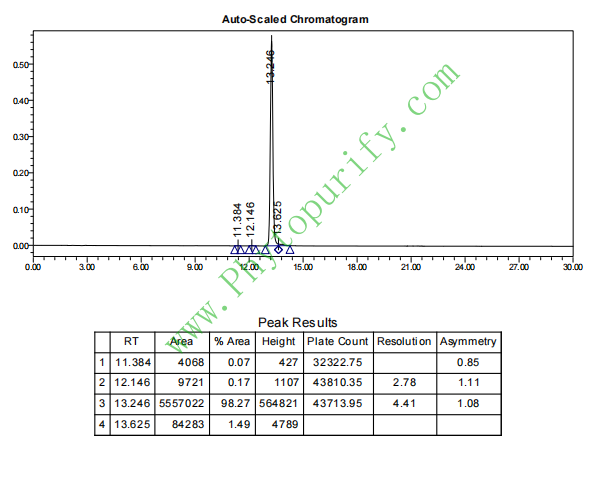
Storage conditions:Short-term storage at 2~8℃, long-term storage at -20 ~ -80℃
Columbianadin (CAS number: 5058-13-9) is a natural coumarin compound derived from the plant Heraclium hemsleyanum in the Umbelliferae family. As a natural product with multiple biological activities, dihydroeucalyptol Angelica sinensis ester has attracted much attention in pharmacological research in recent years, especially in the fields of anti-inflammatory and anti-cancer, showing significant potential. Coumarin compounds have long been regarded as an important source of natural medicine development due to their unique chemical structure and diverse biological activities. This article will provide a systematic review of the chemical structure and physicochemical properties, plant sources and extraction methods, pharmacological activity and mechanism of action, pharmacological evaluation and pharmacokinetic characteristics of dihydroeucalyptol Angelica sinensis ester. The focus will be on exploring its molecular targets in anti-inflammatory diseases and the possibility of future clinical applications, in order to provide theoretical basis and reference for further research and development of this compound.
Dihydroeucalyptol Angelica sinensis ester belongs to the coumarin class of natural products, with a molecular formula of C19H20O6 and a molecular weight of 328.36. Its chemical structure contains a typical coumarin skeleton, connected with angelica ester groups, giving it unique chemical and biological activity characteristics. The LogP value is 3.27, indicating that it has moderate lipid solubility, which is beneficial for penetrating cell membranes and biofilm systems. The polar surface area (TPSA) is 77.49 Å ² and the number of hydrogen bond acceptors is 5, indicating that the molecule has a certain polarity and hydrogen bond formation ability, which is of great significance for its binding to biological targets.
Structurally, dihydroeucalyptol Angelica sinensis ester contains multiple hydroxyl and ester groups, giving it a good balance of hydrophilicity and lipophilicity, which has a significant impact on its distribution and metabolism in the body. Although there is currently no detailed data on its blood-brain barrier penetration ability, hepatotoxicity, cardiotoxicity, hERG inhibition, and Ames mutagenicity tests, its physicochemical parameters suggest that the compound has certain drug similarity and potential for further development.
Dihydroeucalyptol Angelica sinensis ester is mainly isolated from Heraclium hemsleyanum. Heraclium hemsleyanum is a plant in the Umbelliferae family, widely distributed in some parts of China, traditionally used to treat rheumatic diseases and inflammation related symptoms. This plant contains abundant coumarin compounds, and dihydroeucalyptol Angelica sinensis ester is one of its main active ingredients.
The extraction method usually uses solvent extraction combined with chromatographic separation technology. The specific steps include:
In recent years, with the advancement of extraction technology, new green extraction methods such as ultrasound assisted extraction and microwave-assisted extraction have also been applied to the extraction of this compound, significantly improving extraction efficiency and purity.
Dihydroeucalyptol Angelica sinensis ester has been extensively studied in the field of anti-inflammatory. Both in vitro and in vivo experiments have shown that it can significantly inhibit the expression and release of inflammatory factors, and alleviate inflammatory reactions. Its main manifestations are:
Animal model studies have shown that dihydroeucalyptol Angelica sinensis ester significantly reduces tissue inflammation and damage in inflammatory disease models such as arthritis and enteritis, indicating its good anti-inflammatory effect.
In addition to its anti-inflammatory activity, dihydroeucalyptol Angelica sinensis ester also exhibits certain anti-cancer potential. Multiple studies have reported that it can induce apoptosis of tumor cells, inhibit tumor cell proliferation and migration. The mechanism involves regulating cell cycle related proteins and promoting the activation of apoptosis related proteins such as caspase-1 (CASP1). In addition, the compound exhibits inhibitory effects on various cancer cell lines such as liver cancer, lung cancer, and colon cancer cells.
Some studies have also found that dihydroeucalyptol Angelica sinensis ester has antioxidant, analgesic, and neuroprotective effects, which may be achieved by regulating nitric oxide synthase 2 (NOS2) and related signaling pathways. These diverse biological activities provide a theoretical basis for its development as a multi-target drug.
The pharmacological effects of dihydroeucalyptol Angelica sinensis ester are mainly achieved by regulating various inflammatory and cellular signaling pathways. Its key molecular targets include:
In summary, Dihydroeucalyptol Angelica sinensis ester exerts its anti-inflammatory and anticancer pharmacological effects through multi-target and multi pathway synergistic effects, demonstrating its advantages as a potential multifunctional drug.
The pharmacological evaluation of dihydroeucalyptol Angelica sinensis ester is based on its physicochemical properties and preliminary pharmacokinetic data. Its molecular weight is 328.36, which conforms to the Lipinski rule for drug molecular weight range. The LogP value of 3.27 suggests that it has moderate lipid solubility, which is beneficial for oral absorption and cell membrane permeation. The TPSA is 77.49, below 140 Å ², which is usually favorable for oral bioavailability.
The number of hydrogen bond receptors is 5, indicating that the molecule has a certain affinity when binding to protein targets, but does not excessively affect membrane permeability. Currently, there is a lack of safety data regarding its blood-brain barrier penetration ability, liver metabolism, cardiac toxicity (such as hERG channel inhibition), and genetic toxicity (Ames test), and further systematic evaluation is needed.
In terms of pharmacokinetics, a small number of in vivo studies have shown that this compound has good absorption after oral administration, moderate plasma half-life, and wide distribution, but the specific metabolic pathways and excretion mechanisms are not yet clear. In the future, systematic in vivo pharmacokinetic and toxicological studies need to be conducted to evaluate their safety and effective dose range.
Dihydroeucalyptol Angelica sinensis ester has broad clinical application potential due to its significant anti-inflammatory and anticancer activities. Inflammation is a common pathological basis for various chronic diseases such as rheumatoid arthritis, inflammatory bowel disease, and certain neurodegenerative diseases. Dihydroeucalyptol Angelica sinensis ester regulates the inflammatory signaling pathway through multiple targets and is expected to become a candidate molecule for novel anti-inflammatory drugs.
In addition, its anti-cancer activity provides new ideas for tumor treatment, especially in combination chemotherapy or targeted therapy, which may play a synergistic role. In the future, nanocarrier technology can be combined to optimize its pharmacokinetic properties, improve bioavailability and targeting.
However, the clinical research on dihydroquercetin Angelica sinensis ester is still in its infancy and lacks systematic clinical trial data. In the future, the focus should be on:
Through interdisciplinary collaborative research, dihydroeucalyptol Angelica sinensis ester is expected to become an important candidate in the development of natural product drugs.
Dihydroeucalyptol Angelica sinensis ester, as a natural coumarin compound derived from Heraclium hemsleyanum, exhibits multi-target anti-inflammatory and anticancer activities. Its unique chemical structure and physicochemical properties endow it with good drug similarity and great potential for drug development. By regulating key molecular targets such as IL-6, STAT3, CASP1, TRPV1, PTGS1/2, TNF, NOS2, and NFKB1, dihydroeucalyptol Angelica sinensis ester can effectively intervene in inflammation and tumor related signaling pathways, exerting a wide range of biological effects.
Although research on its safety, pharmacokinetics, and clinical efficacy is still limited, its multifunctional pharmacological properties provide valuable resources for the development of natural product drugs. In the future, it is necessary to strengthen basic and clinical research, promote its transformation into clinical applications, and assist in the innovative development of natural medicines in modern medicine.
