


Synonym name: Dihydrooroselol
Catalogue No.: BP0382
Cas No.: 3804-70-4
Formula: C14H14O4
Mol Weight: 246.262
Botanical Source: Lomatium dissectum (Leptotaenia multifida)
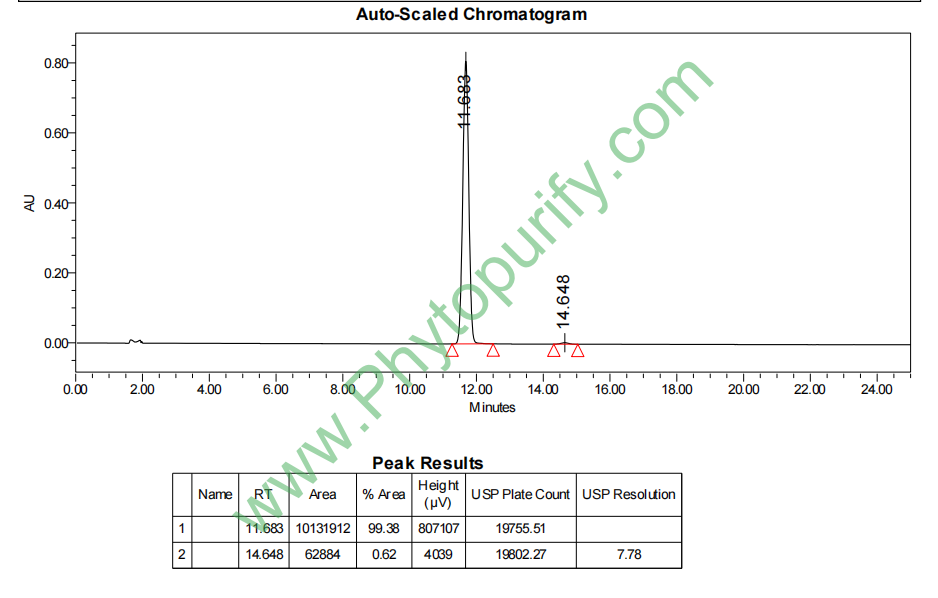
Purity: 95%~99%
Analysis Method: HPLC-DAD or/and HPLC-ELSD
Identification Method: Mass, NMR
Packing: Brown vial or HDPE plastic bottle
Can be supplied from milligrams to grams.
For Reference Standard and R&D, Not for Human Use Directly.
Inquire for bulk scale.
HPLC of columbianetin
Storage conditions:Short-term storage at 2~8℃, long-term storage at -20 ~ -80℃
Dihydroeucalyptol (CAS number: 3804-70-4), as a natural product, has received widespread attention in recent years due to its significant biological activity. It belongs to an isomer of furan coumarin compounds, mainly found in plants of the Eucommia genus, and plays an important role in the disease resistance mechanism of celery. Research has shown that dihydroeucalyptol not only has good antifungal activity, but also exhibits significant anti-inflammatory effects, making it a potential candidate molecule for the development of natural anti-inflammatory drugs. This article provides a systematic review of the chemical structure, plant origin, pharmacological activity, mechanism of action, and pharmacological evaluation of dihydroeucalyptol, aiming to provide scientific basis for its clinical application and new drug development.
Dihydroeucalyptol is a furan coumarin compound with a molecular formula of C14H014O4 and a molecular weight of 246.26. Its structural features include the fusion of a furan ring and a coumarin core structure, endowing it with unique biological activity. The LogP value of this compound is 1.97, indicating that it has moderate lipid solubility, which is beneficial for membrane penetration and in vivo distribution. The polar surface area (TPSA) is 63.6 Å ² and the number of hydrogen bond acceptors is 4, indicating that it has good affinity and selectivity when binding to biological targets.
From the perspective of stereochemistry, (+) - dihydroeucalyptol is an optical isomer of dihydroeucalyptol, and the different stereoconfigurations may affect its biological activity and metabolic pathways. This compound has good stability and is easily soluble in moderately polar organic solvents, making it suitable for the development of pharmaceutical formulations.
Dihydroeucalyptol is mainly found in plants of the Eucalyptus genus (such as Angelica spp.) and celery (Apium graveolens), and is a natural antitoxin that plants use to resist pathogen infections. Its content varies with the growth stage of the plant and changes in environmental conditions, especially during the storage of celery. The accumulation of dihydroeucalyptol is closely related to the plant's resistance to pathogens such as fungi.
The extraction method usually uses organic solvent extraction combined with column chromatography separation. Common extraction solvents include ethanol, methanol, and ethyl acetate, which are purified by silica gel column chromatography or high-performance liquid chromatography (HPLC) after extraction. In recent years, the application of ultrasound assisted extraction and microwave-assisted extraction technologies has improved extraction efficiency and purity. In addition, the structure was identified by combining mass spectrometry (MS) and nuclear magnetic resonance (NMR) techniques to ensure the purity of the extract and the accuracy of the active ingredients.
Dihydroeucalyptol, as a natural plant antitoxin, exhibits significant antifungal activity. In vitro experiments have shown that the compound can inhibit the growth of various plant pathogenic fungi, such as Botrytis cinerea and Erysiphe spp. Its antifungal mechanism may involve disrupting the integrity of fungal cell membranes and inhibiting fungal cell wall synthesis, thereby blocking the invasion process of pathogens.
The anti-inflammatory effect is a key focus of research on dihydroquercetin. Multiple in vitro and in vivo experiments have shown that this compound can significantly inhibit the release of inflammatory mediators and alleviate inflammatory reactions. For example, in a mouse model of acute inflammation, dihydroeucalyptol significantly reduced redness, swelling, and cell infiltration at the site of inflammation. Cell level studies have shown that it can inhibit the expression of pro-inflammatory factors such as TNF - α and IL-6 in macrophages and other immune cells.
In addition, dihydroeucalyptol has shown good relief effects on neuroinflammation and chronic inflammation models, indicating its potential therapeutic value in inflammation related diseases such as arthritis and inflammatory bowel disease.
The anti-inflammatory effect of dihydroeucalyptol involves multiple signaling pathways and key molecular targets, mainly including:
IL-6 (interleukin-6)As a pro-inflammatory cytokine, IL-6 plays a central regulatory role in the inflammatory response. Dihydroeucalyptol can downregulate the expression of IL-6 and alleviate the inflammatory cascade reaction.
STAT3 (Signal Transduction and Transcription Activation Factor 3)STAT3 is a key transcription factor in the IL-6 signaling pathway, regulating the expression of various inflammation related genes. Dihydroeucalyptol inhibits the phosphorylation of STAT3, blocks its nuclear translocation, and suppresses the transcription of inflammatory genes.
CASP1 (caspase 1)CASP1 is involved in the activation of inflammasomes, promoting the maturation and release of inflammatory factors such as IL-1 β. Dihydroeucalyptol can inhibit CASP1 activity and alleviate inflammatory response.
TRPV1 and TRPA1 (transient receptor potential channels)These two ion channels play important roles in inflammation and pain transmission. The regulatory effect of dihydroeucalyptol on it helps alleviate inflammation related pain symptoms.
PTGS1 and PTGS2 (cyclooxygenase 1 and 2)PTGS2 (COX-2) is a key enzyme involved in prostaglandin synthesis during inflammation. Dihydroeucalyptol inhibits the expression of PTGS2 and reduces the production of pro-inflammatory prostaglandins.
TNF (tumor necrosis factor)TNF - α is a typical pro-inflammatory factor, and dihydroeucalyptol reduces inflammation by inhibiting the production of TNF - α.
NOS2 (inducible nitric oxide synthase)NOS2 produces a large amount of NO and participates in the inflammatory process. Dihydroeucalyptol inhibits the expression of NOS2 and reduces NO mediated inflammatory damage.
NFKB1 (nuclear factor kappa B)The NFKB signaling pathway is the core regulatory pathway of inflammatory response. Dihydroeucalyptol blocks inflammatory signaling by inhibiting the activation of NFKB1.
In summary, dihydroeucalyptol exerts its anti-inflammatory activity through multi-target and multi pathway synergistic effects, and has high pharmacological value.
Dihydroeucalyptol exhibits excellent medicinal properties. Its molecular weight is 246.26, which conforms to Lipinski's rule and is beneficial for oral absorption. A LogP value of 1.97 suggests that it has moderate lipid solubility, which facilitates membrane penetration and in vivo distribution. The TPSA is 63.6 Å ² and the number of hydrogen bond receptors is 4, indicating its good bioavailability and targeted binding ability.
The high permeability of the blood-brain barrier suggests its potential application value in central nervous system related diseases. The toxicity assessment showed that dihydroeucalyptol has no hepatotoxicity, cardiotoxicity, or hERG channel inhibition. The Ames test result was negative, indicating a low risk of genetic toxicity and good safety.
In terms of pharmacokinetics, existing research is relatively limited, but preliminary in vivo experiments have shown that dihydroquercetin is well absorbed after oral administration, with a moderate plasma half-life and stable metabolism, mainly through liver metabolic enzymes for biotransformation. Further systematic pharmacokinetic and toxicological studies are needed in the future to guide clinical dosage and administration regimens.
Based on its excellent anti-inflammatory and antifungal activities, dihydroeucalyptol has shown broad prospects in clinical applications. Firstly, in the field of inflammatory diseases such as rheumatoid arthritis, inflammatory bowel disease, and neuroinflammation, dihydroeucalyptol is expected to serve as a new natural anti-inflammatory drug, providing a safe and effective treatment option. Secondly, its antifungal properties make it potentially valuable for the prevention and treatment of plant diseases and related fungal infections.
In addition, the excellent blood-brain barrier permeability of dihydroeucalyptol suggests its potential application in central nervous system diseases such as neuroinflammation and neurodegenerative diseases. In the future, combining nanocarriers and targeted delivery technology is expected to enhance its bioavailability and targeted therapeutic efficacy.
However, current preclinical studies on dihydroeucalyptol are still limited, lacking systematic pharmacokinetic, toxicological, and clinical trial data. Future research should focus on in-depth analysis of its pharmacological mechanism, formulation optimization, and safety evaluation to promote its clinical translation.
Dihydroeucalyptol, as a natural product with multi-target anti-inflammatory and antifungal activities, has demonstrated good pharmacological and safety properties. Its complex mechanism of action encompasses multiple inflammation related signaling pathways, providing an important molecular basis for the development of novel anti-inflammatory drugs. With the continuous deepening of extraction and purification technology and pharmacological research, dihydroeucalyptol is expected to become a star compound in the field of natural medicine development. In the future, combining modern medicinal chemistry and drug delivery technology, the clinical application prospects of dihydroeucalyptol are worth looking forward to. The pharmacokinetics and clinical research of the system will be the key to its successful transformation. In summary, dihydroeucalyptol provides valuable resources for natural product pharmacology research and new drug development, and has important scientific and clinical value.
