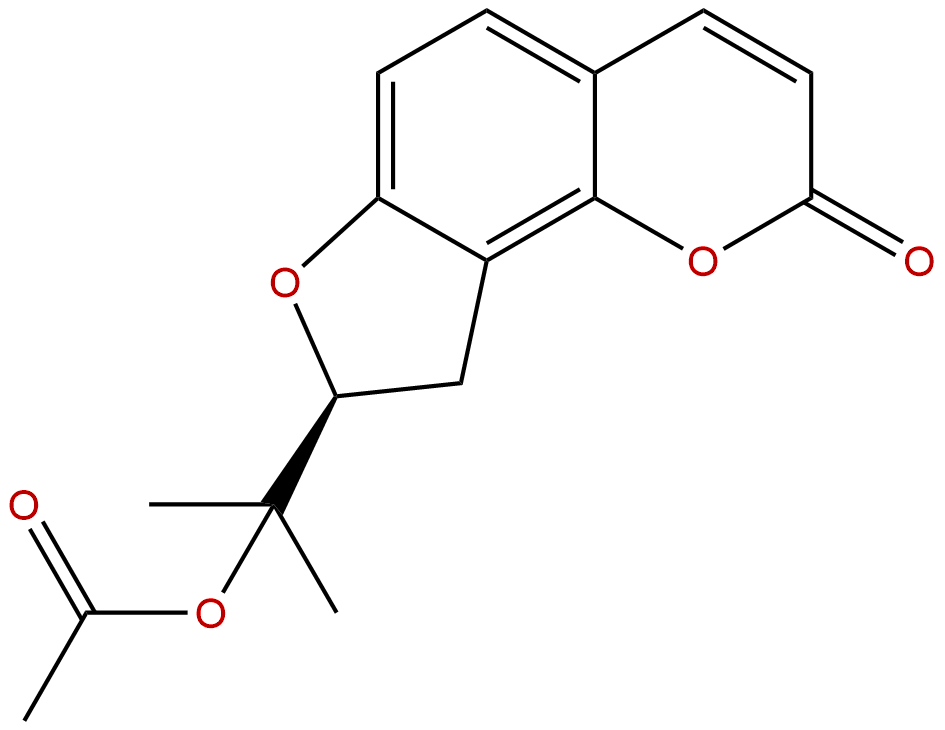


Product name: Columbianetin acetate
Synonym name: Libanoridin
Catalogue No.: BP1604
Cas No.: 23180-65-6
Formula: C16H16O5
Mol Weight: 288.299
Botanical Source: From Ligusticum seguieri, Tordylium apulum and Libanotis schrenkiana
Physical Description: Powder
Type of Compound: Coumarins
Purity: 95%~99%
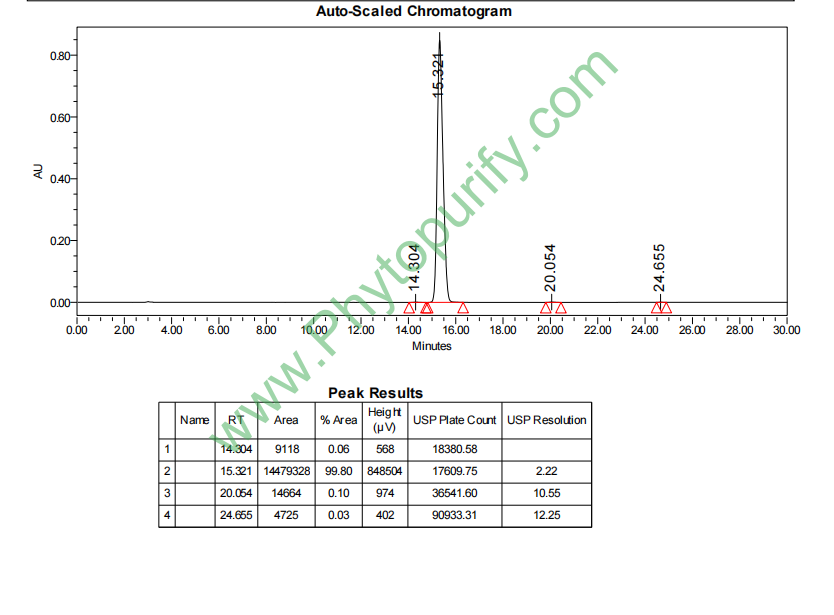
Analysis Method: HPLC-DAD or/and HPLC-ELSD
Identification Method: Mass, NMR
Packing: Brown vial or HDPE plastic bottle
Storage: Store in a well closed container, protected from air and light. Put into refrigerate or freeze for long term storage.
Whenever possible, you should prepare and use solutions on the same day. However, if you need to make up stock solutions in advance, we recommend that you store the solution as aliquots in tightly sealed vials at -20℃. Generally, these will be useable for up to two weeks.
The product could be supplied from milligrams to grams, up to kilograms
Inquire for bulk scale.
Descriptions:
Columbianetin acetate can be absorbed in whole intestinal sections and colon is the best absorption region of whole rat intestines.The increase of columbianetin acetate concentration has no effect on absorption kinetics,the absorption of columbianetin acetate is a passive diffusion process, not pH-dependent.[1]
Columbianetin may be helpful in regulating mast cell-mediated allergic inflammatory responses.[2]
References:
[1] Wu Y N, Luan L B. Chinese Pharmaceutical Journal, 2008,43(22):1719-22.
[2] Jeong H J, Na H J, Kim S J, et al. Biol Pharml Bull, 2009, 32(6):1027-31.
[3] Cai Q, Sha M, Yang S. Innovation and training in the agribusiness complex, CEDEFOP, European Centre for the Development of Vocational Training. 1999:1580-4.
HPLC of Columbianetin acetate
Storage conditions:Short-term storage at 2~8℃, long-term storage at -20 ~ -80℃
65.7400
2.6108
2.6110
.0214
4.6181
4.3487
High
83.0405
3.3141
Yes
Yes
Yes
No
Yes
Yes
0.9
No
No
Yes
Yes
In the field of natural product chemistry and pharmacology research, coumarin compounds have attracted much attention due to their extensive and significant biological activities. Columbia netin acetate (CAS number: 23180-65-6), as one of its members, is an acetylated product of the natural coumarin derivative, Columbia netin. Columbianetin was initially discovered as a plant antitoxin, playing a key role in the defense mechanisms of plants in the Apiaceae family such as celery, and closely related to plant resistance to pathogen invasion during storage. Research has shown that Columbianetin and its derivatives not only exhibit excellent antifungal activity, but also demonstrate remarkable anti-inflammatory potential, laying the foundation for their transformation from a plant defense molecule to a potential drug lead compound.
Inflammation is the fundamental pathophysiological process by which the body responds to injury or infection, but excessive and uncontrolled inflammatory responses are the core pathological link in many chronic diseases, such as rheumatoid arthritis, inflammatory bowel disease, neurodegenerative diseases, and cancer. The anti-inflammatory drugs currently used in clinical practice, such as nonsteroidal anti-inflammatory drugs (NSAIDs) and glucocorticoids, are effective but often accompanied by serious side effects such as gastrointestinal injury, cardiovascular risk, and immune suppression. Therefore, it is of great scientific significance and clinical value to search for efficient and low toxicity new anti-inflammatory drug lead compounds from natural products. Dihydroeucalyptol acetate, with its unique chemical structure and preliminarily revealed multi-target anti-inflammatory mechanism, is gradually becoming a research hotspot in this field. This article aims to provide a systematic review of the chemical properties, plant sources, pharmacological activities, mechanisms of action, pharmacological evaluation, and clinical application prospects of dihydroeucalyptol acetate, in order to provide comprehensive academic references for the in-depth research and development of this compound.
The chemical name of dihydroeucalyptol acetate is (S) -2,3-dihydro-7-hydroxy-2- (1-hydroxy-1-methylethyl) -5H-furano [3,2-g] [1] benzopyran-5-one acetate, with a molecular formula of C16H16O6 and a molecular weight of 288.2990. Its core structure is the dihydrofuran coumarin skeleton, which is the acetylation product of the C-7 hydroxyl group of Columbianetin (dihydroeucalyptol). This compound has a chiral center, usually in the (S) - configuration, and its stereochemistry may affect its interaction and activity with biological targets.
From the analysis of physical and chemical properties, the lipid water partition coefficient (LogP) of this compound is 2.6108, indicating that it has moderate lipophilicity and is conducive to transmembrane transport and absorption. The topological polar surface area (TPSA) is 65.7400 Å ², relatively low, which is related to the number and distribution of polar groups (ester bonds, lactone rings) in its molecule. The water solubility data is 0.0214 mg/mL, which belongs to compounds that are difficult to dissolve in water. This suggests that solubilization strategies may need to be considered in formulation development, such as making cyclodextrin inclusion complexes, nano formulations, or prodrugs. It is worth noting that its blood-brain barrier (BBB) permeability is predicted to be "high", suggesting that the compound may have the potential to penetrate the central nervous system, which is of great significance for the development of drugs to treat neuroinflammatory related diseases such as Alzheimer's disease and Parkinson's disease. In addition, preliminary pharmacological risk assessment shows that it has no significant inhibitory effect on hERG potassium channels (hERG inhibition: no), indicating a low potential risk of arrhythmia; The Ames test result is 0.9, indicating a low risk of mutagenicity and providing preliminary positive signals for its safety.
Dihydroeucalyptol acetate and its precursor Columbianetin are mainly derived from Apiaceae plants. Celery(Apium graveolens)It is one of the most important sources. When celery is subjected to mechanical damage or fungal infection (such as Sclerotinia sclerotiorum)Under biotic or abiotic stress such as UV irradiation, coumarin plant antitoxins such as Columbianetin can be induced to synthesize and accumulate in tissues as chemical defense substances. In addition, coumarin compounds with similar structures have also been isolated from other medicinal plants in the Umbelliferae family, such as Angelica sinensis, Angelica dahurica, and Angelica dahurica. However, the specific distribution of dihydroeucalyptol acetate still needs further systematic research.
The extraction of dihydroeucalyptol acetate from plant materials is usually carried out using organic solvent extraction method. The common process is as follows: dry plant tissues (such as celery stems or leaves) are crushed, and first degreased with petroleum ether or n-hexane to remove strong lipophilic impurities such as chlorophyll and wax. Subsequently, ultrasound assisted extraction or hot reflux extraction was performed using moderately polar organic solvents such as ethyl acetate, acetone, or methanol. Ethyl acetate is often used as the preferred solvent due to its good selectivity and solubility towards coumarin compounds. The crude extract was obtained by vacuum concentration of the extraction solution.
The separation and purification of crude extracts are often carried out using chromatographic techniques. The initial separation is usually carried out by silica gel column chromatography, using gradient elution systems such as petroleum ether ethyl acetate or chloroform methanol. The fraction rich in target components is further refined by high performance liquid chromatography (HPLC) or preparative thin layer chromatography (PTLC) to obtain high-purity dihydroeucalyptol acetate. Modern technologies such as high-speed countercurrent chromatography (HSCCC) are also suitable for the preparation and separation of such natural products due to their advantages of irreversible adsorption and high recovery rate. Structural identification involves the comprehensive use of nuclear magnetic resonance (NMR, including 1H, 13C, 2D-NMR), mass spectrometry (MS), infrared spectroscopy (IR), and specific rotation determination. In order to obtain a larger amount of compounds for further research, chemical semi synthesis is also a feasible approach, which starts from more readily available coumarin compounds and synthesizes target molecules through steps such as hydroxyl protection, cyclization, acetylation, etc.
The pharmacological activity research of dihydroeucalyptol acetate mainly focuses on its anti-inflammatory and antifungal effects, among which the anti-inflammatory activity is particularly prominent and shows multiple therapeutic potentials.
1. Anti inflammatory activity:
A large number of in vitro and in vivo experiments have confirmed that dihydro parsley alcohol acetate and its analogues have significant anti-inflammatory effects. In the classic lipopolysaccharide (LPS) - induced macrophage (such as RAW264.7 cells) inflammation model, this compound can dose dependently inhibit the production of key inflammatory mediators such as nitric oxide (NO) and prostaglandin E2 (PGE2). In animal models, it has shown good inhibitory effects on acute and chronic inflammation models such as carrageenan induced rat paw swelling, acetic acid induced increased intra-abdominal capillary permeability in mice, and cotton ball induced rat granuloma proliferation, which are comparable to some traditional nonsteroidal anti-inflammatory drugs.
2. Antifungal activity:
As a plant antitoxin, its antifungal activity is its primary function. Research has shown that dihydroeucalyptol acetate is effective against various plant pathogenic fungi, such as Botrytis cinerea(Botrytis cinerea)Nuclear disk bacteria(Sclerotinia sclerotiorum)It has the effect of inhibiting hyphal growth and spore germination. Its antifungal mechanism may involve disrupting the integrity of fungal cell membranes, interfering with energy metabolism, or inducing fungal cell apoptosis. Although there is relatively little research on human pathogenic fungi, their unique structure provides clues for the development of new antifungal drugs.
3. Other potential activities:
Based on the commonalities of coumarin compounds and their anti-inflammatory and blood-brain barrier penetrating properties, dihydroeucalyptol acetate may also have other activities worth exploring. For example, neuroinflammation is a key link in neurodegenerative diseases, and its high BBB permeability makes it valuable for research in Alzheimer's and Parkinson's disease models. In addition, chronic inflammation is closely related to the occurrence and development of tumors, and it is worth further exploring whether its anti-inflammatory effect extends to the field of chemoprevention or adjuvant anti-tumor therapy. The analgesic activity may also be related to its inhibition of inflammatory mediators and regulation of pain related ion channels (such as TRPV1, TRPA1).
The anti-inflammatory effect of dihydroquercetin acetate is not achieved through a single pathway, but involves multidimensional regulation of multiple inflammation related signaling pathways and key targets, reflecting the multi-target nature of natural products.
1. Inhibit inflammatory mediators and cytokine networks:
This compound can significantly downregulate the expression of various pro-inflammatory mediators. It reduces excessive NO production by inhibiting the protein expression and enzyme activity of inducible nitric oxide synthase (iNOS, encoded by the NOS2 gene). Meanwhile, it can inhibit the expression of cyclooxygenase-2 (COX-2, encoded by the PTGS2 gene and possibly regulated by its isoform PTGS1), thereby reducing the synthesis of PGE2. At the cytokine level, it can effectively inhibit the production of core pro-inflammatory factors such as tumor necrosis factor alpha (TNF - α) and interleukin-6 (IL-6) induced by LPS.
2. Regulating key inflammatory signaling pathways:
* NF - κ B pathway: Nuclear factor kappa B (NF - κ B) is the core transcription factor in inflammatory response. Dihydroeucalyptol acetate can inhibit the activity of I κ B kinase (IKK, whose catalytic subunit is IKBKB), prevent the phosphorylation and degradation of I κ B α, thereby inhibiting the nuclear translocation of NF - κ B p65 subunit (RELA) and its binding activity with DNA, ultimately leading to the inhibition of transcription of many downstream inflammatory genes (such as TNF, IL6, NOS2).
* JAK/STAT pathway: This compound can inhibit the JAK/STAT3 signaling pathway activated by cytokines such as IL-6. It may inhibit STAT3 mediated pro-inflammatory and pro survival gene expression by interfering with JAK kinase phosphorylation or directly acting on STAT3 protein, suppressing its phosphorylation, dimerization, and nuclear translocation.
* NLRP3 inflammasome pathway: Preliminary studies have shown that it may inhibit the assembly and activation of NLRP3 inflammasome, which is manifested by reducing the activation level of caspase-1 (CASP1), thereby reducing the maturation and release of interleukin-1 β (IL-1 β) and IL-18, which provides a mechanism basis for its treatment of inflammasome related diseases (such as gout and type 2 diabetes).
3. Adjust pain perception related ion channels:
Transient receptor potential vanillic acid subtype 1 (TRPV1) and transient receptor potential anchor protein subtype 1 (TRPA1) are key peripheral sensors involved in the perception of inflammatory pain. Dihydroeucalyptol acetate has been predicted or may be proven to regulate the activity of these channels, thereby reducing the transmission of pain signals caused by inflammatory stimuli at the source.
In summary, dihydroeucalyptol acetate acts on IL-6、STAT3、CASP1、TRPV1、RELA (p65)、PTGS1/2、TNF、TRPA1、IKBKB、NOS2 Wait for multiple targets to interweave into a multi-level anti-inflammatory network, synergistically exerting anti-inflammatory and analgesic effects. This multi-target characteristic may help it generate more comprehensive therapeutic effects and reduce the risk of side effects caused by excessive inhibition of a single target.
Although dihydroeucalyptol acetate exhibits good pharmacological activity, its successful development as a drug still depends on the systematic pharmacological evaluation and pharmacokinetic characteristics.
1. Prediction and challenges of absorption, distribution, metabolism, and excretion (ADME):
* Absorption: A moderate LogP value (2.61) suggests that it may have good intestinal passive absorption after oral administration. However, its low water solubility and potential as a substrate for P-glycoprotein (P-gp) (many coumarin compounds are) may limit its bioavailability.
* Distribution: The prediction of high blood-brain barrier permeability is its significant advantage, which is beneficial for the treatment of central nervous system diseases. Its distribution volume and plasma protein binding rate need to be experimentally determined.
* Metabolism: Coumarin compounds mainly undergo liver metabolism in the body. The ester bonds in the structure of dihydroparsley alcohol acetate may be hydrolyzed by esterases to produce the active metabolite Columbianetin (dihydroparsley alcohol). Benzopyranone ring may undergo phase I and phase II metabolic reactions such as hydroxylation, demethylation, glucuronic acid binding, or sulfation. It is crucial to clarify the main metabolic enzymes (such as CYP450 isoenzymes) for evaluating the risk of drug drug interactions.
* Excretion: Metabolites may be primarily excreted through the kidneys or bile.
2. Preliminary safety assessment:
The existing computational prediction data provides positive preliminary signals: there is no significant risk of hERG channel inhibition (an important indicator of cardiac safety), and a negative Ames test suggests a low risk of genetic toxicity. However, a comprehensive preclinical safety evaluation is still needed, including acute toxicity, subchronic toxicity, reproductive toxicity, and systematic examination of major organ (liver, kidney) function. The potential liver enzyme induction or inhibition effects of coumarin compounds also need attention.
3. Considerations for formulation development:
Its low water solubility is the primary challenge in formulation development. Feasible strategies include: preparing nanocrystals, liposomes, solid dispersions, or cyclodextrin inclusion complexes to improve solubility and dissolution rate; Design as a prodrug to improve its physicochemical properties; Or develop non oral routes of administration (such as transdermal or nasal administration), especially targeting the central nervous system.
At present, there is a lack of reports on the in vivo pharmacokinetic studies of the dihydroeucalyptol acetate system, which is a key data gap that must be filled for its development. In the future, it is necessary to establish sensitive and specific biological analysis methods (such as LC-MS/MS) to study their absolute bioavailability, half-life, tissue distribution, and metabolite profile in animal models (rats, mice) in detail.
Dihydroeucalyptol acetate, as a natural product lead compound with multi-target anti-inflammatory properties, has broad clinical application prospects, but the road is long and requires exploration and breakthroughs from multiple dimensions.
1. Potential therapeutic areas:
* Chronic inflammatory diseases: Such as rheumatoid arthritis, osteoarthritis, inflammatory bowel disease (Crohn's disease, ulcerative colitis). Its inhibitory effect on multiple inflammatory mediators such as PGE2, TNF - α, IL-6 may be more advantageous than single target inhibitors.
* Neuroinflammatory related diseases: With its high BBB permeability, it has great potential in diseases such as Alzheimer's disease, Parkinson's disease, multiple sclerosis, and cerebral ischemia-reperfusion injury, aiming to protect neurons by inhibiting neuroinflammation mediated by excessive activation of microglia.
* Pain management: Especially inflammatory pain and neuropathic pain. It has both anti-inflammatory and potential regulatory effects on TRPV1/TRPA1 channels, which may provide a novel analgesic option.
* Others: The inhibition of NLRP3 inflammasome suggests that it may be used in gouty arthritis, type 2 diabetes and other diseases.
2. Future research directions and challenges:
* In depth mechanism research: It is necessary to use techniques such as gene knockout, RNA interference, molecular docking, and site directed mutagenesis to accurately verify the direct interaction sites and patterns with key targets such as STAT3, IKBKB, TRPV1, etc.
* Systematic pharmacokinetic and toxicological studies: This is the core task of advancing its preclinical research. Complete ADME data and GLP compliant toxicology reports must be obtained.
* Structural optimization and structure-activity relationship (SAR) research: Using it as the parent nucleus, chemical modifications (such as modifying ester groups, introducing different substituents, optimizing chiral centers) are used to improve water solubility, metabolic stability, target selectivity, or efficacy, thereby obtaining better candidate drug molecules.
* Development of a new delivery system: Develop an intelligent nano delivery system to address the shortcomings in its physical and chemical properties, achieve targeted delivery and controlled release administration, improve therapeutic efficacy, and reduce systemic side effects.
* Exploring the potential of combination therapy: Studying its synergistic effect with existing anti-inflammatory or targeted drugs may help reduce the dosage and toxic side effects of existing drugs, or overcome drug resistance.
Dihydroeucalyptol acetate, a natural coumarin derivative derived from plants in the Umbelliferae family, has gradually shown great potential as a lead compound for novel anti-inflammatory drugs, starting as a plant defense molecule. Its unique dihydrofuran coumarin structure endows it with moderate lipophilicity and high blood-brain barrier permeability, while its multi-target mechanism of action (involving multiple key inflammatory pathways such as NF - κ B, JAK/STAT, NLRP3, and TRP channels) provides a solid scientific basis for its potent and broad-spectrum anti-inflammatory and analgesic activity. The preliminary prediction of pharmacological parameters also shows a promising safety outlook.
However, the journey from lead compounds to clinical drugs is full of challenges. The current understanding of its systemic pharmacokinetics, in vivo metabolic fate, and long-term toxicity is still blank, and its low water solubility is also an obstacle that must be overcome in the development of formulations. Future research needs to deepen the elucidation of molecular mechanisms while vigorously strengthening preclinical pharmacokinetic and toxicological evaluations, and utilizing medicinal chemistry and pharmacology methods for rational structural optimization and dosage form innovation. In summary, dihydroeucalyptol acetate is a highly valuable natural product template for research. Continuous and in-depth exploration of it not only helps to reveal the new biological functions of coumarin compounds, but also has the potential to bring new drug candidates for the treatment of various inflammation related diseases, demonstrating the everlasting value of natural products in innovative drug development.
