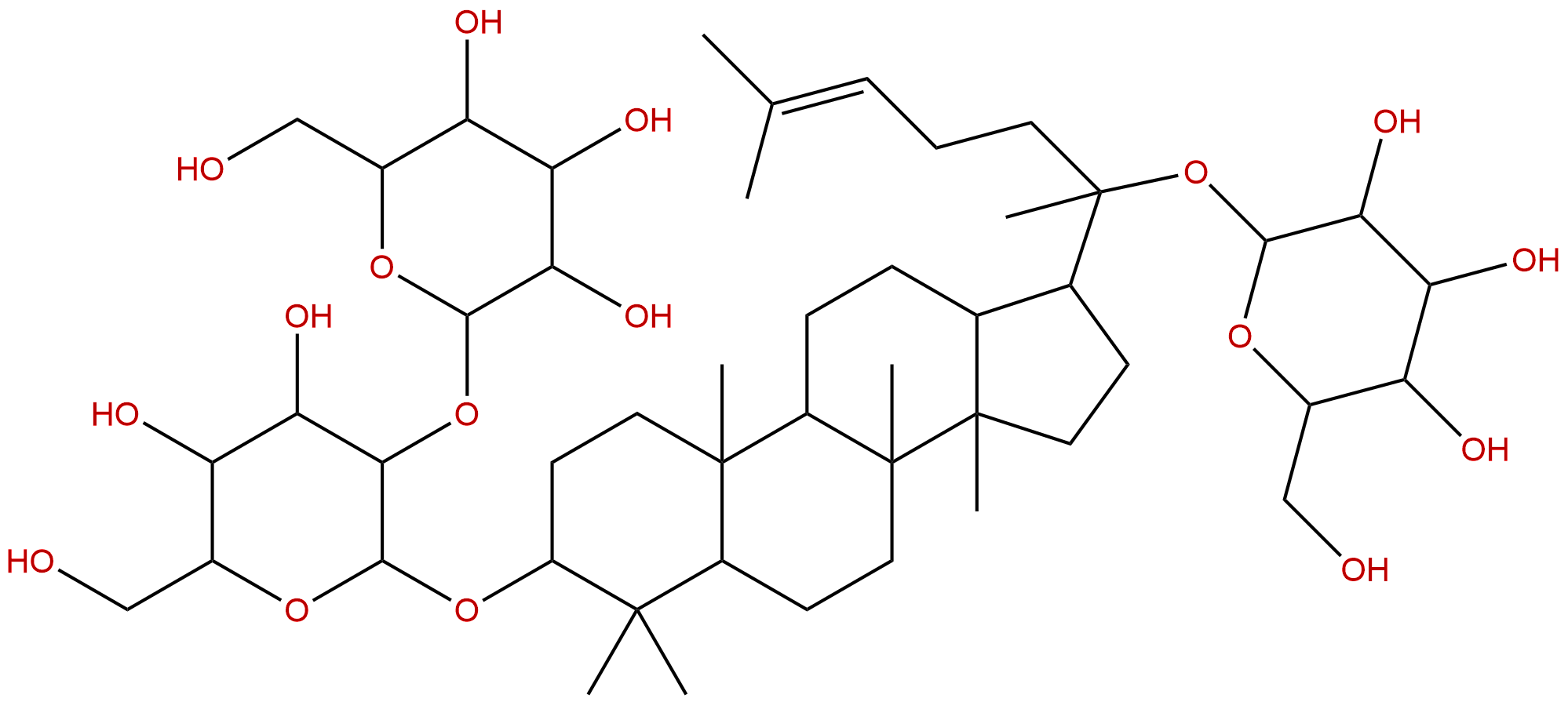


Product name: vina-ginsenoside R3
Synonym name:
Catalogue No.: BP3418
Cas No.: 156012-92-9
Formula: C48H82O17
Mol Weight: 931.167
Botanical Source:
Physical Description:
Type of Compound: Triterpenoids
Purity: 95%~99%
Analysis Method: HPLC-DAD or/and HPLC-ELSD
Identification Method: Mass, NMR
Packing: Brown vial or HDPE plastic bottle
The product could be supplied from milligrams to grams. Inquire for bulk scale.
We provide solution to improve the water-solubility of compounds, thereby facilitating the variety of activity tests and clinic uses.
For Reference Standard and R&D, Not for Human Use Directly.
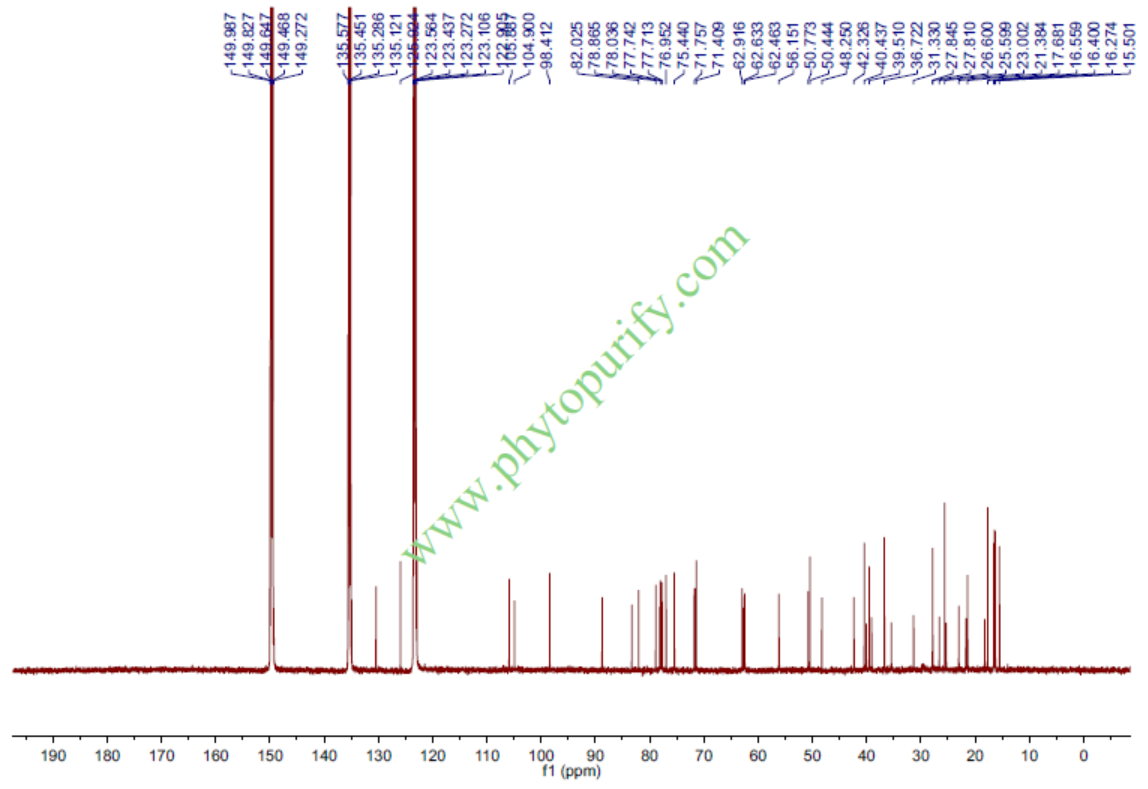
NMR of vina-ginsenoside R3
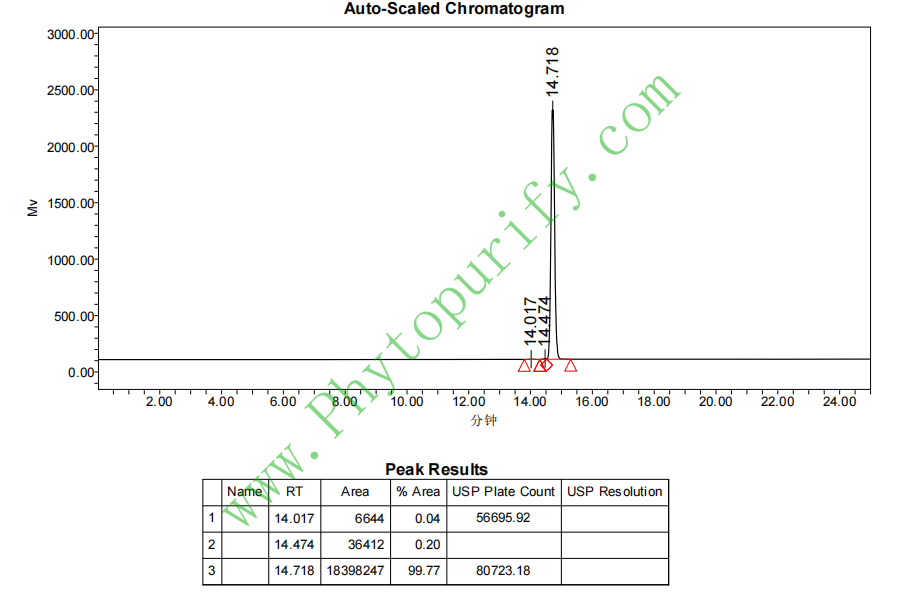
HPLC of vina-ginsenoside R3
Storage conditions:Short-term storage at 2~8℃, long-term storage at -20 ~ -80℃
277.9100
2.9613
2.9617
.0835
.5292
.1527
Low
78.6619
6.2888
No
No
No
No
No
No
0.0
Yes
No
No
No
Natural products, as an important treasure trove for drug discovery and development, play an irreplaceable role in the history of human disease prevention and treatment. Among them, triterpenoid saponins have always been a hot topic in pharmacological research due to their structural diversity and wide range of biological activities. Vina ginsenoside R3 (CAS number: 156012-92-9), a type of triterpenoid saponin isolated from Vietnamese ginseng (Panax vietnamensis), has attracted much attention in recent years due to its significant antioxidant activity and related pharmacological effects. Oxidative stress is one of the core pathological mechanisms of the occurrence and development of various chronic diseases (such as neurodegenerative diseases, cardiovascular diseases, diabetes complications, skin photoaging, etc.), which involves the imbalance of excessive production and clearance of intracellular reactive oxygen species (ROS). Therefore, the search for efficient and low toxicity natural antioxidants has important scientific significance and application value. This article aims to systematically review the chemical structure, plant origin, pharmacological activity, especially its antioxidant activity and molecular targets of Vietnamese ginsenoside R3, and evaluate and prospect its medicinal properties and clinical application prospects, in order to provide comprehensive academic references for the in-depth research and development of this compound.
Vietnamese ginsenoside R3 is a dammarane type tetracyclic triterpenoid saponin. Its molecular formula is C ₄₈ H ₈₂ O ₁₈, and its molecular weight is 931.1670. Its basic skeleton is damane, and sugar chains are usually connected at C-3 and C-20 positions to form a disaccharide chain saponin structure, which is the key to its biological activity. The specific composition and connection positions of sugar groups need to be accurately analyzed through techniques such as nuclear magnetic resonance (NMR) and mass spectrometry (MS), usually involving common sugar groups such as glucose, arabinose, xylose, etc.
In terms of physicochemical properties, this compound exhibits typical saponin characteristics. Its calculated lipid water partition coefficient (LogP) is 2.9613, indicating that it has a certain degree of lipophilicity, but not high lipid solubility. The topologically polar surface area (TPSA) is as high as 277.9100 Å ², which is mainly attributed to the abundant hydroxyl and sugar structures in the molecule, resulting in strong polarity. The water solubility parameter is 0.0835, indicating that it has low solubility in water and belongs to a poorly soluble compound, which may affect its oral bioavailability. These physicochemical parameters provide key basis for subsequent formulation research and pharmacokinetic optimization.
Vietnamese ginsenoside R3 mainly comes from the Panax vietnamensis Ha et Grushv. plant in the Araliaceae family, also known as "Vietnamese Panax notoginseng" or "Pearl ginseng". This plant is mainly distributed in the central highlands of Vietnam and is an important medicinal herb used in traditional medicine for nourishing and strengthening the body, anti fatigue, and anti stress. Its chemical composition and pharmacological activity are similar to traditional ginseng and Panax notoginseng, but also unique.
The extraction of Vietnamese ginsenoside R3 from plant materials usually follows the conventional process of natural product chemistry. Firstly, the dried roots or rhizomes of Vietnamese ginseng are crushed and subjected to reflux extraction or ultrasound assisted extraction using polar solvents such as methanol, ethanol, or aqueous ethanol to maximize the extraction of saponin components. Subsequently, crude extract was obtained by vacuum concentration. After water dispersion, the crude extract is often subjected to liquid-liquid extraction using n-butanol or water saturated n-butanol to enrich the saponin fraction. Further purification relies on various chromatographic techniques, including macroporous adsorption resin column chromatography (such as D101, AB-8 type), silica gel column chromatography, reverse phase silica gel column chromatography (such as ODS-C18), and high-performance liquid chromatography (HPLC) or preparative high-performance liquid chromatography (pre HPLC). Modern separation and analysis techniques, such as high-speed countercurrent chromatography (HSCCC) combined with mass spectrometry guided preparation separation, can significantly improve the separation efficiency and purity of target saponins. The extraction and separation process requires strict control of temperature, pH, and solvent to avoid hydrolysis or structural changes of saponins.
The pharmacological activity research of Vietnamese ginsenoside R3 is currently mainly focused on antioxidant It exhibits various biological effects in related fields.
The antioxidant effect of Vietnamese ginsenoside R3 is not achieved through a single pathway, but involves a multi-target, multi pathway network regulatory system, with the core being the activation of the cell's own antioxidant defense system.
In summary, Vietnamese ginsenoside R3 systematically enhances the antioxidant capacity of cells by targeting the core hub of NRF2, while also inhibiting specific damaging enzymes (such as MMPs), forming its multi-level and networked antioxidant mechanism.
Based on the provided pharmacological parameters and the general characteristics of saponin compounds, the preliminary evaluation of the pharmacological properties of Vietnamese ginseng saponin R3 is as follows:
At present, there are few public reports on the pharmacokinetic studies of Vietnamese ginsenoside R3 system, such as absolute bioavailability, half-life, tissue distribution, excretion, etc. This is a key data gap that must be filled in order to move towards drug development.
The clinical application prospects of Vietnamese ginsenoside R3 mainly revolve around its strong antioxidant and cell protective activities, but it needs to be steadily promoted from basic research to applied research.
However, achieving its clinical application still requires overcoming many challenges:
* In depth mechanism research It is necessary to validate its efficacy on more disease-related animal models and use techniques such as gene knockout and proteomics to more finely elucidate its signaling network.
* Pharmacokinetic optimization It is necessary to conduct systematic ADME research and develop suitable drug delivery routes and novel delivery systems (such as transdermal drug delivery and nano targeted delivery) based on their physical and chemical property defects.
* Comprehensive evaluation of safety Complete standardized preclinical toxicology studies, including acute toxicity, subchronic toxicity, reproductive toxicity, etc.
* Sustainable sources and synthesis The wild resources of Vietnamese ginseng are limited and require the development of artificial cultivation. Meanwhile, explore its chemical synthesis or synthetic biology preparation methods to meet future large-scale demands.
Vietnamese ginsenoside R3, as a natural triterpenoid saponin derived from traditional medicinal plants, exhibits unique potential and research value in combating oxidative stress-related diseases due to its strong antioxidant and cell protective activities centered on activating the NRF2 pathway. From chemical structure to preliminary pharmacological mechanisms, research has outlined the basic outline of it as a lead compound. However, there is still a long way to go from active molecules in the laboratory to real therapeutic drugs or health products. Future research should focus on its systematic pharmacokinetic behavior, breakthroughs in pharmacokinetics, in-depth in vivo pharmacological validation, and comprehensive safety evaluation. Through interdisciplinary collaboration, Vietnamese ginsenoside R3 is expected to develop from a promising natural product into an innovative substance with practical application value in the fields of dermatology, chronic disease prevention, and health promotion, providing another example for the modern development of natural products.
