Introduction/Overview
Natural products have long been an important source of innovative drug discovery, among which ginseng plants have attracted much attention due to their extensive pharmacological activities. Vina ginsenoside R8, a rare ocotilol type saponin isolated from Vietnamese ginseng (Panax vietnamensis), has become a hot topic in natural product pharmacology research in recent years due to its significant anti-tumor activity. Its CAS number is 156042-22-7. Compared with the common dammarane type ginsenosides, the Oketilon type saponins have a unique tetrahydrofuran ring structure at position C-20, which often endows them with unique biological activity and mechanism of action. Existing research has preliminarily revealed that Vietnamese ginsenoside R8 exhibits inhibitory potential on various tumor cells by intervening in multiple key biological processes such as apoptosis, proliferation, invasion, and metastasis. Its effects involve multiple key molecular targets such as MCL1, BCL2, STAT3, and MMP2. This article aims to systematically review the chemical properties, plant sources, pharmacological activities, mechanisms of action, and medicinal properties of Vietnamese ginsenoside R8, in order to provide comprehensive academic references for the in-depth research and development of this compound.
Chemical structure and physicochemical properties
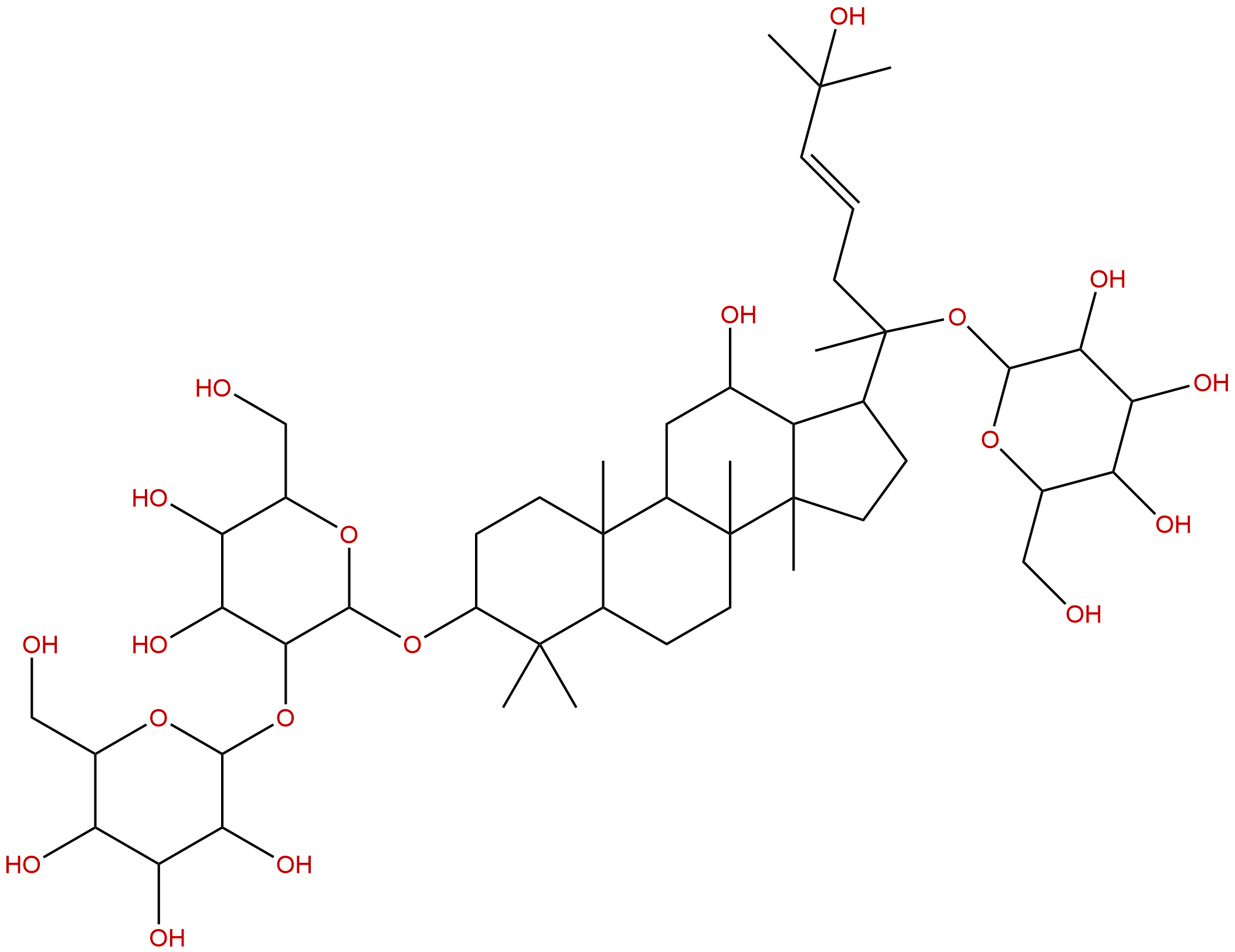
The molecular formula of Vietnamese ginsenoside R8 is C ₄₈ H ₈₂ O ₁₉, with a molecular weight of 963.1650. Its core structure is an Oktyrone type tetracyclic triterpenoid sapogenin, characterized by the formation and connection of a tetrahydrofuran ring at position C-20 of the Damane skeleton. The sapogenin is connected to sugar chains at positions C-3 and C-6, respectively. The typical glycosylation composition may include glucose, rhamnose, etc. The specific sequence and position of glycosylation connections are key to its structural uniqueness and directly affect its biological activity and physicochemical properties.
From the analysis of parameters related to drug properties, its lipophilic water partition coefficient (LogP) is 1.8397, indicating that the compound has a certain degree of lipophilicity, but is not highly hydrophobic. The topologically polar surface area (TPSA) is as high as 318.3700 Å ², mainly attributed to the abundant hydroxyl and glycosyl structures in the molecule, which provide multiple hydrogen bond donor and acceptor sites. High TPSA usually means that the permeability of the molecular membrane may be limited. Its water solubility value is 0.2538 (usually measured in mg/mL or log mol/L, depending on the context, usually indicating poor solubility), indicating poor water solubility prediction. These physicochemical parameters collectively suggest that Vietnamese ginsenoside R8 belongs to the typical "Beyond Rule of 5" class of molecules, and its oral bioavailability may face challenges. Solubilization strategies may need to be considered during formulation development. In addition, the prediction shows that its ability to cross the blood-brain barrier is low, which limits its direct effect on central nervous system tumors, but may also reduce the risk of central neurotoxicity. The inhibition prediction of hERG is' no ', indicating a low potential risk of cardiac toxicity. The Ames test predicted a value of 0.0, indicating that it may not be mutagenic, but experimental verification is needed.
Plant sources and extraction methods
Vietnamese ginsenoside R8 is mainly derived from the Panax vietnamensis Ha et Grushv. plant in the family Araliaceae, also known as Vietnamese Panax notoginseng. This plant is mainly distributed in the central highlands of Vietnam and is a precious medicinal herb used in traditional local medicine for nourishing and strengthening the body, anti fatigue, and treatment. Compared with common Asian ginseng or Panax notoginseng, Vietnamese ginseng contains a higher proportion of Oketilon type saponins, such as Vietnamese ginsenosides R1-R8, which constitute its characteristic chemical composition.
Its extraction and separation usually follow the conventional process of natural product chemistry. Firstly, the dried roots and stems of Vietnamese ginseng are crushed and subjected to reflux extraction or ultrasound assisted extraction using methanol, ethanol, or ethanol water mixed solvents to maximize the extraction of saponin components. Subsequently, crude extract was obtained by vacuum concentration. Crude extracts are often initially enriched by macroporous adsorption resin (such as D101, AB-8) column chromatography, followed by gradient elution with water and different concentrations of ethanol (such as 30%, 50%, 70%, 95%). Saponins are mainly concentrated in the elution sites of medium to high concentrations of ethanol. After obtaining the saponin enrichment site, further repeated separation and purification are required using normal phase silica gel column chromatography, reverse phase silica gel (such as ODS) column chromatography, and high-performance liquid chromatography (HPLC) or preparative high-performance liquid chromatography (pre HPLC). Considering that Vietnamese ginsenoside R8 is a rare saponin with low content in plants, its isolation and purification process is often cumbersome and the yield is not high. Modern technologies such as high-speed countercurrent chromatography (HSCCC) have shown advantages in the separation of structurally similar saponins due to their high recovery rate and separation efficiency. Structural identification involves the comprehensive use of spectroscopic methods such as mass spectrometry (MS), nuclear magnetic resonance (NMR, including ¹ H-NMR, ¹ ³ C-NMR, 2D-NMR such as HSQC, HMBC), etc.
Pharmacological activity research
The pharmacological activity research of Vietnamese ginsenoside R8 is currently mainly focused on the field of anti-tumor, and it has shown broad-spectrum anti proliferative activity in various in vitro tumor cell models and some in vivo models.
1. Antitumor activity
Studies have shown that Vietnamese ginsenoside R8 has a concentration dependent growth inhibitory effect on many human tumor cell lines, such as breast cancer, liver cancer, lung cancer, colon cancer, leukemia, etc. For example, in models such as breast cancer MCF-7 and MDA-MB-231 cells, hepatoma HepG2 and SMMC-7721 cells, the compound can significantly reduce cell viability, and its half inhibitory concentration (IC ≮₀) is usually at the micromolar level. In terms of in vivo research, in a mouse model of transplanted tumors, intraperitoneal injection or gavage of Vietnamese ginsenoside R8 can effectively inhibit tumor growth and volume, and no significant weight loss or organ toxicity was observed within a certain dose range, indicating that it has a certain therapeutic window.
2. Other potential activities
In addition to its direct anti-tumor effect, it is speculated that Vietnamese ginsenoside R8 may also have potential activities such as anti-inflammatory, antioxidant, and neuroprotective effects based on the activity of its structural analogues (other ginsenosides and octron type saponins). However, direct experimental evidence in these areas still needs to be further enriched. Its anti-inflammatory activity may be achieved by regulating signaling pathways such as NF - κ B and MAPK.
Mechanism of action and molecular targets
The anti-tumor effect of Vietnamese ginsenoside R8 involves multi-target and multi pathway synergistic mechanisms. Preliminary studies have revealed its important regulatory effects on cell apoptosis, cycle arrest, invasion and metastasis, and tumor microenvironment.
1. Inducing cell apoptosis
This is one of the core mechanisms of its anti-tumor effect. Vietnamese ginsenoside R8 can upregulate the expression of pro apoptotic proteins such as Bax and Bak, while downregulating anti apoptotic proteins MCL1 and BCL2 The expression of caspase leads to the disruption of mitochondrial membrane potential, resulting in the release of cytochrome c, activation of caspase cascade reaction, and ultimately triggering endogenous apoptosis pathway. In addition, it can also inhibit STAT3 Activation of signaling pathways. STAT3, as an important transcription factor, its sustained activation promotes cell survival and proliferation. Vietnamese ginsenoside R8 further promotes apoptosis by inhibiting the phosphorylation of STAT3 and reducing the expression of downstream target genes such as Survivor and Bcl xL.
2. Inhibit cell invasion and metastasis
Tumor metastasis is the main cause of treatment failure. Vietnamese ginsenoside R8 can significantly inhibit the migration and invasion ability of tumor cells. The mechanism is closely related to the downregulation of matrix metalloproteinases (MMPs) expression, especially MMP2 And MMP9. MMP2 is a key enzyme that degrades extracellular matrix (ECM) and basement membrane. This compound reduces the transcription and secretion of MMP2 by interfering with related signaling pathways such as PI3K/Akt and MAPK, thereby weakening the invasive ability of tumor cells.
3. Interference with DNA metabolism and cell cycle
Research suggests that Vietnamese ginsenoside R8 may act as a topoisomerase inhibitor. Topoisomerase I(TOP1)And topoisomerase II α(TOP2A)It is a key enzyme that regulates DNA topology and a target for various chemotherapy drugs. This compound may inhibit cell proliferation by interfering with the function of these enzymes, leading to DNA damage and replication failure. At the same time, it can also block the cell cycle in the G0/G1 phase or G2/M phase, and its mechanism may be related to regulating the expression of cyclins and cyclin dependent kinases (CDKs).
4. Regulating tumor microenvironment and hormone signaling
The hypoxic state in the tumor microenvironment is an important factor in promoting tumor progression. Vietnamese ginsenoside R8 has been shown to inhibit hypoxia inducible factor-1 α(HIF1A)Stability and activity. HIF1A accumulates under hypoxic conditions and activates a series of genes that promote angiogenesis (such as VEGF) and reprogramming of glucose metabolism. Inhibiting HIF1A can improve the tumor microenvironment and inhibit tumor growth. In addition, for hormone dependent tumors such as breast cancer, the compound may also act on estrogen receptor α(ESR1)Or aromatase(CYP19A1)To interfere with the estrogen signaling pathway, but its specific mode of action (excitation or antagonism) needs to be further studied.
5. Regulating key signaling pathways
Mitogen activated protein kinase 1(MAPK1 ERK2 is a core component of the MAPK/ERK signaling pathway, involved in cell proliferation and survival. Vietnamese ginsenoside R8 has a regulatory effect on the MAPK pathway and may exert anti proliferative effects by inhibiting its excessive activation.
Evaluation of drug properties and pharmacokinetics
Although Vietnamese ginsenoside R8 exhibits good in vitro activity, its medicinal properties face challenges mainly due to its inherent physicochemical properties.
1. Absorption, distribution, metabolism, and excretion (ADME)
* absorb The high TPSA and large molecular weight severely limit its passive transmembrane diffusion ability, leading to poor oral absorption and low bioavailability. Formulation strategies such as nanocrystals, liposomes, phospholipid complexes, or in combination with absorption enhancers may be necessary ways to improve oral absorption.
* distribution Predict low blood-brain barrier permeability, mainly distributed in peripheral tissues. The binding rate of saponins to plasma proteins is not yet clear, but saponin components usually have a high protein binding rate, which can affect their free drug concentration and distribution volume.
* Metabolism As a saponin compound, it is easily metabolized by enzymes in the gastrointestinal tract and liver (such as gut microbiota β - glucosidase and liver cytochrome P450 enzyme system) in vivo. The hydrolysis (deglycosylation) of glycosylation is its main metabolic pathway, which may generate more or less active secondary glycosides. It is crucial to clarify its metabolic profile and major active metabolites for drug efficacy evaluation.
* excretion The prototype drug and its metabolites may be mainly excreted through bile and kidneys.
2. Preliminary evaluation of safety
According to calculations, it is predicted that there is no risk of hERG inhibition or Ames mutagenicity, providing a positive signal for early safety. However, comprehensive preclinical safety evaluation, including acute toxicity, long-term toxicity, reproductive toxicity, etc., still requires systematic research in animal models.
3. Challenges in Pharmaceutical Science
Due to its poor water solubility and lipid solubility, developing a suitable drug delivery system is the key to promoting its application. Nanodelivery systems, such as polymer nanoparticles and micelles, can not only improve solubility and stability, but also target tumor tissues through enhanced permeability and retention (EPR) effects, enhancing therapeutic efficacy and reducing systemic toxicity.
Clinical application prospects and prospects
Vietnamese ginsenoside R8, as a natural lead compound with multi-target anti-tumor activity, has broad clinical application prospects, but the road ahead is long.
1. As a lead compound for novel anti-tumor drugs
Its unique Oketilon type structure and multi-target mechanism of action provide new ideas for developing new drugs to overcome existing chemotherapy drug resistance. By studying the structural modification and structure-activity relationship of the system, it is expected to optimize its activity, selectivity, and drug properties, and develop more promising derivatives or analogues.
2. Combination therapy strategy
Given its complementary mechanism of action with multiple targeted and chemotherapy drugs, Vietnamese ginsenoside R8 is expected to be used as an adjuvant drug, in combination with conventional chemotherapy (such as topoisomerase inhibitors), targeted therapy (such as BCL-2 inhibitors, STAT3 inhibitors), or immunotherapy, to produce synergistic effects, reduce the dosage and toxic side effects of single drugs, and reverse tumor drug resistance.
3. Modernization of Traditional Chinese Medicine and Precision Medicine
Vietnamese ginsenoside R8 is an important component of the pharmacological substance basis research of Vietnamese ginseng. Elucidating its internal processes and targets of action can help interpret the efficacy of this traditional medicinal herb from a modern scientific perspective and promote its international application. In the future, combined with biomarker research, precise medication for tumor patients with specific target abnormalities (such as high activation of STAT3 and high expression of BCL2) may be achieved.
4. Challenges faced and future research directions
The main challenges include: ① improving bioavailability, requiring innovative formulation technologies; ② Thoroughly elucidate its precise molecular targets and interaction patterns, especially the direct evidence of interaction with TOP1/2 and ESR1; ③ Conduct systematic preclinical pharmacological and safety evaluations; ④ Explore its potential applications in non tumor diseases such as inflammation and metabolic disorders. Future research should integrate methods from chemical biology, computational chemistry, and systems pharmacology to accelerate their transformation process.
Conclusion
Vietnamese Ginsenoside R8 is a rare Oketilon type saponin derived from Vietnamese ginseng. With its unique chemical structure and multi-target anti-tumor pharmacological activity, it has become an attractive lead compound in the field of natural anti-tumor drug research. It plays multiple roles in inducing tumor cell apoptosis, inhibiting invasion and metastasis, and regulating the tumor microenvironment by regulating multiple key targets such as MCL1, BCL2, STAT3, MMP2, and HIF1A. However, its poor pharmacokinetic parameters (such as high TPSA and low water solubility) are the main bottleneck restricting its clinical application. Future research needs to focus on improving its pharmacokinetic properties through rational structural optimization and advanced drug delivery systems, and conducting in-depth preclinical and clinical studies to fully tap into its therapeutic potential, providing a solid scientific basis for the development of new generation multi-target anti-tumor drugs.