


Product name: Timosaponin BII
Synonym name:
Catalogue No.: BP1396
Cas No.: 136656-07-0
Formula: C45H76O19
Mol Weight: 921.084
Botanical Source: Anemarrhena asphodeloides Bge.
Physical Description:
Type of Compound: Steroids
Purity: 95%~99%
Analysis Method: HPLC-DAD or/and HPLC-ELSD
Identification Method: Mass, NMR
Packing: Brown vial or HDPE plastic bottle
Storage: Store in a well closed container, protected from air and light. Put into refrigerate or freeze for long term storage.
The product could be supplied from milligrams to grams
Inquire for bulk scale.
Description:
Timosaponin BII has anti-diabetes, antioxidant, anti-inflammatory, and anti-dementia activities, it can significantly reduce the neurotoxicity induced by beta amyloid peptide 25-35 in primary neurons, the mechanism of which may be related with resisting oxidative damage and regulating the cholinergic system.Timosaponin BII can improve the neurological symptoms of cerebral ischemic rat, reduce infarct size, relieve brain water edema, improve hemorheology, reduce inflammatory injury of cerebral ischemia; it could be used in the preparation of a medicament or product for the prevention and treatment of stroke.
References:
Chinese Pharmacological Bulletin, 2009, 25(2):244-7.
Protective effects of timosaponin BII on primary neurons against beta amyloid peptide 25-35.
To study the protective effects of Timosaponin BII on primary neurons against beta amyloid peptide 25-35 induced toxicity.
METHODS AND RESULTS:
Immunofluorescence was used to identify primary neurons. MTT(tetrazolium salt) assay was used to measure neurons metabolic state. Spectrophotometric method was used to measure the release of LDH (lactate dehydrogenase), the activity of SOD (superoxide dismutase), the activity of AChE (acetylcholine) and the production of MDA(malonaldehyde) in the culture medium.Treatment with beta amyloid peptide 25-35 (20 μmol · L-1) for 24 h caused a significant damage in primary neurons. Timosaponin BII 10-4 10-5 mol · L-1 markedly improved neurons metabolic activity, decresed the release of LDH and the production of MDA, markedly increased the activity of SOD and decresed the activity of AChE.
CONCLUSIONS:
Timosaponin BII could significantly reduce the neurotoxicity induced by beta amyloid peptide 25-35 in primary neurons. The mechanism of which may be related with resisting oxidative damage and regulating the cholinergic system.
Planta Med. 2012 Jan;78(1):18-23. doi: 10.1055/s-0031-1280268.
Anti-diabetic effects of TongGuanWan, a Chinese traditional herbal formula, in C57BL/KsJ-db/db mice.
In the present study, the anti-diabetic effects of a traditional Chinese medicinal formula extract, TongGuanWan, were investigated in type 2 diabetic animals.
METHODS AND RESULTS:
It was orally administered to C57BL/KsJ-db/db mice once a day for 4 weeks at the doses of 62, 125, and 250 mg/kg body weight. TongGuanWan significantly lowered the blood glucose and glycosylated haemoglobin levels as well as improved the glucose tolerance in db/db mice. The serum triglyceride levels in the db/db mice were significantly decreased, whereas the high-density lipoprotein cholesterol levels were significantly increased, after treatment with this herbal formula. TongGuanWan also markedly decreased the animals' body weights compared to those of the control db/db group but did not alter food intake. The effects of TongGuanWan were compared to those of the drug rosiglitazone. In addition, five main constituents of TongGuanWan, mangiferin, berberine, cinnamic aldehyde, Timosaponin BII, and timosaponin AIII, were quantified using high performance liquid chromatography coupled with a diode array and an evaporative light scattering detector (HPLC-DAD-ELSD).
CONCLUSIONS:
These results suggest that TongGuanWan may be useful for the treatment of type 2 diabetes.
US20090075912[P]. 2009.
Use of Timosaponin BII in the Preparation Of A Medicament or Product for the Prevention and Treatment of Stroke
The invention disclosed the use of Timosaponin BII in the preparation of a medicament or product for the prevention and treatment of stroke. The experiments prove that Timosaponin BII can improve the neurological symptoms of cerebral ischemic rat, reduce infarct size, relieve brain water edema, improve hemorheology, reduce inflammatory injury of cerebral ischemia.
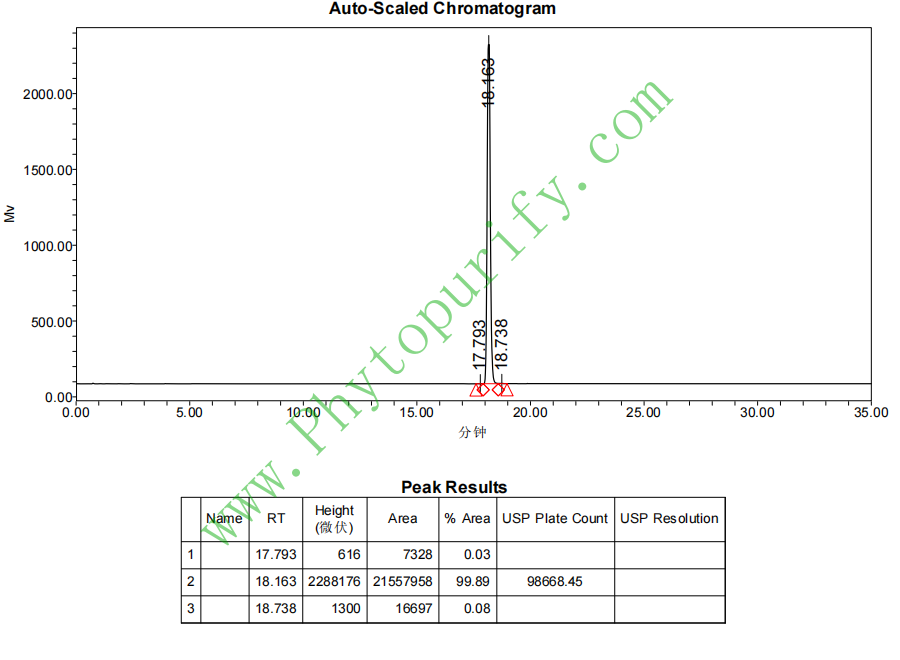
HPLC of Timosaponin BII
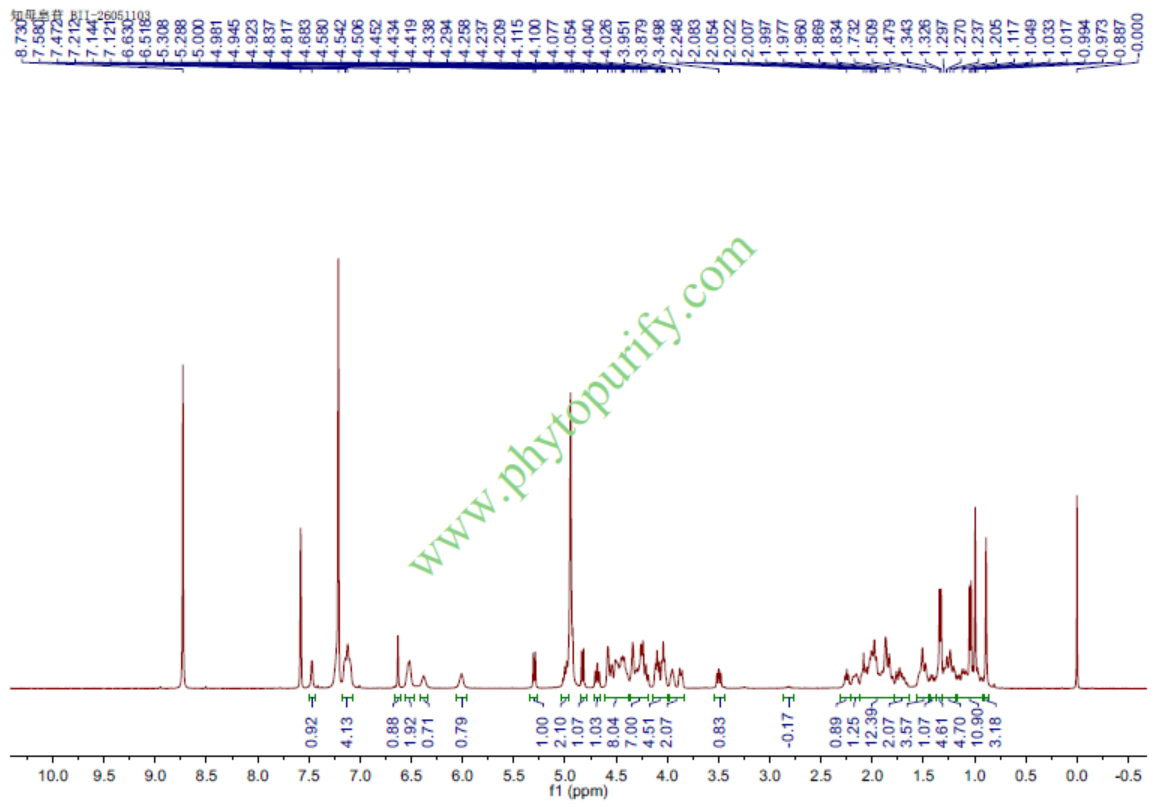
HNMR of Timosaponin BII
Storage conditions:Short-term storage at 2~8℃, long-term storage at -20 ~ -80℃
307.3700
1.2707
1.2707
.1575
.5090
.3949
Low
55.9162
6.3209
No
No
No
No
No
No
0.0
Yes
No
No
No
Zhimu, as one of the representative medicinal herbs of traditional Chinese medicine "clearing heat and purging fire", has a long history of medicinal use, first recorded in the "Shennong Bencao Jing". Its base was originally the lily family plant Anemarrhena(Anemarrhena asphodeloides Bunge's dried rhizomes are commonly used in clinical practice to treat conditions such as fever, thirst, lung heat, dry cough, and bone steaming and hot flashes. Modern pharmacological research has confirmed that the various biological activities of Ganoderma lucidum are mainly attributed to its rich steroidal saponin components. Among them, Timosaponin BII (also known as Prototemosaponin A III, CAS: 136656-07-0), as one of the representative saponins with abundant content and significant activity in Ganoderma lucidum, has received widespread attention in recent years.
Zhimu saponin BII is a spirostanol type steroid saponin, and its unique chemical structure is the material basis for its diverse pharmacological effects. Early research has revealed that it has basic activities such as neuroprotection, anti-inflammatory, and antioxidant properties. With the deepening of research, especially the application based on network pharmacology and multi omics technology, its potential antiviral activity gradually emerges, providing new candidate molecules for the development of novel antiviral drugs. This article aims to systematically review the chemical structure, plant origin, pharmacological activity, mechanism of action, pharmacological evaluation, and clinical application prospects of saponins BII from Anemarrhena chinensis, in order to provide comprehensive scientific references for the in-depth research and development of this compound.
The molecular formula of Zhimu saponin BII is C45H76O19, with a molecular weight of 921.0840. Its chemical structure belongs to the spirostanol type steroidal saponins, which is a typical characteristic of saponins in Anemarrhena. Its basic skeleton consists of a steroid core (cyclopentane and perfluorophenanthrene) composed of 27 carbon atoms and a furan spirostane structure (F ring is a five membered oxygen-containing ring, connected to E ring through spiro carbon atoms). In the structure of Zhimu saponin BII, a complex oligosaccharide chain is connected to the C-3 hydroxyl group of the steroid nucleus, which is usually composed of monosaccharides such as glucose and galactose. This is the key to its saponin properties and an important factor affecting its water solubility and biological activity.
From the perspective of physical and chemical properties, the theoretical lipid water partition coefficient (LogP) of Zhimu saponin BII is 1.2707, indicating that it has a certain lipophilicity but is not highly lipophilic. Its topological polar surface area (TPSA) is as high as 307.3700 Å ², which is mainly attributed to the numerous hydroxyl groups and oxygen atoms on the sugar chain in the molecule, resulting in strong polarity. The calculated water solubility value is 0.1575 mg/mL, belonging to the category of slightly soluble to insoluble, which is consistent with its high molecular weight and multi hydroxyl structure. These physical and chemical parameters collectively determine its absorption and distribution characteristics in living organisms. For example, higher TPSA and molecular weight indicate weaker ability to cross cell membranes (such as the blood-brain barrier) through passive diffusion, and the pharmacological parameters also indicate that its blood-brain barrier permeability is "low". In addition, preliminary toxicity predictions showed no inhibitory activity on hERG potassium channels (hERG inhibition: No), and the Ames test predicted a value of 0.0, suggesting that it may not have mutagenicity and potential cardiac toxicity risks, providing preliminary positive signals for its safety evaluation.
Zhimu saponin BII specifically originates from Zhimu plants in the Liliaceae family(Anemarrhena asphodeloides Bunge's dried rhizomes. Zhimu is mainly distributed in northern China, and its roots and stems are rich in various steroidal saponins. Zhimu saponin BII is one of the important active ingredients. The content of saponins BII in the rhizomes of Anemarrhena chinensis may fluctuate under different production areas, harvesting periods, and processing methods, which directly affects the quality and subsequent extraction efficiency of the medicinal materials.
At present, solvent extraction method is mainly used to extract saponins BII from Ganoderma lucidum, combined with various modern separation and purification techniques. The conventional extraction process is as follows:
1. Extract Usually, methanol, ethanol, or ethanol water solutions of different concentrations are used for heating reflux extraction or ultrasound assisted extraction of Anemarrhena powder. The alcohol extraction method can effectively extract saponins with high polarity.
2. Enrichment and Coarse Separation After the extraction solution is concentrated under reduced pressure, the obtained extract can be suspended in water and then subjected to gradient extraction with organic solvents such as petroleum ether, ethyl acetate, and n-butanol in sequence. Zhimu saponin BII is mainly enriched in the n-butanol extraction site.
3. Separation and purification: The n-butanol part is further finely separated by column chromatography. The commonly used fillers include silica gel, reverse silica gel (such as ODS), macroporous adsorption resin (such as D101, AB-8) and dextran gel (such as Sephadex LH-20). By using solvent systems with different polarities (such as chloroform methanol water, methanol water, etc.) for gradient elution, combined with thin layer chromatography (TLC) or high-performance liquid chromatography (HPLC) monitoring, high-purity saponin BII monomers can be separated.
4. Identification and Quality Control The purified compound needs to be structurally confirmed by spectroscopic methods such as nuclear magnetic resonance (NMR, including 1H-NMR and 13C-NMR), mass spectrometry (MS), and infrared spectroscopy (IR). In the quality control of medicinal materials and preparations, high-performance liquid chromatography evaporative light scattering detector (HPLC-ELSD) or liquid chromatography-mass spectrometry (LC-MS) has become the mainstream method for quantitative analysis of saponin BII content in Anemarrhena henryi due to its good response to saponins without strong UV absorption.
Zhimu saponin BII exhibits a wide and diverse range of pharmacological activities, and its research has expanded from basic cell models to animal disease models.
The multiple pharmacological activities of Zhimu saponin BII stem from its regulatory effects on multiple signaling pathways within cells, and its mechanism of action exhibits multi-target and multi pathway characteristics.
Core signaling pathway:
Molecular target interaction:
In addition to regulating the aforementioned pathways, research also points to specific molecular targets. For example, in neurodegenerative disease models, it may improve cognitive function by regulating the cholinergic system and inhibiting acetylcholinesterase (AChE) activity. In terms of antiviral activity, as mentioned earlier, its potential direct targets may include viral proteins (such as HIV1-PR, INT, HSV TK, etc.) and host factors (such as CCR5, CXCR4). However, the direct binding affinity, mode of action, and structure-activity relationship of these virus related targets are currently the most urgently needed experimental confirmation in mechanism research.
From the perspective of systems biology Network pharmacology analysis further supports the characteristic of "multi-component multi-target multi pathway" action of Zhimu saponin BII, predicting that it may exert synergistic therapeutic effects by intervening in virus host interaction networks, inflammation immune networks, and cell apoptosis autophagy networks.
Although the in vitro activity of Zhimu saponin BII is significant, its drug like and in vivo pharmacokinetic (PK) characteristics are the key bottlenecks determining its successful development as a drug.
Drug analysis Based on its physicochemical parameters, Zhimu saponin BII faces typical challenges in natural product like medicinal properties. Its molecular weight (>900 Da) far exceeds the upper limit of 500 Da recommended by Lipinski's "Five Rules", and its TPSA is extremely high (>300 Å ²), resulting in poor membrane permeability and expected low oral bioavailability. The calculated blood-brain barrier (BBB) permeability is "low", which is consistent with the observed need for higher doses to achieve effective concentrations in the brain in experiments, but also limits its direct efficacy for central nervous system diseases. Fortunately, it has no hERG inhibition or mutagenicity warning, laying the foundation for subsequent safety development.
Pharmacokinetic study Current limited pharmacokinetic studies have shown that the absorption of saponins BII from Anemarrhena asphodeloides is slow, the distribution is not widespread, and the elimination is fast in vivo. After oral administration, its absolute bioavailability is low, which may be mainly due to: ① gastrointestinal stability issues (saponins are easily hydrolyzed by gut microbiota); ② Poor permeability across intestinal epithelial cell membranes; ③ The first pass effect is significant. It mainly undergoes phase I metabolism (such as hydroxylation) and phase II metabolism (such as glucuronidation and sulfation) in the body, with fewer prototype drugs. The main excretion pathway may be bile excretion. These PK characteristics suggest that in order to develop it into oral formulations, advanced formulation strategies must be adopted, such as making nanocrystals, liposomes, polymer micelles, or prodrugs, to improve its solubility, stability, and intestinal absorption.
Pharmaceutical Strategy The new drug delivery system is a breakthrough direction for its drug defects. For example, preparing it into phospholipid complexes or self microemulsions can significantly improve its lipid solubility and oral absorption. Designing brain targeted nanoparticles or modifying their structure to increase BBB penetration is key to enhancing their therapeutic efficacy in neurological diseases. For antiviral applications, local administration (such as topical preparations for HSV) or inhalation administration (for respiratory viruses) may be more feasible initial development pathways.
As a multi active natural product, Zhimu saponin BII has broad clinical application prospects, but the road ahead is long and full of challenges.
Potential therapeutic areas:
challenges faced:
Future research directions:
Zhimu saponin BII is a steroid saponin with important research value isolated from traditional Chinese medicine Zhimu. It not only inherits the traditional efficacy of "clearing heat" of Zhimu, but also demonstrates multidimensional biological activities such as neuroprotection, anti-inflammatory, antioxidant, and potential antiviral from a modern pharmacological perspective. It acts on multiple molecular targets by regulating key signaling pathways such as NF - κ B, MAPK, Nrf2, PI3K/Akt, reflecting the unique advantages of natural product multi-target intervention in complex diseases.
However, its enormous molecular weight, poor membrane permeability, and unsatisfactory pharmacokinetic properties constitute the main obstacles to its transformation into modern drugs. Future research should focus on: on the one hand, through rigorous in vitro and in vivo experiments, especially using modern virological models, to confirm and deepen the mechanism research of its antiviral and other new activities; On the other hand, it is necessary to optimize its structure or design innovative delivery systems through the means of medicinal chemistry and new formulation studies to overcome its drug weakness. Only through continuous interdisciplinary efforts can the ancient natural molecule of saponins BII from Anemarrhena be truly transformed into modern drugs that can be used for clinical treatment, providing new options for the treatment of major health problems such as neurodegenerative diseases and viral infections. At the same time, it also provides a valuable path for the deep development and internationalization of active ingredients in traditional Chinese medicine.
