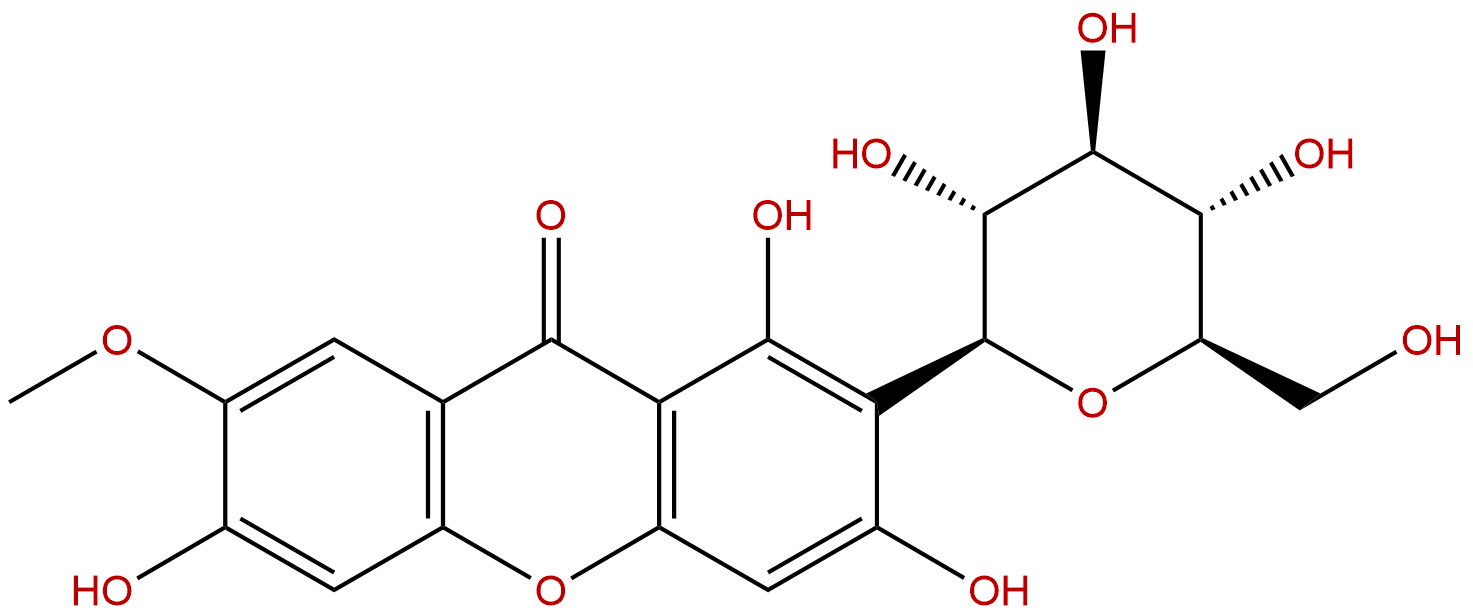


Product name: 7-O-Methylmangiferin
Synonym name:
Catalogue No.: BP1566
Cas No.: 31002-12-7
Formula: C20H20O11
Mol Weight: 436.369
Botanical Source: Constit. of Iris florentina and Polygala tenuifolia
Physical Description: Powder
Type of Compound: Xanthones
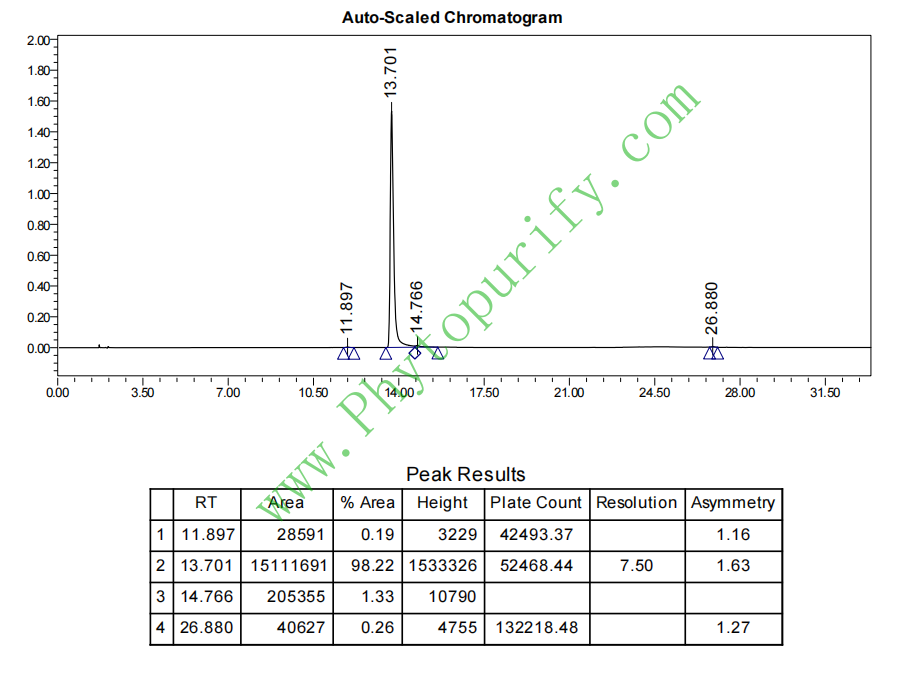
Purity: 95%~99%
Analysis Method: HPLC-DAD or/and HPLC-ELSD
Identification Method: Mass, NMR
Packing: Brown vial or HDPE plastic bottle
The product could be supplied from milligrams to grams. Inquire for bulk scale.
We provide solution to improve the water-solubility of compounds, thereby facilitating the variety of activity tests and clinic uses.
For Reference Standard and R&D, Not for Human Use Directly.
HPLC of 7-O-Methylmangiferin
Storage conditions:Short-term storage at 2~8℃, long-term storage at -20 ~ -80℃
190.2800
.0439
-.0663
1.3947
.5914
.3382
Low
75.8829
4.0303
Yes
No
No
No
Yes
No
0.9
Yes
No
Yes
No
Natural products have always been an important source of innovative drug discovery, among which polyphenolic compounds have attracted much attention due to their wide range of biological activities. 7-O-Methylmangiferin (CAS number: 31002-12-7) has gradually become a hot topic in pharmacological research in recent years as an oxanthracene-C-glycosidic compound isolated from traditional medicinal plants. This compound was initially isolated from the cortex of Polygala tenuifolia Willd., a classic Chinese medicinal herb commonly used in traditional Chinese medicine theory for calming the mind, improving intelligence, dispelling phlegm, and opening up orifices. Modern pharmacological studies have also revealed its potential in anti-inflammatory and neuroprotective effects. As one of its active ingredients, 7-O-methylmangiferin's unique chemical structure endows it with significant anti-inflammatory activity. Relevant studies have preliminarily revealed that it exerts its effects by regulating multiple key inflammatory targets such as IL-6, STAT3, TNF - α, etc. With the development of modern molecular biology and network pharmacology, research on this compound has shifted from single target validation to systematic exploration of multiple targets and pathways, providing a theoretical basis for its application in inflammation related diseases such as neurodegenerative diseases, metabolic syndrome, pain, etc. This article aims to systematically review the chemical properties, plant sources, pharmacological activities, molecular mechanisms of action, pharmacological evaluation, and clinical application prospects of 7-O-methylmangiferin, in order to provide comprehensive academic references for the in-depth development and transformation research of this natural product.
The chemical name of 7-O-methylmangiferin is 2-C - β - D-glucopyranosyl-1,3,6,7-tetrahydroxy-9H-oxaanthrone 7-methyl ether, with a molecular formula of C20H20O11 and a molecular weight of 436.3690. Structurally, it belongs to the class of anthraquinone compounds and is a methylated derivative of mangiferin. Its core structure is a tricyclic anthraquinone skeleton, connected to a β - D-glucosyl group through a C-C bond at C-2 position, which is its characteristic feature as a C-glycoside. Compared with O-glycosides, C-glycosides are more stable in vivo and are not easily hydrolyzed. The key difference between mangiferin and its parent compound is that its hydroxyl group at position 7 is replaced by a methoxy group (- OCH3), which significantly affects its physicochemical properties and biological activity.
In terms of physicochemical properties, the calculated lipid water partition coefficient (LogP) is 0.0439, indicating that the compound has a high degree of hydrophilicity, which is consistent with the presence of multiple hydroxyl and sugar groups in the molecule. Its topological polar surface area (TPSA) is as high as 190.28 Å ², further confirming its strong polarity characteristics. The water solubility value is 1.3947 (usually referring to logS or related solubility indicators), indicating that it has good solubility in water, which is beneficial for its development in water-based formulations. However, high polarity and large TPSA also pose challenges, especially as their blood-brain barrier (BBB) permeability is predicted to be "low", which may limit their direct efficacy in central nervous system diseases and require improvement through pharmaceutical strategies. In addition, preliminary pharmacological risk assessment shows that it has no inhibitory activity on hERG potassium channels (hERG inhibition: no), indicating a low potential risk of arrhythmia; The Ames test result is 0.9 (usually a value close to 1 indicates no mutagenicity), preliminarily indicating no significant genetic toxicity risk and providing early positive signals for its safety evaluation.
7-O-methylmangiferin is mainly isolated from the dried root bark of Polygala tenuifolia, a plant in the family Polygalaceae. Yuanzhi is a traditional Chinese medicinal herb for calming the nerves and promoting intelligence, mainly distributed in North China, Northeast China, and Northwest China. Modern plant chemistry research has shown that the active ingredients of Yuanzhi mainly include triterpenoid saponins, oligosaccharide esters, anthraquinone and its glycosides, among which 7-O-methylmangiferin is one of the important members of its anthraquinone components.
Its extraction and separation usually follow the conventional process of natural product chemistry. Firstly, crush the dried root bark of Eucommia ulmoides and extract it using a polar solvent. Common extraction methods include:
1. Solvent extraction method Methanol, ethanol, or ethanol water mixed solvents are often used for reflux extraction or ultrasound assisted extraction to fully extract polar glycosides.
2. Coarse separation After the extract is concentrated under reduced pressure, the resulting paste is often subjected to gradient extraction using solvents such as petroleum ether, ethyl acetate, and n-butanol in sequence. 7-O-methylmangiferin is mainly enriched in the n-butanol extraction site or aqueous layer due to its strong hydrophilicity.
3. Fine separation and purification: The n-butanol fraction was further separated and purified by a variety of chromatographic techniques, including silica gel column chromatography, reverse phase C18 column chromatography (ODS), dextran gel column chromatography (such as Sephadex LH-20), and high performance liquid chromatography (HPLC). HPLC, Especially for preparative HPLC, it is a key step to obtain high-purity 7-O-methylmangiferin, and methanol water or acetonitrile water (containing a small amount of formic acid or acetic acid to adjust pH) is often used as the mobile phase for elution.
4. appraisal The isolated monomer compounds were structurally identified using spectroscopic techniques such as nuclear magnetic resonance (NMR, including 1H-NMR and 13C-NMR), mass spectrometry (MS), and ultraviolet spectroscopy (UV), and confirmed by comparing with literature data or standard samples.
In addition to Yuanzhi, this compound has also been found in trace amounts in other plants such as mango leaves and Anemarrhena, but Yuanzhi is still the main and most valuable plant source currently known. Optimizing the extraction process (such as using microwave or supercritical fluid extraction) to improve yield, as well as obtaining the compound through biotechnology methods such as plant tissue culture, are research directions for sustainable resource utilization in the future.
Numerous in vitro and in vivo pharmacological studies have confirmed that 7-O-methylmangiferin has a wide range of biological activities, among which anti-inflammatory activity The most prominent and core.
anti-inflammatory effect In various inflammatory models, 7-O-methylmangiferin has shown significant anti-inflammatory effects. In the lipopolysaccharide (LPS) - induced macrophage (such as RAW264.7 cells) inflammation model, it can dose dependently inhibit the excessive production of nitric oxide (NO) and prostaglandin E2 (PGE2). In animal models, such as rat paw swelling induced by carrageenan or Freund's complete adjuvant, and mouse ear swelling induced by xylene, this compound can effectively reduce tissue edema and inflammatory cell infiltration in acute or chronic inflammation models. Its anti-inflammatory effect is not limited to peripheral inflammation, but also shows protective effects in central nervous system inflammation related diseases such as cerebral ischemia-reperfusion injury and Alzheimer's disease models.
Analgesic effect Its anti-inflammatory activity is closely related to its analgesic effect. Research has shown that 7-O-methylmangiferin can alleviate pain responses caused by chemical stimuli such as formalin test and acetic acid writhing test. Its mechanism may be related to inhibiting the release of inflammatory mediators and regulating pain related ion channels (such as TRPV1, TRPA1).
Neuroprotective effect Based on the traditional use of Yuanzhi, the neuroprotective effect of 7-O-methylmangiferin has attracted attention. In addition to reducing neuroinflammation through anti-inflammatory effects, research also suggests that it may have multiple effects such as antioxidant stress, inhibition of neuronal apoptosis, and promotion of neurotrophic factor expression, showing potential in improving learning and memory disorders, protecting neurons from beta amyloid toxicity, and more.
Other potential activities: The preliminary study also suggests that 7-O-methylmangiferin may have antioxidant, anti diabetes (by improving insulin resistance), liver protection and other activities, which are often intertwined with its core anti-inflammatory and antioxidant network.
The anti-inflammatory and other pharmacological effects of 7-O-methylmangiferin are not achieved through a single target, but rather through a complex inflammatory regulatory network. Existing research has preliminarily revealed its effects on multiple key signaling pathways and molecular targets:
Inhibition of NF - κ B signaling pathway This is one of the core mechanisms of its anti-inflammatory effect. NF - κ B is a key transcription factor that regulates the expression of numerous inflammatory cytokine genes. 7-O-methylmangiferin can inhibit the activity of I κ B kinase (IKBKB), prevent the phosphorylation and degradation of I κ B α, thereby inhibiting the nuclear translocation of NF - κ B p65 subunit (RELA), and ultimately downregulating the expression of downstream inflammatory mediators such as TNF - α, IL-6, inducible nitric oxide synthase (NOS2), and cyclooxygenase-2 (COX-2/PTGS2, whose isoform PTGS1 may also be regulated).
Regulating the JAK/STAT signaling pathway This pathway, especially the activation of STAT3, plays a crucial role in chronic inflammation and immune regulation. Research has shown that 7-O-methylmangiferin can inhibit the phosphorylation activation of JAK kinase and STAT3 induced by cytokines such as IL-6, thereby blocking the transcription of downstream pro-inflammatory genes.
Inhibition of NLRP3 inflammasome activation Inflammatory bodies are multi protein complexes that sense danger signals within cells and trigger inflammatory responses. Research suggests that this compound may intervene in the assembly and activation of NLRP3 inflammasomes by inhibiting the activation of CASP1 (cysteine protease-1), thereby reducing the release of mature inflammatory cytokines such as IL-1 β and IL-18.
Regulating ion channels related to pain perception Transient receptor potential vanillic acid subtype 1 (TRPV1) and transient receptor potential anchor protein subtype 1 (TRPA1) are important sensors mediating inflammatory pain. 7-O-methylmangiferin has been shown to regulate the activity of these channels and reduce the sensitivity of neurons to nociceptive stimuli, providing a direct target explanation for its analgesic effect.
Inhibit the synthesis of classical inflammatory mediators In addition to regulating transcription factors, it can also directly or indirectly inhibit the activity of key inflammatory enzymes, such as inducible nitric oxide synthase (NOS2) and cyclooxygenase (PTGS1/COX-1, which may also act on COX-2), thereby reducing the production of effector molecules such as NO and PGE2.
In summary, 7-O-methylmangiferin regulates inflammatory response comprehensively at the transcriptional level, post-translational modification level, and effector molecule level through multi-target and multi pathway synergistic effects, which is in line with the characteristics of natural product pleiotropy and provides advantages for its treatment of complex inflammatory diseases.
Although 7-O-methylmangiferin exhibits excellent pharmacological activity, its pharmacological properties still require systematic evaluation.
Absorption, distribution, metabolism, excretion (ADME):
Current status of pharmacokinetic research Currently, there are relatively few reports on pharmacokinetic studies of the 7-O-methylmangiferin system. Limited animal experiment data (such as rats) suggest that it may distribute rapidly in the body after intravenous administration, but key parameters such as elimination half-life and absolute bioavailability need to be clarified. Establishing sensitive and accurate plasma drug concentration detection methods (such as LC-MS/MS) is a prerequisite for conducting in-depth pharmacokinetic studies.
Preliminary evaluation of safety Based on existing data, negative hERG inhibition and Ames test are good early safety signals. However, a comprehensive preclinical safety evaluation is still needed, including acute toxicity, long-term toxicity, reproductive toxicity, etc., to assess its safety window.
Challenges and Strategies in Pharmaceutical Science In order to improve its oral bioavailability and/or brain targeting ability, modern formulation technology is needed. Possible strategies include: preparing phospholipid complexes and cyclodextrin inclusion complexes to increase lipid solubility; Developing self microemulsions and solid dispersions to improve dissolution and absorption; Design a brain targeted nano drug delivery system based on ligands or receptors to overcome the blood-brain barrier.
7-O-methylmangiferin, as a natural compound with clear multi-target anti-inflammatory activity, has broad clinical application prospects but also faces challenges.
Potential therapeutic areas:
challenges faced:
Future research directions:
7-O-methylmangiferin is a natural active ingredient with important research value discovered from traditional Chinese medicine Yuanzhi. Its unique C-glycosidic anthraquinone structure endows it with powerful and multi-target anti-inflammatory activity, involving multiple key inflammatory signaling pathways such as NF - κ B, JAK/STAT, NLRP3, and demonstrating broad application potential in neuroprotection, analgesia, and other areas. Although there are challenges in drug formulation, especially in oral absorption and central distribution, this also provides innovative space for modern pharmacy and medicinal chemistry. With the continuous in-depth analysis of its mechanism of action and the successful development of new drug delivery systems, 7-O-methylmangiferin is expected to gradually move from a promising lead compound to clinical practice, providing a natural and novel multi-target treatment option for the treatment of complex inflammation related diseases, especially central nervous system diseases. Future research requires interdisciplinary collaboration to jointly promote the transformation of this natural product from laboratory research to clinical applications.
