Introduction/Overview
In the field of natural product chemistry and pharmacology research, flavonoids have attracted much attention due to their structural diversity and wide range of biological activities. Cirsimarin (CAS number: 13020-19-4), as a flavonoid glycoside isolated from plants, has entered the research field in recent years due to its significant anti lipid activity. The initial research showed that Binjihuang glycoside can effectively reduce the deposition of adipose tissue in mice, demonstrating the potential for treating obesity and related metabolic diseases. Its mechanism of action is mainly attributed to its antagonistic effect on adenosine A1 receptors and inhibition of phosphodiesterase, thereby promoting lipolysis. It is worth noting that in addition to its anti lipid activity, subsequent studies have also revealed the potential value of Binjihuang glycoside in the field of antiviral therapy. Its targets involve key proteins of various viruses, such as human immunodeficiency virus (HIV) and herpes virus, greatly expanding its pharmacological research dimensions. This article aims to systematically review the chemical structure, plant origin, pharmacological activity, mechanism of action, medicinal properties, and clinical application prospects of Platycodon grandiflorus, in order to provide comprehensive scientific references for the deep development and utilization of this natural product.
Chemical structure and physicochemical properties
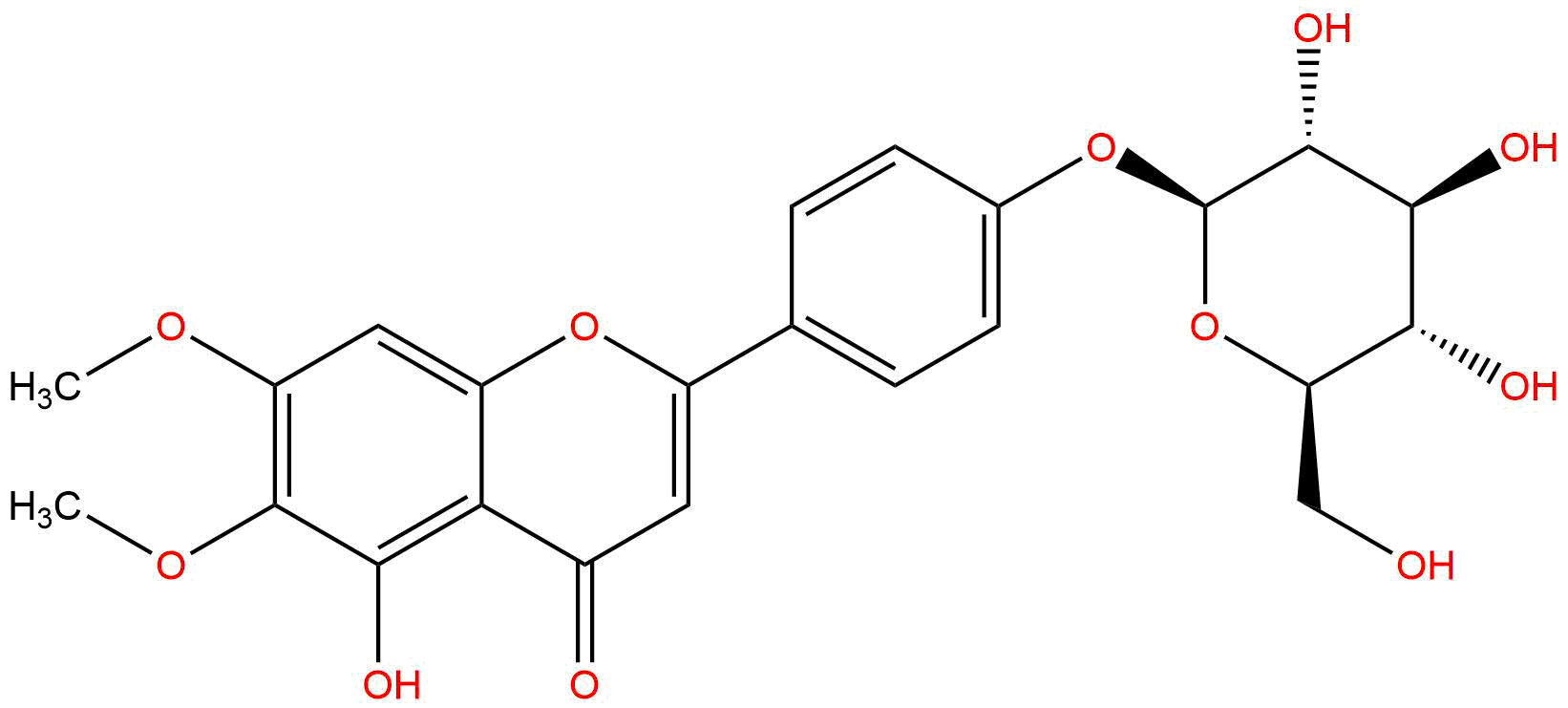
Binjihuang glycoside is an O-methylated flavonoid carbon glycoside, with the chemical name 5,4 '- dihydroxy-6,7-dimethoxyflavone-8-C - β - D-glucoside. Its molecular formula is C23H24O11 and its molecular weight is 476.4340. Structurally, its parent nucleus is flavonoids, with one methoxy group at each of the 6th and 7th positions of the A ring, a β - D-glucosyl group directly connected to the 8th position through a C-C bond, and a hydroxyl group at the 4 'position of the B ring. This C-glycosidic structure usually has better chemical and metabolic stability compared to common O-glycosides.
The key physicochemical property parameters are as follows: the calculated lipid water partition coefficient (LogP) is 0.3617, indicating that the molecule has a certain degree of hydrophilicity. The topologically polar surface area (TPSA) is as high as 168.28 Å ², mainly due to the numerous oxygen atoms in the molecule (from hydroxyl, methoxy, sugar, and carbonyl groups), and high TPSA values are usually unfavorable for passive transmembrane diffusion. The predicted value of water solubility is 0.5341 mg/mL, which belongs to the category of slight solubility. These properties collectively determine the basic behavioral characteristics of Platycodon grandiflorum in organisms: moderate lipophilicity but high polarity, and its membrane permeability may be limited. The specific physical constants such as crystal morphology, melting point, UV and infrared spectral characteristics have been reported in early separation and identification literature, which are important basis for its chemical identification.
Plant sources and extraction methods
Binjihuang glycoside was not initially isolated from plants of the Binjizi genus, but rather from Microtea debilis The anti lipid activity of a species of Caryophyllaceae plant was first obtained and reported. In addition, subsequent studies have found that the compound is also widely present in various Asteraceae plants, such as some Binji genus(Cirsium Spp.) and Cornflower genus(Centaurea The name "Binjihuang Glycoside" comes from this plant, known as "spp.". These plants are often used in folk medicine for anti-inflammatory and choleretic purposes, providing traditional application clues for the biological activity research of Platycodon grandiflorus.
The extraction of astragaloside from plant materials is usually carried out using organic solvent extraction method. The common process is as follows: dry and crushed aboveground parts of plants (such as stems and leaves) are extracted by cold soaking or hot reflux with methanol or ethanol, and concentrated to obtain crude extract. The crude extract was then subjected to fractional extraction using solvents of different polarities such as petroleum ether, ethyl acetate, and n-butanol. Binjihuang glycoside is mainly enriched in the polar n-butanol or water-soluble parts. Further purification depends on column chromatography technology. Silica gel, reverse phase silica gel (such as C18), dextran gel (Sephadex LH-20), etc. are often used as stationary phases, and chloroform methanol, methanol water and other gradient elution systems are used for separation. High performance liquid chromatography (HPLC), especially preparative HPLC, is the final key step in obtaining high-purity Binjihuang glycoside monomers. The optimization of extraction processes, such as modern technologies such as ultrasound assisted extraction and microwave-assisted extraction, can help improve extraction efficiency and yield of target compounds.
Pharmacological activity research
The pharmacological activity research of Platycodon grandiflorus mainly focuses on two fields: metabolic diseases and viral infections, demonstrating the characteristic of multi-target action.
1. Anti fat and anti obesity activity
This is the earliest discovered and most extensively studied core activity of Platycodon grandiflorus. In vivo experiments have shown that administering high-fat diet induced obese mice with astragaloside can significantly reduce their weight gain, decrease the weight and volume of white adipose tissue (especially epididymal fat and retroperitoneal fat), and improve liver steatosis. In vitro studies further confirmed that Binjihuang glycoside can directly stimulate the lipolysis of 3T3-L1 preadipocytes and mature adipocytes, increasing the release of glycerol and non esterified fatty acids in the culture medium. This effect of promoting fat breakdown and inhibiting fat accumulation provides direct evidence for its application in metabolic syndrome related diseases such as obesity and non-alcoholic fatty liver disease.
2. Antiviral activity
In recent years, research has revealed the broad-spectrum antiviral potential of Platycodon grandiflorum, which involves multiple viruses:
* Antiherpesvirus Research has shown that Binjihuang glycoside has inhibitory effects on herpes simplex virus (HSV) and human cytomegalovirus (HCMV). Its targets may involve viral DNA polymerase helper proteins (such as UL42, UL54), immediate early proteins (such as ICP27), and thymidine kinase (TK), which interfere with the virus's replication cycle.
* Anti human immunodeficiency virus (HIV)Binjihuang glycoside has been reported to inhibit HIV-1 replication. The mechanism may include: acting as antagonists of chemokine receptors CCR5 and CXCR4, blocking virus entry into host cells; Inhibiting viral protease (HIV1-PR) and integrase (INT), interfering with viral maturation and genome integration.
* Other viruses Its potential regulatory effect on myeloperoxidase (MPO) may also indirectly affect the viral infection process associated with inflammation. Interference with viral glycoproteins (such as gD) is another possible pathway for preventing virus adsorption and invasion.
3. Other potential activities
Based on the commonality of flavonoids, Platycodon grandiflorus may also have auxiliary activities such as antioxidant and anti-inflammatory effects. These activities may have synergistic effects with its anti lipid and antiviral effects, but further specialized research is needed.
Mechanism of action and molecular targets
The multiple pharmacological activities of Platycodon grandiflorus stem from its interactions with multiple key biomolecule targets.
1. The core mechanism of anti fat effect
* Adenosine A1 receptor antagonist Adenosine strongly inhibits lipolysis by activating the A1 receptor on adipocytes. Binjihuang glycoside has been confirmed to be a selective antagonist of adenosine A1 receptor. By competitively blocking the A1 receptor, it relieves the inhibition of adenosine on lipolysis, thereby activating downstream lipolytic enzymes such as hormone sensitive lipase (HSL), promoting the breakdown of triglycerides into glycerol and free fatty acids.
* Phosphodiesterase (PDE) inhibition Cyclic adenosine monophosphate (cAMP) is an important intracellular second messenger of lipolysis. PDE is responsible for degrading cAMP. Binjihuang glycoside can inhibit the activity of PDE (especially PDE3/4 isoenzymes), leading to an increase in cAMP levels in adipocytes. The increase of cAMP further activates protein kinase A (PKA), which in turn phosphorylates and activates HSL and adipose triglyceride lipase (ATGL), ultimately enhancing lipolysis. A1 receptor antagonism and PDE inhibition have a synergistic effect in increasing cAMP levels, which is the molecular basis for its potent anti lipid effect.
2. Multi target mechanism of antiviral effect
The antiviral effect of Binjihuang glycoside exhibits multi-target characteristics, targeting key stages of the lifecycle of different viruses:
* Virus entry inhibitor By binding or interfering with the virus co receptors CCR5 and CXCR4 (targeting HIV) on the surface of host cells, or the virus envelope glycoprotein gD (targeting HSV), the fusion and endocytosis of the virus with the cell membrane are prevented.
* Viral enzyme inhibitor Directly inhibit enzymes necessary for virus replication, such as HIV-1 protease (HIV1-PR) and integrase (INT), as well as the DNA polymerase complex components (UL42, UL54), thymidine kinase (TK), and regulatory protein (ICP27) of herpes virus. The inactivation of these enzymes will lead to abnormal virus protein processing, hindered DNA synthesis, or dysregulated gene expression.
* Host factor regulation The potential impact on myeloperoxidase (MPO) may create an unfavorable intracellular environment for virus replication by regulating the host's oxidative stress and inflammatory response.
Evaluation of drug properties and pharmacokinetics
Despite its significant in vitro activity, the road to becoming an ideal drug still faces challenges in terms of drug development.
1. Analysis of drug properties parameters based on calculations and preliminary experiments
* Absorption and distribution The molecular weight (476.4) is slightly higher than the upper limit of the "Five Rules for Generic Drugs", but it is still acceptable. High TPSA (168.28) and moderate LogP (0.36) indicate that its oral bioavailability may be low, mainly due to poor intestinal passive permeability. The blood-brain barrier permeability is predicted to be "low", which is consistent with the characteristics of most highly polar flavonoid glycosides, indicating that they may not easily enter the central nervous system.
* Metabolism and Safety Preliminary computer predictions and in vitro experiments have shown that astragaloside has no significant inhibition on hERG potassium channels (hERG inhibition: no), indicating a low risk of causing QT interval prolongation in the heart. The Ames test result is 0.6 (usually considered to have mutagenic risk if>1.0), indicating a low risk of genetic toxicity. However, as a flavonoid glycoside, it is likely to be hydrolyzed by glycosidases in the gut microbiota or tissues in the body to produce aglycones (Cirsimaritin), which may have different activities and metabolic fates. There is still a lack of detailed publicly available research data on its metabolic stability, major metabolic enzymes (such as CYP450 isoenzymes), and metabolites in liver microsomes.
* excretion Due to its hydrophilicity and high polarity, the prototype drug and its metabolites may be primarily excreted through the kidneys via urine.
2. Current status of pharmacokinetic research
At present, there are few reports in public literature on the pharmacokinetic studies of the Binjihuang glycoside system, including absolute bioavailability, tissue distribution, half-life, clearance rate, etc. Limited animal experiments (such as rats) suggest that after oral administration, its concentration in plasma may be lower and peak time may be faster, which is consistent with its predicted low permeability. Future research requires the use of technologies such as liquid chromatography-mass spectrometry (LC-MS/MS) to establish sensitive and specific biological analysis methods, comprehensively elucidating their ADME (absorption, distribution, metabolism, excretion) processes in animal bodies, which is an indispensable part of promoting their conversion into drugs.
Clinical application prospects and prospects
The unique dual pharmacological activities (anti lipid and antiviral) of Platycodon grandiflorus provide promising prospects for its clinical application, but also indicate the key direction for future research and development.
1. Potential application areas
* Metabolic diseases As a new type of lipolysis promoter, Binjihuang glycoside is expected to be developed as a plant or chemical drug for the treatment of simple obesity, non-alcoholic fatty liver disease (NAFLD), and hypertriglyceridemia. It works through a dual mechanism of receptors and enzymes, which may have advantages over single target drugs. It can be developed as an oral formulation or used in combination with existing drugs such as insulin sensitizers.
* Viral infectious diseases Its broad-spectrum antiviral activity, especially its inhibitory effect on HIV and herpes virus, provides lead compounds for the development of new antiviral drugs. Given its multi-target effect, it may help reduce the development of viral drug resistance. It can be explored for local treatment (such as topical preparations for herpes virus infection) or as a supplementary ingredient in anti HIV cocktail therapy.
* combination therapy Obesity often coexists with certain viral infections (such as fat metabolism disorders after HIV infection), and the "one stone, two birds" characteristic of Binjihuang glycoside makes it uniquely valuable for the treatment of specific comorbid patient populations.
2. Challenges faced and future research directions
* Optimize drug properties The oral bioavailability of natural Platycodon grandiflorus is its biggest weakness. Future research can be conducted through Structural modification Optimization: For example, modifying the sugar moiety (preparing prodrugs or sugar mimetics), or esterifying or alkylating the mother core hydroxyl group to appropriately reduce polarity, improve lipid solubility and membrane permeability, while retaining or enhancing its activity.
* In depth mechanism research More precise elucidation of its binding mode, affinity, and selectivity to each target (such as A1 receptor, PDE subtype, and various viral proteins) is needed to facilitate rational drug design based on structure.
* Comprehensive preclinical evaluation Systematic toxicology studies (acute toxicity, long-term toxicity, reproductive toxicity, etc.) must be completed, and their efficacy and safety must be validated on disease animal models to clarify the treatment window.
* Explore new dosage forms Develop novel drug delivery systems such as nanoliposomes, solid dispersions, and self microemulsions to enhance their solubility and bioavailability.
Conclusion
Binjihuang glycoside, as a plant derived flavonoid glycoside compound, has become a highlight molecule in the pharmacological research of natural products due to its significant anti lipid activity mediated by antagonizing adenosine A1 receptors and inhibiting phosphodiesterase, as well as its antiviral potential demonstrated by multi-target intervention in the virus lifecycle. It not only provides new candidate lead compounds for the treatment of metabolic and viral diseases, but also reveals the multi-target and multifunctional characteristics of natural products. However, the road from active compounds to successful drugs is still long. The inherent physical and chemical properties leading to drug defects are the main scientific challenges that need to be overcome at present. Future research should focus on structural optimization through medicinal chemistry methods, combined with modern pharmaceutical technologies to improve delivery efficiency, and supplemented by systematic and in-depth pharmacological, pharmacokinetic, and toxicological evaluations. Only in this way can the therapeutic potential of Platycodon grandiflorus be fully released, promoting its transition from laboratory to clinical use and ultimately benefiting human health.