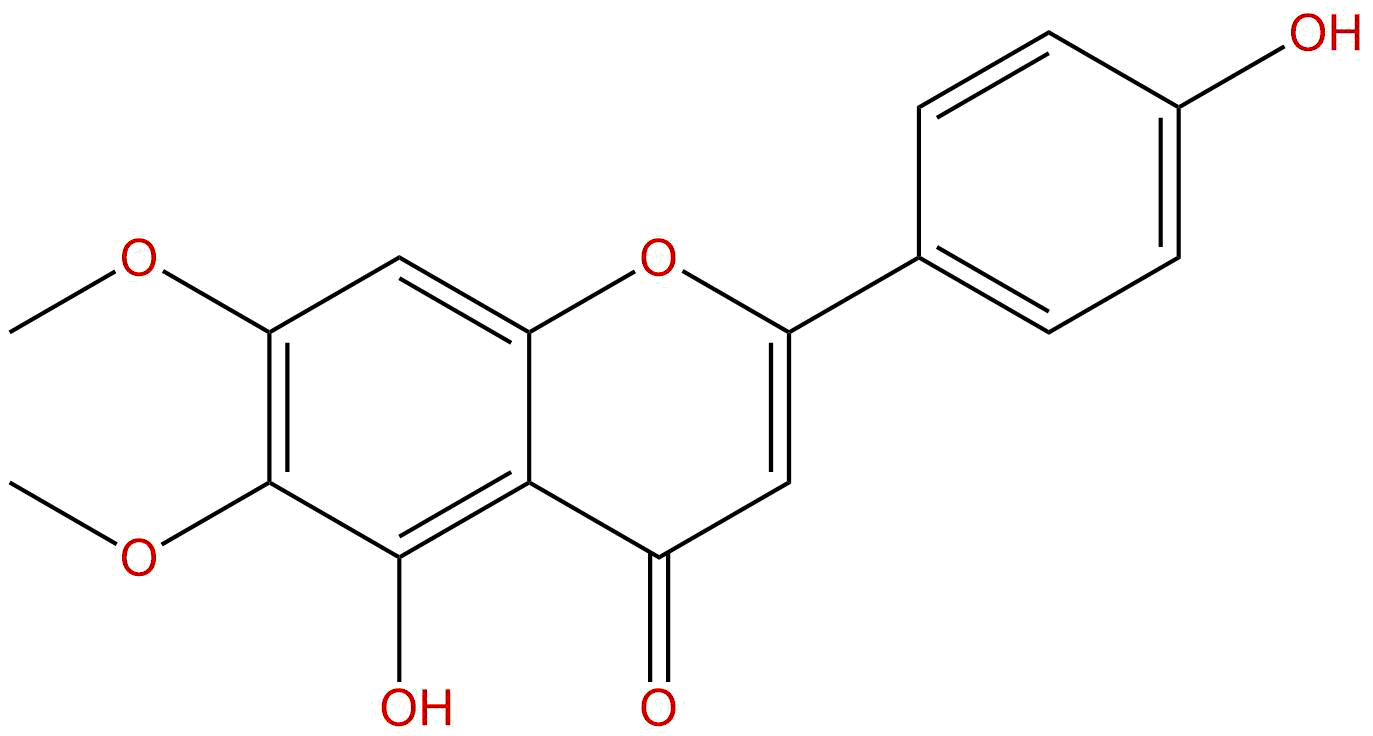


Product name: Cirsimaritin
Synonym name: Scrophulein;Skrofulein;6,7-Dimethoxyscutellarein
Catalogue No.: BP4489
Cas No.: 6601-62-3
Formula: C17H14O6
Mol Weight: 314.293
Botanical Source: Abrus precatorius L.
Type of Compound: Flavonoids
Purity: 95%~99%
Analysis Method: HPLC-DAD or/and HPLC-ELSD
Identification Method: Mass, NMR
Packing: Brown vial or HDPE plastic bottle
Storage: Store in a well closed container, protected from air and light. Put into refrigerate or freeze for long term storage.
Whenever possible, you should prepare and use solutions on the same day. However, if you need to make up stock solutions in advance, we recommend that you store the solution as aliquots in tightly sealed vials at -20℃. Generally, these will be useable for up to two weeks.
The product could be supplied from milligrams to grams
Inquire for bulk scale.
For Reference Standard and R&D, Not for Human Use Directly.
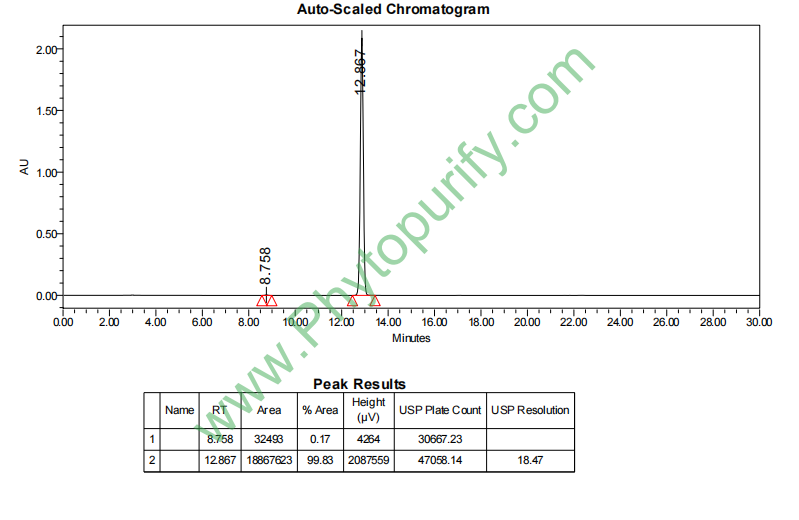
HPLC of Cirsimaritin
Storage conditions:Short-term storage at 2~8℃, long-term storage at -20 ~ -80℃
89.1300
2.2994
2.2429
.0386
3.0808
19.9148
Low
89.9182
2.2759
Yes
No
Yes
No
Yes
No
0.6
No
No
Yes
No
In the vast treasure trove of natural products, flavonoids have attracted much attention for their diverse biological activities and extensive pharmacological effects. Cirsimaritin, as a naturally occurring methoxyflavonoid, has gradually entered the field of researchers in recent years and demonstrated unique pharmacological value. Binjihuang, also known as 5,4 '- dihydroxy-6,7-dimethoxyflavone, is a secondary metabolite with a typical flavonoid core structure. It is widely present in various medicinal plants, such as the Lamiaceae and Asteraceae families. Its name originates from the original species of thistle in the genus Cirsium(Cirsium)It is named "Binjihuang" because of its separation and identification.
The pharmacological activity spectrum of Bin Ji Huang is relatively broad, covering multiple fields such as central nervous system, antiviral, anti-inflammatory, antioxidant, etc. Of particular note is that research has found that astaxanthin can target the benzodiazepine (BZD) site on gamma aminobutyric acid type A (GABAA) receptors with relatively weak affinity, which makes it potentially have anti anxiety, anti depression, and anti seizure effects. Compared with classic benzodiazepines such as diazepam, Binjihuang, as a natural ligand, may have different binding modes and pharmacological effects, providing a new lead compound for the development of novel, low side effect anti anxiety/antidepressant drugs.
In addition, Binjihuang has demonstrated remarkable activity in the field of antiviral therapy. Research has shown that it has a certain inhibitory effect on various viruses, including herpes simplex virus (HSV), human immunodeficiency virus (HIV), etc. Its antiviral mechanism may involve multiple targets, such as myeloperoxidase (MPO), viral DNA polymerase helper protein (UL42), DNA polymerase catalytic subunit (UL54), viral protein ICP27, thymidine kinase (TK), glycoprotein D (gD), as well as host cell chemokine receptors CCR5 and CXCR4. This multi-target characteristic of action gives Bin Ji Huang a potential advantage in combating viral drug resistance.
Despite exhibiting many promising biological activities, the pharmacological potential of Bin Ji Huang as a drug candidate molecule still needs to be comprehensively evaluated. Its molecular weight is moderate (314.2930 Da), lipid water partition coefficient (LogP) is 2.2994, and topological polar surface area (TPSA) is 89.1300 Å ². These physicochemical parameters suggest that it has certain oral absorption potential. However, its poor water solubility (0.0386 mg/mL) and low blood-brain barrier penetration ability may limit its application in certain central nervous system diseases. Preliminary toxicological evaluation shows that Binjihuang has no significant inhibitory effect on hERG potassium channels (hERG inhibition: No), and the Ames test result (0.6) suggests a low genetic toxicity risk, but further verification is needed.
This article aims to systematically review the chemical structure, plant origin, pharmacological activity, mechanism of action, pharmacological evaluation, and clinical application prospects of Bin Ji Huang, in order to provide comprehensive scientific basis for the in-depth research and development of this natural product.
Cirsimaritin belongs to the flavonoid class of compounds, and its chemical structure has a typical flavonoid nucleus (2-phenylchromenone). Specifically, its chemical name is 5,4 '- dihydroxy-6,7-dimethoxyflavone. The structural features are as follows: the C-5 position of ring A is connected to a hydroxyl group (- OH), and the C-6 and C-7 positions are each connected to a methoxy group (- OCH ∝); The C-4 'position of the B ring is connected to a hydroxyl group. This substitution mode endows Bin Ji Huang with unique physicochemical properties and biological activity.
From the molecular formula, the molecular formula of Binjihuang is C ₁₇ H ₁₄ O ₆, with a molecular weight of 314.2930 g/mol. Its molecular weight is moderate and meets the requirement of molecular weight less than 500 in Lipinski's Rule of Five, which provides a basis for the development of its oral medication. The lipid water partition coefficient (LogP) is an important parameter for measuring the lipophilicity of compounds. The LogP of Binjihuang is 2.2994, indicating its moderate lipophilicity, which is beneficial for transmembrane transport and interaction with biological targets. The topological polar surface area (TPSA) is 89.1300 Å ², which reflects the total surface area of polar atoms (such as oxygen and nitrogen) and their connected hydrogen atoms in the molecule. Generally, compounds with a TPSA of less than 140 Å ² have good oral absorption and intestinal permeability, and the TPSA value of Bin Ji Huang is within this range, indicating that its oral bioavailability may be good.
However, the water solubility of Bin Ji Huang is poor, with a water solubility parameter of only 0.0386 mg/mL. This characteristic may become a challenge in the development of its formulations, as low water solubility often limits the dissolution rate and absorption of drugs in the body. To improve its water solubility, it may be necessary to use formulation techniques such as solid dispersions, nanoparticles, liposomes, or cyclodextrin inclusion complexes.
In terms of stability, Bin Ji Huang, as a flavonoid compound, is relatively stable under acidic conditions, but is prone to degradation under alkaline conditions. In addition, light exposure, high temperature, and oxidative environment may also affect its stability. Therefore, appropriate measures such as light avoidance, low temperature, and oxidation prevention need to be taken during storage and formulation.
Regarding the blood-brain barrier (BBB) penetration ability, existing data indicates that the BBB penetration ability of berberine is relatively low. This characteristic has a dual significance: on the one hand, for antidepressant, anti anxiety, and anticonvulsant activities that require action in the central nervous system, lower BBB penetration may limit their efficacy; On the other hand, for antiviral and anti-inflammatory activities that require peripheral action, lower BBB penetration may reduce central nervous system side effects. How to improve its BBB penetration through structural modification or optimization of drug delivery routes is an important direction for future research.
Binjihuang, as a natural flavonoid compound, is widely present in various medicinal plants, especially in Lamiaceae and Asteraceae plants, where its content is relatively abundant. Common plant sources include:
Due to the significant differences in the content of astaxanthin in different plants and its frequent coexistence with other structurally similar flavonoids, it is crucial to choose appropriate plant sources and efficient extraction and separation methods.
extraction method Traditional extraction methods include solvent extraction, such as cold soaking, percolation, or reflux extraction using methanol, ethanol, acetone, or their aqueous solutions. Due to the lipophilicity of Bin Ji Huang, 70% -95% ethanol or methanol is usually selected as the extraction solvent. In order to improve extraction efficiency and selectivity, some modern extraction techniques have been widely applied in recent years, such as ultrasound assisted extraction, microwave-assisted extraction, enzyme assisted extraction, and supercritical fluid extraction. These methods can shorten extraction time, reduce solvent usage, and improve the extraction rate of target compounds.
Separation and purification methods The crude extract obtained from extraction usually contains various impurities, which require further separation and purification to obtain high-purity Bin Ji Huang. Common separation and purification techniques include:
During the separation process, it is usually necessary to combine thin layer chromatography (TLC) or HPLC for real-time monitoring to determine the elution position of the target compound. Finally, the isolated compound was structurally identified using spectroscopic techniques such as nuclear magnetic resonance (NMR) and mass spectrometry (MS), confirming its identity as astaxanthin.
Binjihuang, as a multifunctional natural flavonoid, has been studied for its pharmacological activities in multiple fields including central nervous system, antiviral, anti-inflammatory, antioxidant, and anti-tumor.
One of the most notable activities of Bin Ji Huang is its effect on the central nervous system. Research has found that Bin Ji Huang can bind to the benzodiazepine site on GABAA receptors with low affinity, thereby exerting its pharmacological effects. GABAA receptors are the main inhibitory neurotransmitter receptors in the central nervous system, and their activation can cause neuronal hyperpolarization, reduce neural excitability, and produce effects such as anti anxiety, sedation, and anticonvulsant.
Binjihuang also exhibits broad-spectrum activity in the field of antiviral, especially in inhibiting herpes virus and HIV virus.
In addition to the main activities mentioned above, Binjihuang has also been reported to have anti-tumor, hepatoprotective, hypoglycemic, antibacterial and other effects. For example, Bin Ji Huang can inhibit the proliferation of various cancer cells and induce apoptosis, and its mechanism may be related to regulating the cell cycle and activating apoptotic signaling pathways. In terms of liver protection, Binjihuang can alleviate chemical liver damage, reduce serum transaminase levels, and its effects are closely related to antioxidant and anti-inflammatory activities.
The pharmacological activity of Bin Ji Huang is derived from its interactions with various molecular targets. Its mechanism of action exhibits the characteristics of multi-target and multi pathway.
The effect of Bin Ji Huang on the central nervous system is mainly attributed to its regulation of GABAA receptors. GABAA receptor is a pentameric ligand gated chloride ion channel with diverse subunit compositions, among which receptors containing the γ 2 subunit are sensitive to benzodiazepines. Benzodiazepine drugs bind to the interface between the alpha and gamma subunits (i.e. the benzodiazepine site), increasing the affinity of GABA for receptors through allosteric regulation, thereby enhancing the opening frequency of chloride ion channels and producing inhibitory effects.
Compared with classic benzodiazepines such as diazepam, Binjihuang has a lower affinity for this site and belongs to partial or weak agonists. This characteristic may result in weaker anti anxiety and anticonvulsant effects, while avoiding side effects such as excessive sedation, muscle relaxation, tolerance, and dependence that may occur with complete agonists. Further research is needed to investigate the selectivity of Binjihuang towards different subtypes of GABAA receptors, which may be the key to its unique pharmacological effects.
The antiviral activity of Bin Ji Huang involves multiple viral and host targets, reflecting its multi mechanism antiviral characteristics.
Virus target:
Host target:
To develop Bin Ji Huang into a clinical drug, a comprehensive evaluation of its pharmacological properties, including physicochemical properties, pharmacokinetic characteristics, and safety, is required.
As mentioned earlier, the molecular weight (314.2930 Da), LogP (2.2994), and TPSA (89.1300 Å ²) of Binjihuang all comply with the "five rules of drug class", indicating its good oral absorption potential. However, its poor water solubility (0.0386 mg/mL) is the main factor limiting its oral bioavailability. In addition, its blood-brain barrier penetration ability is relatively low, which may limit the activity of the central nervous system.
At present, there is insufficient systematic research on the pharmacokinetics of Platycodon grandiflorus. However, based on its physicochemical properties and studies of similar compounds, possible pharmacokinetic characteristics can be inferred
The preliminary safety evaluation results showed that Binjihuang had no significant inhibitory effect on hERG potassium channels (hERG inhibition: No), indicating a low risk of cardiac toxicity. The Ames test result (0.6) indicates a low risk of genetic toxicity, but this value may indicate slight mutagenicity under specific conditions and requires more comprehensive genetic toxicity tests (such as in vivo micronucleus test, chromosome aberration test) to confirm. In addition, systematic toxicological studies on acute toxicity, subchronic toxicity, reproductive toxicity, etc. are needed to comprehensively evaluate their safety.
Binjihuang, as a natural flavonoid with multi-target activity, has shown potential clinical application prospects in multiple therapeutic fields.
Binjihuang, as a weak agonist of GABAA receptors, is expected to be developed as a novel anti anxiety and antidepressant drug. Compared with existing benzodiazepines and selective serotonin reuptake inhibitors (SSRIs), it may have the advantages of fast onset and fewer side effects (such as no sedation, muscle relaxation, dependence, and sexual dysfunction). However, its lower BBB penetration is an obstacle that needs to be overcome. In the future, its BBB penetration ability can be improved through structural modification (such as introducing lipophilic groups or prodrug design) or the use of novel drug delivery systems (such as nanoparticles, liposomes, nasal delivery, etc.), thereby enhancing the efficacy of the central nervous system.
The broad-spectrum antiviral activity of Bin Ji Huang, especially its inhibitory effect on HSV and HIV, makes it potential for development as an antiviral drug. Its multi-target mechanism of action is beneficial for reducing the development of viral drug resistance. For HSV infection, binjixanthin can be used as a candidate drug for local medication (such as cream, gel) or oral medication. For HIV infection, berberine can be used as an adjuvant drug in combination antiretroviral therapy (cART) to enhance the effectiveness of existing therapies by inhibiting virus replication and blocking virus entry. But further research is needed to determine the selectivity index between its antiviral activity and cytotoxicity to ensure its safety.
The anti-inflammatory and antioxidant activities of Bin Ji Huang make it potentially valuable in the treatment of chronic inflammatory diseases such as rheumatoid arthritis, inflammatory bowel disease, asthma, etc. Its multi-target anti-inflammatory mechanism may have better efficacy and lower side effects than single target anti-inflammatory drugs.
Although some progress has been made in the study of astaxanthin, there are still many issues that need to be addressed:
Binjihuang, as a naturally occurring methoxy flavonoid, occupies a place in the field of natural product pharmacology due to its unique chemical structure and diverse pharmacological activities. It can act on GABAA receptors with weak affinity, exerting anti anxiety, anti depression, and anti seizure effects, as well as inhibiting the replication of various viruses through multi-target mechanisms. At the same time, it also has significant anti-inflammatory and antioxidant activities. These characteristics make it a highly promising natural drug lead compound for development.
However, the pharmacological properties of Binjihuang still face challenges, especially its low water solubility and low blood-brain barrier penetration ability, which limit its clinical application. Future research should focus on structural optimization, formulation innovation, and in-depth pharmacokinetic and toxicological evaluation to overcome these obstacles. With the continuous deepening of research, Bin Ji Huang and its derivatives are expected to play an important role in the treatment of central nervous system diseases, viral infections, and inflammation related diseases, and contribute to human health. The research road of Binjihuang from natural products to innovative drugs is still long, but the prospects are bright.
