| Catalog No | Package | Original Price | Price | Inventory | Quantity | Operating |
|---|---|---|---|---|---|---|
| BP4193-5mg | 5mg | $296.00 | Sign in |
|


Storage conditions:Short-term storage at 2~8℃, long-term storage at -20 ~ -80℃
107.9700
1.6836
1.6837
.0243
3.0792
5.4397
High
83.0338
4.7292
No
No
No
No
Yes
No
0.0
Yes
No
No
Yes
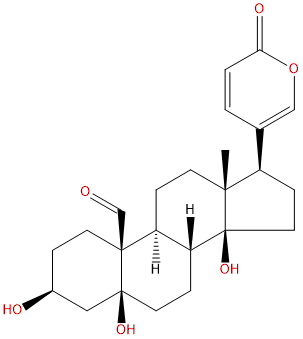
Bufotalin, CAS number 465-90-7, is a natural steroid aldehyde derived from toad secretions and belongs to the 5 β - bufanolide family. As a typical type of toad toxin, toads have attracted widespread attention in the field of natural product pharmacology in recent years due to their unique chemical structure and diverse biological activities. It not only exhibits significant anti-tumor, anti leishmaniasis, and autophagy inducing activities, but also plays an important role in regulating cell apoptosis and metabolism. This article aims to provide a systematic review of the chemical structure, sources, pharmacological activities, mechanisms of action, and pharmacological evaluation of toad derivatives, and explore their potential and challenges in future clinical applications.
The toad is a steroid aldehyde with a complex structure, with a molecular formula of C24H-34O6 and a molecular weight of 416.5140. Its structural features include multiple functional groups such as 3 β - hydroxyl, 14 β - hydroxyl, 19 oxo, and 5 β - hydroxyl, and it belongs to a mixed type compound of steroid aldehydes and steroidal lactones. The compound has moderate lipid solubility with a LogP value of 1.6836, indicating that it has good lipid solubility and is beneficial for cell membrane penetration. The polar surface area (TPSA) is 107.97 Å ², indicating that it has certain polarity characteristics in drug absorption and distribution.
The water solubility of toads is relatively low (0.0243 mg/mL), which to some extent limits their bioavailability, but their high blood-brain barrier penetration ability provides the possibility for treating central nervous system diseases. It is worth noting that the compound showed negative results in hERG channel inhibition experiments, indicating a low risk of cardiac toxicity; At the same time, the Ames mutagenicity test result was 0, indicating a low risk of genotoxicity.
Toad alkaloids are mainly found in the skin gland secretions of toads (Bufo spp.) and are one of the important defensive alkaloids in toads. Its natural sources mainly include Chinese toads (Bufo gargarizans) and American toads (Bufo marinus). In traditional Chinese medicine, toad secretions are used as topical drugs to treat tumors and inflammatory diseases, while modern research has isolated active ingredients such as bufotalin from them.
The extraction method usually uses organic solvent extraction combined with liquid-liquid distribution technology. The general steps include: collection and drying of toad secretions, followed by extraction with methanol or ethanol, concentration and distribution through an ethyl acetate water system, and further purification using silica gel column chromatography or high-performance liquid chromatography (HPLC). In recent years, supercritical CO2 extraction technology has also been applied to improve extraction efficiency and purity, reduce the use of organic solvents, and conform to the concept of green chemistry.
The pharmacological activities of toads are rich, covering multiple aspects such as anti-tumor, autophagy induction, cell apoptosis regulation, and anti parasitic effects.
Toad has shown significant cell proliferation inhibition in various tumor cell lines. In vitro experiments have shown that it can significantly reduce the survival rate of cancer cells by inducing cell cycle arrest and promoting apoptosis. The research covers a variety of solid tumor types such as breast cancer, lung cancer, liver cancer and colorectal cancer. Its anti-tumor activity is related to regulating multiple signaling pathways, such as inhibiting STAT3 and MAPK1 signaling, reducing MMP2 mediated cell migration ability, and inhibiting tumor metastasis potential.
Toads can activate cellular autophagy by regulating the expression of autophagy related proteins LC3 and Beclin-1, promoting the formation of autophagosomes. In addition, its induced apoptosis is manifested as loss of mitochondrial membrane potential, activation of Caspase cascade reaction, and changes in BCL2 family protein expression, demonstrating its multiple roles in regulating cell fate.
As a natural antiparasitic agent, bufotaxime has shown good inhibitory effects on Leishmania parasites. Its mechanism of action may involve disrupting the integrity of parasite cell membranes and interfering with parasite energy metabolism, which has the potential to develop new anti parasitic drugs.
It has also been found that toads have the ability to regulate animal metabolism, possibly by affecting the activity of steroid metabolizing enzymes and regulating endocrine and metabolic balance. In addition, it has also been reported to participate in defense responses in plant metabolism, demonstrating the diversity of its biological functions.
The pharmacological effects of toads depend on their interactions with multiple molecular targets, especially in the field of anti-tumor therapy.
In summary, toads exhibit complex and effective pharmacological mechanisms through multi-target and multi pathway synergistic effects.
The pharmacological evaluation of toads indicates that they have certain potential for drug development. Its molecular weight of 416.5 meets the requirements of Lipinski's rule, and a moderate LogP value indicates good membrane permeability. A higher TPSA value may limit oral absorption, but its high blood-brain barrier permeability provides advantages for the treatment of central nervous system related diseases.
Low water solubility is a major limitation for its medicinal properties, and its bioavailability needs to be improved through drug formulation technology. The pharmacokinetic studies in vivo are not yet complete, but preliminary data indicate that it is widely distributed in animals, metabolically stable, and does not show significant risk of cardiac toxicity.
The hERG channel inhibition experiment was negative, reducing the risk of arrhythmia; The Ames mutagenicity test showed no positive results, indicating good genetic safety. These data provide strong support for its preclinical safety evaluation.
Future research needs to focus on its in vivo metabolic pathways, half-life, and drug interactions to improve its pharmacokinetic characteristics and guide clinical development.
As a multifunctional natural steroid aldehyde, toad has a wide range of pharmacological activities, especially in the field of anti-tumor, showing good application prospects. Its multi-target mechanism of action gives it unique advantages in overcoming tumor drug resistance, inhibiting metastasis, and inducing apoptosis. The high blood-brain barrier penetration ability provides the possibility for the treatment of central nervous system diseases such as brain tumors.
However, the low water solubility and potential toxicity risks inherent in toads remain the main obstacles to clinical translation. In the future, modern drug delivery technologies such as structural modification and nanocarriers are needed to enhance its bioavailability and targeting, and reduce side effects.
In addition, the potential of toads in the fields of anti parasitic and metabolic regulation remains to be further explored. By combining modern molecular biology techniques and systematically analyzing its functional network, it is expected to promote its clinical applications in multiple fields.
Overall, as a typical representative of natural product drug development, toad has the potential to become a new type of anti-tumor and antiparasitic drug. Future research should focus on optimizing its efficacy and evaluating its safety to promote its clinical translation.
As a unique natural product of steroid aldehydes, toads have become an important subject of pharmacology research due to their diverse biological activities and complex mechanisms of action. This article provides a systematic review of its chemical structure, origin, pharmacological activity, mechanism of action, and drug evaluation, revealing its potential in anti-tumor, autophagy induction, and anti parasitic effects. Despite facing challenges such as poor water solubility and insufficient safety assessment, bufotaxime still demonstrates promising clinical application prospects. In the future, through interdisciplinary collaboration and optimization of drug properties and delivery systems, it is expected to achieve the transformation from natural products to clinical drugs, benefiting patients.
