


Synonym name: 3'-Geranyl-4',7-dihydroxyisoflavone; Corylinin
Catalogue No.: BP0397
Cas No.: 775351-88-7
Formula: C25H26O4
Mol Weight: 390.479
Botanical Source: the seeds of Psoralea corylifolia
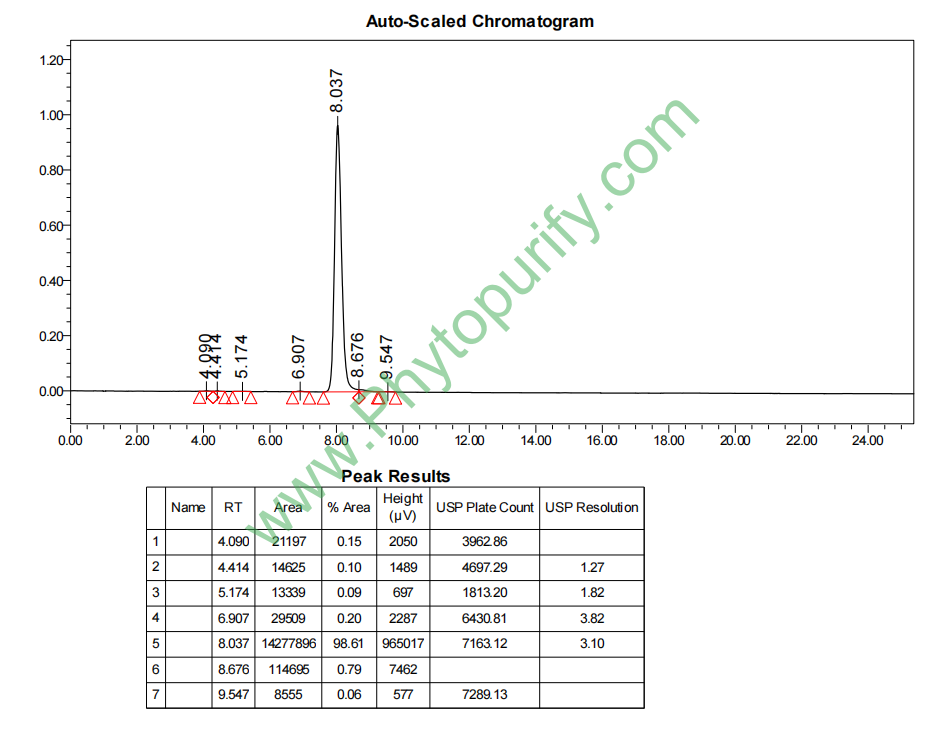
Purity: 95%~99%
Analysis Method: HPLC-DAD or/and HPLC-ELSD
Identification Method: Mass, NMR
Packing: Brown vial or HDPE plastic bottle
Can be supplied from milligrams to grams.
For Reference Standard and R&D, Not for Human Use Directly.
Inquire for bulk scale.
HPLC of Corylifol A
Storage conditions:Short-term storage at 2~8℃, long-term storage at -20 ~ -80℃
74.6000
4.0000
3.5000
Low
Unknown
Unknown
Unknown
Unknown
Unknown
Unknown
Unknown
Corylifol A (CAS number: 775351-88-7) is a natural flavonoid compound derived from the traditional Chinese medicine Psoralea corylifolia L. In recent years, with the deepening development of natural product pharmacology, psoralen isoflavone A has gradually become a research hotspot due to its significant biological activity, especially its potential role in inflammation regulation and tumor signaling pathways. It can effectively inhibit the activation and phosphorylation of signal transduction and transcription activator 3 (STAT3) induced by IL-6, exhibiting a low half maximal inhibitory concentration (IC50 of 0.81 μ M), indicating its important application value in the treatment of inflammatory diseases and tumors.
STAT3, as a key transcription factor in the signaling of various cytokines and growth factors, plays a central role in cell proliferation, apoptosis, immune regulation, and tumor development. Abnormal activation of the IL-6/STAT3 signaling pathway is considered the molecular basis of various inflammatory diseases and tumors. Therefore, the development of inhibitors targeting this pathway has become an important direction for drug research and development. Psoralen isoflavone A provides a new approach for the development of natural product drugs due to its unique molecular structure and significant inhibitory activity.
This article will provide a systematic review of the chemical structure and physicochemical properties, plant sources and extraction methods, pharmacological activity and mechanism of action, pharmacological evaluation and pharmacokinetic characteristics of Fructus Psorale Isoflavones A. Combined with current research progress, it will explore their clinical application prospects and future development directions.
Psoralen Isoflavones A belong to the natural isoflavone class, with a molecular formula of C24H26O5 and a molecular weight of 390.47. Its chemical structure contains a typical isoflavone skeleton with multiple hydroxyl and methoxy substituents, endowing it with certain polarity and biological activity. The specific structural features include:
In terms of physicochemical properties, the LogP value of psoralen isoflavone A is about 4.0, indicating its good lipid solubility, which is beneficial for cell membrane penetration, but may also affect its water solubility and bioavailability. The topological polar surface area (TPSA) is 74.6 Å ², which is within the TPSA range of most oral drugs, indicating that it may have good membrane permeability. The molecule contains four hydrogen bond receptors, and moderate hydrogen bonding ability is beneficial for its stable binding with the target protein.
The prediction of low blood-brain barrier permeability suggests limited distribution in the central nervous system, which may be advantageous for certain non central targeted diseases and reduce the risk of central nervous system side effects. There is currently no clear data on its liver toxicity, cardiac toxicity (including hERG channel inhibition), and genotoxicity (Ames test), and further systematic evaluation is needed.
Psoralea flavanone A is mainly isolated from the traditional Chinese medicine Psoralea corylifolia L. Psoralea is a leguminous plant widely distributed in China, India, and Southeast Asia. It has always been used to treat osteoporosis, skin diseases, and immune related diseases.
The mature seeds of Fructus Psorale are the main medicinal parts, containing abundant isoflavones, coumarins, and volatile oil components. Psoralen A, as one of the important isoflavone components, although not as abundant as the main component Psoralen, its biological activity is particularly prominent.
Solvent extraction
Ethanol or methanol are commonly used as extraction solvents, and efficient extraction of isoflavone components can be achieved through reflux or ultrasound assisted extraction. After concentration, impurities are removed using liquid-liquid distribution method.
Column chromatography separation
Further purify Fructus Psorale Isoflavones A using silica gel column chromatography, reverse phase C18 column chromatography, or high-performance liquid chromatography (HPLC) techniques. Utilize their polarity differences and adsorption characteristics to achieve separation.
Modern technology assisted extraction
Emerging technologies such as supercritical CO2 extraction and microwave-assisted extraction have shown advantages in improving extraction efficiency and purity, and are beneficial for protecting the structural integrity of active ingredients.
The purified fructooligosaccharides A are usually subjected to structural identification and purity confirmation through methods such as nuclear magnetic resonance (NMR), mass spectrometry (MS), and infrared spectroscopy (IR).
Psoralen Isoflavones A have shown significant biological effects in various pharmacological studies, especially in anti-inflammatory, anti-tumor, and immune regulatory aspects, with potential value.
The IL-6/STAT3 signaling pathway is a key regulatory axis in inflammatory response, and psoralen isoflavone A can effectively inhibit IL-6-induced STAT3 activation and phosphorylation, with an IC50 of 0.81 μ M, demonstrating strong targeted inhibition ability. By downregulating STAT3 signaling, psoralen isoflavone A can inhibit the expression of pro-inflammatory cytokines and alleviate inflammatory responses.
Related cell experiments have shown that fructooligosaccharides A can inhibit the release of inflammatory mediators in macrophages and other immune cells, reduce the expression of inflammatory factors such as tumor necrosis factor alpha (TNF - α) and IL-1 β, indicating its potential application value in chronic inflammation and autoimmune diseases.
Abnormal activation of the STAT3 signaling pathway is commonly present in various tumors and is involved in tumor cell proliferation, anti apoptosis, invasion, and metastasis. Psoralen isoflavone A inhibits the activation of STAT3, blocks the growth signal of tumor cells, induces cell cycle arrest and apoptosis.
Several in vitro tumor cell line experiments show that Psoralea isoflavone A can inhibit the proliferation of breast cancer, liver cancer, colorectal cancer and other tumor cells, and has low toxicity to normal cells, showing good selectivity. In addition, it can enhance the sensitivity of chemotherapy drugs and has potential value for combination therapy.
Preliminary studies have also found that flavonoids A from Fructus Psorale may have antioxidant, antibacterial, and neuroprotective effects, but the relevant mechanisms still need further clarification.
The main molecular target of psoralen isoflavone A is STAT3 protein, especially its activation state induced by IL-6. After IL-6 binds to its receptor, it activates Janus kinase (JAK), which phosphorylates STAT3. The phosphorylated STAT3 dimer is translocated to the nucleus, regulating downstream gene expression, promoting cell proliferation, and anti apoptosis.
Psoralen Isoflavones A exert inhibitory effects through the following mechanisms:
Blocking STAT3 phosphorylation
Directly or indirectly inhibit JAK kinase activity, reduce STAT3 phosphorylation levels, and prevent its activation.
Interference with STAT3 nuclear translocation
By affecting the conformational changes or binding of STAT3, it prevents it from entering the nucleus and inhibits the transcription of target genes.
Regulating downstream gene expression
By inhibiting STAT3 signaling, reducing the expression of pro proliferative genes (such as Cyclin D1), anti apoptotic genes (such as Bcl-2), and pro-inflammatory factors, cell fate is regulated.
Molecular docking and dynamic simulation studies have shown that psoralen isoflavone A can bind to the SH2 domain of STAT3, competitively block its interaction with phosphotyrosine residues, and inhibit STAT3 dimerization and functional activation.
In addition, psoralen isoflavone A may exert anti-inflammatory and anti-tumor effects by regulating other signaling pathways such as NF - κ B and MAPK, but the specific mechanism still needs to be further studied.
The molecular weight of psoralen isoflavone A is 390.47, which conforms to Lipinski's "drug similarity rule". Its LogP value is 4.0, indicating moderate lipid solubility, which is beneficial for cell membrane penetration. However, excessive lipid solubility may affect water solubility and oral absorption.
The TPSA is 74.6 Å ², indicating moderate polarity and potential for good membrane permeability and oral bioavailability. The number of hydrogen bond receptors is 4, which is within a reasonable range and helps to form effective binding with the target protein.
The predicted permeability of the blood-brain barrier is low, which may limit its distribution in the central nervous system and reduce the risk of central side effects.
At present, there is limited in vivo pharmacokinetic data on fructooligosaccharides A. It is known to have good oral absorption, but its bioavailability is limited by the first pass effect of metabolic enzymes. Its metabolic pathway in the liver is not fully understood, and there is a lack of data on liver toxicity and cardiac toxicity (including hERG channel inhibition), requiring a systematic safety evaluation.
Further research is needed to evaluate the in vivo stability and sustained efficacy of the metabolites and activities of fructooligosaccharides A.
There are currently no systematic toxicological studies reported. Given its structural characteristics, it is necessary to focus on potential liver toxicity, cardiac toxicity, and genotoxicity risks. In the future, acute toxicity, long-term toxicity, and genetic toxicity tests should be conducted to provide safety guarantees for clinical applications.
Psoralen isoflavone A, as a natural product with clear molecular targets, exhibits excellent anti-inflammatory and anti-tumor potential and has significant clinical translational value.
Inflammatory diseases
By inhibiting the IL-6/STAT3 signaling pathway, psoralen isoflavone A is expected to be used for the treatment of autoimmune diseases such as rheumatoid arthritis and systemic lupus erythematosus, and to alleviate chronic inflammatory states.
tumor therapy
For tumor types with abnormal activation of STAT3, psoralen isoflavone A can be used as an adjuvant therapy for monotherapy or combination chemotherapy to enhance efficacy and reduce drug resistance.
immunomodulation
Its potential to regulate immune cell function provides new ideas for the treatment of immune related diseases.
Pharmacokinetic optimization
It is necessary to improve its water solubility, bioavailability, and in vivo stability through structural modification or drug carrier technology.
safety assessment
Improve toxicology research to ensure clinical safety.
In depth study of mechanisms
Further elucidate its multi-target mechanism of action and its interaction with other signaling pathways.
Clinical trial design
Conduct early clinical trials to verify its efficacy and safety, and promote clinical translation.
As a natural flavonoid compound derived from traditional Chinese medicine, psoralen isoflavone A exhibits significant anti-inflammatory and anti-tumor activities due to its effective inhibition of the IL-6-induced STAT3 signaling pathway. Its reasonable physicochemical properties and potential medicinal properties provide a solid foundation for the development of new drugs. Although there is currently insufficient research on its pharmacokinetics and safety, with the application of modern drug development technology, psoralen isoflavone A is expected to become an innovative drug candidate molecule targeting the STAT3 signaling pathway. In the future, through systematic pharmacological, toxicological, and clinical research, psoralen isoflavone A is expected to play an important role in the treatment of inflammatory diseases and tumors, promoting the clinical translation process of natural product pharmacology.
