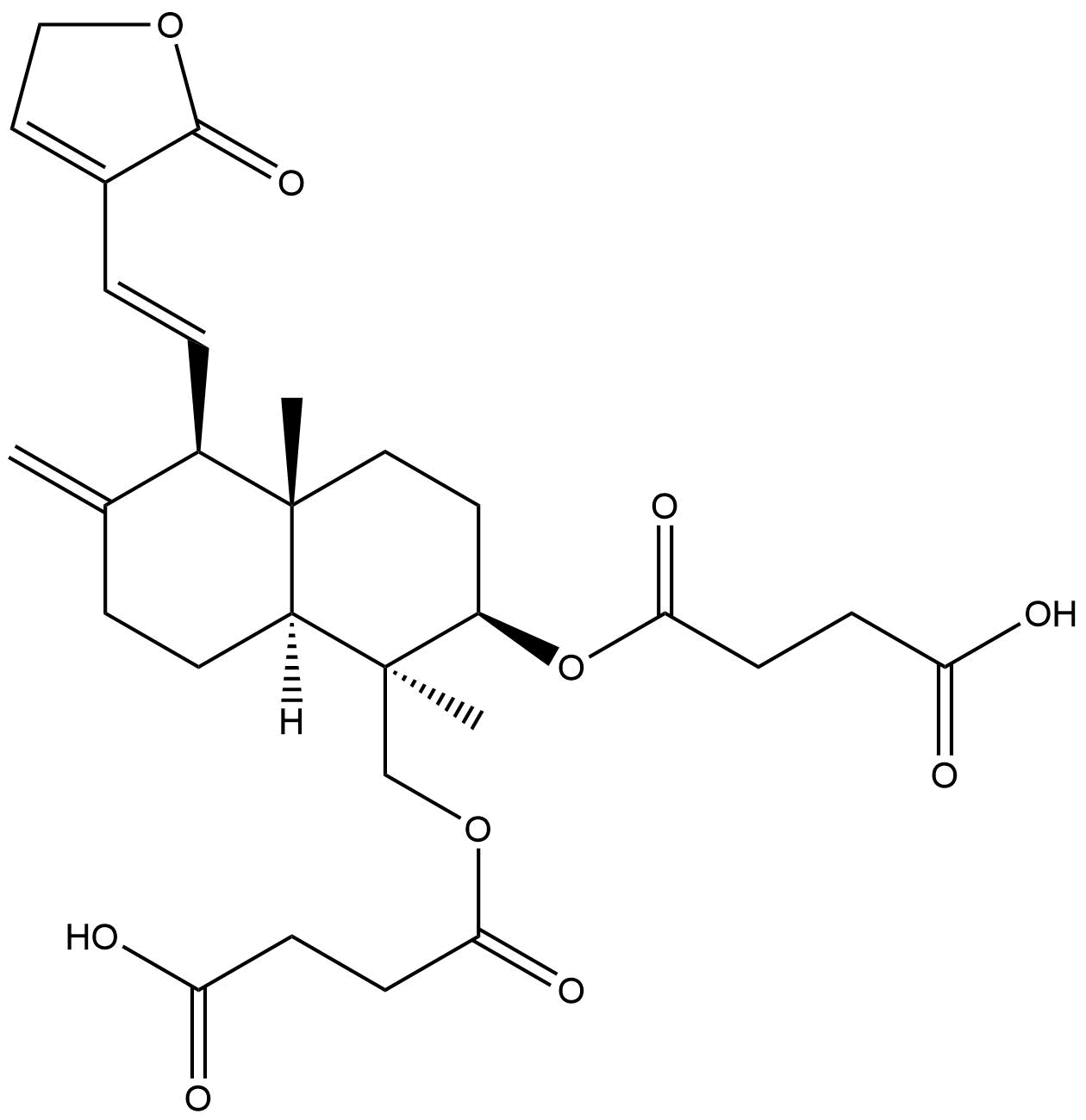


Product name: Dehydroandrographolide succinate
Synonym name: 14-Deoxy-11,12-didehydroandrographolide bis(hemisuccinate)
Catalogue No.: BP4068
Cas No.: 786593-06-4
Formula: C28H36O10
Mol Weight: 532.586
Botanical Source: Andrographis Herba
Physical Description:
Type of Compound: Diterpenoids
Purity: 95%~99%
Analysis Method: HPLC-DAD or/and HPLC-ELSD
Identification Method: Mass, NMR
Packing: Brown vial or HDPE plastic bottle
Storage: Store in a well closed container, protected from air and light. Put into refrigerate or freeze for long term storage.
Whenever possible, you should prepare and use solutions on the same day. However, if you need to make up stock solutions in advance, we recommend that you store the solution as aliquots in tightly sealed vials at -20℃. Generally, these will be useable for up to two weeks.
The product could be supplied from milligrams to grams
Inquire for bulk scale.
For Reference Standard and R&D, Not for Human Use Directly.
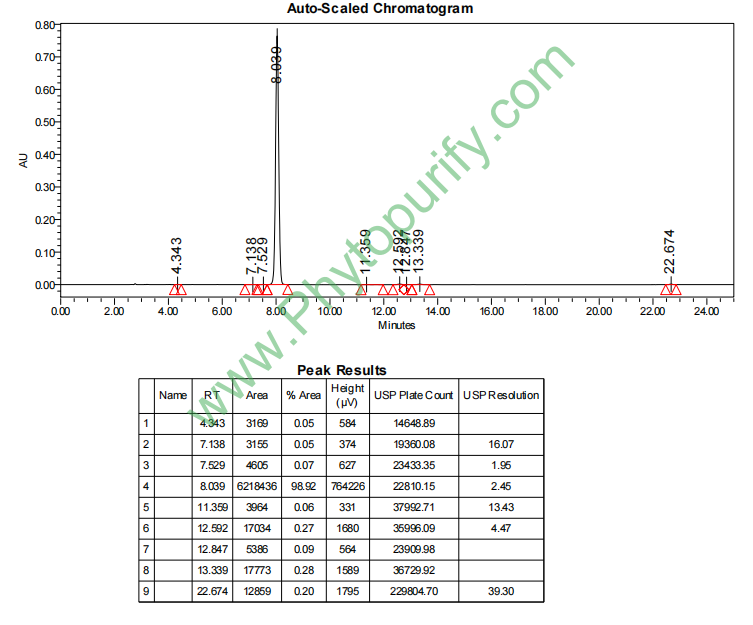
HPLC of Dehydroandrographolide succinate
Storage conditions:Short-term storage at 2~8℃, long-term storage at -20 ~ -80℃
Dehydroandrographolide succinate (CAS number: 786593-06-4) is a natural derivative derived from the traditional Chinese medicine Andrographis paniculata. As a widely used medicinal plant in traditional Asian medicine, the main active ingredient of Chuanxinlian, dehydrated Chuanxinlian lactone and its derivatives, have attracted much attention due to their significant anti-inflammatory, antiviral, and immunomodulatory effects. Dehydrated andrographolide succinate, as a succinate derivative of dehydrated andrographolide, has shown unique advantages in pharmacological activity and drug formation due to its good water solubility and bioavailability, and has become a hot topic in natural product pharmacology research in recent years.
This review aims to systematically summarize the chemical structure and physicochemical properties, plant sources and extraction methods, pharmacological activities, and molecular mechanisms of dehydrated andrographolide succinate, with a focus on the molecular targets and signaling pathway regulation of its anti-inflammatory effects. Combined with drug efficacy evaluation and pharmacokinetic data, it explores its clinical application prospects and future development directions, providing theoretical support and research references for subsequent drug development and clinical translation.
The molecular formula of dehydrated andrographolide succinate is C28H36O10, with a molecular weight of 532.5860. Its chemical structure is based on the core skeleton of dehydrated andrographolide, which is modified by esterification of succinic acid groups to improve its water solubility and biocompatibility. The LogP value of this compound is 2.7913, indicating that it has moderate lipid solubility, which is beneficial for cell membrane penetration and in vivo distribution. The TPSA (topological polar surface area) is 153.5 Å ², indicating strong polarity characteristics that facilitate binding to polar targets.
The water solubility is 0.0762 mg/mL, which is significantly improved compared to the original compound and beneficial for formulation development and oral absorption. The low permeability of the blood-brain barrier suggests a lower risk of side effects in the central nervous system. The hERG channel inhibition test was negative, indicating a low risk of cardiac toxicity. The Ames test result is 0.0, indicating no significant genotoxicity and high safety.
Structurally, dehydrated andrographolide succinate retains the diterpenoid lactone core of andrographolide. The introduction of succinate groups not only improves physicochemical properties, but may also affect its binding affinity with the target through spatial conformational changes, thereby regulating its biological activity.
The parent compound of dehydroandrographolide succinate is mainly found in Andrographis paniculata. Chuanxinlian is a plant of the Scrophulariaceae family, widely distributed in tropical and subtropical regions of Asia, especially in southern China, India, and Southeast Asian countries. This plant is widely used in traditional medicine to treat diseases such as colds, fever, and inflammation due to its bitter taste and heat clearing and detoxifying effects.
Organic solvent extraction combined with chromatographic separation technology is commonly used to extract the lactones from Houttuynia cordata. Common extraction solvents include ethanol, methanol, and their aqueous solutions. The extraction process is generally as follows: after drying and crushing the leaves of Houttuynia cordata, 70% ethanol is used for reflux extraction, concentrated and separated by silica gel column chromatography, combined with high-performance liquid chromatography (HPLC) purification to obtain dehydrated Houttuynia cordata lactone. Subsequently, dehydrated andrographolide was reacted with succinic anhydride through esterification reaction to generate dehydrated andrographolide succinate. The reaction conditions require strict control of temperature, reaction time, and catalyst dosage to ensure product purity and yield.
In recent years, new technologies such as ultrasound assisted extraction and microwave-assisted extraction have also been applied to the extraction of paeoniflorin compounds, improving extraction efficiency and purity. In addition, the development of biocatalytic esterification methods provides a new approach for the green synthesis of dehydrated andrographolide succinate.
The pharmacological activity research of dehydrated andrographolide succinate mainly focuses on its anti-inflammatory effect. A large number of in vitro cell models and in vivo animal experiments have shown that this compound can significantly inhibit the production of inflammatory mediators and the activation of inflammatory signaling pathways, exhibiting good anti-inflammatory effects.
In immune cell models such as macrophages and monocytes, dehydrated andrographolide succinate can inhibit the secretion of pro-inflammatory cytokines such as IL-6 and TNF - α, reducing the inflammatory response. Its mechanism of action involves the regulation of multiple inflammation related signaling pathways, including key transcription factors such as NF - κ B and STAT3. In animal inflammation models (such as mouse foot swelling models and pneumonia models), administration of this compound significantly reduces inflammatory indicators and alleviates histopathological damage to tissues.
In addition to anti-inflammatory effects, dehydrated andrographolide succinate also exhibits certain immunomodulatory, analgesic, and antioxidant activities. It exerts analgesic effects by regulating TRPV1 and TRPA1 channels; By regulating the expression of NOS2, it affects the synthesis of nitric oxide and participates in the regulation of oxidative stress response. In addition, the regulation of apoptosis related protein CASP1 by this compound suggests its potential role in regulating cell survival and inflammatory cell death.
The anti-inflammatory effect of dehydrated andrographolide succinate is mainly achieved through multi-target and multi pathway synergistic regulation. Its key targets include:
In summary, dehydrated andrographolide succinate exhibits significant anti-inflammatory effects through multi-target synergistic effects, regulating the production of inflammatory mediators and activation of signaling pathways.
Dehydrated Chuanxinlian lactone succinate exhibits ideal properties in terms of medicinal properties. Its molecular weight is 532.5860, slightly higher than the recommended 500 Da by Lipinski rule, but combined with its moderate LogP value (2.7913) and high polar surface area (TPSA 153.5), it overall meets the reasonable requirements for drug affinity and in vivo distribution.
The water solubility has significantly increased compared to the original compound (0.0762 mg/mL), which is beneficial for the development of oral formulations and in vivo absorption. The blood-brain barrier has low permeability, reducing the potential toxicity risk to the central nervous system. HERG channel inhibition was negative and Ames test showed no mutagenicity, indicating its high safety.
Pharmacokinetic studies have shown that dehydrated andrographolide succinate has good stability and a long half-life in vivo, and can maintain effective blood drug concentrations. Its main metabolic pathway includes hepatic esterase mediated hydrolysis, release of active dehydrated andrographolide, and subsequent excretion through hepatic phase II metabolism. Oral bioavailability is moderate and less affected by first pass effects.
In addition, the compound has weak interactions with common drug metabolizing enzymes such as the CYP450 family, reducing the risk of drug interactions. Overall, dehydrated andrographolide succinate has good pharmacokinetic characteristics and safety, and has strong potential for drug development.
Based on its significant anti-inflammatory activity and good pharmacological properties, dehydrated andrographolide succinate has shown broad clinical application prospects in the treatment of various inflammation related diseases. Inflammation is the pathological basis of various chronic diseases, such as rheumatoid arthritis, inflammatory bowel disease, asthma, and metabolic syndrome. Developing safe and effective anti-inflammatory drugs is of great clinical significance.
At present, the anti-inflammatory and analgesic effects of dehydrated andrographolide succinate have been validated in multiple animal models. In the future, further systematic preclinical toxicological evaluation and pharmacological studies are needed to clarify its safe dosage range and mechanism of action. Based on its low blood-brain barrier permeability and no risk of cardiac toxicity, it is expected to become an ideal therapeutic drug for peripheral inflammation.
In addition, by combining modern pharmaceutical formulation technologies such as nanocarriers and sustained-release formulations, it is expected to further enhance its bioavailability and targeting, and expand its clinical indications. Future research should also focus on its potential for combined use with existing anti-inflammatory drugs, explore synergistic mechanisms, and reduce drug tolerance and side effects.
With the development of natural product pharmacology and molecular pharmacology techniques, the structural optimization and derivative design of dehydrated andrographolide succinate will provide more possibilities for its clinical translation. The mechanism advantage of multi-target regulation gives it unique advantages in the treatment of complex inflammatory diseases and is worthy of further development.
Dehydrated andrographolide succinate, as an important derivative of andrographolide natural products, has shown great potential for drug development due to its excellent anti-inflammatory activity, multi-target mechanism of action, and good drug properties. Through systematic pharmacological research and drug evaluation, a solid foundation has been laid for its clinical application. In the future, combining modern drug development technology and precision medicine concepts, dehydrated andrographolide succinate is expected to become a new safe and effective drug for treating inflammatory diseases, injecting new vitality into the development of natural product pharmacology.
