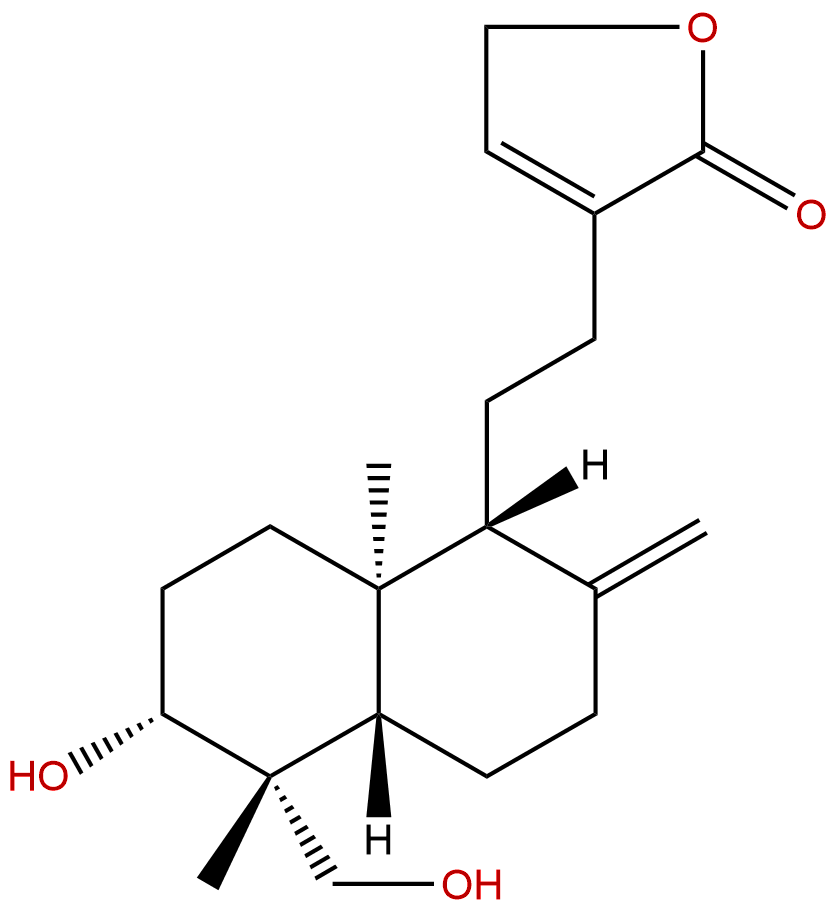


Product name: 14-Deoxyandrographolide
Synonym name:
Catalogue No.: BP1811
Cas No.: 4176-97-0
Formula: C20H30O4
Mol Weight: 334.456
Botanical Source: Andrographis paniculata
Physical Description: Cryst.
Type of Compound: Diterpenoids
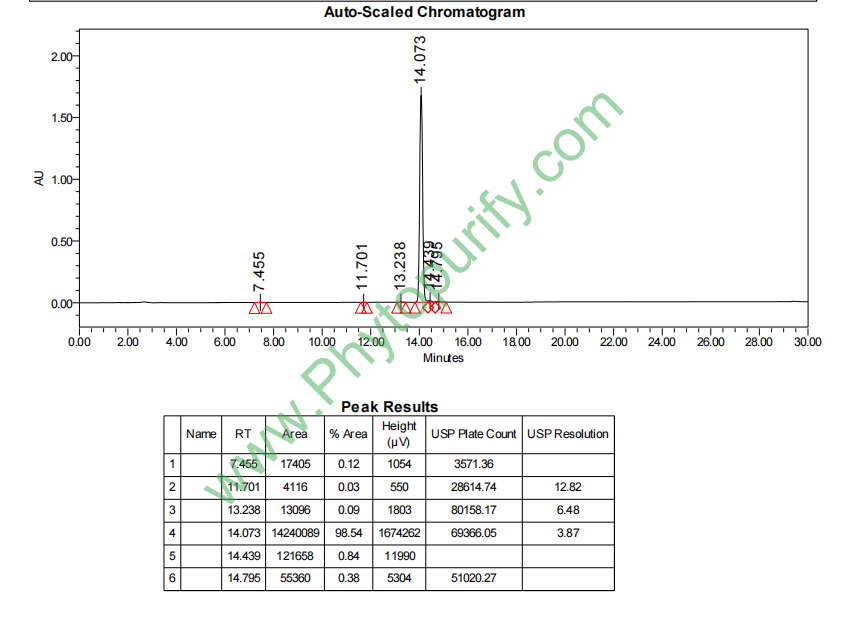
Purity: 95%~99%
Analysis Method: HPLC-DAD or/and HPLC-ELSD
Identification Method: Mass, NMR
Packing: Brown vial or HDPE plastic bottle
The product could be supplied from milligrams to grams. Inquire for bulk scale.
We provide solution to improve the water-solubility of compounds, thereby facilitating the variety of activity tests and clinic uses.
For Reference Standard and R&D, Not for Human Use Directly.
Description:
14-Deoxyandrographolide has hepatoprotective activity, mediates activation of adenylate cyclase-cAMP signaling leading to up-regulation of cNOS, may provide a promising approach in the prevention of liver diseases during chronic alcoholism. It desensitizes hepatocytes to TNF-alpha-mediated apoptosis through the release of TNFRSF1A.
References:
Br J Pharmacol. 2010 Aug;160(7):1823-43.
14-Deoxyandrographolide desensitizes hepatocytes to tumour necrosis factor-alpha-induced apoptosis through calcium-dependent tumour necrosis factor receptor superfamily member 1A release via the NO/cGMP pathway.
Andrographis paniculata (AP) has been found to display hepatoprotective effect, although the mechanism of action of the active compounds of AP in this context still remains unclear. Here, we evaluated the hepatoprotective efficacy of 14-Deoxyandrographolide (14-DAG), a bioactive compound of AP, particularly its role in desensitization of hepatocytes to tumour necrosis factor-alpha (TNF-alpha)-induced signalling of apoptosis.
METHODS AND RESULTS:
TNF-alpha-mediated ligand receptor interaction in hepatocytes in the presence of 14-DAG was studied in vitro in primary hepatocyte cultures, with the help of co-immunoprecipitation, confocal microscopy and FACS analysis. Events associated with 14-DAG-induced TNFRSF1A release from hepatocytes were determined using immunoblotting, biochemical assay and fluorimetric studies. Pulse-chase experiments with radiolabelled TNF-alpha and detection of apoptotic nuclei by terminal transferase-mediated dUTP nick-end labelling were performed under in vivo conditions. 14-DAG down-regulated the formation of death-inducing signalling complex, resulting in desensitization of hepatocytes to TNF-alpha-induced apoptosis. Pretreatment of hepatocytes with 14-DAG accentuated microsomal Ca-ATPase activity through induction of NO/cGMP pathway. This resulted in enhanced calcium influx into microsomal lumen with the formation of TNFRSF1A-ARTS-1-NUCB2 complex in cellular vesicles. It was followed by the release of full-length 55 kDa TNFRSF1A and a reduction in the number of cell surface TNFRSF1A, which eventually caused diminution of TNF-alpha signal in hepatocytes.
CONCLUSIONS:
Taken together, the results demonstrate for the first time that 14-DAG desensitizes hepatocytes to TNF-alpha-mediated apoptosis through the release of TNFRSF1A. This can be used as a strategy against cytokine-mediated hepatocyte apoptosis in liver dysfunctions.
Food Chem Toxicol. 2013 Sep;59:236-48.
14-Deoxyandrographolide targets adenylate cyclase and prevents ethanol-induced liver injury through constitutive NOS dependent reduced redox signaling in rats.
Chronic alcoholism is one of the most common causes of liver diseases worldwide. Nitric oxide (NO) has been proposed to have potential for clinical application against chronic hepatocellular injuries. However, mechanisms underlying hepatoprotective functions of NO in ethanol-induced apoptosis are largely unknown.
METHODS AND RESULTS:
Sprauge-Dawley rats were exposed to ethanol for 8 weeks. Half of the ethanol-fed animals received 14-Deoxyandrographolide (14-DAG) treatment for the last 4 weeks of study. Preventive effect of 14-Deoxyandrographolide against ethanol-induced hepatotoxicity involved constitutive nitric oxide synthase (cNOS) activation followed by up-regulation of γ-glutamylcysteine synthetase activity and reduced oxidative stress. 14-Deoxyandrographolide acted as activator of adenylate cyclase and modulated cyclic AMP (cAMP) mediated expression of caveolin-1 and calmodulin.
CONCLUSIONS:
Our results suggest that, protective effect of 14-Deoxyandrographolide against ethanol-induced hepatic injury is based on its ability to reduce oxidative stress through cNOS dependent improvement of redox status. 14-Deoxyandrographolide mediated activation of adenylate cyclase-cAMP signaling leading to up-regulation of cNOS may provide a promising approach in the prevention of liver diseases during chronic alcoholism.
HPLC of 14-Deoxyandrographolide
Storage conditions:Short-term storage at 2~8℃, long-term storage at -20 ~ -80℃
66.7600
2.5335
2.5333
.1424
3.5496
14.0087
High
76.7426
4.5041
No
No
No
No
Yes
No
0.0
No
No
Yes
Yes
Sepsis is a life-threatening organ dysfunction syndrome caused by an imbalance in the host's response to infection. Its pathophysiological processes involve uncontrolled inflammatory responses, immune disorders, coagulation dysfunction, and tissue damage, and it is one of the leading causes of death in intensive care unit patients worldwide. Despite the continuous advancement of anti infective therapy and life support technology, the mortality rate of sepsis remains high, and the development of new, efficient, and multi-target therapeutic drugs is an urgent need in current research. In this context, exploring active natural products with anti sepsis potential from traditional medicinal plants has become an important strategy for drug development. Heart piercing lotus(Andrographis paniculata)As a herbaceous plant widely used in traditional Asian medicine systems, its main active diterpenoid component Andrographolide has been extensively studied for its anti-inflammatory and immunomodulatory effects. 14 Deoxyandrographolide (14-DAG, CAS number: 4176-97-0), as a structural analogue of andrographolide, has attracted increasing attention from the pharmacological community in recent years due to its unique pharmacological activity, particularly in anti-inflammatory, immune regulation, and organ protection, especially in sepsis related models where it exhibits multi-target intervention potential. This article aims to systematically review the chemical properties, plant sources, and pharmacological activities of 14 deoxyandrographolide, with a focus on its key targets and signaling pathways involved in the treatment of sepsis. The mechanism of action is explored in depth, and its pharmacological properties are evaluated, in order to provide comprehensive scientific basis for the in-depth research and clinical translation of this compound.
14 Deoxyandrographolide is a diterpenoid lactone compound of the Laodan lipid type. Its molecular formula is C20H30O4 and its molecular weight is 334.4560. Its core structure is similar to that of Chuanxinlian lactone, both having a decahydronaphthalene skeleton, an alpha, beta unsaturated gamma lactone ring, and multiple hydroxyl substituents. The most significant structural difference between it and Chuanxinlian lactone is the lack of hydroxyl (- OH) substitution at the C-14 position, hence the name "14 deoxy". This structural modification has had a profound impact on the polarity, spatial conformation, and interaction with target proteins of its molecules.
In terms of physicochemical properties, the lipid water partition coefficient (LogP) of 14 deoxyandrographolide is 2.5335, indicating its moderate lipophilicity, which is beneficial for transmembrane transport and bioavailability. Its topological polar surface area (TPSA) is 66.7600 Å ², which is relatively low, further confirming its good membrane permeability. The water solubility parameter is 0.1424, which belongs to the category of slightly soluble to poorly soluble. This suggests that in the development of formulations, it may be necessary to improve their solubility through techniques such as salt formation, cyclodextrin inclusion, or nanomaterialization. It is worth noting that its blood-brain barrier (BBB) penetration is predicted to be "high", indicating its potential for treating central nervous system related complications such as sepsis related encephalopathy. In early safety screening, the compound did not show hERG potassium channel inhibitory activity (hERG inhibition: No), reducing the risk of causing QT interval prolongation and apical torsion type ventricular tachycardia; The Ames test result is 0.0, indicating that it has no mutagenicity and providing preliminary support for its safety.
14 Deoxyandrographolide is mainly derived from the Euphorbiaceae plant Andrographis paniculata(Andrographis paniculata The whole grass of Burm. f. Nees. Chuanxinlian, also known as "bitter gallbladder herb" in traditional Chinese medicine, has a cold nature and a bitter taste. It has the effects of clearing heat, detoxifying, cooling blood, and reducing swelling. It is commonly used to treat symptoms such as colds, fever, sore throat, and abscesses. Its pharmacological basis is closely related to the various diterpenoid lactones it contains.
In the plant of Andrographis paniculata, 14 deoxyandrographolide usually coexists with andrographolide, neoandrographolide, dehydrated andrographolide, etc., but its content is relatively low. The extraction and separation method of this compound is similar to other paeoniflorin compounds, and the main process is as follows: first, the dried paeoniflorin whole plant is crushed, and polar solvents such as methanol, ethanol, or aqueous ethanol are used for reflux extraction or ultrasound assisted extraction. After vacuum concentration, the crude extract obtained was subjected to liquid-liquid extraction using solvents such as petroleum ether and ethyl acetate to preliminarily enrich diterpenoid components. Further purification is often carried out using column chromatography, with silica gel as the stationary phase and gradient elution using chloroform methanol or petroleum ether ethyl acetate mixed solvents in different ratios. Collect the fractions containing the target components by combining thin layer chromatography (TLC) or high-performance liquid chromatography (HPLC) monitoring. To obtain high-purity monomers, repeated column chromatography or preparative high-performance liquid chromatography (pre HPLC) is often required for final purification. Modern separation techniques such as high-speed countercurrent chromatography (HSCCC) have also been applied to the separation of such compounds due to their high efficiency and avoidance of adsorption losses. The optimization of extraction processes, such as solvent selection, temperature, time, and the combination of enzymatic hydrolysis or microwave-assisted extraction, aims to improve the yield and purity of the target compound.
14 Deoxyandrographolide exhibits broad and significant pharmacological activities, and its research focus has expanded from early smooth muscle effects to complex anti-inflammatory, immune regulatory, and cell protective fields.
The anti sepsis and multi organ protective effects of 14 deoxyandrographolide stem from its networked regulation of multiple key signaling pathways. Based on the provided target information, its core mechanism of action can be summarized as follows:
Inhibition of TLR4/NF - κ B classical inflammatory pathway The key step in initiating sepsis is the recognition of Toll like receptor 4 (TLR4) by pathogen associated molecular patterns (such as LPS). 14 Deoxyandrographolide has been shown to interfere with the activation or downstream signal transduction of TLR4, thereby inhibiting the activation of nuclear factor kappa B (NF - κ B, encoded by NFKB1). NF - κ B is a core transcription factor in the inflammatory response, and its inhibition leads to downregulation of gene expression of numerous downstream pro-inflammatory factors (TNF, IL-1 β, IL-6), inducible nitric oxide synthase (NOS2), and cyclooxygenase-2 (PTGS2/COX-2), thus suppressing the "cytokine storm" from the source.
Regulating the MAPK and PI3K/Akt signaling pathways The mitogen activated protein kinase (MAPK, such as MAPK1/ERK) and phosphatidylinositol 3-kinase/protein kinase B (PI3K/Akt, involving PIK3CA and AKT1) pathways are important signaling branches downstream of TLR4, jointly regulating inflammation, cell survival, and apoptosis. 14 Deoxyandrographolide can regulate the phosphorylation levels of these pathways. On the one hand, inhibiting excessive activation of MAPK to reduce the production of pro-inflammatory mediators; On the other hand, it may exert anti apoptotic and cell protective effects, especially in organ parenchymal cells, by activating the PI3K/Akt pathway.
Intervention in cell pyroptosis and apoptosis In sepsis, pyroptosis (a pro-inflammatory programmed cell death) is mediated by inflammasome activated caspase-1 (CASP1). 14 Deoxyandrographolide has been reported to inhibit the activation of CASP1, thereby reducing the maturation and release of IL-1 β and IL-18, and alleviating tissue damage associated with cell apoptosis. Meanwhile, as mentioned earlier, by upregulating the soluble form of TNFR1, neutralizing TNF - α or interfering with death signaling, liver cells and other cells are desensitized to TNF - α - induced apoptosis.
Regulating GSK-3 β activity Glycogen synthase kinase-3 β (GSK3B) is a multifunctional serine/threonine kinase involved in the regulation of inflammation, apoptosis, and mitochondrial function. In sepsis, increased GSK-3 β activity typically promotes inflammation and apoptosis. Research has shown that 14 deoxyandrographolide may exert anti-inflammatory and organ protective effects by inhibiting the activity of GSK-3 β or promoting its inhibitory phosphorylation, which may be related to Akt's regulation of GSK-3 β.
Multi target synergistic effect In summary, 14 deoxyandrographolide does not act on a single target, but simultaneously acts on a complex signaling network composed of TLR4, NF - κ B, MAPK, PI3K/Akt, CASP1, GSK-3 β, and others. This multi-target characteristic enables it to systematically intervene in the pathological process of sepsis from multiple levels such as pathogen recognition, signal transduction, transcriptional activation, mediator release to cell death, which is in line with the current trend of developing multi-target treatment strategies for complex diseases.
Based on its physicochemical parameters and preliminary biological data, 14 deoxyandrographolide has shown certain potential as a drug, but also faces challenges.
Advantage aspects:
- Good membrane permeability and BBB permeability Moderate LogP and lower TPSA indicate that oral absorption may be better, and high BBB penetration provides unique advantages for its treatment of neuroinflammatory related diseases.
- Preliminary safety is good The absence of hERG inhibition and Ames mutagenicity alert laid the foundation for its preclinical safety studies.
- Clear in vitro activity and multi-target mechanism At the cellular and molecular levels, it has clear activity concentrations and targets of action, and the mechanism research is relatively in-depth.
Challenge aspect:
- Poor water solubility This is the main obstacle facing its formulation development. It is necessary to explore suitable drug delivery systems, such as solid dispersions, liposomes, nanoparticles, or prodrug strategies, to improve their dissolution and bioavailability.
- Lack of pharmacokinetic data Currently, there are relatively few publicly reported studies on the systematic pharmacokinetics of 14 deoxyandrographolide, including absorption, distribution, metabolism, excretion, and ADME. Key parameters such as metabolic pathways, major metabolites, half-life, and tissue distribution characteristics (although BBB penetration prediction is high) urgently need to be elucidated. Related studies on andrographolide have shown that diterpenoid lactones are metabolized rapidly in the body and may have first pass effects, while 14 deoxyandrographolide may face similar problems.
- Potential Metabolism and Interactions It is necessary to investigate whether it is a substrate, inducer, or inhibitor of the cytochrome P450 enzyme system to assess potential drug drug interaction risks.
Future drug efficacy optimization work should focus on: 1) conducting systematic preclinical pharmacokinetic studies; 2) Developing new formulations to enhance their bioavailability; 3) Conduct a comprehensive toxicological evaluation, including long-term toxicity, reproductive toxicity, etc.
The clinical application prospects of 14 deoxyandrographolide mainly focus on the prevention and treatment of sepsis and its complications, and may be extended to other excessive inflammation related diseases.
Looking ahead to the future, research on 14 deoxyandrographolide should be conducted in the following areas:
- Deep exploration of mechanisms Using chemical biology methods such as affinity fishing, molecular docking, and kinetic simulation to accurately identify its direct target proteins and draw a clearer pharmacological action network map.
- structural optimization Using it as a lead compound, structural modification and structure-activity relationship studies are conducted with the aim of enhancing activity, improving water solubility and pharmacokinetic properties, and developing better derivatives or prodrugs.
- Preclinical development Complete pharmacological, pharmacokinetic, and toxicological evaluations that comply with the preclinical research guidelines for new drugs, and provide a complete data package for their application for clinical trials.
- Combination therapy research Explore its combination therapy with existing anti infective drugs, immunosuppressants, or other targeted drugs in order to generate synergistic effects, improve efficacy, and potentially reduce individual doses and side effects.
14 Deoxyandrographolide, as a natural diterpenoid derived from the traditional medicinal plant Andrographis paniculata, has shown great potential in the fields of anti-inflammatory, immune regulation, and organ protection due to its unique chemical structure and multi-target pharmacological activity. Especially in addressing sepsis, a major global health challenge, it provides new intervention ideas and candidate molecules. It inhibits cell apoptosis and pyroptosis by regulating key signaling pathways such as TLR4/NF - κ B, MAPK, PI3K/Akt, and GSK-3 β, and addresses the complex pathological process of sepsis from multiple perspectives. Despite facing challenges such as water solubility in drug development, its excellent membrane permeability, BBB permeability, and preliminary safety characteristics have laid a solid foundation for its further development. Future research needs to focus on overcoming its pharmaceutical shortcomings, elucidating systemic pharmacokinetic behavior, and promoting standardized preclinical and clinical studies. With the continuous deepening of research, 14 deoxyandrographolide is expected to move from the laboratory to clinical practice, providing a new treatment option for major diseases such as sepsis that is naturally derived and has a clear mechanism of action, demonstrating the scientific value of modernization and internationalization of traditional Chinese medicine.
