
| Catalog No | Package | Original Price | Price | Inventory | Quantity | Operating |
|---|---|---|---|---|---|---|
| BP0164-20mg | 20mg | $20.00 | Sign in |
|


Product name: Andrographolide
Synonym name:
Catalogue No.: BP0164
Cas No.: 5508-58-7
Formula: C20H30O5
Mol Weight: 350.455
Botanical Source: Andrographis Herba
Physical Description:
Type of Compound: Diterpenoids
Purity: 95%~99%
Analysis Method: HPLC-DAD or/and HPLC-ELSD
Identification Method: Mass, NMR
Packing: Brown vial or HDPE plastic bottle
Storage: Store in a well closed container, protected from air and light. Put into refrigerate or freeze for long term storage.
Whenever possible, you should prepare and use solutions on the same day. However, if you need to make up stock solutions in advance, we recommend that you store the solution as aliquots in tightly sealed vials at -20℃. Generally, these will be useable for up to two weeks.
The product could be supplied from milligrams to grams
Inquire for bulk scale.
Chengdu Biopurify Phytochemicals Ltd. is a leading company in the research, development, manufacture and marketing of High Quality Phytochemicals and Extracts(especially Active Ingredients from Traditional Chinese Medicine,TCM), Natural Active Pharmaceutical Ingredients worldwide.
The main services:
A. Supply active ingredients and reference standards of TCM, from mgs to kgs scale
B. Custom extraction and purification, target Herb Active Ingredients
C. Custom synthesis and semi-synthesis for Natural Active Ingredients
D. CR(contract research), CM(contract manufacture) and PD(process development) services from lab scale, pilot scale to commercial scale(GMP is also available)
E. TCM compounds library for drug screen,more than 3000 compounds available, many of them are rare and unique.
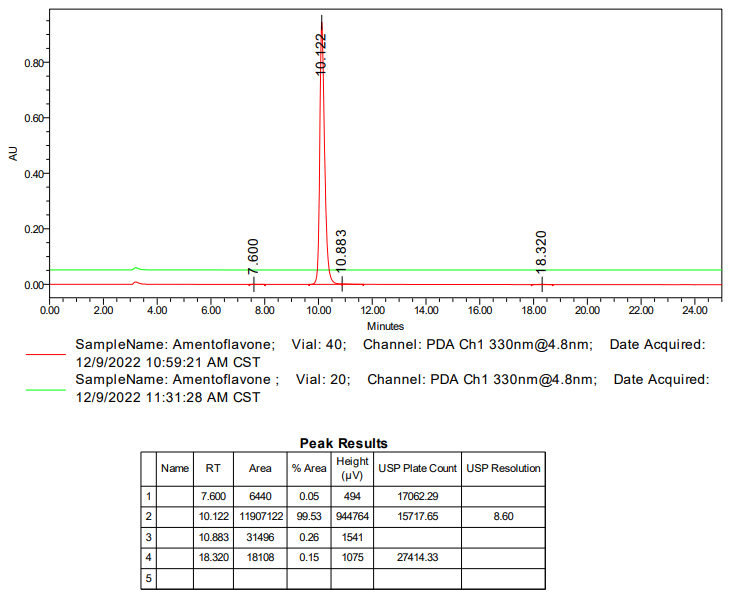
HPLC of Andrographolide
Storage conditions:Short-term storage at 2~8℃, long-term storage at -20 ~ -80℃
86.9900
1.6087
1.6087
.5410
1.8638
8.4887
High
63.8536
4.7047
No
No
No
No
Yes
No
0.0
Yes
No
Yes
Yes
Natural products, as an important source of drug discovery, play an irreplaceable role in the history of human disease prevention and treatment. Andrographolide (CAS number: 5508-58-7), a traditional medicinal plant derived from Andrographis paniculata(Andrographis paniculata The diterpenoid lactones isolated from Burm. f. Nees are outstanding representatives in this field. Chuanxinlian has a long history of application in traditional Asian medicine, mainly used to treat infections, fever, and inflammatory diseases. Modern pharmacological research has revealed that andrographolide is the main active ingredient that exerts various biological activities, exhibiting broad-spectrum pharmacological effects, including anti-inflammatory, antiviral, anti-tumor, hepatoprotective, cardiovascular protection, and metabolic regulation. Of particular note is its enormous potential in combating modern metabolic diseases such as insulin resistance and obesity, as well as inhibiting key inflammatory pathways such as nuclear factor kappa B (NF - κ B). This article aims to systematically review the chemical properties, pharmacological activities, molecular mechanisms of action, pharmacological evaluation, and clinical application prospects of Chuanxinlian lactone, in order to provide comprehensive scientific references for the in-depth research and development of this natural product.
The chemical name of Chuanxinlian lactone is 3- [2- [decahydroxy-6-hydroxy-5- (hydroxymethyl) -5,8a-dimethyl-2-methylene-1-naphtholyl] ethylidene] dihydro-4-hydroxy-2 (3H) - furanone, with a molecular formula of C20H30O5 and a molecular weight of 350.4550. Its structure belongs to the class of diterpenes, and its skeleton is composed of three hexagonal rings (decahydronaphthalene structure) and one gamma lactone ring fused together. The structure contains multiple characteristic functional groups: an alpha, beta unsaturated gamma lactone ring (C12-C13 double bond conjugated with C14 lactone carbonyl), two hydroxyl groups (one primary alcohol located at C19 and one secondary alcohol located at C14), and an extra cyclic methylene group (C8). These structural features, particularly the alpha, beta unsaturated lactone rings and ene bonds, are believed to be key pharmacophores involved in Michael addition reactions with biomolecules such as thiol groups in proteins, thereby exerting various pharmacological activities.
In terms of physical and chemical properties, Chuanxinlian lactone is a white crystalline or crystalline powder with an extremely bitter taste. Its calculated lipid water partition coefficient (LogP) is about 1.61, indicating that it has a certain degree of lipophilicity, but not highly hydrophobic. The topological polar surface area (TPSA) is 86.99 Å ², indicating its potential for hydrogen bonding. The water solubility is relatively low, about 0.541 mg/mL, which to some extent limits its bioavailability. However, its high blood-brain barrier permeability prediction suggests that it may have therapeutic potential for central nervous system related diseases. The preliminary safety assessment shows that there is no risk of hERG potassium channel inhibition (indicating low risk of cardiac toxicity), and the Ames test result is negative (indicating no mutagenicity), laying a good safety foundation for its further development.
Chuanxinlian lactone is mainly derived from the plant Chuanxinlian in the family Menispermaceae(Andrographis paniculata)The aboveground part, especially the leaves, has the highest content, and the roots also contain it. Chuanxinlian is widely distributed in South Asia and Southeast Asia, and is also cultivated in southern China. It is an important medicinal plant resource.
The traditional method for extracting Chuanxinlian lactone is mainly based on solvent extraction. The common process is to crush the dried whole plant of Houttuynia cordata, and first use non-polar solvents such as petroleum ether or n-hexane for degreasing treatment to remove impurities such as chlorophyll and oil. Then, polar solvents such as ethanol, methanol, or ethanol water mixed solvents with different ratios are used for reflux extraction or percolation extraction. After concentration, the crude extract was preliminarily separated by silica gel column chromatography, and gradient elution systems such as petroleum ether ethyl acetate or chloroform methanol were used to effectively enrich paeoniflorin. To further obtain high-purity monomers, modern separation and purification techniques such as recrystallization (commonly used solvents are methanol or ethanol), preparative high-performance liquid chromatography (HPLC), or high-speed countercurrent chromatography (HSCCC) are often required. In recent years, green extraction techniques such as ultrasound assisted extraction and microwave-assisted extraction have also been applied to improve extraction efficiency and shorten extraction time. The optimization of extraction process is usually evaluated based on the yield and purity of paeoniflorin.
The pharmacological activity research of Chuanxinlian lactone is extensive and in-depth, and it has been confirmed to have multiple biological effects:
1. Anti inflammatory and immune regulatory activity This is one of the core activities of Chuanxinlian lactone. It exhibits significant inhibitory effects on various acute and chronic inflammation models, such as carrageenan induced paw swelling in rats, increased intra-abdominal capillary permeability in mice induced by acetic acid, and collagen induced arthritis. Its anti-inflammatory effect is closely related to inhibiting the production of pro-inflammatory cytokines (such as TNF - α, IL-1 β, IL-6) and reducing the release of inflammatory mediators (such as prostaglandin E2, nitric oxide).
2. Antiviral activity Research has shown that andrographolide has inhibitory effects on various viruses, including human immunodeficiency virus (HIV), influenza virus, dengue virus, hepatitis C virus (HCV), and severe acute respiratory syndrome coronavirus 2 (SARS-CoV-2). Its anti HIV mechanism involves interfering with the virus replication cycle; In influenza virus infection, it can regulate the host immune response and alleviate excessive inflammatory damage.
3. Antitumor activity Andrographolide can inhibit the growth and induce apoptosis of many tumor cell lines in vitro and in vivo, such as lung cancer, liver cancer, breast cancer, colon cancer and leukemia cells. Its anti-cancer mechanisms are diverse, including cell cycle arrest, induction of apoptosis, inhibition of tumor cell invasion and metastasis, and anti angiogenesis.
4. Metabolic regulation and anti insulin resistance activity This is a research hotspot in recent years. In high-fat diet induced obesity and insulin resistance mouse models, andrographolide can significantly improve glucose tolerance, enhance insulin sensitivity, and reduce fasting blood glucose and lipid levels. It can promote browning of white fat, increase energy expenditure, and improve liver lipid metabolism disorders.
5. Cardiovascular protective activity Andrographolide has the effects of anti thrombosis, lowering blood pressure and anti atherosclerosis. It can inhibit platelet aggregation, protect endothelial function, alleviate oxidative stress and inflammation damage to blood vessels.
6. Hepatoprotective activity Chuanxinlian lactone has shown clear protective effects against chemical liver damage caused by carbon tetrachloride, acetaminophen, alcohol, etc. Its mechanism is related to anti lipid peroxidation, enhanced antioxidant enzyme activity, and inhibition of inflammatory response.
7. Neuroprotective activity Due to its excellent blood-brain barrier permeability, andrographolide has shown neuroprotective potential in animal models of Alzheimer's disease, Parkinson's disease, cerebral ischemia-reperfusion injury, and depression, mainly through anti-inflammatory, antioxidant, and anti apoptotic pathways.
The multiple pharmacological activities of Chuanxinlian lactone stem from its interactions with multiple key signaling pathways and molecular targets within cells, and its mechanism of action is characterized by multi-target and network regulation.
Core anti-inflammatory mechanism: inhibition of NF - κ B pathway Chuanxinlian lactone is widely recognized as a natural NF - κ B inhibitor. Its α, β - unsaturated lactone ring can covalently modify cysteine residues (such as Cys62) on the NF - κ B p50 subunit through Michael addition reaction. This covalent modification does not typically prevent the degradation of I κ B α or nuclear translocation of the p50/p65 complex, but directly inhibits the binding ability of NF - κ B to DNA, thereby blocking the transcriptional activation of downstream inflammatory genes such as TNF - α, IL-6, COX-2, iNOS, etc. This is the cornerstone of its broad-spectrum anti-inflammatory and partial anti-tumor effects.
Target network for improving insulin resistance and metabolic regulation Regarding insulin resistance, andrographolide acts on a complex network of targets:
Other mechanisms Its antiviral effect may be related to interfering with the binding of the virus to host cells, inhibiting the activity of viral replication enzymes, or regulating the host's antiviral immune response. Inducing tumor cell apoptosis involves activating the caspase cascade, regulating the Bcl-2/Bax ratio, and inducing depolarization of mitochondrial membrane potential.
Although Chuanxinlian lactone has excellent pharmacological activity, its pharmacological properties, especially pharmacokinetic properties, pose certain challenges and are key factors restricting its transformation into modern drugs.
The clinical application prospects of Chuanxinlian lactone are broad, but currently it is mainly applied in the form of Chuanxinlian extract or compound preparations containing Chuanxinlian lactone in clinical practice. As an innovative drug with a single component, it is still in the research and development stage.
Current application and development stage The extract preparation of Chuanxinlian has been used in some countries to alleviate symptoms of common cold and upper respiratory tract infections. In China, injections containing paeoniflorin (such as paeoniflorin sulfonate injection) have been used to treat viral pneumonia and upper respiratory tract infections. At present, the research and development of new drugs targeting andrographolide and its derivatives are focusing on more specific indications, such as nonalcoholic fatty liver disease (NAFLD), type 2 diabetes, rheumatoid arthritis, inflammatory bowel disease, and adjuvant treatment of specific types of cancer.
Future research directions and challenges:
Chuanxinlian lactone, as a natural diterpenoid derived from traditional herbs, shines brightly in modern pharmacological research due to its unique chemical structure and multi-target, multi pathway pharmacological mechanism of action. From classic anti-inflammatory and antiviral effects to cutting-edge improvements in insulin resistance and metabolic syndrome, its extensive biological activity demonstrates the enormous potential of natural products in addressing complex diseases. Although it faces challenges in developing drug properties, especially in terms of oral bioavailability, these obstacles are gradually being overcome through modern pharmaceutical strategies such as structural modifications and novel drug delivery systems. In the future, with further analysis of its molecular mechanism and continuous advancement of clinical research, andrographolide is highly likely to be successfully transformed from a promising candidate molecule into an innovative drug for treating inflammatory, metabolic, and even tumor diseases, becoming a model that connects traditional medical wisdom with modern scientific discoveries.
