


Product name: Neoandrographolide
Synonym name:
Catalogue No.: BP0988
Cas No.: 27215-14-1
Formula: C26H40O8
Mol Weight: 480.598
Botanical Source: Andrographis Herba
Physical Description:
Type of Compound: Diterpenoids
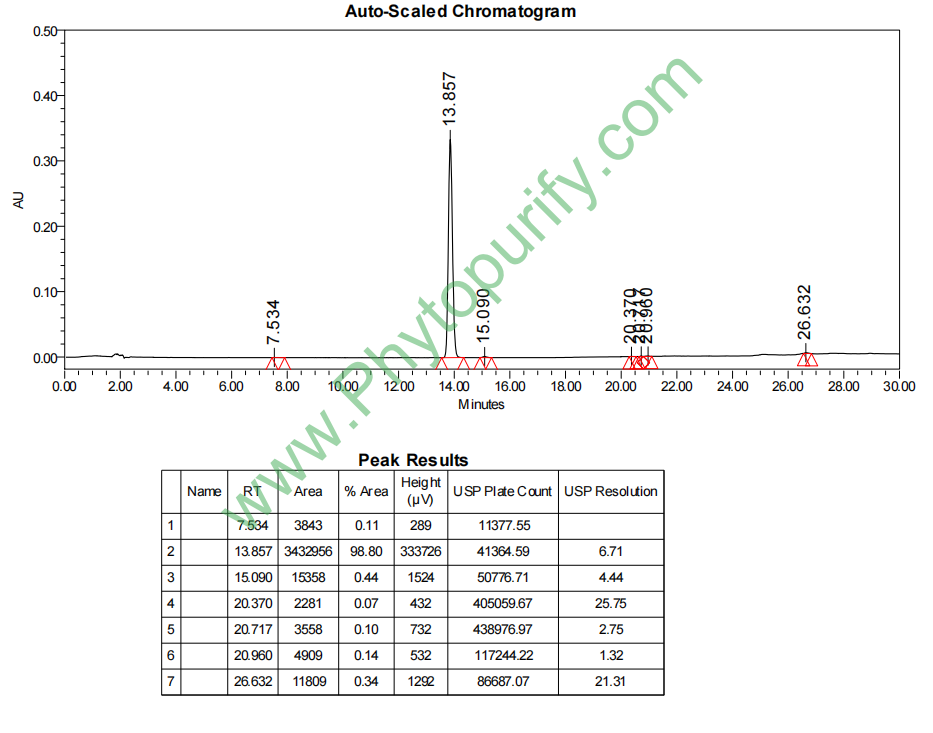
Purity: 95%~99%
Analysis Method: HPLC-DAD or/and HPLC-ELSD
Identification Method: Mass, NMR
Packing: Brown vial or HDPE plastic bottle
Storage: Store in a well closed container, protected from air and light. Put into refrigerate or freeze for long term storage.
Whenever possible, you should prepare and use solutions on the same day. However, if you need to make up stock solutions in advance, we recommend that you store the solution as aliquots in tightly sealed vials at -20℃. Generally, these will be useable for up to two weeks.
The product could be supplied from milligrams to grams
Inquire for bulk scale.
Description:
Neoandrographolide has antiradical, anti-inflammatory,and hypolipidemic effects, it protects the cardiovascular without significant liver damage. Neoandrographolide as chemosensitizer in S-Jurkat and X chromosome-linked inhibitor of apoptosis protein (XIAP)-overexpressing Jurkat cells, a model for chemoresistance.Neoandrographolide inhibits iNOS and COX-2 expression through inhibiting p38 MAPKs activation.
References:
Planta Med. 2010 Oct;76(15):1698-700.Neoandrographolide from Andrographis paniculata as a potential natural chemosensitizer.
Extracts of the traditional medicinal herb Andrographis paniculata and its main constituents are described in the literature as showing anticancer activity. The aim of this study was to isolate the main constituents of a commercially available phytotherapeutic preparation of A. paniculata and to determine their chemosensitizing potential in a leukemia cell line.
METHODS AND RESULTS:
Chromatographic separation steps resulted in the isolation of the diterpenes andrographolide (1) and 14-deoxy-11,12-didehydroandrographolide (3) and the diterpene glucoside Neoandrographolide (2). The combination of these constituents with suboptimal concentrations of etoposide revealed compound 2 as chemosensitizer in S-Jurkat and X chromosome-linked inhibitor of apoptosis protein (XIAP)-overexpressing Jurkat cells, a model for chemoresistance.
Phytother Res. 2013 Apr;27(4):618-23.
Hypolipidemic effects of andrographolide and neoandrographolide in mice and rats.
Andrographolide (AND) and Neoandrographolide (NEO) are the diterpenoids from the Andrographis paniculata (Acanthaceae). It is reported the diterpenoids exhibit a wide spectrum of biological activities.
METHODS AND RESULTS:
The aim of this study was to investigate the hypolipidemic effect of AND and NEO in hyperlipidemic mice induced by 75% yolk emulsion and in hyperlipidemic rats induced by high fat emulsion, respectively. The results showed that the levels of triglyceride, total cholesterol (TC) and low-density lipoprotein cholesterol were reduced by AND and NEO in a dose-dependent tendency in mice. Compared with the model group, the plasma TC levels of experimental groups with AND and NEO at 100 mg/kg dosage decreased by 23.9 and 20.2% in rats, respectively (P < 0.05). It was also found that the plasma aspartate transaminase and alanine transaminase levels were significantly decreased by feeding with AND and NEO in rats, compared with positive group (simvastatin) (P < 0.01). Otherwise, AND and NEO could protect the cardiovascular due to down-regulation of iNOS expression and up-regulation of eNOS expression.
CONCLUSIONS:
In conclusion, AND and NEO have potent hypolipidemic effects and protect the cardiovascular without significant liver damage.
Am J Chin Med. 2007;35(2):317-28.
In vivo and in vitro anti-inflammatory activities of neoandrographolide.
Neoandrographolide, one of the principal diterpene lactones, isolated from a medicinal herb Andrographis paniculata Nees, was tested in vivo and in vitro for its anti-inflammatory activities and mechanism.
METHODS AND RESULTS:
Oral administration of Neoandrographolide (150 mg/kg) significantly suppressed ear edema induced by dimethyl benzene in mice. Oral administration of Neoandrographolide (100-150 mg/kg) also reduced the increase in vascular permeability induced by acetic acid in mice. In vitro studies were performed using the macrophage cell line RAW264.7 to study the effect of Neoandrographolide on suppressing phorbol-12-myristate-13-acetate (PMA)-stimulated respiratory bursts and lipopolysaccharide (LPS)-induced production of nitric oxide (NO) and tumor necrosis factor-alpha (TNF-alpha). Respiratory bursts were quantified by chemiluminescence (CL) measurements. Results showed that Neoandrographolide suppressed PMA-stimulated respiratory bursts dose-dependently from 30 muM to 150 muM. Neoandrographolide also inhibited NO and TNF-alpha production in LPS-induced macrophages, contributing to the anti-inflammatory activity of A. paniculata.
CONCLUSIONS:
These results indicate that Neoandrographolide possesses significant anti-inflammatory effects, which implies that it would be one of the major contributing components to participate in the anti-inflammatory effect of A. paniculata. and a potential candidate for further clinical trial.
HPLC of Neoandrographolide
Storage conditions:Short-term storage at 2~8℃, long-term storage at -20 ~ -80℃
125.6800
1.8541
1.8541
.3543
.6593
.7873
Low
75.5530
5.0069
No
No
No
No
Yes
No
0.0
Yes
No
No
No
Neoandrographolide is a diterpenoid compound isolated from the traditional Chinese medicine Andrographis paniculata, which has significant pharmacological activity. As a widely used heat clearing and detoxifying herb in traditional Chinese medicine, the main active ingredients of Chuanxinlian include Chuanxinlian lactones and Chuanxinlian glycosides. In recent years, with the in-depth study of the pharmacological effects of natural products, the new glycoside of Chuanxinlian has become a research hotspot in the fields of anti-inflammatory, antiviral, bone metabolism regulation, and cardiovascular protection due to its multi-target and multi pathway regulatory ability. This article will provide a systematic review of the chemical structure and physicochemical properties, plant sources and extraction methods, pharmacological activity, mechanism of action, pharmacological evaluation, and clinical application prospects of the new glycoside from Chuanxinlian. The aim is to provide a theoretical basis and research direction for its subsequent drug development and clinical application.
The chemical name of the new glycoside of Chuanxinlian is 19-deoxy-3-O - β - D-glucosinolate Chuanxinlian lactone, with a molecular formula of C28H40O8 and a molecular weight of 480.5980. Its structure belongs to the diterpenoid lactone class, with a core of a tetracyclic diterpene skeleton and a 3-hydroxyl group modified by β - D-glucosylation. The glycoside structure endows it with good water solubility (approximately 0.3543 mg/mL), which is beneficial for absorption and distribution in vivo.
In terms of physical and chemical properties, the LogP value of Chuanxinlian glycoside is 1.8541, indicating that it has moderate lipid solubility and is conducive to cell membrane permeability. The topological polar surface area (TPSA) is 125.68 Å ², indicating its high polarity, which may affect its transmembrane absorption and blood-brain barrier penetration ability. The relevant pharmacokinetic parameters showed that the blood-brain barrier permeability of Chuanxinlian glycoside was low, the hERG channel inhibition experiment was negative, and the Ames mutagenicity test result was 0, indicating its good safety and low toxicity risk.
The main source of new glycosides in Andrographis paniculata comes from this plant, which is an annual herbaceous plant in the family Scrophulariaceae and widely distributed in tropical and subtropical regions of Asia. Chuanxinlian is widely used in the treatment of diseases such as colds, hepatitis, and respiratory infections due to its traditional effects of clearing heat, detoxifying, reducing inflammation, and relieving pain.
The extraction of new glycosides from Chuanxinlian is usually carried out using alcohol extraction method. The specific steps include:
In recent years, the application of supercritical CO2 extraction and membrane separation technology has provided new methodological support for the efficient extraction and purification of new glycosides from Houttuynia cordata.
Chuanxinlian Xinxin exhibits various pharmacological activities, including anti-inflammatory, antiviral, bone metabolism regulation, cardiovascular protection, and more.
Chuanxinlian Xin Gan can significantly inhibit the activity of inducible nitric oxide synthase (iNOS) and the generation of reactive oxygen species (ROS), and alleviate inflammatory reactions. It activates endothelial nitric oxide synthase (eNOS), promotes nitric oxide (NO) production, improves endothelial function, and exerts anti-inflammatory and vascular protective effects. Multiple in vitro and in vivo experiments have shown that Chuanxinlian glycoside can reduce the expression of pro-inflammatory factors such as TNF - α, IL-1 β, and IL-6 in inflammatory models, and alleviate tissue damage.
Chuanxinlian glycoside exhibits inhibitory effects on various viruses, involving targets such as myeloperoxidase (MPO), herpes virus associated proteins UL42, UL54, ICP27, viral thymidine kinase (TK), glycoprotein D (gD), as well as HIV related CCR5, CXCR4 receptors, HIV1 protease (HIV1-PR), integrase (INT), etc. Through the synergistic effect of multiple targets, Chuanxinlian glycoside inhibits virus replication, infection, and spread, and has potential broad-spectrum antiviral value.
Chuanxinlian glycoside regulates bone metabolism balance by inhibiting osteoclast differentiation and bone resorption. Its mechanism of action involves signaling pathways such as MAPK, NF - κ B, PI3K/AKT, GSK3 β, PPAR, and CAMK, which inhibit osteoclast formation, slow down bone loss, and have the potential to prevent and treat osteoporosis and osteoarthritis.
Chuanxinlian Xin Gan can inhibit apoptosis of rat embryonic ventricular myocytes, alleviate myocardial cell damage, and protect heart function. Its antioxidant and anti-inflammatory effects help alleviate myocardial ischemia-reperfusion injury and improve overall cardiovascular health.
The multiple pharmacological effects of Xinxin from Chuanxinlian are attributed to its regulation of key cellular signaling pathways and molecular targets.
Chuanxinlian glycoside directly or indirectly acts on multiple molecular targets:
In summary, the new glycoside of Chuanxinlian achieves its wide-ranging pharmacological effects through multi-target and multi pathway synergistic effects.
The pharmacological parameters of Chuanxin Lianxin glycoside indicate that it has certain potential for drug development.
In terms of pharmacokinetics, existing studies have shown that the absorption of Chuanxinlian glycoside is relatively fast after oral administration, with a moderate plasma half-life. It is mainly metabolized by the liver and excreted by the kidneys. Its glucoside structure may release active ingredients through hydrolysis by gut microbiota, affecting in vivo metabolic kinetics.
Due to its multi-target and multi pathway pharmacological properties, Chuanxinlian glycoside has shown broad clinical application prospects in multiple disease fields.
Future research should focus on:
As an important active ingredient in Houttuynia cordata, Xinxin from Houttuynia cordata has rich biological activity and good medicinal properties, exhibiting multiple pharmacological effects such as anti-inflammatory, antiviral, bone metabolism regulation, and cardiovascular protection. It demonstrates the advantages of natural product multi-target drugs through synergistic regulation of multiple signaling pathways and molecular targets. Although the research on its pharmacological mechanism and clinical application is still in the preliminary stage, the new glycoside of Chuanxinlian undoubtedly provides valuable resources and potential for the development of natural product drugs. In the future, through systematic pharmacology, pharmacokinetics, and clinical research, it is expected to promote the clinical application of Chuanxinlian glycoside and benefit more patients.
