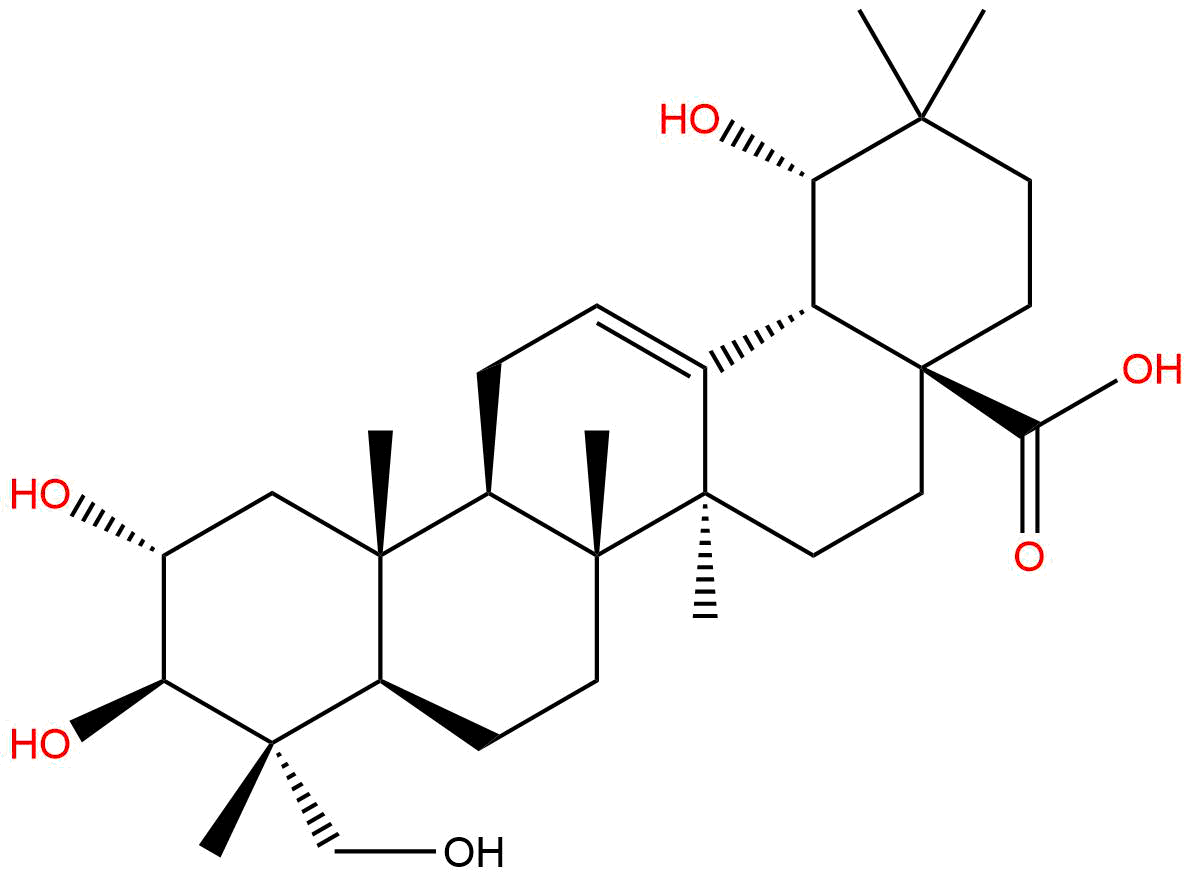
Product name: Arjungenin
Synonym name: 2-alpha,19-alpha,23-Trihydroxyoleanolic acid
Catalogue No.: BP2029
Cas No.: 58880-25-4
Formula: C30H48O6
Mol Weight: 504.708
Botanical Source:
Physical Description:
Type of Compound: Triterpenoids
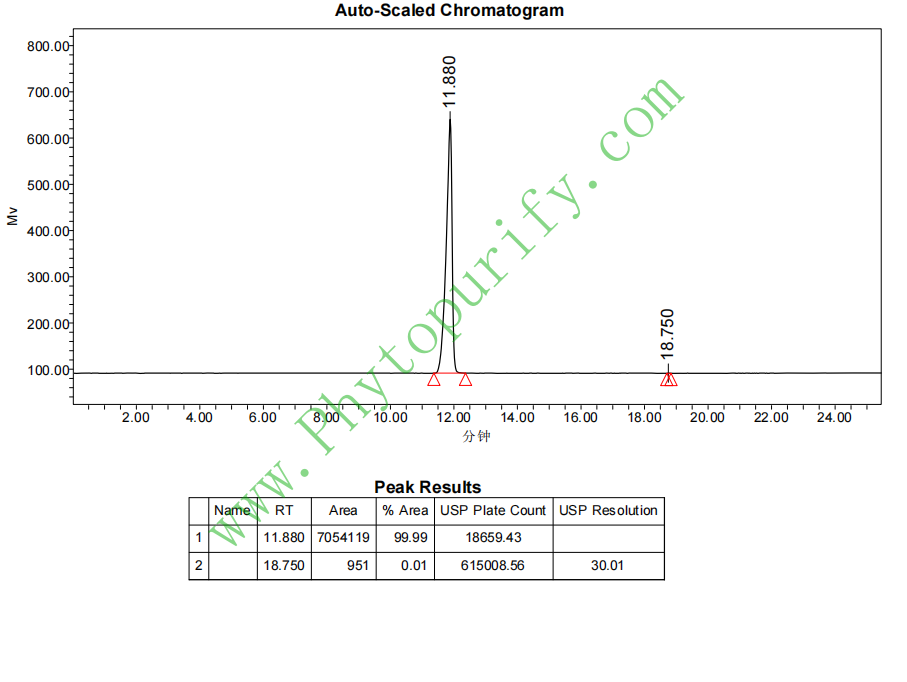
Purity: 95%~99%
Analysis Method: HPLC-DAD or/and HPLC-ELSD
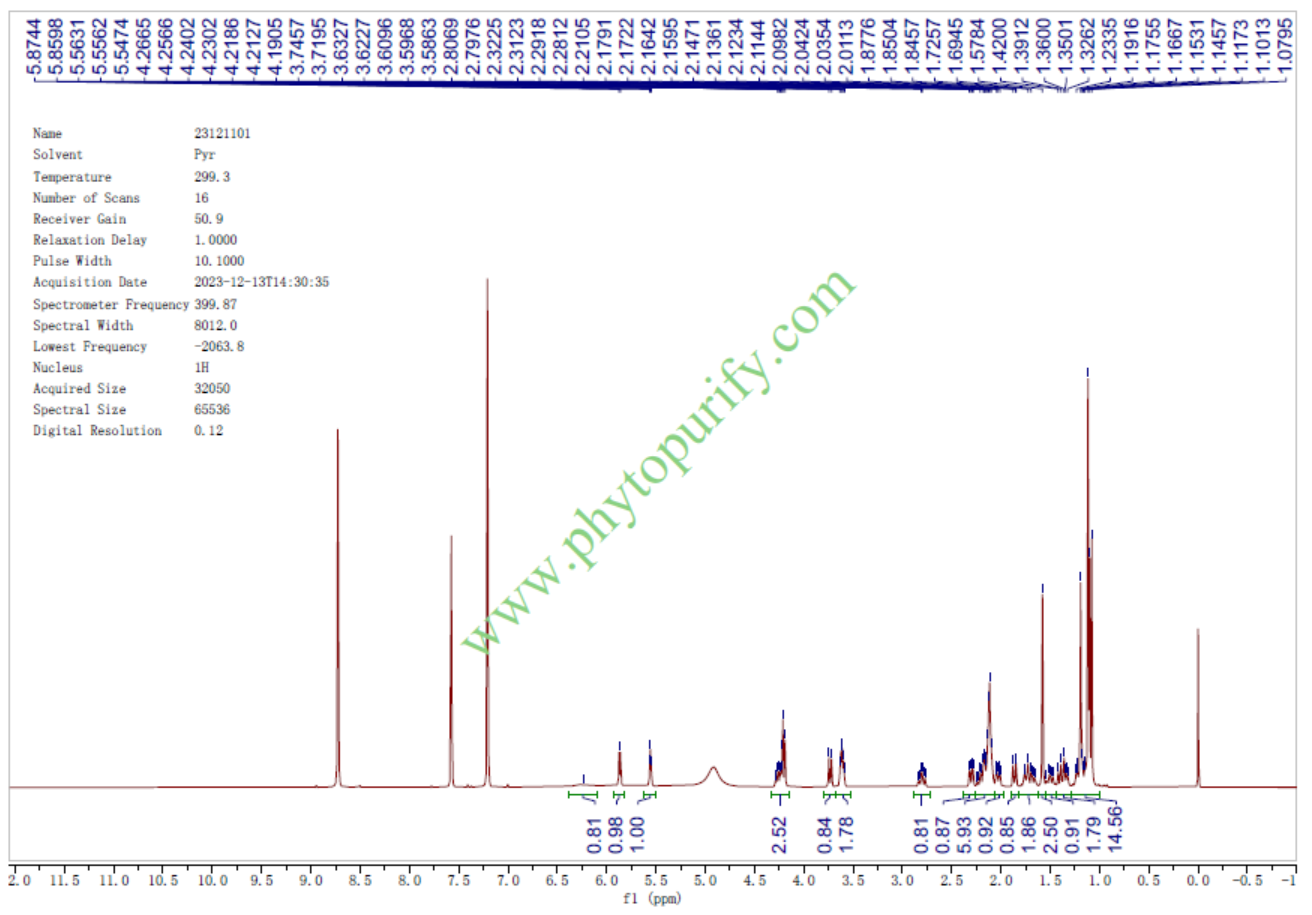
Identification Method: Mass, NMR
Packing: Brown vial or HDPE plastic bottle
Storage: Store in a well closed container, protected from air and light. Put into refrigerate or freeze for long term storage.
The product could be supplied from milligrams to grams
Inquire for bulk scale.
For Reference Standard and R&D, Not for Human Use Directly.
Description:
Arjungenin shows β-glucuronidase inhibitory activity, it shows antiviral, and anti-inflammatory activities. Arjungenin exhibits moderate antibacterial activity against Staphylococcus aureus, Escherichia coli and Enterococcus faecalis (MICs within a range of 64 and 256 ug/mL). Arjungenin shows significant protection against domoic acid induced toxicity in Caco-2 cell line.
References:
Cytotechnology. 2017 Aug;69(4):725-739.
Modulatory effects of Terminalia arjuna against domoic acid induced toxicity in Caco-2 cell line.
Domoic acid is a potent marine algal toxin produced by diatomic genus of Pseudo-nitzschia causing amnesic shell fish poisoning. Domoic acid toxicosis mainly involves excitotoxic effects coupled with oxidative stress.
METHODS AND RESULTS:
The present study was aimed to evaluate the protective effects of hydro-alcoholic extract of Terminalia arjuna (TA) against domoic acid induced toxic effects in Caco-2 cell line. It was observed that the toxicity induced by domoic acid in Caco-2 cells was mediated by oxidative insult leading to morphological changes, DNA damage and apoptosis. In our study pre-treatment of the cells with TA (10, 20 and 30 μg/ml) showed significant protection against domoic acid induced morphological, oxidative and apoptotic damages in a dose dependent manner. The effect of phytocompounds present in TA viz., kaempferol and Arjungenin showed significant protection against domoic acid induced toxicity in Caco-2 cell line.
CONCLUSIONS:
Hence, it could be inferred that the protective effect of TA extract against domoic acid induced toxicity could be due to the individual or synergistic effects of kaempferol and argungenin. However, further clinical studies are warranted to consider TA as a natural remedy to prevent amnesic shell fish poisoning.
Fitoterapia. 2016 Apr;110:89-95.
Antibacterial and cytotoxic triterpenoids from the roots of Combretum racemosum.
A new pentacyclic triterpenoid glucoside, together with fourteen known compounds, was isolated from the roots of Combretum racemosum. Combretaceae).
METHODS AND RESULTS:
The structure of the new compound was established as 28-O-β-d-glucopyranosyl-2α,3β,21β,23-tetrahydroxyolean-18-en-28-oate (1) on the basis of detailed spectroscopic data including MS, 1D, and 2D NMR. The inhibitory activity of compounds 1-15 against promyelocytic leukemia HL-60 and human erythromyeloblastoid leukemia K562 cell lines was evaluated. Compounds 11 (3-O-β-acetyl-ursolic acid), 14 (betulinic acid), and 15 (quadranoside II) exhibited significant cytotoxicity, with IC50 values of 13 to 50 μM. Among the isolated triterpenes, compounds 1, 3 (Arjungenin), 5 (terminolic acid), and 11 exhibited moderate antibacterial activity against Staphylococcus aureus, Escherichia coli and Enterococcus faecalis (MICs within a range of 64 and 256 μg/mL).
Zeitschrift Für Naturforschung B, 2005, 60(3):347-350.
Some chemical constituents of Terminalia glaucescens and their enzymes inhibition activity.
METHODS AND RESULTS:
A new triterpenoid, glaucinoic acid (2α, 3β, 19α, 24-tetrahydroxyolean-12-en-30-oic acid) (1) along with several known compounds, arjunic acid (2), Arjungenin (3), sericoside (4), and friedelin (5) were isolated from the stem barks of Terminalia glaucescens.
CONCLUSIONS:
These compounds showed β-glucuronidase inhibitory activity. The structures were identified on the basis of spectroscopic techniques.
HPLC of Arjungenin
HNMR of Arjungenin
Storage conditions:Short-term storage at 2~8℃, long-term storage at -20 ~ -80℃
118.2200
3.5278
1.7997
.0281
1.4280
3.7154
Low
86.8125
5.0945
No
No
No
No
No
No
0.0
Yes
No
Yes
No
Arjungnin is a typical natural product of pentacyclic triterpenoids, which was first isolated from the traditional Chinese medicinal herb Terminalia arjuna. As a type of natural triterpenoid with diverse biological activities, Ajinomycin has attracted widespread attention in the fields of pharmacology and natural product chemistry in recent years due to its unique chemical structure and extensive pharmacological activities. Research has shown that Ajinomoto not only acts as an agonist of Farnesoid X receptor (FXR), regulating adipocyte function to improve insulin sensitivity, but also exhibits significant antioxidant, antiviral, and insect growth inhibitory activities. In addition, Ajiangelenin has shown certain application prospects in the potential treatment of tumor diseases such as thyroid cancer.
The purpose of this article is to systematically review the chemical structure and physicochemical properties, plant sources and extraction methods, pharmacological activity and mechanism of action, drug evaluation and pharmacokinetic characteristics of Ajiangelenin, and to explore its potential clinical applications and future development directions in combination with existing research, providing theoretical basis and reference for the in-depth research and drug development of this natural product.
Ajiang Lanren Su (CAS number: 58880-25-4) belongs to the pentacyclic triterpenoid class, with a molecular formula of C30H48O5 and a molecular weight of 504.7080. Its core structure is a five ring skeleton, containing multiple hydroxyl and carboxyl functional groups, endowing it with certain polarity and biological activity. The LogP value is 3.5278, indicating that it has moderate lipid solubility, which is beneficial for membrane penetration and bioavailability. The polar surface area (TPSA) is 118.22 Å ², indicating that the molecule may have some polarity limitation in vivo, but still has good drug compatibility.
The low water solubility (0.0281 mg/mL) of Ajianglansu limits its solubility and bioavailability in aqueous media to some extent, but it is expected to overcome this limitation through appropriate formulation improvements. Its blood-brain barrier permeability is relatively low, indicating that the distribution of Ajinomycin in the central nervous system is limited, reducing the potential risk of central neurotoxicity. The negative result of hERG channel inhibition experiment indicates a low risk of cardiac toxicity. The Ames mutagenicity test result was 0.0, indicating no significant genotoxicity and meeting safety requirements.
Structurally, the hydroxyl and carboxyl groups of Ajinomycin not only serve as key binding sites for its target proteins, but also provide the basis for its antioxidant activity. The pentacyclic triterpenoid skeleton provides the molecular basis for its multi-target action and is the core of its multiple biological activities.
Ajiang Lanren is mainly derived from Terminalia arjuna, a traditional medicinal plant used for the treatment of cardiovascular diseases. Ajianglan is widely distributed in South Asia, especially in India and Sri Lanka. Its bark and fruit are rich in various triterpenoids and phenolic compounds.
The traditional method for extracting Ajiangelenin usually uses solvent extraction technology. Common solvents include methanol, ethanol, ethyl acetate, etc., which are extracted step by step based on polarity differences to enrich the target components. The specific steps are generally as follows:
In recent years, the application of new technologies such as ultrasound assisted extraction and microwave-assisted extraction has improved the extraction efficiency and purity of Ajinomoto, reduced solvent usage and extraction time, and provided technical support for industrial production.
As an effective agonist of the farnesol X receptor (FXR), Ajiangelenin can regulate the function of adipocytes and improve insulin sensitivity. FXR is a nuclear receptor that primarily regulates bile acid metabolism, lipid metabolism, and glucose homeostasis. By activating FXR, aganglionin can promote the balance of lipid metabolism in adipocytes, inhibit fat accumulation, and enhance the sensitivity of insulin signaling pathway, which has potential therapeutic value for type 2 diabetes and metabolic syndrome.
Animal experiments have shown that the group treated with Ajinomoto significantly improved insulin resistance, reduced blood glucose levels, and decreased expression of inflammatory factors in adipose tissue, suggesting that it regulates metabolic inflammation through multi-target regulation.
Ajiang Lanren Su exhibits moderate levels of free radical scavenging ability, especially with certain scavenging effects on hydroxyl radicals and superoxide anions. In addition, its inhibitory activity on the production of hypochlorous acid (HOCl) is also significant. Hypochloric acid is a strong oxidant produced in inflammatory reactions, and excessive amounts of hypochlorous acid can lead to tissue damage and chronic inflammation.
Ajiang Lanren Su exerts anti-inflammatory and protective effects by inhibiting the production of hypochlorous acid, reducing oxidative stress, protecting cells from oxidative damage. This characteristic provides a theoretical basis for its application in oxidative stress-related diseases such as cardiovascular disease and neurodegenerative diseases.
Ajianglansu exhibits significant inhibitory effects on various viruses, especially RNA viruses such as Chikungunya virus (CHIKV). In vitro cell model studies have shown that Ajinomycin can effectively inhibit virus replication, reduce viral load, and lower viral induced cell damage.
Its antiviral mechanism may involve interfering with virus invasion, replication, and assembly processes, while enhancing antiviral defense capabilities by regulating host immune responses. This activity provides a new approach for the development of antiviral drugs using Ajinomycin.
Although the research on Ajinomycin in the field of cancer is still in its early stages, previous studies have indicated that it has a certain inhibitory effect on tumor cells such as thyroid cancer. The key pathogenic genes of thyroid cancer include TP53, BRAF, NRAS, PTEN, and RET. Ajinomycin may inhibit tumor cell proliferation and promote apoptosis by regulating these signaling pathways.
In vitro experiments have shown that Ajinomycin can induce tumor cell cycle arrest, reduce cell migration and invasion ability, indicating its potential as an adjuvant anticancer drug.
Ajiang Lanren Su has shown significant growth inhibitory effects on the agricultural pest Spilarctina obliqua. This activity provides a natural and low toxicity candidate compound for its application in pesticide development, and has the development value of eco-friendly insecticides.
The multiple pharmacological activities of Ajiangelenin are attributed to its ability to regulate multiple molecular targets, mainly including:
As an agonist of FXR, Ajinomoto induces receptor conformational changes, activates downstream gene expression, regulates bile acid metabolism, lipid synthesis, and glucose homeostasis by binding to the FXR ligand binding domain. FXR activation promotes fatty acid oxidation and energy metabolism in adipocytes, reducing insulin resistance.
Ajiang Lanren Su enhances cellular antioxidant capacity, reduces ROS (reactive oxygen species) production, and protects cells from oxidative damage by regulating the expression of antioxidant enzymes such as NADPH oxidase, superoxide dismutase (SOD), and glutathione peroxidase (GPx).
In its antiviral effect, Ajinomycin may interfere with the viral life cycle by inhibiting the RNA dependent RNA polymerase activity, blocking the synthesis and assembly of viral proteins. In addition, Ajiangelenin regulates host immune signaling pathways, such as interferon signaling, and enhances antiviral response.
The regulation of thyroid cancer-related genes such as TP53, BRAF, NRAS, PTEN, RET by Ajiang Lanren Su may activate the apoptotic pathway, inhibit MAPK/ERK signaling, block cell cycle progression, and reduce tumor cell proliferation and metastasis.
Ajianglansu interferes with the insect endocrine system, inhibits growth hormone synthesis, affects molting hormone signaling, and leads to delayed or even death of Spodoptera litura larvae, demonstrating its growth inhibitory effect.
The pharmacological parameters of Ajiang Lanren Su show that it has good potential for drug development:
In terms of pharmacokinetics, existing research is relatively limited. Preliminary animal experiments have shown that the oral bioavailability of Ajianglansu is moderate, mainly metabolized through the liver, and the safety of the metabolites is good. Its half-life is moderate and suitable for daily administration. In the future, further systematic research is needed on its absorption, distribution, metabolism, and excretion (ADME) characteristics to optimize the dosing regimen.
Due to its multi-target and multifunctional pharmacological properties, Ajiang Lanren Su has demonstrated broad clinical application potential in various disease fields
metabolic diseases As an FXR agonist, aganglionin is expected to become a new drug for the treatment of type 2 diabetes, non-alcoholic fatty liver disease (NAFLD) and metabolic syndrome. Its ability to improve insulin sensitivity and regulate lipid metabolism meets the current demand for the treatment of metabolic diseases.
antiviral therapy Regarding emerging viral infections such as the Chikungunya virus, Ajinomycin provides a candidate molecule for natural antiviral drugs, especially in viral diseases lacking specific drugs, which is of great significance.
neoadjuvant therapy Regarding thyroid cancer and other tumors, Ajinomycin regulates tumor growth through multiple pathways and has potential adjuvant therapeutic value. Combining existing targeted drugs may improve treatment efficacy and reduce drug resistance.
Antioxidant and anti-inflammatory properties Its antioxidant and anti-inflammatory activities provide new ideas for the treatment of chronic inflammatory diseases such as cardiovascular diseases and neurodegenerative diseases.
Agricultural applications The insect growth inhibitory activity of Ajiang Lanren Su makes it an ideal candidate for natural pesticide development, which is in line with the trend of green agriculture development.
Future research should focus on the preclinical safety evaluation, pharmacokinetic optimization, and formulation development of Ajinomycin, while combining modern molecular biology techniques to deeply analyze its mechanism of action and promote its clinical translation.
As a natural product of pentacyclic triterpenoids, Ajiangelenin has shown extensive pharmacological potential due to its unique chemical structure and diverse biological activities. Its application prospects as an FXR agonist in the treatment of metabolic diseases are particularly prominent, and its antioxidant, antiviral, anti-tumor, and insect growth inhibitory activities provide a solid foundation for its development in multiple fields. Although the research on its pharmacokinetics and clinical application is still in its early stages, with the continuous deepening of extraction and purification technology and molecular pharmacology research, Ajinomycin is expected to become an important breakthrough in the development of natural product drugs.
Future work needs to strengthen the systematic analysis of its mechanism of action, optimize drug formulations, improve bioavailability, conduct systematic preclinical and clinical research, promote the transition of Ajinomycin from laboratory to clinical use, and benefit human health.