


Product name: Chebulagic acid
Synonym name:
Catalogue No.: BP0338
Cas No.: 23094-71-5
Formula: C41H30O27
Mol Weight: 954.664
Botanical Source: Tannin derived from divi-divi (fruit of Caesalpinia coriaria) and myrobalans (fruit of Terminalia chebula). Present in Geranium spp.
Physical Description: Powder
Type of Compound: Phenols
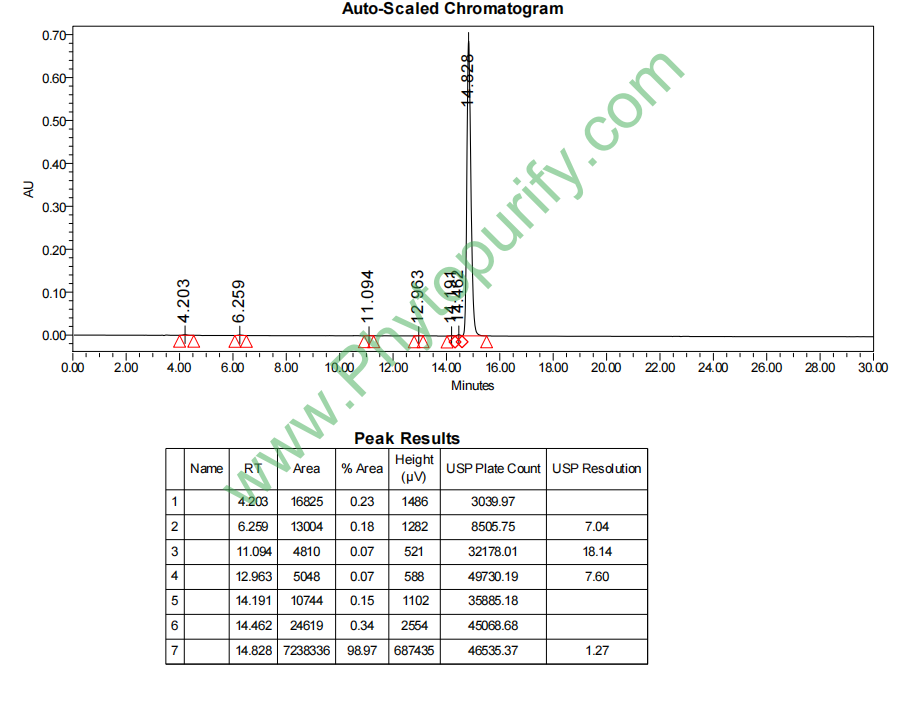
Purity: 95%~99%
Analysis Method: HPLC-DAD or/and HPLC-ELSD
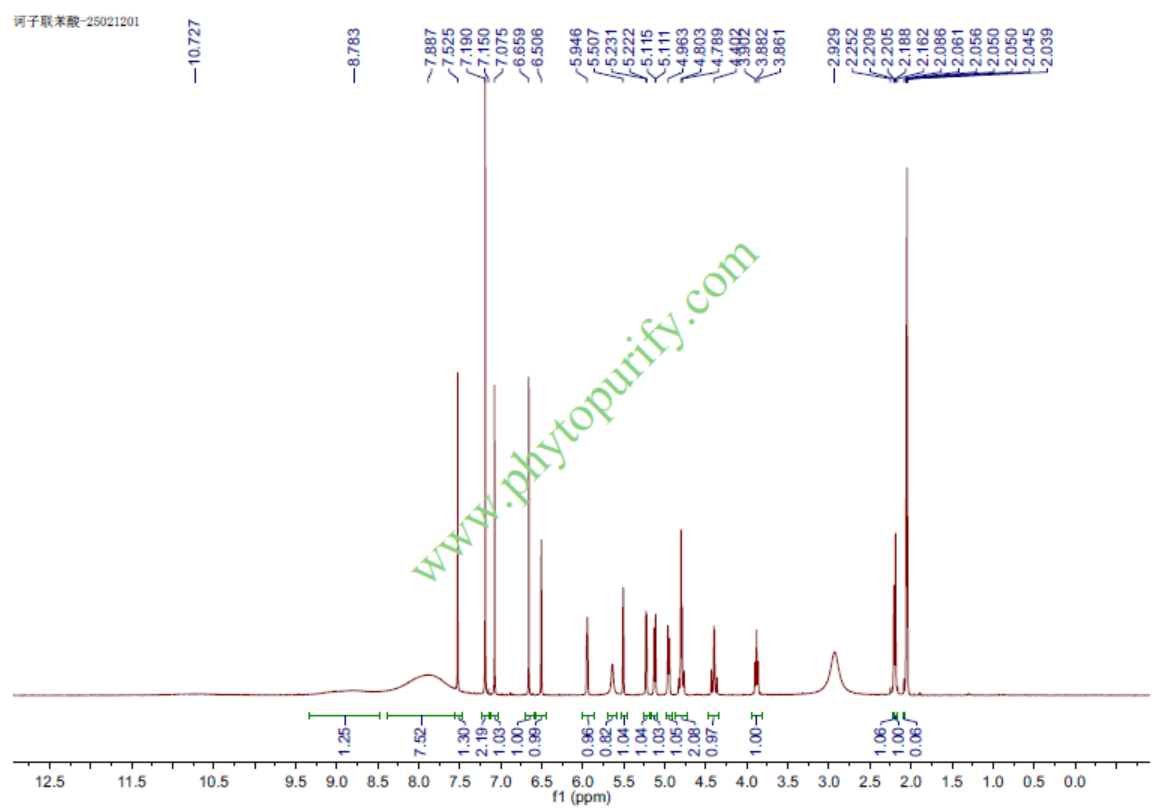
Identification Method: Mass, NMR
Packing: Brown vial or HDPE plastic bottle
Storage: Store in a well closed container, protected from air and light. Put into refrigerate or freeze for long term storage.
Whenever possible, you should prepare and use solutions on the same day. However, if you need to make up stock solutions in advance, we recommend that you store the solution as aliquots in tightly sealed vials at -20℃. Generally, these will be useable for up to two weeks.
The product could be supplied from milligrams to grams, up to kilograms
Inquire for bulk scale.
Descriptions:
Chebulagic acid, isolated from the fruits of Terminalia, it shows potent COX–LOX dual inhibition activity with IC50 values of 15 ± 0.288, 0.92 ± 0.011 and 2.1 ± 0.057 μM for COX-1, COX-2 and 5-LOX respectively, it also shows anti-proliferative activity against HCT-15, COLO-205, MDA-MB-231, DU-145 and K562 cell lines, it induces apoptosis in COLO-205 cell line.[1]
Chebulagic acid significantly suppresses the onset and progression of arthritis (CIA) in mice, immune suppression via the induction of TGFbeta and CD4+,CD25+ T cells may represent a new strategy in the development of therapies for managing rheumatoid arthritis and other inflammatory diseases.[2]
Chebulagic acid , a natural anti-oxidant, shows potent anti-inflammatory effects by suppressing NF-κB and MAPK activation in LPS-stimulated RAW 264.7, a mouse macrophage cell line. [3]
Chebulagic acid can reduce the viral cytopathic effect on rhabdomyosarcoma cells with an IC50 of 12.5 ug/mL, the utilization of the chebulagic acid treatment on mice challenged with a lethal dose of enterovirus 71 is able to efficiently reduce mortality and relieve clinical symptoms through the inhibition of viral replication, suggests that chebulagic acid may represent a potential therapeutic agent to control infections to enterovirus 71.[4]
Chebulagic acid and punicalagin have broad-spectrum antiviral activity against viruses that use glycosaminoglycans for entry.[5]
Chebulagic Acid is a potent α-glucosidase inhibitor, has anti-hyperglycemic effect .[6,7]
Chebulagic acid has neuroprotective effect via autophagy induction in SH-SY5Y cells.[8]
References:
[1] Reddy D B, Reddy T C M, Jyotsna G, et al. J Ethnopharmacol, 2009, 124(3):506-12.
[2] Sang-Ik Lee ?, Hyun P M, Kim S H, et al. Arthritis & Rheumatol, 2005, 52(1):345-53.
[3] Reddy D B, Reddanna P. Biochem Bioph Res Co, 2009, 381(1):112-7.
[4] Yang Y, Xiu J, Liu J, et al. Int J Mol Sci, 2013, 14(5):9618-27.
[5] Lin L T, Chen T Y, Lin S C, et al. Bmc Microbiol, 2013, 13(1): 187-91.
[6] Huang Y N, Zhao D D, Gao B, et al. Int J Mol Sci, 2012, 13(5):6320-33.
[7] Gao H, Huang Y N, Gao B, et al. Biosci Biotech Bioch, 2008, 72(2):601-3.
[8] Kim H J, Kim J, Kang K S, et al. Biomol Ther, 2014, 22(4):275-81.
[9] Nie G H, Li Z G, Lv Y Q, et al.Chinese Pharmaceutical Journal, 2001, 36 (8): 517-9.
HPLC of Chebulagic acid
HNMR of Chebulagic acid
Storage conditions:Short-term storage at 2~8℃, long-term storage at -20 ~ -80℃
Chebulagic acid (CAS number: 23094-71-5), also known as gallic acid, is a natural polyphenolic compound isolated from the fruits of traditional medicinal plants and belongs to the tannin class. As a natural product with multi-target activity, succinic acid has attracted much attention in recent years due to its significant anti-inflammatory, antioxidant, and antiviral activities. Its unique double inhibition of COX-LOX provides a theoretical basis for its anti-inflammatory mechanism. At the same time, its inhibition on influenza virus M2 (S31N) mutant and novel coronavirus SARS-CoV-2 shows its broad prospects as a potential antiviral drug in the field of anti infection. In addition, the role of succinic acid in regulating oxidative stress-related signaling pathways provides a molecular basis for its application in antioxidant damage and related disease prevention and treatment. This article provides a systematic review of the chemical structure and physicochemical properties, plant sources and extraction methods, pharmacological activity and mechanism of action, pharmacological evaluation, and clinical application prospects of succinic acid. The aim is to provide scientific references for the in-depth research and drug development of this natural product.
Hezibiphenylic acid is a complex polyphenolic compound with a molecular formula of C41H28O27 and a molecular weight of 890.66 Da. Its structural characteristics are mainly manifested by the binding of the core structure of biphenylic acid with multiple phenolic hydroxyl and ester bonds, forming a highly oxidized polyphenol network. This compound has 27 hydrogen bond acceptors, extremely high polarity (TPSA about 500 Å ²), a LogP value of -1.5, and exhibits strong hydrophilicity and low lipophilicity. Its high polarity and abundant hydroxyl groups endow succinic acid with excellent antioxidant capacity, but also pose challenges to its membrane permeability and bioavailability.
From the perspective of physical and chemical properties, hedonic acid is not easily able to pass through the blood-brain barrier, and currently has no significant hepatotoxicity, cardiotoxicity, or hERG channel inhibitory activity, indicating good safety. Its complex molecular structure and high polarity may limit its absorption and distribution in pharmacokinetics, but this also provides the possibility of targeting specific tissues or cells.
Hedyotis diffusa mainly exists in the fruit of Terminalia chabula Retz., which is a widely used medicinal herb in traditional Chinese medicine and Ayurvedic medicine. Its fruit is rich in various tannic compounds, including succinic acid, tannic acid, etc. In addition to Hezi, some plants in the Terminalia genus also contain this compound, but at lower levels.
The extraction method usually uses water extraction or alcohol extraction combined with liquid-liquid separation technology to ensure the integrity and activity of the compound. Common extraction techniques include:
During the extraction process, attention should be paid to avoiding high temperature and strong acid-base conditions to prevent compound degradation. Purified succinic acid typically exists in the form of a brownish yellow powder, soluble in water and polar organic solvents.
As a dual inhibitor of COX (cyclooxygenase) and LOX (lipoxygenase), succinic acid can effectively inhibit the synthesis of prostaglandins and leukotrienes, and alleviate inflammatory reactions. In vitro experiments have shown that succinic acid significantly inhibits COX-2 and 5-LOX enzyme activity, and reduces the expression of pro-inflammatory factors such as TNF - α, IL-1 β, and IL-6. In animal models, hedonic acid reduces edema and cell infiltration in inflammatory tissues, demonstrating good anti-inflammatory effects.
Hedyotis diffusa exerts antioxidant protection by regulating various antioxidant enzymes and signaling pathways. It can activate the NFE2L2/NRF2 signaling pathway, promote the expression of downstream antioxidant enzymes SOD1, SOD2, CAT, GPX1, and HMOX1, clear reactive oxygen species (ROS), and alleviate cell damage caused by oxidative stress. This mechanism provides theoretical support for its potential application in oxidative damage related diseases such as neurodegenerative diseases, cardiovascular diseases, and chronic inflammation.
Hezibenzidine exhibits multiple activities in the field of antiviral activity. Firstly, as an effective inhibitor of the S31N mutant strain of influenza virus M2 protein, it can block the ion channel function of the virus and inhibit virus replication. Secondly, recent studies have found that chebula biphenyl acid has a significant inhibitory effect on the replication of SARS CoV-2 virus, with an EC50 of about 9.76 μ M, suggesting that chebula biphenyl acid is a potential candidate drug against COVID-19. In addition, hedonic acid also exhibits inhibitory activity against other viruses such as hepatitis B virus and herpes simplex virus, demonstrating its broad-spectrum antiviral potential.
Some studies have also reported that hedonic acid has anti-tumor, immune regulatory, and liver protective effects, but the relevant mechanisms still need further clarification.
The multi-target mechanism of action of succinic acid mainly includes:
Molecular docking and structural biology studies have shown that the polyphenolic hydroxyl groups of succinic acid form stable hydrogen bonds and hydrophobic interactions with the active sites of target proteins, enhancing binding affinity and supporting its multi-target pharmacological activity.
The pharmacological evaluation of succinic acid shows that it has certain advantages and challenges:
At present, there is limited pharmacokinetic data on hedonic acid, and preliminary studies suggest that its oral bioavailability is low, and its metabolic stability in vivo still needs further evaluation. To improve its pharmacokinetic performance, strategies such as nanocarriers, liposome encapsulation, and structural modification are being explored.
As a natural multifunctional drug candidate molecule, succinic acid has broad clinical application potential:
Future research should focus on:
As a natural polyphenolic compound derived from traditional medicinal plants, hedonic acid exhibits broad pharmacological value and clinical application potential due to its unique COX-LOX dual inhibition, antioxidant, and antiviral activities. Despite the pharmacokinetic challenges posed by its large molecular weight and high polarity, it is expected to overcome these limitations with the assistance of modern drug design and delivery technologies. The pharmacological mechanism research, pharmacological optimization, and clinical evaluation of future systems will provide a solid foundation for the drug development of hedonic acid and promote it as a new generation of safe and effective natural drug candidate molecules.
