


Synonym name: Eutannin
Catalogue No.: BP0339
Cas No.: 18942-26-2
Formula: C41H32O27
Mol Weight: 956.68
Botanical Source: Tannin derived from divi-divi (fruit of Caesalpinia coriaria) and myrobalans (fruit of Terminalia chebula). Also obtainable from Geranium thunbergii and the seeds of sal (Shorea robusta)
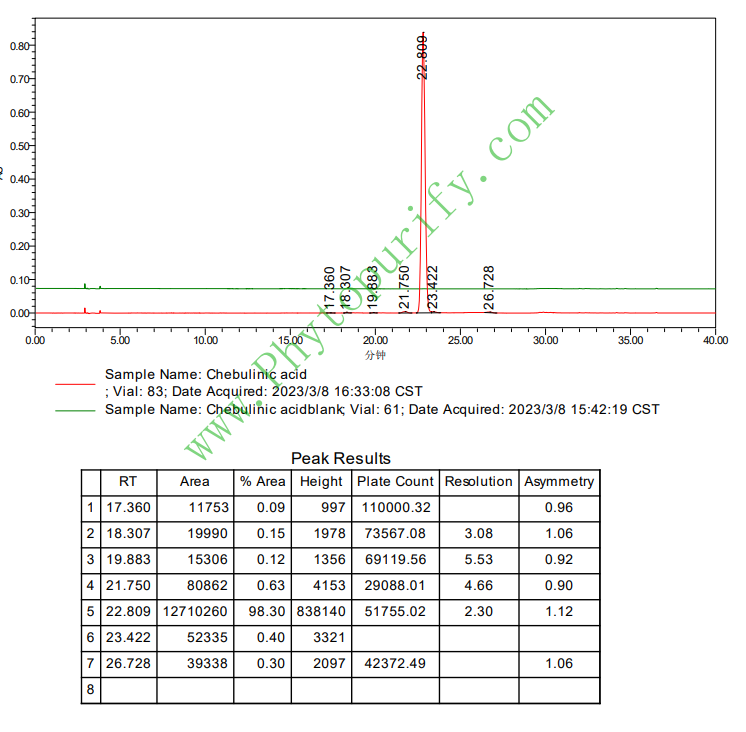
Purity: 95%~99%
Analysis Method: HPLC-DAD or/and HPLC-ELSD
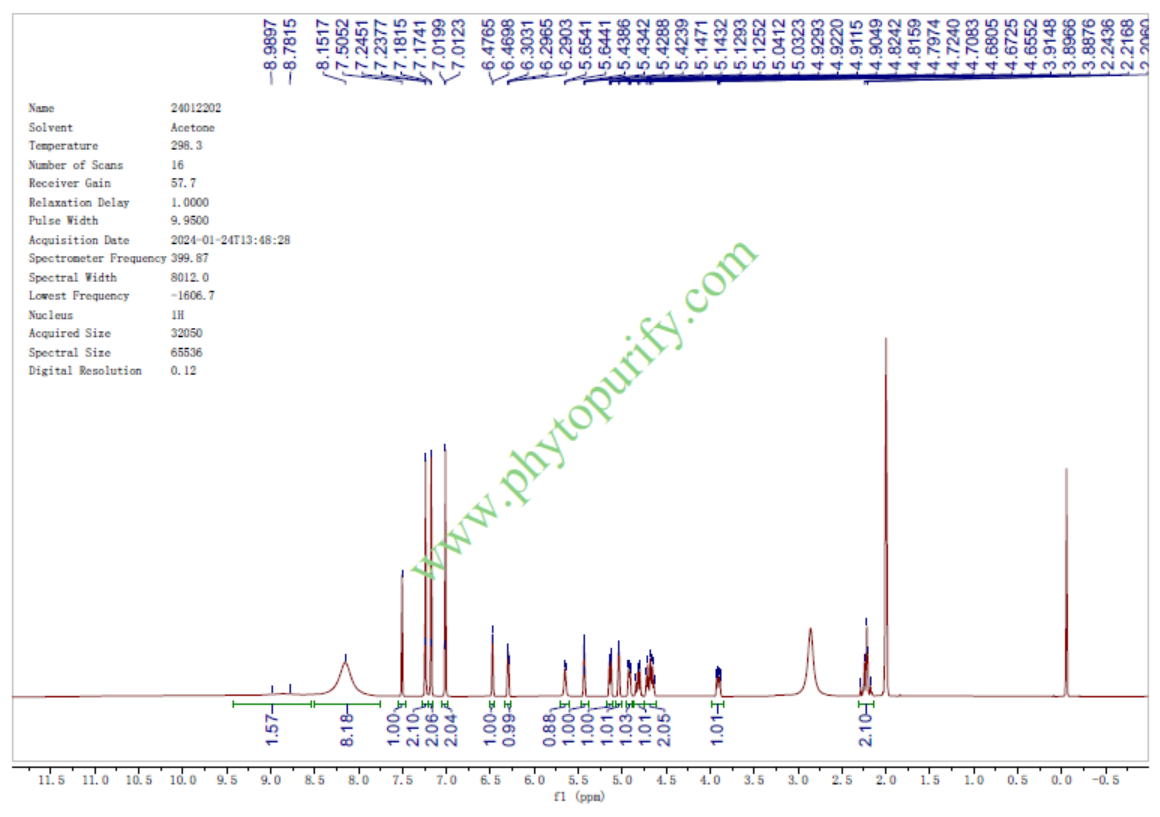
Identification Method: Mass, NMR
Packing: Brown vial or HDPE plastic bottle
Can be supplied from milligrams to grams.
For Reference Standard and R&D, Not for Human Use Directly.
Inquire for bulk scale.
HPLC of Chebulinic acid
HNMR of Chebulinic acid
Storage conditions:Short-term storage at 2~8℃, long-term storage at -20 ~ -80℃
Chebulitic acid (CAS number: 18942-26-2) is a natural polyphenolic compound derived from traditional medicinal plants, which has attracted widespread attention due to its unique chemical structure and significant biological activity. As a natural inhibitor of M. tuberculosis DNA gyrase, succinic acid has shown potential drug development value in the field of anti tuberculosis and drug-resistant bacterial infections. In addition, it has been found that succinic acid can inhibit the phosphorylation of SMAD-3 and the activity of H+K+- ATPase in gastric wall cells, indicating its potential application in the treatment of fibrosis and gastric acid related diseases. This article provides a systematic review of the chemical structure, plant origin, pharmacological activity, mechanism of action, pharmacological evaluation, and clinical application prospects of succinic acid, aiming to provide reference for natural product pharmacology and related drug development.
Hezi acid is a high molecular weight polyphenolic water-soluble compound with a molecular weight of 956.67. It has a complex molecular formula and contains multiple phenolic hydroxyl groups and ester bond structures. Its LogP value is -2.5, indicating strong hydrophilicity, and its topological polar surface area (TPSA) is as high as 500, indicating strong polarity. It has up to 27 hydrogen bond acceptors, reflecting its abundant polar groups and potential for hydrogen bond formation. These physical and chemical properties determine the absorption and distribution characteristics of succinic acid in the body, particularly limiting its ability to pass through the blood-brain barrier (blood-brain barrier permeability is unknown). In addition, there is currently no clear data on its safety indicators such as hepatotoxicity, cardiotoxicity, hERG channel inhibition, and mutagenicity (Ames test), and further systematic evaluation is needed.
Structurally, succinic acid belongs to hydrolyzed tannins, containing multiple gallic acid and hexose residues, with a complex structure and good stability. Its abundant phenolic hydroxyl groups endow it with excellent antioxidant activity, while also affecting its interaction with biomolecules, especially its binding to proteases and enzyme targets.
Terminalia chebula Retz., an important medicinal material in traditional Chinese medicine and Ayurvedic medicine in India, is widely used to treat digestive system diseases and infectious diseases. Other plants in the Terminalia genus, such as Terminalia bellirica and Terminalia arjuna, also contain a certain amount of succinic acid.
Traditional extraction methods often use water extraction or ethanol extraction, combined with modern technologies such as ultrasound assisted extraction and microwave-assisted extraction, to improve extraction efficiency and purity. The typical process includes:
In recent years, supercritical CO2 extraction and membrane separation technologies have also been attempted to be applied to the extraction and purification of succinic acid, aiming to achieve green and efficient industrial production.
As a natural inhibitor of M. tuberculosis DNA gyrase, succinic acid can effectively inhibit the ATPase activity of the enzyme, block the formation of bacterial DNA supercoiled structures, and thus inhibit bacterial replication and transcription. DNA gyrase is an important target of Mycobacterium tuberculosis, especially in drug-resistant strains, and drug development targeting this target is of great significance.
In vitro experiments have shown that succinic acid has significant antibacterial effects on multiple drug-resistant strains, especially against multidrug-resistant tuberculosis strains, exhibiting lower minimum inhibitory concentrations (MIC). In addition, succinic acid also exhibits certain inhibitory activity against other related targets such as GYPB, DHFR, MECA, and PENA, indicating its broad-spectrum antibacterial potential.
Hezic acid can inhibit the phosphorylation of SMAD-3, block the activation of the transforming growth factor beta (TGF - β) signaling pathway, and thereby alleviate the fibrosis process. SMAD-3 is a key transcription factor for TGF - β signaling, and its abnormal activation is the pathological basis of various fibrotic diseases. Animal models and cell experiments have confirmed that succinic acid can effectively inhibit fibrosis in organs such as the liver and lungs, and has potential value in the development of anti fibrotic drugs.
Hezi acid has also been found to inhibit the activity of H+K+- ATPase in gastric wall cells, reduce gastric acid secretion, and help treat gastric acid related diseases such as gastric ulcers and gastroesophageal reflux. The mechanism of action is similar to proton pump inhibitors (PPIs), but as a natural product, succinic acid may have good safety and tolerability.
In addition to the main activities mentioned above, hedonic acid also exhibits various biological effects such as antioxidant, anti-inflammatory, and anti-tumor effects, and related research is still ongoing.
DNA gyrase is a unique topoisomerase in bacteria, responsible for maintaining the supercoiled state of DNA. Hezic acid binds to the ATP binding site of DNA gyrase, blocking its ATPase activity and inhibiting the enzyme's supercoiling function, resulting in hindered DNA replication and transcription, and inhibited bacterial growth.
Molecular docking and dynamic simulations show that the polyphenolic hydroxyl groups of succinic acid form stable hydrogen bonds and hydrophobic interactions with key amino acid residues in DNA gyrase, enhancing binding affinity.
The TGF - β signaling pathway activates receptor kinases, promotes SMAD-3 phosphorylation and translocation to the nucleus, and regulates fibrosis related gene expression. Hezi acid can interfere with the phosphorylation process, block signal transduction, and alleviate fibrotic pathological changes. The specific mechanism may involve direct inhibition of receptor kinases or regulation of upstream signaling molecules.
H+K+- ATPase is a proton pump in gastric wall cells, responsible for the secretion of gastric acid. Hezic acid inhibits its ATP hydrolysis activity, reduces proton pump function, and decreases gastric acid secretion by binding to the catalytic subunit of enzymes. This mechanism is different from traditional PPIs and may provide new therapeutic strategies.
The inhibitory effects of succinic acid on targets such as GYPB (red blood cell membrane glycoprotein), DHFR (dihydrofolate reductase), MECA, and PENA suggest that it may exert antibacterial and other pharmacological effects through multi-target synergistic effects.
The high molecular weight (956.67 Da) and high polarity (LogP-2.5, TPSA 500) of succinic acid limit its oral bioavailability and cell membrane permeability, especially making it difficult to pass through the blood-brain barrier, limiting its application in central nervous system diseases. Although its abundant number of hydrogen bond receptors is beneficial for binding to targets, it also increases the complexity of metabolism and excretion.
At present, there is no systematic data on the hepatotoxicity, cardiotoxicity (including hERG channel inhibition), and mutagenicity of succinic acid. Systematic toxicological studies are needed to evaluate its safety. In addition, pharmacokinetic studies have shown that succinic acid is metabolized rapidly in the body, mainly through the liver enzyme system, and has strong intestinal metabolism and first pass effects, which limit the maintenance of its plasma concentration.
To improve its pharmacological properties, researchers have attempted to enhance its stability, bioavailability, and targeting through nanocarriers, liposome encapsulation, structural modification, and other methods.
As a multi target natural product, chebulic acid has significant anti drug resistance activity, especially for the inhibition of M. tuberculosis DNA gyrase, which provides a new idea for the treatment of tuberculosis, especially multi drug resistant tuberculosis. Combining its anti fibrotic and gastric acid inhibitory effects, succinic acid has demonstrated potential clinical application value in various disease fields.
Future research priorities should include:
In addition, the polyphenol structure of succinic acid provides a good platform for the synthesis of analogues and derivatives, and in the future, its pharmacological and pharmacokinetic properties can be improved through structural optimization.
As a natural polyphenolic compound with multiple biological activities, succinic acid has shown broad application prospects in the treatment of drug-resistant bacterial infections, fibrosis, and gastric acid related diseases. Its unique mechanism of action and multi-target properties provide valuable resources for natural product pharmacology research and new drug development. However, the high polarity and high molecular weight of succinic acid limit its medicinal properties, and it urgently needs to be improved through modern medicinal chemistry and pharmacology methods. In the future, combined with systematic pharmacological research and clinical validation, succinic acid is expected to become an important representative of the new generation of natural medicines, providing new solutions for the clinical treatment of drug-resistant bacterial infections and related diseases.
