


Synonym name: Cimigenol-3-O-Beta-D-xylpyranoside; Cimigenoside; Cimigoside
Catalogue No.: BP0358
Cas No.: 27994-11-2
Formula: C35H56O9
Mol Weight: 620.824
Botanical Source: Actaea racemosa
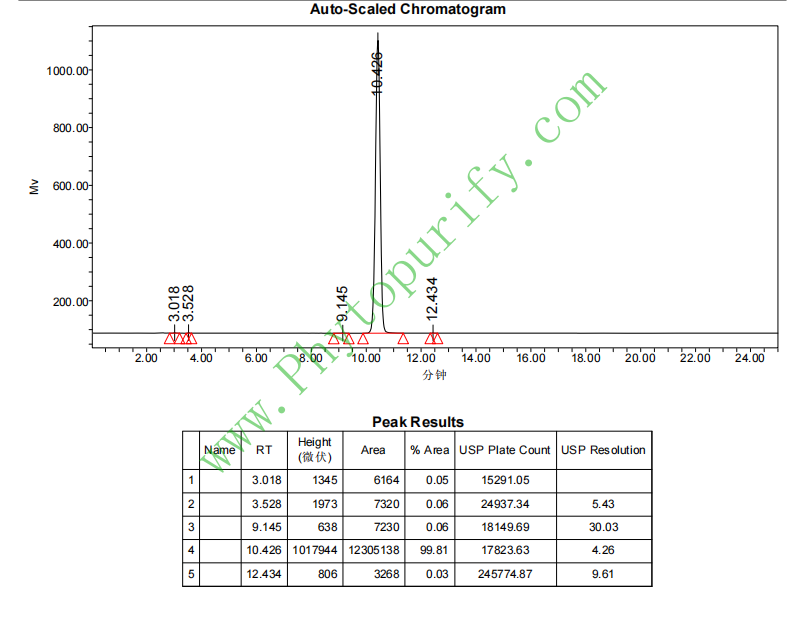
Purity: 95%~99%
Analysis Method: HPLC-DAD or/and HPLC-ELSD
Identification Method: Mass, NMR
Packing: Brown vial or HDPE plastic bottle
Can be supplied from milligrams to grams.
For Reference Standard and R&D, Not for Human Use Directly.
Inquire for bulk scale.
HPLC of CiMigenol 3-beta-D-xylopyranoside
Storage conditions:Short-term storage at 2~8℃, long-term storage at -20 ~ -80℃
CiMigenol 3-beta-D-xylopyranoside (CAS number: 27994-11-2) is a natural cucurbitacin glycoside that has attracted widespread attention due to its unique chemical structure and potential biological activity. As a derivative of cucurbitacin compounds, coumarin-3-O - β - D-xyloside not only has a complex triterpenoid skeleton, but also connects xylose units through glycosidic bonds, endowing it with strong water solubility and special pharmacological properties. In recent years, with the in-depth research on the application of natural products in the field of anti-cancer, the therapeutic potential of coumarin-3-O - β - D-xyloside in various diseases such as colon cancer has gradually emerged, becoming an important object of natural drug development and pharmacological mechanism analysis.
As one of the malignant tumors with high incidence rate and mortality worldwide, colon cancer has a complex pathogenesis, involving multiple signaling pathways and molecular targets. Shengma alcohol-3-O - β - D-xylose glycoside exhibits multi-target and multi pathway anticancer potential by regulating key targets such as AMPK, BCL2, STAT3, ALOX5, TOP1, MAPK1, TNF, GSK3B, PIK3CA, and EGFR. This article provides a systematic review of the chemical structure, sources, pharmacological activity, mechanism of action, pharmacological evaluation, and prospects for clinical application of coumarin-3-O - β - D-xyloside, aiming to provide scientific basis for the in-depth research and drug development of this natural product.
Cimicinol-3-O - β - D-xyloside is a typical cucurbitacin triterpenoid glycoside, with its parent nucleus being Cimigenol, which is connected to β - D-xyloside through a 3-hydroxyl group. The molecular formula of the compound is C31H48O12, with a molecular weight of 620.80 Da. The LogP value of the compound is about 3.5, indicating moderate lipid solubility and facilitating membrane penetration. The polar surface area (TPSA) is 164.6 Å ², indicating that the molecule has a large number of polar groups, especially hydroxyl and glycoside moieties, which endow it with good water solubility and binding ability with biomolecules.
Shengma alcohol-3-O - β - D-xyloside contains 10 hydrogen bond receptors, indicating that it may form stable complexes through multiple hydrogen bonds when binding to target proteins. In addition, the compound is not easily able to pass through the blood-brain barrier, indicating that its effects are mainly limited to peripheral tissues, reducing the risk of central nervous system toxicity. The hERG channel inhibition experiment results were negative, indicating a low risk of cardiac toxicity. However, liver toxicity and mutagenicity (Ames test) are not yet clear and further research is needed.
Shengma alcohol-3-O - β - D-xyloside is mainly found in various traditional Chinese medicinal materials and plants, especially in plants of the Cimicifuga genus with higher content. The plants of the Cistanche genus are widely used in traditional Chinese medicine for anti-inflammatory, antipyretic, analgesic, and anti-tumor purposes. Shengma alcohol-3-O - β - D-xyloside, as one of its important active ingredients, plays a significant pharmacological role.
The common methods for extracting coumarin-3-O - β - D-xylosides include solvent extraction, liquid-liquid partitioning, and chromatographic separation. Generally, ethanol or methanol is used as the extraction solvent to obtain the crude extract through reflux extraction. Subsequently, purification was carried out using silica gel column chromatography or high-performance liquid chromatography (HPLC) techniques, and the structure was confirmed by combining mass spectrometry and nuclear magnetic resonance (NMR) methods. In recent years, ultrasound assisted extraction and supercritical fluid extraction technologies have also been applied to improve extraction efficiency and purity, reduce solvent usage, and conform to the concept of green chemistry.
The pharmacological activities of Shengma alcohol-3-O - β - D-xyloside mainly focus on anti-tumor, anti-inflammatory, and metabolic regulation. A large number of in vitro cell experiments and in vivo animal model studies have shown that this compound has a significant inhibitory effect on colon cancer cells, manifested by promoting tumor cell apoptosis, inhibiting proliferation and migration ability.
Shengma alcohol-3-O - β - D-xylose glycoside regulates the growth and apoptosis of tumor cells through multi-target regulation. It exhibits concentration dependent cytotoxicity towards colon cancer cell lines such as HCT116, SW480, etc., and can induce cell cycle arrest and apoptosis. Research has found that this compound can downregulate the expression of anti apoptotic protein BCL2 and activate the intracellular apoptotic signaling pathway. In addition, it also reduces tumor cell proliferation and the formation of inflammatory microenvironment by inhibiting the STAT3 and MAPK1 signaling pathways.
Cimicinol-3-O - β - D-xyloside has a regulatory effect on inflammatory response, which can inhibit the release of pro-inflammatory cytokine TNF - α, reduce ALOX5 mediated lipid peroxidation, and alleviate chronic inflammation related to tumors. It activates the AMPK signaling pathway, regulates cellular energy metabolism, inhibits the PI3K/Akt pathway, and further suppresses the metabolic adaptability and growth of tumor cells.
The anti-tumor mechanism of coumarin-3-O - β - D-xyloside involves multiple signaling pathways and key molecular targets, reflecting its multi-target and multi mechanism pharmacological properties.
AMPK is a key regulatory factor for cellular energy homeostasis. Cimicinol-3-O - β - D-xyloside activates AMPK, promotes energy metabolism balance, and inhibits abnormal proliferation and metabolic reprogramming of tumor cells. The activation of AMPK can also downregulate the mTOR signaling pathway and block cell growth signals.
BCL2 protein is a key factor in cell anti apoptosis. Cimicinol-3-O - β - D-xyloside downregulates BCL2 expression, breaks down the intracellular anti apoptotic barrier, and promotes mitochondrial pathway apoptosis.
STAT3 and MAPK1 are important signaling molecules for tumor cell proliferation, survival, and immune escape. Shengma alcohol-3-O - β - D-xyloside inhibits the phosphorylation of STAT3, blocks its transcriptional activity, and reduces the expression of tumor promoting genes. Inhibition of MAPK1 reduces cell proliferation and migration ability.
ALOX5 participates in fatty acid metabolism and promotes the generation of inflammatory mediators. Cimicinol-3-O - β - D-xyloside inhibits ALOX5 activity and reduces inflammatory response. As a pro-inflammatory cytokine, TNF - α expression is effectively inhibited by this compound, reducing the inflammatory state of the tumor microenvironment.
GSK3B is involved in the regulation of various cellular functions, and coumarin-3-O - β - D-xyloside affects cell cycle and apoptosis by regulating its activity. PIK3CA and EGFR are core molecules in tumor signal transduction. This compound exerts anti-tumor effects by blocking their activation, inhibiting PI3K/Akt and EGFR mediated growth signals.
TOP1 is a DNA topoisomerase involved in DNA replication and transcription. Shengma alcohol-3-O - β - D-xylose glycoside may induce tumor cell death by inhibiting TOP1 activity, blocking DNA replication.
The pharmacological evaluation of Shengma alcohol-3-O - β - D-xyloside shows that it has certain potential for drug development. The molecular weight of 620.8 Da is slightly higher than the ideal range of traditional small molecule drugs, but still within an acceptable range. A LogP value of 3.5 indicates moderate lipid solubility, which is beneficial for cell membrane permeation. A high TPSA indicates good water solubility, but may limit oral absorption and cell membrane penetration.
This compound is not easily able to cross the blood-brain barrier, reducing the risk of central nervous system side effects. The hERG channel inhibition experiment was negative, preliminarily ruling out the risk of cardiac toxicity. However, there is still a lack of data on liver toxicity and mutagenicity, and systematic toxicological studies are needed to support it. In terms of pharmacokinetics, the in vivo absorption, distribution, metabolism, and excretion (ADME) characteristics of coumarin-3-O - β - D-xyloside have not been fully reported, and further clarification is needed in combination with in vivo models and preclinical studies in the future.
Cimicinol-3-O - β - D-xyloside, as a multi-target natural product, has shown good potential in the treatment of colon cancer and is expected to be developed as an adjuvant therapy or a novel targeted drug in the future. It provides new ideas for overcoming single target drug resistance by regulating tumor metabolism, inhibiting proliferation, and promoting apoptosis through multiple mechanisms.
During the clinical translation process, it is necessary to focus on addressing the pharmacokinetic characteristics, toxicological safety, and drug formulation issues. Combining nanocarrier or drug modification technology to enhance its bioavailability and targeting is a key direction for future research. In addition, the potential application of coumarin-3-O - β - D-xyloside in inflammatory and metabolic diseases is also worth further exploration.
With the advancement of multi omics techniques and molecular pharmacology, the mechanism of action of coumarin-3-O - β - D-xyloside will become clearer, providing scientific basis for its clinical development. In the future, verifying its safety and efficacy through preclinical and clinical trials will promote it to become an important member of natural anti-cancer drugs.
Cimicinol-3-O - β - D-xyloside, as a unique cucurbitacin glycoside, has shown broad application prospects in the treatment of diseases such as colon cancer due to its complex chemical structure and multi-target pharmacological activity. It exerts anti-tumor, anti-inflammatory, and metabolic regulatory effects by regulating key molecules such as AMPK, BCL2, STAT3, ALOX5, TOP1, MAPK1, TNF, GSK3B, PIK3CA, and EGFR, demonstrating the profound value of natural product pharmacological research.
In the future, interdisciplinary research combining modern medicinal chemistry, pharmacology, and clinical medicine will further reveal the mechanism of action of coumarin-3-O - β - D-xyloside, optimize its drug properties, and promote its clinical application. This compound not only enriches the research system of cucurbitacin natural products, but also provides new drug candidate molecules for the treatment of complex diseases such as colon cancer, which has important scientific and clinical significance.
