


Product name: Cimicifugoside H1
Synonym name:
Catalogue No.: BP0354
Cas No.: 163046-73-9
Formula: C35H52O9
Mol Weight: 616.792
Botanical Source:
Type of Compound:
Purity: 95%~99%
Analysis Method: HPLC-DAD or/and HPLC-ELSD
Identification Method: Mass, NMR
Packing: Brown vial or HDPE plastic bottle
Storage: Store in a well closed container, protected from air and light. Put into refrigerate or freeze for long term storage.
Whenever possible, you should prepare and use solutions on the same day. However, if you need to make up stock solutions in advance, we recommend that you store the solution as aliquots in tightly sealed vials at -20℃. Generally, these will be useable for up to two weeks.
The product could be supplied from milligrams to grams
Inquire for bulk scale.
For Reference Standard and R&D, Not for Human Use Directly.
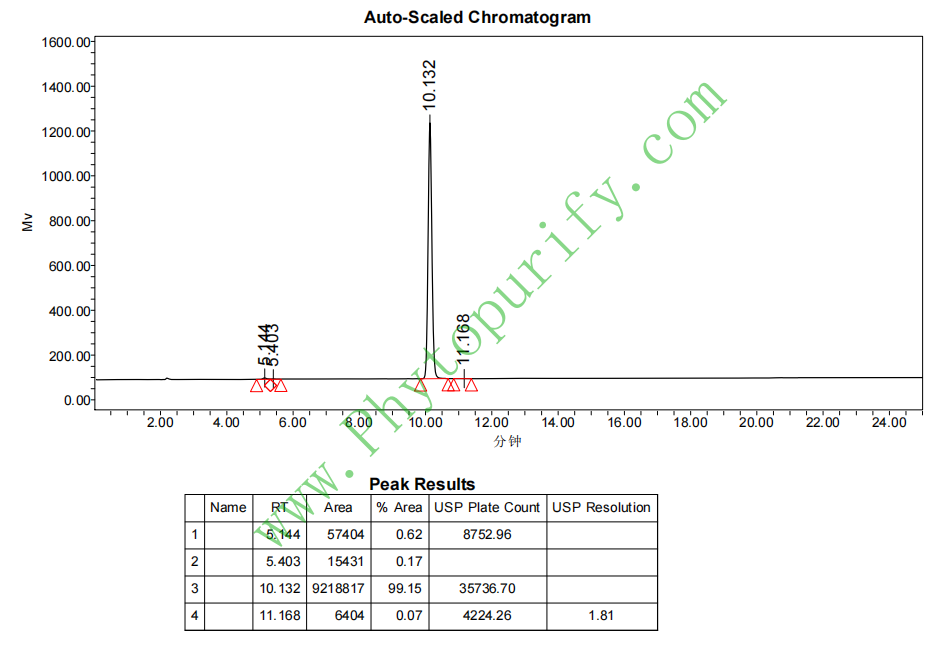
HPLC of Cimicifugoside H1
Storage conditions:Short-term storage at 2~8℃, long-term storage at -20 ~ -80℃
161.1600
2.2100
1.8500
No
.7500
Unknown
Unknown
Unknown
Unknown
Unknown
Unknown
Unknown
Cimicifugoside H1 (CAS number: 163046-73-9) is a natural triterpenoid saponin derived from the Chinese medicinal herb Cimicifuga spp. With the continuous development of natural product pharmacology, Cimicifuga H1 has attracted extensive attention in the field of anti-tumor, especially in the treatment of breast cancer, due to its unique chemical structure and multi-target regulatory ability. Breast cancer is one of the most common malignant tumors for women in the world. its complex pathogenesis and diverse molecular subtypes make the existing treatment methods have some limitations. Cimicifuga glycoside H1 shows potential anti breast cancer activity by regulating multiple signal pathways and key molecular targets, and has high development value.
This article provides a systematic review of the chemical structure and physicochemical properties, plant sources and extraction methods, pharmacological activity and mechanism of action, pharmacological evaluation, and clinical application prospects of hesperidin H1, aiming to provide theoretical basis and reference for related research.
Shengma glycoside H1 belongs to the triterpenoid saponin class, with a molecular formula of C33H-48O11 and a molecular weight of 592.7700. Its structural features mainly include a triterpenoid parent nucleus connected to multiple sugar groups, and the presence of sugar groups endows it with high polarity and water solubility. The LogP value of hesperidin H1 is 2.21, indicating that it has moderate lipid solubility, which is beneficial for cell membrane penetration but not too hydrophobic, and is suitable for in vivo distribution of drugs.
Its topological polar surface area (TPSA) is 161.16 Å ² and the number of hydrogen bond acceptors is 9, indicating strong polarity and potential hydrogen bonding ability, which is of great significance for its binding with biomolecules and target recognition. Cistanche H1 is not easily able to cross the blood-brain barrier (BBB), indicating its limited distribution in the central nervous system, which may reduce the risk of central nervous system toxicity.
At present, there is no clear data on the hepatotoxicity, cardiotoxicity, and hERG channel inhibition of hesperidin H1, and the results of Ames mutagenicity test have not been published, indicating that its safety evaluation still needs further in-depth research.
Cimicifuga H1 is mainly found in the genus Cimicifuga spp. of the Ranunculaceae family, especially in Cimicifuga racemosa (black) and Cimicifuga foetida (stinky). As a traditional Chinese medicine, Shengma is widely used in gynecological diseases and anti-inflammatory treatment. The research on its active ingredients is gradually deepening, and Shengma glycoside H1, as one of the important triterpenoid saponins, has become a research hotspot.
The common methods for extracting hesperidin H1 include:
During the extraction process, attention should be paid to temperature and pH control to prevent degradation and structural changes of coumarin H1.
The pharmacological activities of Cimicifuga H1 mainly focus on anti-tumor, anti-inflammatory and immune regulation, especially its inhibitory effect on breast cancer cells.
Several in vitro cell experiments showed that Cimicifuga H1 could significantly inhibit the proliferation and migration of many breast cancer cell lines (such as MCF-7, MDA-MB-231) and induce apoptosis. Its anti-tumor effect is closely related to regulating the cell cycle and promoting the expression of apoptosis related proteins.
In addition, Cimicifuga H1 shows inhibitory effect on drug resistant breast cancer cells, which may reduce drug resistance and improve the sensitivity of chemotherapy drugs by regulating drug efflux pumps (such as ABCB1 and ABCG2).
In addition to anti-tumor effects, gastrodin H1 also has certain anti-inflammatory activity, which can inhibit the release of inflammatory mediators and alleviate inflammatory reactions. Its immune regulatory effect is manifested by regulating the function of immune cells and promoting immune surveillance ability.
The molecular mechanism of action of Shengma glycoside H1 involves multiple signaling pathways and key targets, including:
AMPK (PRKAA1) activation
AMPK, as a key regulatory factor in cellular energy metabolism, activation can inhibit metabolic reprogramming of tumor cells and promote cell apoptosis. Cimicifuga H1 inhibits the proliferation and survival of breast cancer cells by activating AMPK signaling pathway.
Regulation of anti apoptotic protein BCL2
BCL2 family proteins play a central role in regulating cell apoptosis. Cistanche H1 can downregulate BCL2 expression and promote mitochondrial mediated cell apoptosis.
STAT3 signaling pathway inhibition
STAT3, as an important transcription factor for tumor cell proliferation and immune escape, is inhibited by the phosphorylation and nuclear translocation of Shengma glycoside H1, which blocks its transcriptional activity and suppresses tumor growth.
Regulation of estrogen receptor beta (ESR2)
ESR2 plays a complex role in the occurrence and development of breast cancer. Cimicifuga H1 may affect the hormone dependent growth of breast cancer cells by regulating the expression or activity of ESR2.
Inhibition of drug efflux pumps ABCB1 and ABCG2
Cistanche H1 can inhibit the function of ATP binding cassette transporters ABCB1 and ABCG2, reduce drug efflux, enhance tumor cell sensitivity to chemotherapy drugs, and overcome multidrug resistance.
Regulation of protein kinase C alpha (PRKCA) and microtubule associated protein Tau (MAPT)
By regulating PRKCA and MAPT, hesperidin H1 affects the stability of the cytoskeleton and signal transduction, inhibiting cancer cell migration and invasion.
NFE2L2 (NRF2) pathway activation
NFE2L2, as the main regulator of oxidative stress response, activates the pathway through which hesperidin H1 enhances cellular antioxidant capacity, reduces oxidative damage, and assists in anti-tumor effects.
Topoisomerase I (TOP1) inhibition
TOP1 is involved in DNA replication and transcription, and the inhibitory effect of paeoniflorin H1 on TOP1 may block DNA metabolism in tumor cells and induce cell death.
To sum up, Cimicifuga glycoside H1 can effectively inhibit breast cancer cells through multi target and multi pathway synergy, which reflects the advantages of natural product multi target drugs.
The pharmacological parameters of Shengma glycoside H1 show that it has certain potential for drug development:
Cistanche H1 is not easily able to pass through the blood-brain barrier, reducing the risk of central nervous system side effects. Safety indicators such as hepatotoxicity, cardiotoxicity, and hERG channel inhibition are not yet clear and require systematic in vivo toxicological evaluation.
At present, there is a lack of pharmacokinetic studies on coumarin H1. Preliminary data suggests that its in vivo metabolism may involve liver enzyme systems, and parameters such as half-life and bioavailability need further clarification. In the future, drug delivery systems should be combined to optimize their pharmacokinetic performance, improve in vivo stability and targeting.
Cimicifuga H1 has good clinical application potential because of its multi target anti breast cancer effect. It has great prospects in the following aspects:
Adjuvant treatment of breast cancer
Cistanche H1 can be used as a sensitizer for chemotherapy drugs, by inhibiting resistance related proteins, improving chemotherapy efficacy, and reducing the risk of drug resistance.
Treatment of hormone dependent breast cancer
Cimicifulin H1 is expected to be used in the treatment of hormone receptor positive breast cancer by regulating estrogen receptor and related signaling pathways.
Combined immunotherapy
Its immunomodulatory effect provides auxiliary support for new therapies such as combined immune checkpoint inhibitors, enhancing anti-tumor immune response.
Natural product drug development
As a representative of natural triterpenoid saponins, the structure of hesperidin H1 can serve as a template for drug design, optimizing its efficacy and pharmacokinetic properties through structural modification.
However, the clinical translation of paeoniflorin H1 still faces many challenges, including insufficient safety evaluation, unclear pharmacokinetic properties, and complex preparation processes. Future research should strengthen in vivo pharmacological and toxicological studies, improve pharmacokinetic data, conduct preclinical animal model validation, and lay the foundation for subsequent clinical trials.
Cimicifuga H1, as a natural triterpene saponin with multi target anti breast cancer activity, shows a broad prospect for drug development. Its unique chemical structure and multi-dimensional mechanism of action provide a new idea for the treatment of breast cancer. Although its safety and pharmacokinetic data are not yet complete, with the deepening of research and technological progress, coumarin H1 is expected to become an important candidate molecule for the development of natural anti-cancer drugs.
In the future, systematic research should be focused on the molecular details of its mechanism of action, pharmacokinetic characteristics in vivo and safety evaluation, and modern drug design and delivery technologies should be combined to promote the transformation of cimicioside H1 into clinical application and benefit breast cancer patients.
