


Product name: Triptonide
Synonym name:
Catalogue No.: BP1412
Cas No.: 38647-11-9
Formula: C20H22O6
Mol Weight: 358.39
Botanical Source: Tripterygium wilfordii Hook.f.
Physical Description:
Type of Compound: Diterpenoids
Purity: 95%~99%
Analysis Method: HPLC-DAD or/and HPLC-ELSD
Identification Method: Mass, NMR
Packing: Brown vial or HDPE plastic bottle
Storage: Store in a well closed container, protected from air and light. Put into refrigerate or freeze for long term storage.
Whenever possible, you should prepare and use solutions on the same day. However, if you need to make up stock solutions in advance, we recommend that you store the solution as aliquots in tightly sealed vials at -20℃. Generally, these will be useable for up to two weeks.
The product could be supplied from milligrams to grams
Inquire for bulk scale.
Description:
Triptonide is effective in the treatment of autoimmune diseases and has potent antileukemic and antitumor activities, it possesses anti-inflammatory activity, upregulate the expression of IL-37, and this expression was suppressed by ERK1/2 and p38 MAPK inhibitors.
References:
Zhongguo Yao Li Xue Bao. 1993 May;14(3):238-42.
Effects of triptonide on mouse immune functions.
METHODS AND RESULTS:
Triptonide (Tri) extracted from Tripterygium wilfordii Hook inhibited the proliferation of mouse splenocytes induced by suboptimal concentration of concanavalin A or lipopolysaccharide at concentrations of 0.02, 0.1, and 0.5 microgram.ml-1. It showed a suppressive effect on one way mixed lymphocyte culture (MLC) at 0.1-0.4 microgram.ml-1. The lymphocytes harvested from the first Tri (0.4 microgram.ml-1)-containing MLC inhibited the second MLC after being washed and irradiated with 60Co source (30 Gy). Serum anti-sheep red blood cell antibody (hemolysin) formation and clearance of charcoal particles were also suppressed by Tri in vivo. Although delayed hypersensitivity (DH) reaction to dinitrofluorobenzene (DNFB) was inhibited by Tri 1.2, 2.5, and 5.0 mg.kg-1 (ip, qd x 5 d), the spleen cell interleukin-2 secretion activities of these mice were not suppressed. Graft vs host reaction (GVHR) was not inhibited by Tri 2.5 and 5.0 mg.kg-1 (ig, qd x 5 d). Helper T cells (Th)/suppressor T cells (Ts) ratio was reduced at 2.5 mg.kg-1. The effects of Tri on mouse thymus and spleen weight were related to the age. Tri (1.2, 2.5, 5.0 mg.kg-1) had no effect on thymus and spleen weights in 8-wk-old mice. However, it increased the thymus and spleen weights in 12-wk-old mice at doses of 1.2 and 2.5 mg.kg-1.
CONCLUSIONS:
The data indicated that Tri had extensive suppressive effects on mouse immune function and its mechanism may be related to the reduction of Th/Ts ratio and the induction of Ts cells.
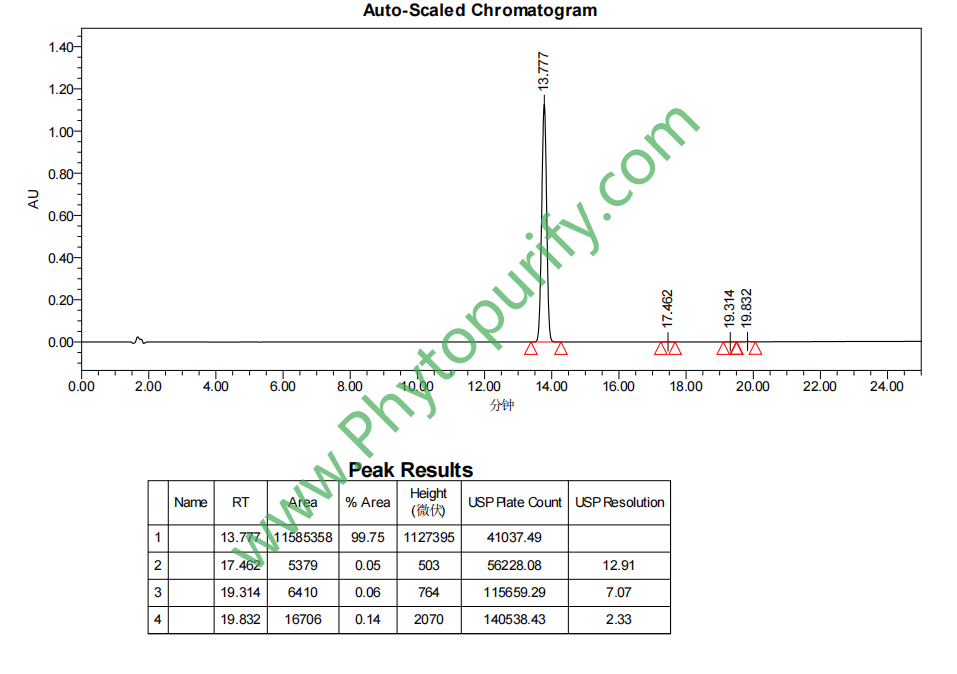
HPLC of Triptonide
Storage conditions:Short-term storage at 2~8℃, long-term storage at -20 ~ -80℃
80.9600
1.8481
1.8481
.0371
4.2172
19.3184
High
61.6743
6.0735
No
No
No
No
Yes
No
1.5
Yes
No
Yes
Yes
Triptonide (CAS number: 38647-11-9) is a natural product isolated from the traditional Chinese medicine Tripterygium wilfordii Hook. f., and belongs to the class of diterpenoid lactones. As a famous multifunctional medicinal plant in traditional Chinese medicine, Thunder God Vine has been widely studied for its significant immune regulation and anti-inflammatory activities. In recent years, with the advancement of molecular pharmacology and natural product chemistry, Triptolide has become a research hotspot in the field of natural medicine development due to its regulatory role in multiple signaling pathways, especially its efficient inhibitory activity on the Wnt signaling pathway. Its IC50 is about 0.3 nM, demonstrating extremely strong biological activity, covering multiple pharmacological effects such as immunosuppression, anti-inflammatory, contraception, neuroprotection, and anti lymphoma.
This article aims to systematically review the chemical structure and physicochemical properties, plant sources and extraction methods, pharmacological activity and mechanism of action, pharmacological evaluation and pharmacokinetic characteristics of Triptolide, as well as its potential and future development direction in clinical applications, providing theoretical support and reference for natural product pharmacology research and new drug development.
Triptolide ketone is a typical natural diterpenoid lactone with a molecular formula of C20H26O6 and a molecular weight of 358.39. Its structure contains multiple cyclic skeletons and lactone groups, endowing it with unique chemical properties and biological activity. The LogP value of Triptolide is 1.8481, indicating its moderate lipid solubility, which is beneficial for membrane penetration and in vivo distribution. Its topological polar surface area (TPSA) is 80.96 Å ², reflecting the distribution of polar groups and suitable for interaction with biomolecules.
Triptolide has a low water solubility (0.0371 mg/mL), which to some extent limits its oral bioavailability. However, its good lipid solubility and high blood-brain barrier penetration ability (BBB high) make it potentially advantageous for use in central nervous system diseases. In addition, Triptolide does not exhibit hERG channel inhibitory activity, indicating a low risk of cardiac toxicity. The Ames test result is 1.5, indicating a low risk of genotoxicity and meeting safety requirements.
Tripterygium wilfordii Hook. f., a woody vine that grows in eastern China and Southeast Asia, is the main source of Tripterygium wilfordii lactone. Thunder God Vine is used in traditional Chinese medicine to treat rheumatoid arthritis, systemic lupus erythematosus, and other immune related diseases. Its roots, stems, and leaves contain various bioactive components, including Triptolide, Triptolide, Triptolide, etc.
Traditional extraction methods typically use organic solvents such as ethanol, methanol, and ethyl acetate to reflux extract dried Tripterygium wilfordii powder, followed by separation and purification through liquid-liquid distribution, column chromatography (silica gel, reverse phase C18), and other methods. Modern extraction techniques such as ultrasound assisted extraction, microwave-assisted extraction, and high-performance liquid chromatography (HPLC) purification have significantly improved the extraction efficiency and purity of Triptolide.
In recent years, research on the optimization of the extraction process of Triptolide has been continuously deepened, aiming to improve yield, reduce process costs and harmful impurities, and promote its large-scale production and clinical application.
Triptolide exhibits diverse pharmacological activities, covering multiple fields such as immune regulation, anti-inflammatory, contraception, neuroprotection, and anti-tumor effects.
Immunosuppressive and anti-inflammatory effects
Triptolide can significantly inhibit the activation and proliferation of T cells and B cells, reduce the expression of inflammatory factors such as TNF - α, IL-6, IL-1 β, and alleviate inflammatory reactions. Its immunosuppressive effect makes it potentially valuable for the treatment of autoimmune diseases such as rheumatoid arthritis and systemic lupus erythematosus.
Contraceptive effect
Animal experiments have shown that Triptolide achieves contraceptive effects by affecting sperm formation and function. Its mechanism of action involves regulating androgen receptors and related signaling pathways in the testes, exhibiting reversibility and low toxicity, making it a research hotspot in the development of male contraceptive drugs.
Neuroprotective effect
Triptolide can penetrate the blood-brain barrier, alleviate neuroinflammation and oxidative stress, and protect nerve cells from damage. Its potential therapeutic effects on neurodegenerative diseases such as Parkinson's disease and Alzheimer's disease are being actively explored.
antitumor activity
Triptolide has shown activity in inhibiting tumor cell proliferation, inducing apoptosis, and inhibiting metastasis in various tumor models. Especially in liver cancer, Triptolide significantly inhibits tumor growth and invasion ability by regulating multiple key molecular targets.
Anti lymphoma effect
Research has shown that Triptolide can effectively inhibit the proliferation of lymphoma cells, induce cell cycle arrest and apoptosis, indicating its potential in lymphoma treatment.
The pharmacological effects of Triptolide are mainly achieved by regulating multiple signaling pathways, especially as a highly effective inhibitor of the Wnt signaling pathway (IC50 of approximately 0.3 nM), which has attracted much attention. The Wnt signaling pathway plays a crucial role in cell proliferation, differentiation, and tumor development. Triptolide inhibits this pathway and blocks the malignant proliferation of abnormal cells.
In addition, the role of Triptolide in liver cancer involves multiple key targets:
Overall, Triptolide achieves a wide range of pharmacological effects through multi-target and multi pathway synergistic effects.
The pharmacological parameters of Triptolide ketone show that it has good potential for drug development. The molecular weight is 358.39, in accordance with Lipinski's rule, with a moderate LogP of 1.8481, which is conducive to absorption and distribution in vivo. TPSA 80.96 Å ² indicates moderate polarity, which is favorable for binding to the target. The low water solubility (0.0371 mg/mL) is a challenge in the development of its formulation, and its bioavailability needs to be improved through technologies such as nano formulations, liposomes, or solid dispersions.
Its high blood-brain barrier penetration ability provides the possibility for the treatment of neurological diseases. The hERG channel has no inhibitory effect and reduces the risk of cardiac toxicity. The Ames test results showed low genotoxicity and good safety.
In terms of pharmacokinetics, existing studies have shown that Triptolide is rapidly absorbed and widely distributed after oral administration, especially at high concentrations in liver and brain tissues. Its metabolism is mainly carried out through the liver cytochrome P450 enzyme system, and the activity and toxicity of metabolites need further research. Moderate half-life, suitable for daily administration. The main excretion pathways are bile and urine.
Further systematic pharmacokinetic (ADME) and toxicological studies of Triptolide are needed in the future to clarify its in vivo behavior and safe dosage range, and promote clinical translation.
Triptolide, with its multi-target and multi mechanism pharmacological properties, has shown broad clinical application prospects in the treatment of various diseases.
tumor therapy
Especially in the field of liver cancer, Triptolide has shown potential as an anti-tumor drug by regulating key targets such as BCL2, STAT3, EGFR, and inhibiting tumor cell proliferation and metastasis. In the future, it can be combined with existing targeted drugs or immunotherapy to enhance efficacy and overcome drug resistance.
Autoimmune and inflammatory diseases
Its immunosuppressive and anti-inflammatory effects make it valuable in autoimmune diseases such as rheumatoid arthritis and systemic lupus erythematosus. By precisely regulating the immune response and reducing side effects.
Neurological disorders
The high blood-brain barrier penetration rate endows it with neuroprotective potential and is suitable for the treatment research of neurodegenerative diseases such as Parkinson's disease and Alzheimer's disease.
Contraceptive drug development
As a candidate molecule for male contraceptives, Triptolide has the advantages of high efficiency, reversibility, and low toxicity, and is expected to fill the gap in the male contraceptive market in the future.
Despite the multiple advantages of Triptolide, its low water solubility and potential pharmacokinetic limitations still need to be overcome. Future research should focus on formulation optimization, dose adjustment, toxicological safety assessment, and clinical trial design to promote its clinical application process.
As an important active ingredient in Tripterygium wilfordii, Triptolide has demonstrated extensive pharmacological activities in the fields of immune regulation, anti-inflammatory, anti-tumor, neuroprotection, and contraception due to its unique chemical structure and multi-target regulatory ability. As a highly effective inhibitor of the Wnt signaling pathway, it provides new molecular targets and drug development directions for the treatment of related diseases.
The drug efficacy evaluation shows that it has good potential for drug development, but its water solubility and pharmacokinetic properties need further optimization. In the future, combining modern pharmaceutical formulation technology and precision medicine strategies, Triptolide is expected to become an innovative drug for various difficult to treat diseases.
In summary, Triptolide not only enriches the research content of natural product pharmacology, but also provides valuable molecular framework and mechanism of action basis for new drug development, which is worthy of continuous in-depth exploration in basic research and clinical translation.
