


Product name: Pterostilbene
Synonym name: 4′-Hydroxy-3,5-dimethoxystilbene
Catalogue No.: BP1175
Cas No.: 537-42-8
Formula: C16H16O3
Mol Weight: 256.301
Botanical Source: Pterocarpus indicus Willd
Physical Description:
Type of Compound: Stibene glucosides
Purity: 95%~99%
Analysis Method: HPLC-DAD or/and HPLC-ELSD
Identification Method: Mass, NMR
Packing: Brown vial or HDPE plastic bottle
Storage: Store in a well closed container, protected from air and light. Put into refrigerate or freeze for long term storage.
Whenever possible, you should prepare and use solutions on the same day. However, if you need to make up stock solutions in advance, we recommend that you store the solution as aliquots in tightly sealed vials at -20℃. Generally, these will be useable for up to two weeks.
The product could be supplied from milligrams to grams
Inquire for bulk scale.
Chengdu Biopurify Phytochemicals Ltd. is a leading company in the research, development, manufacture and marketing of High Quality Phytochemicals and Extracts(especially Active Ingredients from Traditional Chinese Medicine,TCM), Natural Active Pharmaceutical Ingredients worldwide.
The main services:
A. Supply active ingredients and reference standards of TCM, from mgs to kgs scale
B. Custom extraction and purification, target Herb Active Ingredients
C. Custom synthesis and semi-synthesis for Natural Active Ingredients
D. CR(contract research), CM(contract manufacture) and PD(process development) services from lab scale, pilot scale to commercial scale(GMP is also available)
E. TCM compounds library for drug screen,more than 3000 compounds available, many of them are rare and unique.
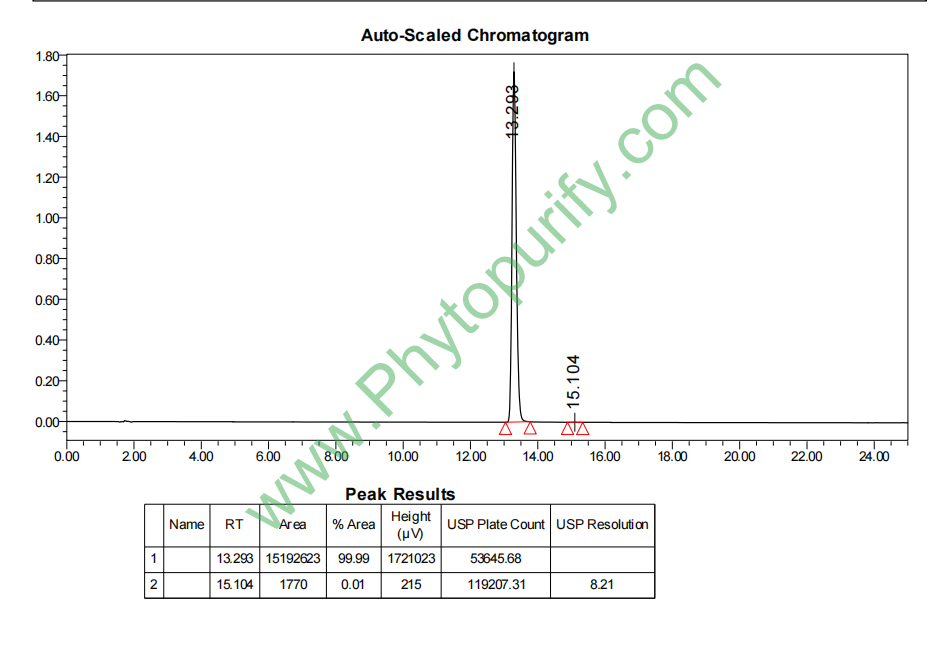
HPLC of Pterostilbene
Storage conditions:Short-term storage at 2~8℃, long-term storage at -20 ~ -80℃
38.6900
3.6976
3.6953
.0601
7.2368
19.8731
High
92.7572
1.8866
Yes
Yes
Yes
No
Yes
No
0.6
No
Yes
Yes
Yes
In the treasure trove of natural products, stilbene compounds have attracted much attention due to their wide range of biological activities. Among them, Resveratrol, as a star molecule, is widely known for its anti-aging and cardiovascular protection effects. However, its low bioavailability and rapid metabolism limit its clinical application. In this context, its structural analogue, Pterostilbene (PTE), has gradually entered the research field. Purple sandalwood, chemical name 3,5-dimethoxy-4 '- hydroxystilbene, CAS number 537-42-8, is a natural stilbene compound mainly found in the heartwood of blueberries, grapes, and traditional medicinal plant Pterocarpus marsupium. Compared to resveratrol, rosewood has superior lipid solubility and metabolic stability due to methoxy substitution, and its oral bioavailability is significantly improved. A large number of studies have shown that red sandalwood stilbene exhibits multiple pharmacological activities such as strong antioxidant, anti-inflammatory, anti-cancer, anti diabetes, neuroprotective and anti-aging activities, and its role involves fine regulation of a variety of key signal pathways and molecular targets. This article aims to provide a systematic review of the chemical properties, plant sources, pharmacological activities, molecular mechanisms of action, medicinal characteristics, and clinical application prospects of purple sandalwood, in order to provide comprehensive scientific references for the deep development and transformation of this natural product.
The molecular formula of purple sandalwood is C16H16O3, with a molecular weight of 256.3010. The core of its chemical structure is the framework of stilbene, specifically on the framework of stilbene (trans-1,2-distyrene), the 3rd and 5th positions of the A ring are replaced by two methoxy groups (- OCH3), while the 4 'position of the B ring is a hydroxyl group (- OH). The substitution mode of 3,5-dimethoxy-4 '- hydroxyl is the key to its differentiation from resveratrol (3,5,4' - trihydroxy), and also determines its unique physicochemical and biological properties.
From the analysis of physical and chemical properties, the introduction of methoxy groups significantly enhances the lipid solubility of rosewood. Its calculated LogP value (lipid water partition coefficient) is about 3.70, much higher than resveratrol (about 3.1), indicating that it is more likely to penetrate cell membranes. Its topological polar surface area (TPSA) is 38.69 Å ², which is relatively small and conducive to transmembrane absorption. However, its water solubility is poor, about 0.0601 mg/mL, which to some extent affects its formulation development. In terms of key parameters for medicinal properties, Pterostilbene has shown good safety potential: its Ames test result is 0.6 (usually considered to have a mutagenic risk of>1.5), indicating a low risk of genetic toxicity; There is no significant inhibitory effect on hERG potassium channels, indicating a lower risk of cardiac toxicity. Of particular importance is that purple sandalwood has a high blood-brain barrier permeability, which lays the material foundation for its central nervous system protective effects (such as anti neurodegenerative diseases). The superiority of its physicochemical and pharmacological parameters makes it a candidate molecule with greater potential for development than resveratrol.
Purple sandalwood is relatively concentrated in nature. Its main plant sources include:
1. Berry category Blueberries (Vaccinium spp.) are the most famous dietary source of purple sandalwood, especially with high content in the skin. In addition, grapes, cranberries, etc. also contain small amounts.
2. medicinal plants The heartwood of the leguminous plant Pterocarpus marsupium Roxb. is the traditional and important source of red sandalwood root, which is commonly used in Ayurvedic medicine to treat diabetes and inflammation.
3. Other sources The presence of rosewood has also been detected in Aquilaria plants, peanut rhizomes, and certain Dracaena plants.
Organic solvent extraction is commonly used to extract rosewood from plant materials. Common solvents include methanol, ethanol, ethyl acetate, etc. In order to improve extraction efficiency and selectivity, modern extraction techniques have been widely applied:
* Ultrasonic assisted extraction Utilizing the cavitation effect of ultrasound to destroy plant cell walls, accelerate solvent permeation and solute release, has the advantages of high efficiency and low temperature.
* Microwave assisted extraction By selectively heating the internal water and polar substances of plants through microwaves, the pressure inside the cells increases and ruptures, causing the target components to dissolve quickly.
* Supercritical fluid extraction Supercritical CO2 is commonly used as an extractant to change its solubility by adjusting temperature and pressure. This method has no solvent residue and good selectivity, making it particularly suitable for extracting thermosensitive and lipophilic components.
The crude extract after extraction usually needs to be separated and purified by column chromatography (such as silica gel column, macroporous adsorption resin column), preparative high-performance liquid chromatography and other techniques to obtain high-purity purple sandalwood monomer. In addition, given the limited natural sources, chemical synthesis and biosynthetic pathways (such as using microorganisms or plant cell cultures) are also actively being developed to meet the needs of future large-scale applications.
The pharmacological activity of purple sandalwood has been extensively and deeply studied, and its pleiotropic characteristics have shown potential therapeutic value in various disease models.
Antioxidant and anti-inflammatory activities Purple sandalwood is a potent antioxidant. In vitro experiments have confirmed that it can effectively scavenge various free radicals such as DPPH, ABTS, hydroxyl, superoxide anion, and hydrogen peroxide, and inhibit the excessive generation of reactive oxygen species (ROS). Its antioxidant capacity is partially attributed to its phenolic hydroxyl structure. In various acute and chronic inflammation models, such as lipopolysaccharide induced macrophage inflammation, mouse ear swelling, and colitis models, purple sandalwood can significantly inhibit the expression and release of pro-inflammatory factors (such as TNF - α, IL-1 β, IL-6), reducing tissue inflammatory damage.
anticancer activity The red sandalwood root has the effects of inhibiting proliferation, inducing apoptosis and blocking cell cycle on a variety of cancer cell lines (such as breast cancer, lung cancer, prostate cancer, colon cancer, liver cancer). Its anti-cancer mechanisms are diverse, including inducing endogenous and exogenous apoptosis pathways, inhibiting cancer cell invasion and metastasis, regulating the tumor microenvironment, and reversing multidrug resistance. Animal experiments have also shown that purple sandalwood can inhibit the growth and metastasis of transplanted tumors.
Metabolic regulatory activity:
Neuroprotective and anti-aging activities Purple sandalwood can penetrate the blood-brain barrier and has been shown to reduce β - amyloid deposition, inhibit Tau protein hyperphosphorylation, alleviate neuroinflammation, and protect dopaminergic neurons in neurodegenerative disease models such as Alzheimer's disease and Parkinson's disease. Its anti-aging activity is not only reflected in prolonging the lifespan of model organisms, but also in improving functional decline and pathological changes related to aging.
Cardiovascular protective activity Research shows that red sandalwood stilbene has the effects of lowering blood fat (lowering total cholesterol, triglyceride, low-density lipoprotein), anti atherosclerosis, protecting vascular endothelial function, inhibiting platelet aggregation, and has multiple protective effects on the cardiovascular system.
The multiple pharmacological activities of purple sandalwood stem from its extensive regulation of cellular signaling networks, and its core mechanism of action is closely related to the following key targets and pathways, especially in the field of anti-aging research
Activate energy and longevity related pathways:
Regulating the oxidative stress defense system:
Affects cell cycle and aging related pathways:
Other potential targets Purple sandalwood can also inhibit the activity of pro-inflammatory mediators such as NF - κ B and COX-2, and regulate signaling pathways such as PI3K/Akt and MAPK. It is worth noting that it may affect TERT (telomerase reverse transcriptase)The activity or expression of this substance indirectly participates in telomere maintenance, which is also one of the exploration directions for its anti-aging mechanism.
In summary, purple sandalwood has constructed a powerful cellular protective network by synergistically acting on core nodes such as AMPK, SIRT1, and NRF2, jointly responding to oxidative damage, metabolic disorders, and aging stress, which constitutes the molecular basis of its pleiotropic pharmacological effects.
Although purple sandalwood is a natural product, its medicinal properties are relatively excellent, providing the possibility for its conversion into drugs.
Absorption, distribution, metabolism, and excretion:
Formulation Challenges and Strategies The main challenge for the medicinal properties of purple sandalwood is its poor water solubility, which may lead to low solubility and significant absorption variability in oral formulations. To address this issue, researchers have developed various new delivery systems:
Preclinical pharmacokinetic studies have provided a basis for the dose design and administration regimen of Pterostilbene, and the application of the aforementioned formulation techniques is expected to further optimize its in vivo processes and enhance therapeutic efficacy.
The transition of purple sandalwood from laboratory research to clinical application has broad prospects but also faces challenges.
Potential application directions:
Challenges and Future Research Directions:
As a natural derived stilbene compound, purple sandalwood has become a shining star in the field of natural product pharmacology research due to its superior metabolic stability and bioavailability compared to resveratrol, as well as extensive pharmacological activities such as antioxidant, anti-inflammatory, metabolic regulation, neuroprotection, and anti-aging. It constructs a powerful cellular defense and homeostasis maintenance network by precisely regulating core signaling axes such as AMPK/SIRT1/NRF2, interpreting the scientific connotation of its pleiotropy at the molecular level. Despite facing challenges such as strengthening clinical evidence and breakthroughs in formulation technology on the path towards mature drugs, the existing advantages in drug properties and a solid foundation in pharmacological research have paved the way for their translational applications. In the future, with the continuous deepening of interdisciplinary research and the continuous advancement of clinical exploration, purple sandalwood is expected to achieve a leap from "natural ingredients" to "effective drugs" not only in the field of dietary supplementation, but also in chronic disease management, neuroprotection, and even anti-aging medicine, contributing its unique value to human health.
