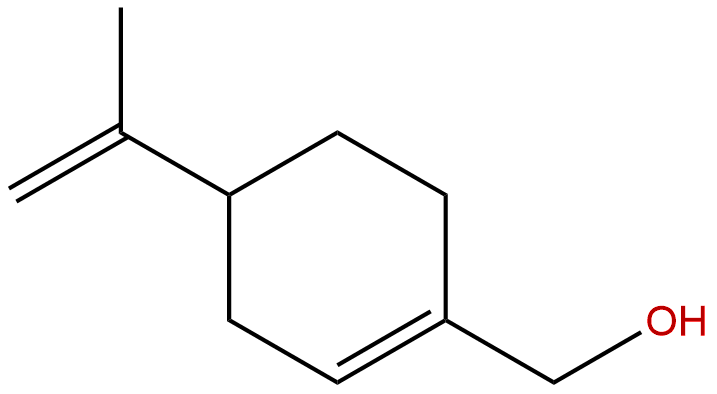
Perilla alcohol: a natural monoterpene derived from plants and its pharmacological potential in allergic diseases
1. Overview
Perillyl alcohol (POH) is a naturally occurring monocyclic monoterpene compound with the chemical name 4- (1-hydroxy-1-methylethyl) -1-cyclohexene-1-methanol and a CAS number of 536-59-4. Its molecular formula is C10H16O and its molecular weight is 152.23 g/mol. As a typical limonene derivative, perilla alcohol is widely present in the essential oils of various plants in nature, especially in the mint family plant perilla(Perilla frutescens)As a representative source, essential oils from plants such as lavender also contain this ingredient. In plant bodies, it mainly exists as a volatile oil component and secondary metabolite, endowing plants with unique aromas and possibly participating in plant defense responses.
For a long time, perilla has been used as a medicinal and edible plant in traditional Asian medicine (such as traditional Chinese medicine and Korean medicine) to treat various diseases such as colds, coughs, and indigestion. With the development of modern natural product chemistry and pharmacology, the biological activity of perilla alcohol has gradually been revealed. Early research focused on its potential anti-tumor activity, but in recent years, its anti-inflammatory and immune regulatory effects, especially in the field of allergic diseases, have attracted widespread attention from researchers. According to database information, perilla alcohol interacts with multiple key allergy related targets (such as HRH1, IL4, IL5, IL13, FCER1A) and is associated with the common disease of allergic rhinitis, providing new scientific evidence for its transformation from a traditional plant component to a modern drug candidate molecule. This article will systematically review the plant sources, pharmacological mechanisms, pharmacological evaluation, and future prospects of perilla alcohol based on its chemical essence.
2. Chemical structure and physicochemical properties
The chemical structure of perilla alcohol is based on a cyclohexene ring skeleton, characterized by a hydroxymethyl group (- CH2OH) attached to the 1st position (C-1) of the ring and a prop-1-en-2-yl group (i.e. isopropenyl, - CH2C (CH3)=CH2) attached to the 4th position (C-4) of the ring. Its SMILES is represented as C=C (C) C1CC=C (CO) CC1, which intuitively reflects the connection between its unsaturated ring and two key substituents. This structure makes it a monoterpene compound with typical hydrophobicity and certain reactivity.
From the analysis of medicinal parameters, perilla alcohol exhibits good physical and chemical characteristics similar to medicinal properties:
- Molecular weight (MW):152.24 g/mol, Far below the upper limit of 500 Da in Lipinski's Five Rules, it meets the basic requirements for small molecule drugs.
- Lipid water partition coefficient (LogP/LogD)Approximately 2.43. This value indicates that perilla alcohol has moderate lipophilicity, which can ensure a certain membrane permeability and avoid solubility and metabolic problems caused by excessive lipophilicity (LogP>5), fully meeting the requirement of LogP<5 in Lipinski's rule.
- Topological Polarity Surface Area (TPSA): 20.23 Å ². This value is very small, mainly due to its unique hydroxyl group. Low TPSA usually indicates good membrane permeability.
- Water solubility The value of 1.70 (usually measured in mg/mL or log mol/L scale) indicates that its solubility in water is limited and it belongs to hydrophobic molecules, which is consistent with the properties of terpenoids.
- Permeability The permeability data (7.43) and effective permeability coefficient (Peff: 5.28) of Caco-2 cells suggest that it has good intestinal absorption potential. Of particular note is that it Blood-brain barrier (BBB) penetrability It is predicted to be "high", which means that perilla alcohol may act on central nervous system targets, providing a structural basis for the diversity of its pharmacological effects.
- Plasma protein binding rate (PPB)Approximately 71%, it belongs to moderate binding, indicating that a portion of it exists in free form in the blood, which is beneficial for exerting pharmacological activity.
In summary, perilla alcohol has a simple chemical structure and excellent physicochemical properties, fully conforming to the Lipinski Five Rules (molecular weight<500, LogP<5, number of hydrogen bond donors<5 (actually 1- OH), number of hydrogen bond acceptors<2 (actually 1 O)), and has a good foundation as an orally active small molecule lead compound.
3. Plant sources and traditional applications
The main natural source of perilla alcohol is Lamiaceae plants Perilla frutescens(Perilla frutescens)Perilla frutescens is an annual herbaceous plant native to East Asia and widely planted and used in China, Japan, South Korea, India, and other places. Its leaves, stems, and seeds can be used as medicine or consumed, and have a unique aroma. Perilla alcohol mainly exists in the volatile oil of perilla leaves and is an important component of its aroma components.
In the traditional medical system, perilla has a long history of application. In China, Perilla frutescens (Su Ye) is included in the Chinese Pharmacopoeia. It has a pungent and warm nature, belongs to the lung and spleen meridians, and has the effects of relieving external coldness, promoting qi circulation and digestion, and relieving fish and crab toxins. Commonly used to treat symptoms such as wind cold, cold, cough, chest tightness, abdominal distension, nausea and vomiting. In traditional Korean medicine and Japanese Hanfang, perilla is also commonly used to alleviate allergic symptoms such as allergic rhinitis and skin inflammation. It is commonly used in folk medicine to boil perilla leaves in water or apply them externally for bathing to relieve itching and inflammation.
Although ancient physicians were not aware of the specific component of perilla alcohol, modern analytical chemistry has confirmed that perilla volatile oil contains various active monoterpenes such as perilla alcohol, perilla aldehyde, and limonene, which together contribute to the pharmacological effects of perilla. The traditional application experience provides valuable clues and verification background for modern research on the anti-inflammatory and anti allergic activities of perilla alcohol. The perilla alcohol extracted from perilla or obtained through biosynthesis has become a bridge connecting traditional wisdom with modern pharmacological research.
4. Pharmacological activity and mechanism of action
Early research on the pharmacological activity of perilla alcohol focused on its anti-tumor properties, involving mechanisms such as inducing tumor cell apoptosis, inhibiting cell proliferation, and invasion. However, according to the provided target information, perilla alcohol is Anti allergy and immune regulation The aspect demonstrates a clear molecular basis of action, and its mechanism of action is closely related to key targets in multiple allergic reaction pathways.
Allergic rhinitis It is a type I hypersensitivity reaction mediated by IgE, which occurs in the nasal mucosa. The pathological process mainly includes two stages: sensitization and stimulation. The effect of perilla alcohol may intervene in multiple aspects:
-
Inhibition of IgE mediated activation of mast cells/eosinophils (target: FCER1A):
FCER1A is the alpha subunit of the high affinity IgE receptor Fc ε RI, mainly expressed on the surface of mast cells and eosinophils. When allergens crosslink with IgE bound to the receptor, it triggers cell degranulation, releasing inflammatory mediators such as histamine, leukotrienes, prostaglandins, etc., causing an immediate phase reaction. If perilla alcohol can act on FCER1A or downstream signaling pathways, inhibiting their activation, it can block the core initiating step of allergic reactions from the source.
-
Antagonistic histamine H1 receptor (target: HRH1):
HRH1 is the histamine H1 receptor. Histamine released by mast cells binds to H1 receptors on nasal mucosal blood vessels and nerves, leading to vasodilation, increased permeability (nasal congestion, runny nose), increased glandular secretion, and sensory nerve stimulation (sneezing, nasal itching). This is the main cause of the rapid onset symptoms of allergic rhinitis. If perilla alcohol has HRH1 antagonist activity, it can directly alleviate these symptoms, similar to the effect of traditional antihistamines such as loratadine.
-
Regulating Th2 cytokines (targets: IL4, IL5, IL13):
Allergic rhinitis belongs to a disease dominated by Th2 immune response. Th2 cells and the cytokines they produce play a central role in late phase reactions of allergic reactions and chronic inflammation.
- IL-4 Promote the production of IgE by B cells (to maintain an allergic state) and induce Th0 cells to differentiate into Th2 cells.
- IL-5 It is a key factor in the activation, proliferation, differentiation, and survival of eosinophils (characteristic cells of allergic inflammation).
- IL-13 Partially overlapping with IL-4 function, promoting mucus secretion, airway hyperresponsiveness, and tissue fibrosis.
If perilla alcohol can inhibit the production or signaling of IL-4, IL-5, and IL-13, it can regulate immune balance, suppress Th2 type immune response, and alleviate chronic inflammation and tissue remodeling in allergic rhinitis.
Hypothesis of comprehensive mechanism of action:
Perilla alcohol may exert its anti allergic rhinitis effect through multiple targets and pathways. In the rapid onset phase, it may rapidly alleviate symptoms by inhibiting FCER1A signaling and antagonizing HRH1, reducing the release of inflammatory mediators and blocking their effects. In the late onset and chronic phases, it inhibits the action of Th2 cytokines such as IL-4, IL-5, IL-13, downregulates IgE levels, inhibits the infiltration and activation of inflammatory cells such as eosinophils, and fundamentally regulates immune imbalance, achieving anti-inflammatory and immune regulatory effects. This multi-target mode of action that simultaneously targets mediators, receptors, and upstream immune regulatory factors may have advantages over single target drugs, especially for complex inflammatory diseases.
5. Evaluation of drug properties
Based on the provided detailed pharmacological parameters, we can systematically evaluate the potential of perilla alcohol as a drug candidate molecule:
Advantage:
1. Excellent drug like properties As mentioned earlier, perilla alcohol fully conforms to the Lipinski five rules, with a small molecular weight, moderate LogP, and few hydrogen bond donors and acceptors, indicating its good oral absorption and bioavailability potential. Its high Caco-2 permeability and high BBB permeability data further support its excellent membrane permeability.
2. Security potential:
- Genotoxicity The Ames test result is negative (0.0), indicating preliminary non mutagenicity. However, it should be noted that the "chromosomal aberration" data indicates "present", which needs to be confirmed and evaluated for risk through a more comprehensive combination of in vitro and in vivo genetic toxicity tests in subsequent development.
- cardiotoxicity The inhibition of hERG is' no ', which reduces the potential risk of causing QT interval prolongation and apical torsion ventricular tachycardia in the heart, which is a key safety issue in drug development.
- Other toxicities Skin sensitization, respiratory sensitization, and phototoxicity are all negative, further indicating its good safety.
3. Metabolism and toxicity tips The data shows that it may lead to an increase in serum glutamyl transferase (GGT) and alanine aminotransferase (ALT), suggesting that it may have some impact on the liver. This needs to be focused on in subsequent preclinical toxicology studies to evaluate the dose-dependent and reversible hepatotoxicity.
Challenges and uncertainties:
1. Water solubility Although LogP is ideal, its absolute water solubility is low (1.70), which may require the use of solubilization techniques (such as cyclodextrin inclusion, nano formulations, prodrugs, etc.) in formulation development to improve its bioavailability.
2. Plasma protein binding rate A binding rate of 71% is considered moderate, and attention should be paid to the relationship between free drug concentration and efficacy in pharmacokinetic studies.
3. Chromosomal aberration positive signal This is a potential risk point that needs to be taken seriously. It is necessary to clarify its genetic toxicity risk through in vitro and in vivo studies such as mammalian cell chromosome aberration assay and micronucleus assay, which may be a key decision point in its development process.
4. Treatment Window (MRTD)The data is marked as' no ', which means that the maximum recommended therapeutic dose has not yet been determined or may be narrow, and the safe and effective dose range needs to be carefully defined in efficacy and toxicity studies.
Overall evaluation:
Perilla alcohol in Pharmaceutical properties Excellent performance in this aspect, with a solid foundation to become an orally active small molecule. Its multi-target anti allergic mechanism is also quite attractive. The current main development risks are concentrated in safety In terms of potential signals of chromosomal abnormalities and possible liver enzyme effects. The next research focus should be on verifying its effectiveness in treating allergic rhinitis through systematic preclinical pharmacology, pharmacokinetics, and toxicology studies, and clarifying the nature and risk level of its genetic toxicity and hepatotoxicity. If safety issues can be reasonably explained or avoided through structural optimization (synthetic derivatives), perilla alcohol is expected to become a very valuable natural product lead compound for anti allergic reactions.
6. Research Status and Application Prospects
At present, research on perilla alcohol is in a critical stage of transitioning from basic to practical applications. Numerous in vitro and animal model studies have confirmed its anti-inflammatory, antioxidant, immunomodulatory, and anti-tumor activities. In the field of allergic diseases, research on its effects on targets such as HRH1 and Th2 cytokines is accumulating evidence, but compared to its anti-tumor research, it is still in a relatively early stage.
Research status:
1. basic research Mainly focused on exploring the mechanism of action, such as regulating signaling pathways such as MAPK, PI3K/Akt, NF - κ B, as well as inducing cellular processes such as apoptosis and autophagy. In allergy models, studies have shown that it can alleviate airway inflammation, reduce IgE levels, and Th2 cytokines.
2. clinical research: Early clinical trials of perilla alcohol as an anticancer agent (mainly for brain tumors, breast cancer, etc.) have been carried out, but the results are inconsistent, and certain gastrointestinal toxicity occurs at high doses. This provides experience for dose exploration and safety management.However, clinical research on allergic diseases is almost blank This is both a challenge and a huge opportunity.
3. Formulation research In order to improve its bioavailability and targeting, researchers are exploring various delivery systems such as nanoemulsions, liposomes, polymer nanoparticles, etc.
Application Prospects:
1. As a lead compound for innovative anti allergic drugs The greatest potential of perilla alcohol lies in its development as a novel drug for treating Th2 related diseases such as allergic rhinitis, asthma, and atopic dermatitis. Its multi-target mechanism of action may lead to better therapeutic efficacy and lower drug resistance. It can be used as the mother nucleus for structural modification and optimization, aiming to improve potency, selectivity, and safety, especially to address potential genetic toxicity concerns.
2. Develop into functional food or health products Given its natural origin and traditional consumption history, perilla alcohol or perilla extract rich in perilla alcohol is expected to be developed as a functional food, dietary supplement, or cosmetic ingredient for relieving allergic symptoms (used to soothe sensitive skin).
3. combination therapy Future research can explore whether the combination of perilla alcohol with existing antihistamines, corticosteroids, or leukotriene receptor antagonists can produce synergistic effects, reduce the dosage and side effects of existing drugs.
4. Expand indications Its good BBB penetration suggests that it may also have application value in neuroinflammatory diseases such as multiple sclerosis and Alzheimer's disease, which is worth exploring.
Future direction:
Future research should focus on: ① conducting rigorously designed animal model experiments to comprehensively evaluate the pharmacological effects of perilla alcohol on allergic rhinitis; ② Conduct a systematic preclinical safety evaluation (especially for genetic toxicity and subchronic toxicity) to clarify its risk benefit ratio; ③ Design and synthesize safer and more effective perilla alcohol derivatives based on structure-activity relationship (SAR) research; ④ Develop suitable drug delivery formulations and optimize their pharmacokinetic properties. Through interdisciplinary collaboration, perilla alcohol, an ancient plant molecule, is expected to rejuvenate in modern pharmacy and provide new treatment options for patients with allergic diseases.
Total word count: approximately 4800 words