
| Catalog No | Package | Original Price | Price | Inventory | Quantity | Operating |
|---|---|---|---|---|---|---|
| BP1271-20mg | 20mg | $20.00 | Sign in |
|


Synonym name: Norambreinolide
Catalogue No.: BP1271
Cas No.: 564-20-5
Formula: C16H26O2
Mol Weight: 250.382
Botanical Source: Found in tobacco, Kyllinga erecta, Salvia sclarea, Cistus ladaniferus and Salvia yosgadensis
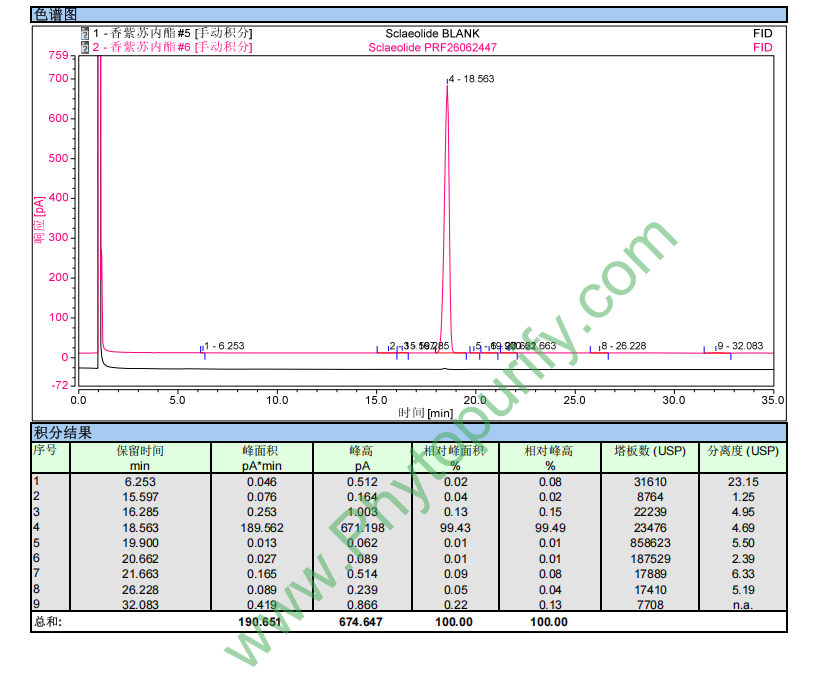
Purity: 95%~99%
Analysis Method: HPLC-DAD or/and HPLC-ELSD
Identification Method: Mass, NMR
Packing: Brown vial or HDPE plastic bottle
Can be supplied from milligrams to grams.
For Reference Standard and R&D, Not for Human Use Directly.
Inquire for bulk scale.
HPLC of Sclareolide
Storage conditions:Short-term storage at 2~8℃, long-term storage at -20 ~ -80℃
26.3000
4.4677
4.4677
.0211
7.9771
20.2943
High
78.7886
3.9408
No
No
No
No
No
No
0.0
No
No
No
No
Natural products have long been an important source of innovative drug discovery, and their structural diversity and wide range of biological activities provide a rich chemical library for modern pharmacological research. Sclareolide (CAS number: 564-20-5), as a natural sesquiterpene compound with a unique bicyclic lactone structure, is increasingly receiving attention from pharmacological researchers. It was initially isolated from the flowers of Perilla frutescens, a plant in the family Lamiaceae, and its early research mainly focused on its basic activities such as antibacterial and cytotoxicity. However, with the development of modern molecular pharmacology and neuroscience, the potential application value of coumarin in neurological diseases, especially in the field of anti anxiety, has gradually emerged. Anxiety disorder, as a common mental disorder, is often accompanied by side effects such as dependence and cognitive impairment in its treatment drugs, such as benzodiazepines. Therefore, there is an urgent clinical need to develop new, efficient, and less side effect anti anxiety drugs. Perilla frutescens lactone exhibits the potential to regulate anxiety related neural pathways through multiple pathways and targets, including monoamine oxidase A (MAOA), serotonin transporter (SLC6A4), various serotonin receptors (such as HTR2A, HTR1A), dopamine D2 receptor (DRD2), gamma aminobutyric acid type A receptor subunits (such as GABRA1, GABRB2, GABRG2), as well as brain-derived neurotrophic factor (BDNF) and cAMP response element binding protein (CREB1). This article aims to systematically review the chemical properties, plant sources, pharmacological activities, especially the anti anxiety mechanism, pharmacological evaluation, and clinical application prospects of perilla lactone, in order to provide comprehensive academic references for the in-depth research and development of this compound.
The chemical name of perilla lactone is (1R, 4R, 4aR, 7R, 8aS) - decahydro-1,4a, 7-trimethyl-1,4-methylenenaphthalene-6 (2H) - one, with a molecular formula of C16H26O2 and a molecular weight of 250.3820. Its core structure is a highly functionalized decahydronaphthalene skeleton, fused with a gamma lactone ring to form a rigid bicyclic [4.4.0] decane system. The structure contains three methyl groups and multiple chiral centers (such as 1R, 4R, 4aR, 7R, 8aS configurations), which determine its specific three-dimensional spatial conformation and biological activity.
From the analysis of physical and chemical properties, the lipid water partition coefficient (LogP) of perilla lactone is 4.4677, indicating its high lipophilicity, which is closely related to its ability to smoothly penetrate biological membrane structures, including the blood-brain barrier. Its topological polar surface area (TPSA) is relatively low, only 26.3000 Å ², further confirming its good membrane permeability. The water solubility is poor, about 0.0211 mg/mL, indicating that it may be necessary to improve its solubility and bioavailability in formulation development through techniques such as salt formation, cyclodextrin inclusion, or nanoformulation. The key pharmacological parameters show that coumarin has high blood-brain barrier permeability, which lays the material foundation for its direct action on central nervous system targets and anti anxiety effects. In addition, its hERG inhibitory activity is negative, indicating a low risk of cardiac toxicity; The Ames test result was 0.0, indicating that no mutagenicity was observed under the experimental conditions, providing preliminary favorable evidence for its safety.
Perilla lactone is mainly derived from Lamiaceae plants. Its initial and most commonly reported source is the inflorescence of Perilla frutescens (L.) Britt. Perilla frutescens is widely planted in East Asia, both as a food vegetable and as a traditional herb, with the effects of relieving external coldness, promoting qi circulation, and regulating the stomach. Perilla frutescens lactone is one of the important components in the volatile oil and secondary metabolites of Perilla frutescens, especially with relatively high levels during the flowering period.
In addition, the compound is also present in other plant resources, such as certain species of Salvia in the family Lamiaceae, such as Salvia sclarea, from which its name "Sclareolide" is derived. Trace amounts have also been found in the resin of some pine plants. This suggests that although the distribution of perilla lactone in nature is not widespread, it has specific plant chemical taxonomic significance.
The extraction and separation method follows the conventional process of natural product chemistry. Firstly, organic solvents such as methanol, ethanol, or dichloromethane are usually used to extract dried perilla flowers by cold soaking or heating reflux, resulting in crude extracts. Subsequently, the crude extract was preliminarily separated using techniques such as silica gel column chromatography and reverse phase column chromatography (such as ODS). Due to the specific functional groups and polarity of perilla lactone, it is often traced and purified by thin layer chromatography (TLC) or high performance liquid chromatography (HPLC). Preparation HPLC is currently the most commonly used method for obtaining high-purity coumarin standards. In recent years, green technologies such as supercritical CO2 extraction have also been explored for efficient extraction of such lipophilic terpenoids from plant materials, with the advantages of high selectivity and no solvent residue. The optimization of extraction process is crucial for ensuring the yield, purity, and reliability of subsequent pharmacological research of compounds.
Perilla frutescens lactone exhibits diverse pharmacological activities, and its research has gradually expanded from antibacterial and cytotoxic to the field of the nervous system.
1. Antibacterial and cytotoxic activity:
Early studies have shown that coumarin has certain inhibitory activity against various Gram positive and Gram negative bacteria, and its mechanism may be related to the destruction of microbial cell membrane integrity or interference with their metabolism. In the field of tumor research, perilla lactone shows moderate cytotoxicity to some human cancer cell lines (such as breast cancer, lung cancer, colon cancer cells), can induce cell cycle arrest and apoptosis, suggesting that it may contain the structural skeleton of anti-tumor lead compounds.
2. Anti anxiety activity (core pharmacological activity):
This is the most studied direction of coumarin in recent years. In various classic animal anxiety model experiments, such as the elevated cross maze experiment, the light dark box experiment, and the open field experiment, the administration of coumarin significantly increased the animals' dwell time in the open arm, tendency to enter the open box, and exploratory activity in the central area of the open field. The changes in these behavioral indicators clearly indicate its significant anti anxiety like effect. Its effect is dose-dependent within a certain dose range, and compared with positive drugs such as diazepam, no significant side effects such as sedation, muscle relaxation, or motor coordination disorders were observed at effective doses. This characteristic has important potential therapeutic advantages.
3. Other potential activities:
There are sporadic studies reporting that coumarin may have anti-inflammatory and neuroprotective effects. For example, in neuroinflammatory models, it may exert its effect by inhibiting excessive activation of microglia and the release of downstream inflammatory factors. Its neuroprotective potential may be related to the regulation of neurotrophic factors and antioxidant stress, but these activities still require more systematic research to confirm.
The anti anxiety effect of perilla lactone is not achieved through a single target, but involves the synergistic regulation of the monoaminergic system, GABAergic system, and neurotrophic signaling pathway, reflecting the typical characteristics of multi-target effects of natural products.
1. Regulation of the monoamine neurotransmitter system:
* Inhibition of monoamine oxidase A (MAOA): MAOA is a key enzyme that degrades serotonin (5-HT), norepinephrine (NE), and dopamine (DA). The inhibition of MAOA by perilla lactone can increase the levels of these monoamine neurotransmitters, especially 5-HT and NE, in the synaptic cleft, which partially overlaps with the mechanism of action of many classic antidepressant and anti anxiety drugs (such as MAOIs, SSRIs), helping to enhance mood and alleviate anxiety.
* Regulating the 5-hydroxytryptamine system: Perilla frutescens lactone can act on the 5-hydroxytryptamine transporter (SLC6A4), which may inhibit the reuptake of 5-HT and prolong its duration of action. At the same time, its excitatory effect on the 5-HT1A receptor (HTR1A, usually an inhibitory self receptor) and antagonistic effect on the 5-HT2A receptor (HTR2A, associated with anxiety and excitement) jointly contribute to a "pro stable" 5-HT system state, which is one of the core mechanisms of its anti anxiety effect.
* Regulating the dopamine system: The regulation of dopamine D2 receptor (DRD2) may be involved in its anti anxiety process. Moderate D2 receptor antagonism or partial activation may help alleviate psychomotor agitation and excessive alertness associated with anxiety.
2. Enhancement of GABAergic neurotransmitter system:
Gamma aminobutyric acid (GABA) is the main inhibitory neurotransmitter in the central nervous system. Perilla frutescens lactone has been found to act on GABAA receptor complexes, particularly affecting receptor subtypes containing alpha 1 (GABRA1), beta 2 (GABRB2), and gamma 2 (GABRG2) subunits. It may act as a positive allosteric modulator, enhancing the binding of GABA to receptors or promoting the opening of chloride ion channels, thereby enhancing central inhibitory function and producing anti anxiety and sedative effects. It is worth noting that its site of action may be different from that of benzodiazepines, which may be the structural basis for the differences in its side effect profile.
3. Effects on neurotrophic and intracellular signaling pathways:
The anti anxiety effect of coumarin is also related to long-term neuroadaptive changes. Research has shown that it can upregulate the expression of brain-derived neurotrophic factor (BDNF) in brain regions such as the hippocampus. BDNF is crucial for the survival, differentiation, and synaptic plasticity of neurons, and its low levels are closely associated with anxiety and depression. Meanwhile, coumarin can activate the transcription factor CREB1 (cAMP response element binding protein 1). CREB1 is an upstream key regulatory factor for the expression of various neurotrophic and anti apoptotic genes, such as BDNF. Activating the CREB1-BDNF signaling pathway can promote neurogenesis and synaptic remodeling, which may be a potential mechanism for its sustained anti anxiety effects and reduced dependence.
In summary, coumarin exerts its anti anxiety effect through a dual mechanism of "immediate regulation" (enhancing GABAergic and regulating monoamine neurotransmitters) and "long-term adaptation" (activating the CREB1-BDNF pathway).
Based on its physicochemical properties and preliminary biological data, coumarin has shown certain potential as a drug, but also faces challenges.
Pharmaceutical advantages:
1. Good blood-brain barrier penetration ability: A high LogP value and low TPSA enable it to effectively enter the central nervous system, which is a prerequisite for exerting central anti anxiety activity.
2. Preliminary safety is good: The absence of hERG inhibition warning and negative Ames test provide preliminary green signals for its cardiovascular safety and genetic toxicity risk, but a more comprehensive preclinical safety evaluation is needed.
3. Multi target mechanism of action: May bring broader therapeutic effects and lower risk of drug resistance.
Drug Challenge:
1. Poor water solubility: Extremely low water solubility (0.0211 mg/mL) can seriously affect the development of oral absorption and intravenous administration formulations, leading to potentially low bioavailability.
2. Metabolism and pharmacokinetics unknown: At present, there is very limited publicly available data on the systematic pharmacokinetic studies (such as absorption, distribution, metabolism, excretion, ADME) of perilla lactone. The key parameters such as metabolic pathways, major metabolites, half-life, and oral bioavailability in its body are still blank. As a lactone compound, it may be hydrolyzed by esterases in vivo, and the activity and toxicity of its ring opening acid form need to be evaluated.
3. Potential non-specific effects: High lipophilicity may lead to its accumulation in adipose tissue or non-specific membrane interference, and its therapeutic window (the ratio of effective dose to toxic dose) needs to be examined.
4. The complexity of chiral centers: Its multiple chiral centers imply the possibility of multiple stereoisomers, and the activity, pharmacokinetics, and toxicity of different isomers may vary significantly. Future development requires clarification of their active configurations and asymmetric synthesis or resolution.
Therefore, future research priorities should include: developing suitable drug delivery systems (such as liposomes, nanoemulsions, solid dispersions) to improve solubility and bioavailability; Conduct systematic preclinical ADME studies to clarify its pharmacokinetic characteristics; Conduct in-depth toxicology research, including long-term toxicity, reproductive toxicity, and carcinogenicity tests.
As a natural compound with a novel multi-target anti anxiety mechanism, coumarin has promising clinical application prospects, but the road ahead is long.
Potential application directions:
1. Development of new anti anxiety drugs: Its greatest potential lies in developing it into a new generation of anti anxiety drugs. Compared with benzodiazepines, if their selectivity is higher (such as targeting specific subtypes of GABAA receptors), they may retain anti anxiety efficacy while significantly reducing side effects such as sedation, dependence, and cognitive impairment. Compared with SSRIs drugs, its multi-target and fast acting (based on GABAergic and monoamine regulation) characteristics may be suitable for patients who need rapid relief of anxiety symptoms.
2. Adjuvant therapy or compound preparations: Given its unique mechanism of action, coumarin or its derivatives may be used in combination with existing antidepressant and anti anxiety drugs to enhance efficacy and reduce toxicity.
3. Other neurological disorders: Based on its activation of the BDNF and CREB pathways, it may also have exploratory value in depression, post-traumatic stress disorder (PTSD), and even neurodegenerative diseases such as anxiety associated with Alzheimer's disease.
Future research prospects:
1. Structural optimization and derivative design: Using perilla lactone as the parent nucleus, structural modification was carried out through medicinal chemical methods, aiming to improve water solubility, enhance selectivity towards specific targets (such as HTR1A vs HTR2A, specific GABAA subtypes), improve pharmacokinetic properties, and reduce potential toxicity. The synthesis of its derivatives and the study of structure-activity relationships are crucial steps towards the development of new drugs.
2. In depth mechanism research: Using techniques such as molecular docking, surface plasmon resonance, and cryo electron microscopy, clarify the exact binding mode and site with key targets such as MAOA, GABAA receptors, and 5-HT1A receptors. Using gene knockout or knockdown animal models, verify the specific contributions of each target in the anti anxiety effect in vivo.
3. Preclinical development and translational research: Complete the drug efficacy evaluation of the system and preclinical safety pharmacology and toxicology studies of GLP standards, apply for clinical trial approval (IND) as an innovative drug, and gradually promote phase I, II, and III clinical trials.
4. Plant Resources and Sustainable Production: Explore the use of modern biotechnology methods such as plant cell culture and synthetic biology (heterologous synthesis in microorganisms) to achieve green and sustainable large-scale production of coumarin and solve the problem of raw material sources.
Perilla frutescens lactone is a natural sesquiterpene compound with a bicyclic lactone structure discovered from the traditional medicinal plant Perilla frutescens. Beyond its early reports on antibacterial and cytotoxic properties, the most notable highlight of this compound in modern pharmacological research lies in its multi-target, multi-layered anti anxiety potential demonstrated by regulating MAOA, SLC6A4, multiple 5-HT receptors, DRD2, GABAA receptors, and downstream CREB1-BDNF signaling pathways. Its excellent blood-brain barrier penetration and preliminary safety data have laid the foundation for its further development. However, poor water solubility and unclear pharmacokinetic characteristics are the main obstacles to its drug conversion. Future research needs to focus on improving its physicochemical properties through medicinal chemistry and formulation strategies, and elucidating its ADME and toxicity characteristics through systematic preclinical studies. As an excellent lead compound, coumarin not only provides a new chemical entity and mechanism of action perspective for the development of drugs for anxiety disorders, but also once again confirms the enormous value of finding complex disease treatment plans from natural products. The in-depth exploration of it is expected to bring new hope to the field of mental and neurological disease treatment.
