


Product name: Physcion
Synonym name:
Catalogue No.: BP1092
Cas No.: 521-61-9
Formula: C16H12O5
Mol Weight: 284.267
Botanical Source: Widely distributed in lichens, e.g. Parmelia spp., higher plants, e.g. Rumex spp. and prod. by Aspergillus and Penicillium spp. Also the marine annelid Urechis unicintus
Physical Description: Yellow powder
Type of Compound: Anthraquinones
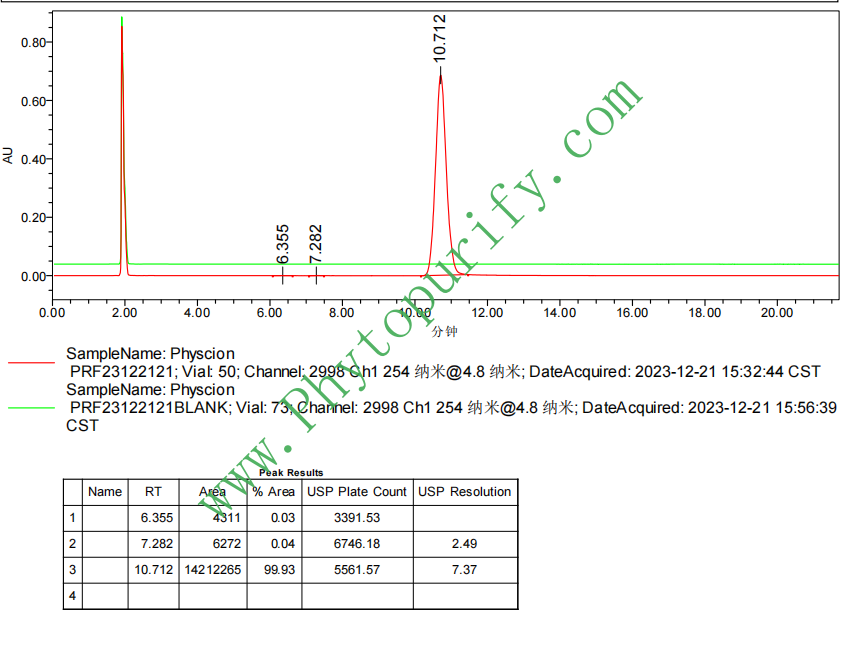
Purity: 95%~99%
Analysis Method: HPLC-DAD or/and HPLC-ELSD
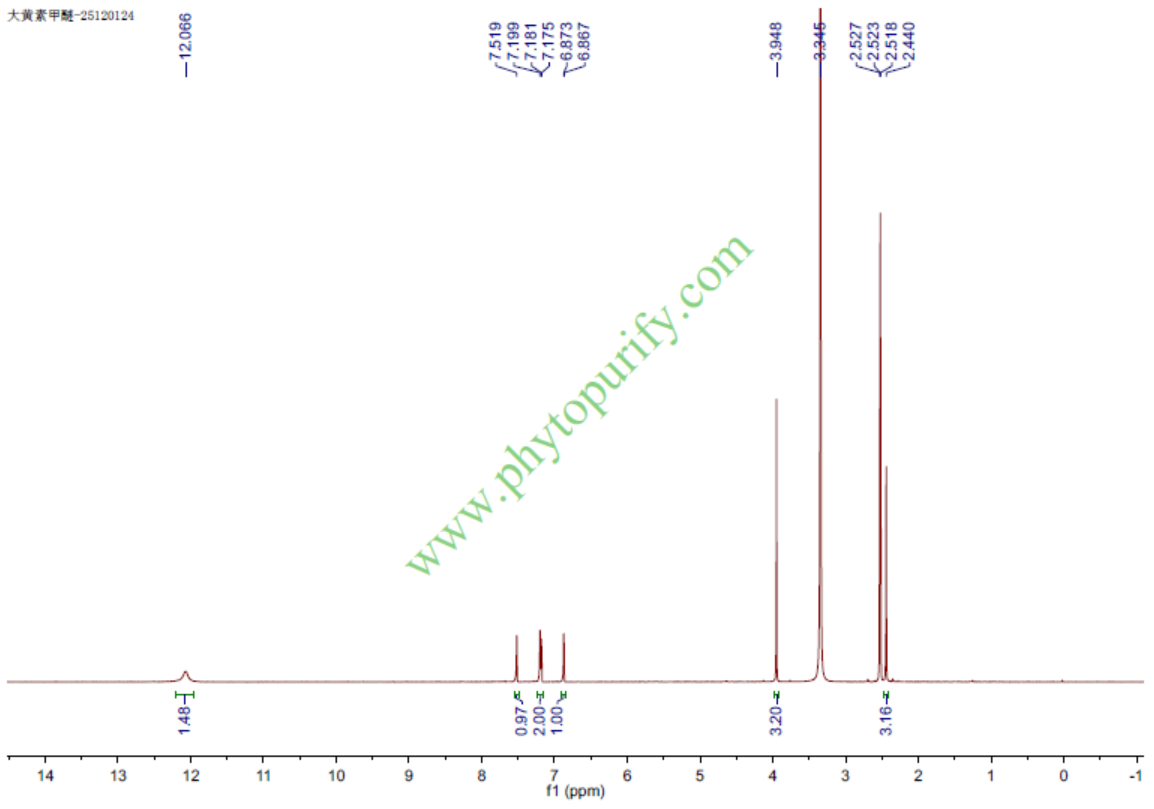
Identification Method: Mass, NMR
Packing: Brown vial or HDPE plastic bottle
Storage: Store in a well closed container, protected from air and light. Put into refrigerate or freeze for long term storage.
Whenever possible, you should prepare and use solutions on the same day. However, if you need to make up stock solutions in advance, we recommend that you store the solution as aliquots in tightly sealed vials at -20℃. Generally, these will be useable for up to two weeks.
The product could be supplied from milligrams to grams, up to kilograms
Inquire for bulk scale.
Descriptions:
Physcion is an anthraquinone from rhubarb (rhizomes of Rheum tanguticum), has anti-inflammatory, hepatoprotective, antifungal, and anti-cancer activities; Physcion has anti-proliferative activity might via the induction of G0/G1 cell cycle arrest and apoptosis in human breast cancer cells.[1]
Physcion is the extract of the plant Baill, is highly active against plant powdery mildew.[2]
Physcion could be a potential candidate in the field of anticancer drug discovery against human cervical cancer, could significantly induce cell apoptosis through down-regulating of Bcl-2 expression, up-regulating of Bax expression, and activating the caspase-3 pathway. [3]
References:
[1] Hong J Y, Chung H J, Song Y B, et al. Asian Pac J Cancer P, 2014, 19(4):273-8.
[2] Yang X, Yang L, Wang S, et al. Pest Manag Sci?, 2007, 63(5):511–515.
[3] Wijesekara I, Zhang C, Ta Q V, et al. Microbiol Res?, 2014, 169(4):255-261.
[4] Zhu L, Song Y. Asia-Pacific Traditional Medicine, 2013, 9(4):28-30.
HPLC of Physcion
HNMR of Physcion
Storage conditions:Short-term storage at 2~8℃, long-term storage at -20 ~ -80℃
83.8300
3.1598
2.8123
.0512
5.9177
9.9580
Low
90.0781
2.3068
Yes
No
No
No
Yes
Yes
1.2
Yes
No
Yes
No
Natural products, as an important source of drug discovery and development, play an irreplaceable role in the history of human disease prevention and treatment. Among them, anthraquinone compounds have attracted much attention due to their wide range of biological activities. Physcion, also known as Parietin, is a typical hydroxy anthraquinone derivative with a CAS number of 521-61-9. It's not just traditional Chinese medicine rhubarb(Rheum palmatum L. One of the characteristic active ingredients of plants in the Polygonaceae family, it is also widely distributed in various lichens and fungi. Traditionally, rhubarb rich in emodin methyl ether has been used for defecation, clearing heat and fire, with a long history of application. With the deepening of modern pharmacological research, the biological effects of emodin methyl ether have far exceeded traditional cognitive categories. Research has shown that it is not only an orally effective and competitive inhibitor of 6-phosphogluconate dehydrogenase (6PGD) that can cross the blood-brain barrier, but also an important regulator of the TLR4/NF - κ B signaling pathway. It exhibits multiple pharmacological activities such as anti-inflammatory, antibacterial, and anti-tumor effects, and can induce cancer cell apoptosis and autophagy. These findings demonstrate enormous potential in the fields of metabolic diseases, inflammatory diseases, and cancer treatment. This article aims to systematically review the chemical properties, plant sources, pharmacological activities, molecular mechanisms of action, pharmacological evaluation, and clinical application prospects of emodin methyl ether, in order to provide comprehensive scientific references for the in-depth research and development of this natural product.
The chemical name of emodin methyl ether is 1,8-dihydroxy-3-methoxy-6-methylanthraquinone, with a molecular formula of C16H12O5 and a molecular weight of 284.2670. Its basic skeleton is the anthraquinone nucleus, with specific structural features including the presence of two hydroxyl groups (- OH) at positions 1 and 8 of anthraquinone, a methoxy group (- OCH3) at position 3, and a methyl group (- CH3) at position 6. This specific substitution pattern determines its unique physicochemical properties and biological activity.
From the analysis of physical and chemical properties, the lipid water partition coefficient (LogP) of emodin methyl ether is 3.1598, indicating its moderate lipophilicity, which is beneficial for its penetration of cell membranes but may also affect its water solubility. Its topological polar surface area (TPSA) is 83.83 Å ², which is relatively small, further supporting its good membrane permeability. However, its water solubility is poor, at around 0.0512 mg/mL, which may be a challenge that needs to be overcome in its formulation development. In the preliminary screening related to drug properties, the Ames test result of emodin methyl ether is 1.2 (usually considered negative if the ratio is less than 2), indicating a low risk of mutagenicity; Meanwhile, the data shows that it has no significant inhibitory effect on hERG potassium channels, indicating that its potential risk of arrhythmia is relatively small, and the preliminary safety assessment is optimistic. It is worth noting that although its LogP value suggests possible central permeability, its blood-brain barrier permeability is evaluated as "low", which may be related to the presence of polar groups (hydroxyl groups) in its molecule and potential binding rate with plasma proteins. The specific mechanism needs further investigation.
Emodin methyl ether is widely distributed in nature, and its main plant source is Polygonaceae plants, especially medicinal rhubarb(Rheum palmatum)Tanggu Extra Large Yellow(Rheum tanguticum)Hand leaf rhubarb(Rheum officinale)Waiting for authentic Rhubarb medicinal herbs. In these plants, emodin methyl ether often coexists with other anthraquinone compounds such as rhein, emodin, aloe emodin, etc., which is one of the important material bases for its laxative effect. In addition, it is also a variety of lichens (such as...)Xanthoria parietina)The key pigment component, hence the name Parietin, has also been found in certain fungi.
Organic solvent extraction is commonly used to extract emodin methyl ether from plant materials. The classic process includes crushing the dried rhubarb herb, first degreasing it with non-polar solvents such as petroleum ether or ether, and removing impurities such as chlorophyll and oil. Then, organic solvents with moderate polarity, such as chloroform, ethyl acetate, or methanol, are used for heating reflux extraction or ultrasound assisted extraction to dissolve free anthraquinone components including emodin methyl ether. For bound anthraquinones (such as glycosides), acid hydrolysis or enzymatic hydrolysis is usually required to convert them into their free form before extraction. After filtration and concentration, the crude extract can be separated and purified by methods such as silica gel column chromatography and preparative high-performance liquid chromatography (HPLC). In recent years, some green extraction techniques such as supercritical CO2 extraction and microwave-assisted extraction have also been explored to improve extraction efficiency and selectivity. The optimization of extraction process requires comprehensive consideration of factors such as solvent type, temperature, time, and solid-liquid ratio to obtain high-purity emodin methyl ether monomer for subsequent pharmacological research and application development.
A large number of in vitro and in vivo studies have confirmed that emodin methyl ether has diverse pharmacological activities, mainly covering the following aspects:
Laxative effect This is its most classic traditional pharmacological effect. Emodin methyl ether stimulates the colonic mucosa, inhibits the absorption of water and electrolytes by intestinal wall cells (possibly related to the inhibition of Na+/K+- ATPase), increases the osmotic pressure of intestinal contents, promotes water secretion into the intestinal lumen, softens feces, increases volume, stimulates intestinal peristalsis, and produces a laxative effect. Its target involves multiple aquaporins (AQP3, AQP4, AQP8) and ion channels/transporters (such as CFTR chloride channels, SLC9A3 Na+/H+exchangers), which exert their effects by regulating intestinal water salt balance.
Anti inflammatory and immune regulatory effects Emodin methyl ether has been proven to be a potent inhibitor of the TLR4/NF - κ B signaling pathway. In inflammation models induced by stimuli such as lipopolysaccharide (LPS), it can effectively inhibit the activation of TLR4, block the phosphorylation and degradation of I κ B α, thereby preventing NF - κ B nuclear translocation and downregulating the expression of key pro-inflammatory mediators such as TNF - α, IL-1 β, IL-6, COX-2, iNOS, etc. This mechanism demonstrates good protective effects in various inflammatory disease models such as acute lung injury, colitis, arthritis, and neuropathy.
antitumor activity The anti-tumor activity is currently a hot topic in the research of emodin methyl ether. It can inhibit proliferation, induce cell cycle arrest, promote apoptosis and autophagy in a variety of cancer cell lines (such as breast cancer, liver cancer, lung cancer, colorectal cancer, gastric cancer, leukemia, etc.). Its pro apoptotic mechanism involves activating the caspase cascade, regulating the Bcl-2/Bax ratio, and inducing a decrease in mitochondrial membrane potential. Meanwhile, it can also induce protective or lethal autophagy by regulating pathways such as AMPK/mTOR and PI3K/Akt. In addition, emodin methyl ether can also inhibit the migration, invasion, and angiogenesis of tumor cells, indicating its potential for anti metastasis.
Antibacterial and antiviral effects Emodin methyl ether has a certain inhibitory effect on various Gram positive bacteria (such as Staphylococcus aureus, Bacillus subtilis) and some Gram negative bacteria, and its mechanism may be related to the destruction of bacterial cell membrane structure and interference with energy metabolism. In addition, some studies have reported that it also has certain inhibitory activity against influenza virus, herpes virus, etc.
Metabolic regulation effect As an inhibitor of 6-phosphogluconate dehydrogenase (6PGD) with an IC50 of 38.5 μ M, emodin methyl ether can intervene in the oxidative branch of the pentose phosphate pathway (PPP). 6PGD catalyzes the formation of 5-phosphate ribulose from 6-phosphogluconic acid and generates NADPH. Inhibition of 6PGD can reduce the production of NADPH and ribose, affecting the biosynthesis and redox homeostasis of tumor cells. This is considered one of the important mechanisms of its anti-tumor effect, and also provides new ideas for the treatment of metabolic diseases.
The multiple pharmacological activities of emodin methyl ether stem from its regulation of multiple key molecular targets and signaling pathways:
Core enzyme target: 6-phosphogluconate dehydrogenase (6PGD)Emodin methyl ether directly binds to the active site of 6PGD through competitive inhibition, with a Kd value of 26.0 μ M. By inhibiting 6PGD, it interferes with the pentose phosphate pathway, resulting in reduced production of NADPH and phosphoribose. NADPH is an important cofactor that maintains the reduced state of glutathione in cells, resists oxidative stress, and supports the synthesis of fatty acids and nucleotides. Therefore, inhibiting 6PGD can simultaneously disrupt the redox balance and biosynthetic ability of tumor cells, induce oxidative damage and metabolic crisis, thereby inhibiting tumor growth.
Key signaling pathway: TLR4/NF - κ B pathway Emodin methyl ether directly or indirectly interferes with the activation of TLR4 and its downstream signaling in inflammation and immune response. It may bind to TLR4 or related adaptor proteins, inhibit MyD88 dependent signaling, prevent activation of the I κ B kinase (IKK) complex, stabilize I κ B α, restrict NF - κ B in the cytoplasm, and ultimately comprehensively inhibit the transcription of a series of pro-inflammatory genes. This is the central mechanism by which it exerts a powerful anti-inflammatory effect.
Cell death regulatory pathway:
Intestinal action related targets To explain its traditional laxative effect, research has found its regulatory effect on specific intestinal proteins
Based on its physicochemical parameters and preliminary biological data, the pharmacological characteristics of emodin methyl ether present both advantages and challenges.
Advantage aspects The molecular weight is moderate (284 Da), and the LogP value shows that it has good lipid solubility and cell membrane permeability potential. There was no significant hERG inhibitory activity or mutagenicity (Ames test negative), providing preliminary safety assurance. Most importantly, it is orally effective and has shown pharmacological activity in various animal models, demonstrating its basic bioavailability.
Challenges and pharmacokinetic (PK) considerations Despite its oral activity, there is still a lack of systematic research on its specific pharmacokinetic parameters in humans. Based on existing data and similar materials, it is speculated that: ①absorb Among them, lipophilicity is beneficial for passive absorption in the intestine, but low water solubility may limit its dissolution rate, becoming the limiting step for oral absorption. ②distribution It can penetrate the blood-brain barrier (although rated as "low"), which is of great significance for its effects on central nervous system diseases such as neuroinflammation and brain tumors, but may also pose potential risks of central side effects. The distribution of tissues in the body may be relatively wide. ③Metabolism As an anthraquinone compound, emodin methyl ether is likely to undergo extensive phase I and phase II metabolism in the liver, such as hydroxylation, demethylation, glucuronidation, and sulfation. Its methoxy and hydroxyl groups are common metabolic sites. ④excretion Metabolites are mainly excreted through bile and urine. The prototype drug may also be partially excreted through the kidneys.
Optimization direction of drug properties To improve the feasibility of its clinical application, future research can focus on: ①Formulation improvement Using technologies such as solid dispersions, nanocrystals, liposomes, and cyclodextrin inclusion complexes to improve their solubility and dissolution rate, and enhance oral bioavailability. ②Structural modification By using semi synthetic methods to modify its hydroxyl and methoxy groups, its solubility, metabolic stability, and targeting are optimized while maintaining its activity. ③Prodrug design Develop prodrugs that are activated in specific areas, such as the tumor microenvironment or gut, to enhance selectivity and reduce systemic toxicity.
The multi-target and multi pathway properties of emodin methyl ether provide broad prospects for its application in various disease fields
Tumor treatment field As a natural product with dual functions of metabolic intervention (6PGD inhibition) and signaling pathway inhibition (TLR4/NF - κ B), emodin methyl ether has great potential in tumor treatment. It may be used for: ①adjuvant therapy Combined with conventional chemotherapy drugs or radiotherapy to enhance efficacy and reduce drug resistance. Its ability to induce autophagy requires careful evaluation and may need to be combined with autophagy inhibitors to achieve optimal pro death effects. ②Targeted metabolic therapy Targeting specific types of tumors that rely on the pentose phosphate pathway, such as certain leukemia and liver cancer. ③New drug lead compounds Using it as a framework for structural optimization, develop new anti-tumor drugs with higher selectivity and lower toxicity.
Inflammatory and immune diseases Its strong TLR4/NF - κ B inhibitory ability makes it valuable for the treatment of rheumatoid arthritis, inflammatory bowel disease (such as ulcerative colitis), acute pancreatitis, sepsis, neurodegenerative diseases accompanied by neuropathy, and other related conditions. We can explore its potential as a novel anti-inflammatory drug, especially for patients who are intolerant or ineffective to traditional nonsteroidal anti-inflammatory drugs or hormone therapy.
Constipation treatment As one of the components in rhubarb that have a laxative effect, emodin methyl ether or its structurally optimized compounds are expected to be developed into safer and milder modern laxatives, reducing the side effects of traditional rhubarb preparations such as colon blackening and electrolyte disorders that may occur due to excessive or long-term use of anthraquinone substances.
Other fields Its antibacterial and antiviral activities are also worth further exploration, especially for drug-resistant bacterial infections or specific viral infections.
However, pushing it into clinical practice still faces many challenges: ①Systematic interpretation of the mechanism of action More precise clarification is needed on its role nodes and priority order in complex biological networks. ②In depth validation of in vivo pharmacodynamics It is necessary to confirm the efficacy and dose-response relationship in animal models that are closer to human diseases, such as humanized tumor xenograft models and complex inflammation models. ③Comprehensive security evaluation Systematic preclinical toxicology studies are required, including long-term toxicity, reproductive toxicity, carcinogenicity, etc., with particular attention to the potential hepatorenal toxicity of anthraquinone compounds. ④Optimize drug delivery strategy Determine the optimal route of administration, dosage, and course of treatment, and explore combination therapy regimens.
Emodin methyl ether, as a natural anthraquinone compound derived from traditional Chinese medicine, has evolved from a traditional laxative component to a star molecule with multiple biological activities such as anti-inflammatory, anti-tumor, and metabolic regulation due to its unique chemical structure and multi-target pharmacological mechanism. Its inhibitory effect on the 6PGD and TLR4/NF - κ B pathways provides a new molecular perspective and intervention strategy for the treatment of tumors and inflammatory diseases. Despite facing challenges such as water solubility and the need to optimize pharmacokinetic properties in drug development, its clear activity, relatively good preliminary safety data, and orally effective characteristics have laid a solid foundation for its further development. Future research should focus on improving its physicochemical properties through modern pharmaceutical and medicinal chemistry methods, combining systems biology methods to deeply reveal its network pharmacology mechanisms, and verifying its efficacy and safety in rigorous preclinical and clinical studies. The research process of emodin methyl ether is a typical case of modernizing traditional Chinese medicine and interpreting its scientific connotation. Its subsequent development is expected to provide valuable lead compounds and new therapeutic strategies for the research and development of innovative drugs.
