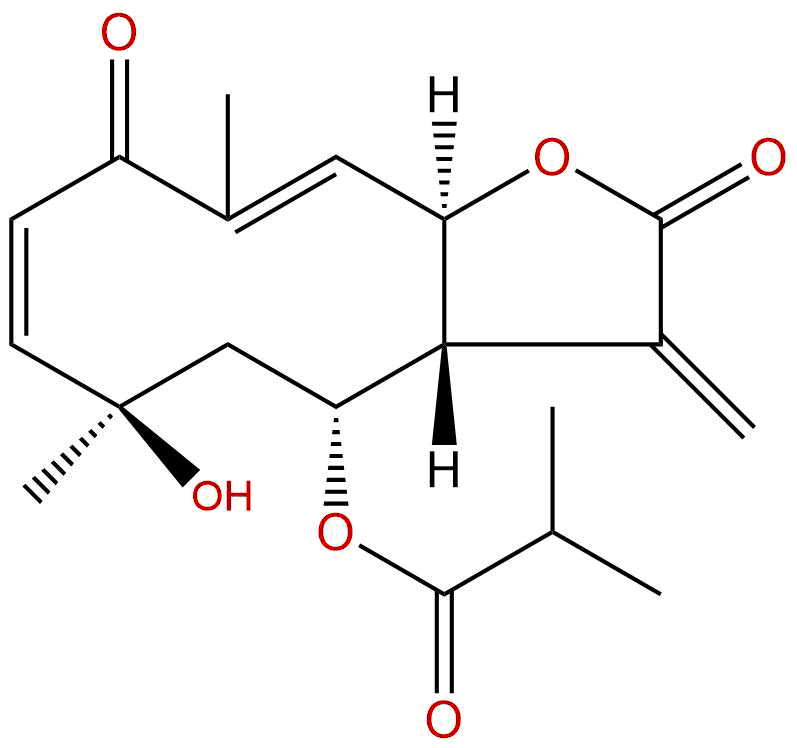


Product name: Tagitinin C
Synonym name:
Catalogue No.: BP2224
Cas No.: 59979-56-5
Formula: C19H24O6
Mol Weight: 348.395
Botanical Source:
Type of Compound: Sesquiterpenoids
Purity: 95%~99%
Analysis Method: HPLC-DAD or/and HPLC-ELSD
Identification Method: Mass, NMR
Packing: Brown vial or HDPE plastic bottle
Storage: Store in a well closed container, protected from air and light. Put into refrigerate or freeze for long term storage.
Whenever possible, you should prepare and use solutions on the same day. However, if you need to make up stock solutions in advance, we recommend that you store the solution as aliquots in tightly sealed vials at -20℃. Generally, these will be useable for up to two weeks.
The product could be supplied from milligrams to grams
Inquire for bulk scale.
For Reference Standard and R&D, Not for Human Use Directly.
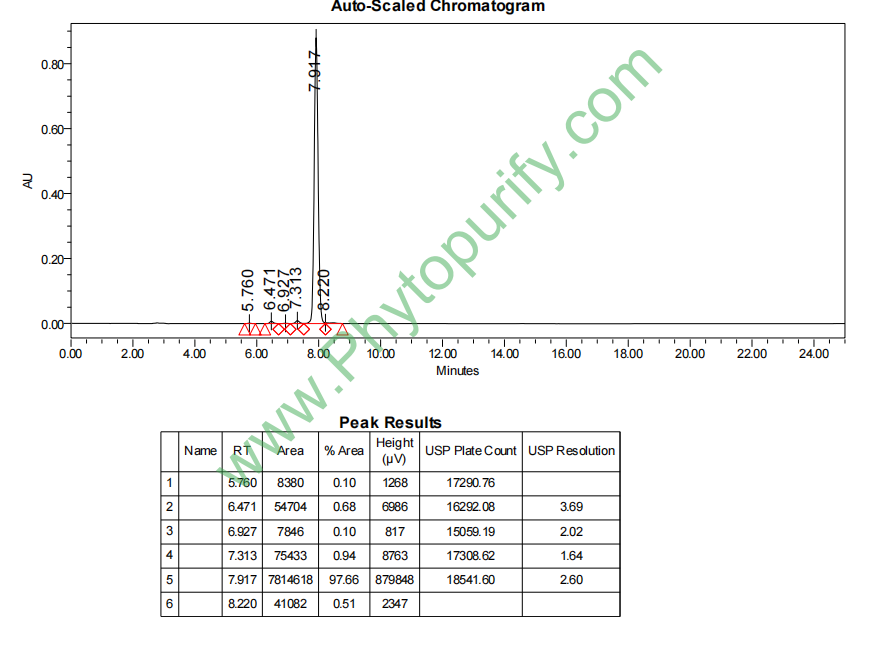
HPLC of Tagitinin C
Storage conditions:Short-term storage at 2~8℃, long-term storage at -20 ~ -80℃
89.9000
1.3997
1.3997
.6123
3.0751
6.1685
High
61.1478
4.8141
No
Yes
No
No
Yes
Yes
0.0
Yes
Yes
Yes
Yes
Natural products, as an important treasure trove for drug discovery, play an irreplaceable role in the history of human disease treatment. Among them, sesquiterpenes have always been a hot topic in medicinal chemistry and pharmacology research due to their structural diversity and wide range of biological activities. Tagitinin C, CAS number 59979-56-5, is a sesquiterpene lactone with significant biological activity isolated from plants of the genus Tagitinin in the Asteraceae family. Early studies have revealed its potential anti-tumor activity, particularly exhibiting clear inhibition of proliferation and induction of death in the malignant glioblastoma cell line U373. In recent years, with the deepening of research, its pharmacological activity spectrum continues to expand, especially in the field of anti atherosclerosis and other cardiovascular diseases, showing new potential, and related molecular targets such as LOX-1, AMPK, MCL1, etc. are gradually revealed. This article aims to systematically review the chemical properties, plant sources, pharmacological activities, mechanisms of action, medicinal properties, and clinical application prospects of Scutellaria baicalensis lactone C, in order to provide comprehensive scientific references for the deep development and utilization of this natural product.
Swelling stem chrysanthemum lactone C is a sesquiterpene lactone compound with a molecular formula of C19H24O6 and a molecular weight of 348.3950. Its core structure contains a characteristic gamma lactone ring, fused with multiple ring systems, and structurally possesses multiple chiral centers, which determine its specific stereochemical configuration and biological activity. The α, β - unsaturated lactone fragments in its chemical structure are key pharmacophores for many sesquiterpene lactones to exert biological activity, often undergoing Michael addition reactions with nucleophilic groups (such as thiol groups) inside cells, thereby affecting various protein functions.
From the analysis of physicochemical parameters related to drug properties, the lipid water partition coefficient (LogP) of Scutellaria baicalensis C is 1.3997, indicating that it has moderate lipophilicity and is conducive to transmembrane transport. The topological polar surface area (TPSA) is 89.9000 Å ², which is a relatively moderate value. The predicted value of its water solubility is 0.6123 mg/mL, which belongs to the category of slight solubility. Of particular note is that its blood-brain barrier (BBB) permeability is predicted to be "high", which is highly consistent with its activity demonstrated in glioblastoma (a central nervous system malignancy) research, suggesting that it may act directly on brain lesions without special modifications. In addition, preliminary toxicity predictions showed no inhibitory tendency towards hERG potassium channels (hERG inhibition: No), and the Ames test predicted a value of 0.0, suggesting that it may not have mutagenicity and significant cardiac toxicity risks, providing preliminary positive signals for its safety evaluation.
The main source of Scutellaria baicalensis lactone C is from plants in the Asteraceae family, especially Scutellaria baicalensis. This genus of plants is widely distributed in tropical and subtropical regions such as the Americas and Africa, and is often used in folk medicine to treat inflammation, infections, and pain. The extraction of natural active ingredients is the foundation of research.
At present, organic solvent extraction method is mainly used to extract steviol lactone C from steviol plant materials. The conventional process is as follows: first, the dried aboveground parts of the plant (such as leaves and stems) are crushed, and then subjected to cold soaking or heating reflux extraction with polar organic solvents such as methanol, ethanol, or acetone. After merging the extracts, the crude extract was obtained by vacuum concentration. Subsequently, the crude extract was preliminarily separated using liquid-liquid partitioning extraction (often using solvents such as petroleum ether, ethyl acetate, n-butanol, etc.), and the coumarin C was usually enriched in the moderately polar ethyl acetate fraction.
To further purify and obtain monomeric compounds, various chromatographic techniques are required. Silica gel column chromatography is commonly used as the main separation method, with different ratios of petroleum ether ethyl acetate or chloroform methanol gradient elution. Collect the fraction containing the target component through thin-layer chromatography (TLC) monitoring. Subsequently, it may be necessary to further refine the product by reverse phase silica gel column chromatography (such as C18 packing, eluted with methanol water system), preparative high-performance liquid chromatography (HPLC), or recrystallization to obtain high-purity crystals or powders of Scutellaria baicalensis C. Modern extraction and separation technologies, such as high-speed countercurrent chromatography (HSCCC), have shown potential applications in the separation of natural products due to their high efficiency and avoidance of irreversible adsorption caused by solid adsorbents.
Phytolactone C shows many pharmacological activities, among which the anti-tumor and anti atherosclerosis effects are the most prominent.
Antitumor activity This is the earliest discovered activity of Scutellaria baicalensis lactone C. Research has confirmed that it has significant cytotoxicity against human glioblastoma U373 cells, with a half maximal inhibitory concentration (IC50) of 6.1 μ g/mL (approximately 17.5 μ M). This compound not only effectively inhibits the proliferation of U373 cells, but also induces their death. Subsequent studies also found that stetholide C also showed certain growth inhibitory activity on some other cancer cell lines, such as breast cancer and lung cancer cells, but its intensity and selectivity varied with cell type, suggesting that its anti-tumor spectrum and specific mechanism might be different.
Antiatherosclerotic activity This is an emerging direction in the pharmacological research of Scutellaria baicalensis lactone C. Atherosclerosis is a complex chronic inflammatory vascular disease. Based on the network pharmacology prediction and preliminary experimental verification, stetholide C may play a protective role by acting on multiple targets closely related to the occurrence and development of atherosclerosis. For example, it may delay or prevent the formation and development of atherosclerotic plaque by influencing lipid metabolism, inhibiting vascular endothelial inflammatory reaction, regulating the formation of foam cells, and affecting the proliferation and migration of vascular smooth muscle cells. Its specific anti atherosclerosis effect and intensity in vivo and in vitro still need to be confirmed by more systematic pharmacodynamics experiments.
Other potential activities Based on the structural characteristics of its sesquiterpene lactone and its primary pharmacological reports, it is speculated that Scutellaria baicalensis lactone C may also have anti-inflammatory and antibacterial activities, which are common to many structurally similar compounds. However, specialized research on these aspects is currently insufficient and further exploration is needed.
The biological activity of Scutellaria baicalensis lactone C originates from its interaction with specific molecular targets within cells. The potential targets revealed by current research are mainly related to its anti-tumor and anti atherosclerosis activities.
In Mechanism of anti-tumor action Inducing cell apoptosis is one of its main pathways. Research has shown that treatment of U373 cells with Scutellaria baicalensis C can lead to a decrease in mitochondrial membrane potential, upregulation of pro apoptotic proteins (such as Bax) expression, and inhibition of anti apoptotic proteins Bcl-2 and MCL1 expression. Bcl-2 and MCL1 are key regulatory factors of cell apoptosis, and their downregulation can disrupt mitochondrial outer membrane permeability, leading to the release of cytochrome C, which in turn activates the caspase cascade reaction and ultimately triggers programmed cell death. In addition, predictions suggest that it may inhibit RECQ1 (a DNA helicase), interfere with DNA replication and repair, which may also contribute to its cytotoxicity.
In Anti atherosclerosis mechanism On the one hand, its target network is more complex, involving multiple key proteins:
* LOX-1 As the main endothelial receptor for oxidized low-density lipoprotein, it plays a central role in initiating endothelial dysfunction and inflammation. Inhibition of LOX-1 can alleviate oxidative stress and inflammatory response.
* AMPK The core sensor of energy metabolism. Activating the AMPK pathway can promote fatty acid oxidation, inhibit cholesterol synthesis, and enhance the expression of ABCA1.
* ABCA1 The key protein for cholesterol reverse transport promotes the efflux of intracellular cholesterol to apolipoprotein A-I, which is an important link in maintaining cholesterol homeostasis. The expression of ABCA1 may be up-regulated by stevia C, which may promote the reversal of macrophage foam process.
* EHMT2 A histone methyltransferase involved in epigenetic regulation. Inhibition of EHMT2 may affect the expression of genes related to inflammation and cell proliferation.
To sum up, steviolactone C may form a multi target and multi pathway action network by simultaneously regulating LOX-1 mediated inflammation, AMPK mediated metabolism, ABCA1 mediated cholesterol efflux, apoptosis related proteins (MCL1, BCL2) and other multiple targets, so as to synergistically play an anti atherosclerosis effect. This multi-target action characteristic is also the basis for many natural products to exert therapeutic advantages in complex diseases.
Although Scutellaria baicalensis C has shown good biological activity in vitro, its development into a drug still requires systematic pharmacological evaluation and pharmacokinetic studies.
Based on computational prediction Five principles of generic drugs Preliminary analysis: Its molecular weight (348.4) is less than 500, LogP (1.4) is within the ideal range (1-3), the number of hydrogen bond donors is relatively small (depending on the hydroxyl groups in the structure), and the number of hydrogen bond acceptors (oxygen atoms) is moderate. These parameters overall meet the general requirements for small molecule oral drugs. A higher blood-brain barrier permeability prediction is a significant advantage in treating central nervous system diseases such as gliomas.
However, the real challenges in drug development may lie in the following areas:
1. Solubility and permeability Although LogP is ideal, its actual water solubility is only slightly soluble, which may affect its absorption (bioavailability) in the gastrointestinal tract. Improvements may need to be made through formulation techniques such as solid dispersion, nanocrystals, cyclodextrin inclusion complexes, etc.
2. Metabolic stability The structure of sesquiterpene lactones, especially the α, β - unsaturated lactones, may serve as substrates for liver metabolic enzymes such as cytochrome P450, or may undergo binding reactions with glutathione, leading to its rapid clearance in the body. This needs to be evaluated through in vitro liver microsomal metabolism experiments.
3. Pharmacokinetic properties At present, there is almost no systematic pharmacokinetic study on the absorption, distribution, metabolism, and excretion of Scutellaria baicalensis lactone C. Its high BBB permeability indicates good brain tissue distribution, but key parameters such as oral absorption degree, plasma protein binding rate, half-life, major metabolites, and excretion pathways are unknown. These are data gaps that must be filled in preclinical development.
4. In vivo efficacy and toxicity: The existing anti-tumor IC50 data are based on cell experiments, and the anti-tumor or anti atherosclerosis activity in vivo needs to be verified in animal models (such as glioma xenotransplantation mouse model, ApoE -/- mouse atherosclerosis model). Meanwhile, safety evaluations such as acute toxicity, long-term toxicity, and reproductive toxicity are crucial.
As a natural compound with multi-target activity, the clinical application prospects of Scutellaria baicalensis C mainly depend on the depth and conversion efficiency of subsequent research.
As a lead compound for novel anti-tumor drugs For malignant tumors with extremely poor prognosis such as glioblastoma, existing treatment methods are limited. Cymbinolide C has a natural high blood-brain barrier permeability, which is an advantage that many chemotherapy drugs do not possess. Future research can focus on: ① optimizing its efficacy and selectivity through structural modification to reduce potential toxicity; ② Develop a drug delivery system for brain tumors (even with good BBB permeability, precise delivery can enhance efficacy and reduce systemic side effects); ③ Explore its combination therapy with existing standard therapeutic drugs such as temozolomide in order to generate synergistic effects.
Potential as antiatherosclerotic drug or health product In view of the multifactorial pathogenic characteristics of atherosclerosis, multi target regulators may have more advantages than single target drugs. Chrysanthemolide C acts on LOX-1, AMPK, ABCA1 and other key links, and has the potential to develop into a new anti atherosclerosis drug. In the early stages, it can also be explored as an ingredient in functional foods or dietary supplements for the prevention of cardiovascular diseases. But this requires extremely strict long-term security data support.
Challenges faced and future research directions:
Swelling stem chrysanthemum lactone C is a sesquiterpene lactone compound with important research value isolated from the traditional medicinal plant Swelling stem chrysanthemum. It not only shows a clear inhibitory activity against glioblastoma and other tumor cells, but also shows the potential of multi target action in the field of anti atherosclerosis, a major chronic disease. Its excellent blood-brain barrier permeability prediction provides unique advantages for its treatment of central nervous system diseases. Although current research has laid the foundation in chemistry, plant sources, and preliminary pharmacological mechanisms, there is still a lot of unknowns to be explored in terms of its comprehensive action network, detailed pharmacokinetic behavior, in vivo efficacy, and safety. In the future, through interdisciplinary collaboration, we aim to clarify its scientific connotation and overcome the bottleneck of drug development. Cymbinolide C is expected to develop from a promising natural product into an innovative drug lead compound for the treatment of tumors or cardiovascular diseases, contributing value to human health.
