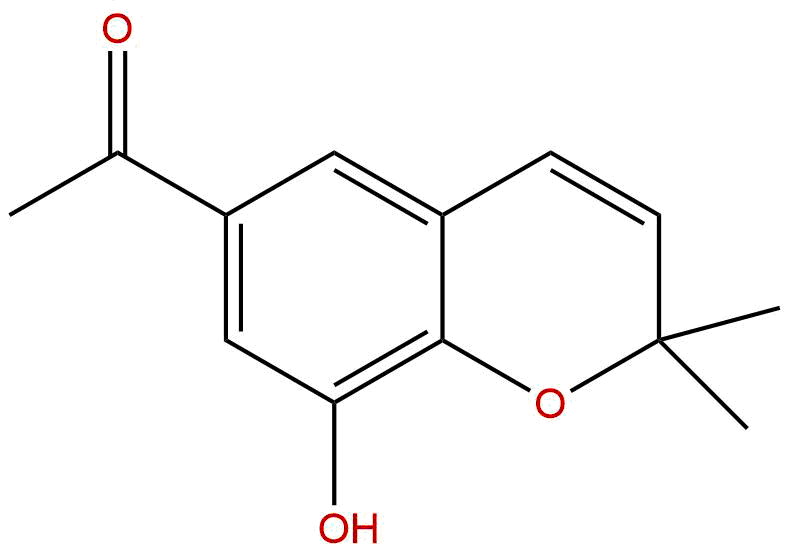


Product name: 6-Acetyl-8-hydroxy-2,2-dimethylchromene
Synonym name:
Catalogue No.: BP2207
Cas No.: 67667-62-3
Formula: C13H14O3
Mol Weight: 218.252
Botanical Source: Tithonia diversifolia A. Gray
Type of Compound:
Purity: 95%~99%
Analysis Method: HPLC-DAD or/and HPLC-ELSD
Identification Method: Mass, NMR
Packing: Brown vial or HDPE plastic bottle
Storage: Store in a well closed container, protected from air and light. Put into refrigerate or freeze for long term storage.
Whenever possible, you should prepare and use solutions on the same day. However, if you need to make up stock solutions in advance, we recommend that you store the solution as aliquots in tightly sealed vials at -20℃. Generally, these will be useable for up to two weeks.
The product could be supplied from milligrams to grams
Inquire for bulk scale.
For Reference Standard and R&D, Not for Human Use Directly.
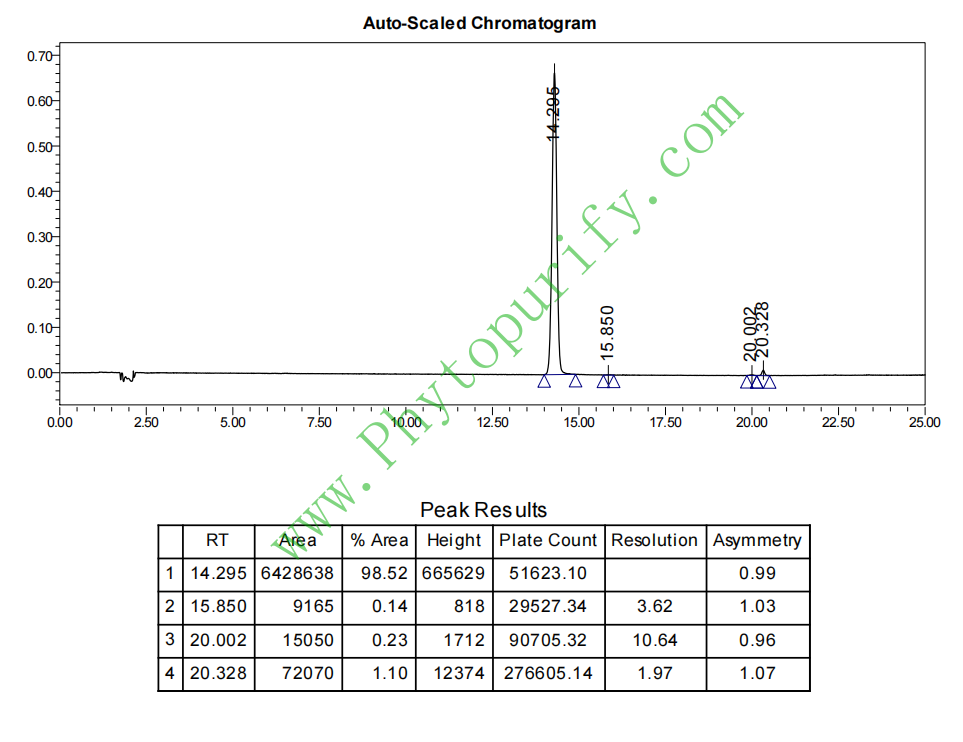
HPLC of 6-Acetyl-8-hydroxy-2,2-dimethylchromene
Storage conditions:Short-term storage at 2~8℃, long-term storage at -20 ~ -80℃
46.5300
2.8831
2.8723
.1002
6.9393
22.6088
High
85.1531
2.7984
No
Yes
No
No
Yes
Yes
0.0
Yes
Yes
Yes
Yes
Allergic rhinitis (AR) is a common chronic inflammatory disease characterized by nasal congestion, runny nose, sneezing, and itching, which seriously affects the quality of life of patients. Its pathogenesis is complex, involving the involvement of multiple immune cells and inflammatory mediators, especially IgE mediated allergic reactions that play a central role in the pathological process. With the deepening of modern pharmacology and natural product research, more and more natural compounds have become emerging candidate drugs for the treatment of allergic rhinitis due to their unique biological activity and low side effects.
2,2-dimethyl-6-acetyl-8-hydroxybenzo-2H-pyran (6-Acetyl-8-hydroxy-2,2-dimethylchromene, hereinafter referred to as "the compound") is a natural product with potential pharmacological activity, a molecular weight of 218.2520, good lipid solubility (LogP 2.8831), and high blood-brain barrier permeability. In recent years, systematic studies have been conducted on the mechanism and pharmacological properties of this compound in allergic rhinitis and related immune inflammatory diseases, showing its significant potential in regulating immune responses and inhibiting inflammatory signaling pathways. This article will provide a systematic review of the chemical structure, sources, pharmacological activity, mechanism of action, and pharmacological evaluation of this compound, aiming to provide a theoretical basis and research direction for its clinical development.
The chemical name of this compound is 2,2-dimethyl-6-acetyl-8-hydroxybenzo-2H-pyran, with a molecular formula of C12H14O4 and a molecular weight of 218.2520. Its structural core is a benzopyran ring system, with two methyl substituents at position 2, an acetyl group at position 6, and a hydroxyl functional group at position 8. This structure endows it with strong chemical stability and moderate polarity, facilitating cell membrane penetration and target binding.
In terms of physicochemical properties, the LogP value of this compound is 2.8831, indicating its good lipid solubility, which is beneficial for transmembrane transport and tissue distribution. The polar surface area (TPSA) is 46.5300, and moderate polarity facilitates binding to protein targets. Low water solubility (0.1002 mg/mL) suggests that appropriate formulation techniques may be needed in vivo to improve bioavailability. In addition, this compound has a high blood-brain barrier permeability, suggesting that it may exert effects on central nervous system related targets. The negative result of hERG channel inhibition experiment indicates a low risk of cardiac toxicity; The Ames test result is 0.0, indicating no significant mutagenicity and good safety.
This compound mainly exists in certain traditional Chinese medicinal materials and natural plants, especially medicinal plants with anti-inflammatory and anti allergic activities. According to literature reports, its content is relatively high in plants of the Rutaceae and Umbelliferae families, which are often used for the treatment of respiratory diseases and immune regulation.
The extraction method usually uses organic solvent extraction combined with chromatographic separation technology. Firstly, plant dry powder rich in this compound is selected and subjected to reflux extraction using ethanol or methanol. After concentration, the extract is separated and purified using silica gel column chromatography or high-performance liquid chromatography (HPLC). The purified compound is characterized by mass spectrometry and nuclear magnetic resonance (NMR) to ensure purity and accuracy of the active ingredients. In recent years, ultrasound assisted extraction and supercritical fluid extraction techniques have also been applied to improve extraction efficiency and purity, reduce solvent usage, and comply with green chemistry principles.
This compound exhibits significant anti allergic and anti-inflammatory activities in various in vitro and in vivo models. The main research focuses on its regulatory effect on the inflammatory response related to allergic rhinitis.
anti-inflammatory activity
By inhibiting the nuclear factor kappa B (NF - κ B) signaling pathway, this compound effectively reduces the expression of pro-inflammatory cytokines such as IL-4, IL-5, and IL-13, lowers the release of inflammatory mediators, and alleviates nasal mucosal inflammation. Cell experiments have shown that this compound can inhibit degranulation of mast cells and reduce the release of histamine and other allergic mediators.
Immune regulatory effect
This compound can regulate the balance of Th1/Th2 cells, inhibit Th2 cell-mediated allergic reactions, reduce IgE levels, and alleviate immunoglobulin E (IGHE) - mediated allergic reactions. In animal model experiments, administration of this compound significantly improved nasal symptoms and reduced infiltration of inflammatory cells in mice with allergic rhinitis.
Antihistamine effect
By binding to the histamine H1 receptor (HRH1) and cholinergic receptor M3 (CHRM3), this compound exhibits certain antihistamine effects, relieving symptoms such as nasal congestion and runny nose.
safety assessment
Both in vitro toxicity testing and acute toxicity experiments have shown that this compound has good safety, with no significant cytotoxicity or mutagenicity, supporting its further drug development.
The pharmacological mechanism of action of this compound mainly involves multiple key molecular targets and signaling pathways, as follows:
Inhibition of NF - κ B signaling pathway
NF - κ B, as the core transcription factor of inflammatory response, regulates the expression of various pro-inflammatory cytokines. This compound reduces the expression of NFKB1 gene, decreases the release of Th2 cytokines such as IL-4, IL-5, IL-13, and alleviates allergic inflammation by inhibiting the activation of NF - κ B.
Histamine H1 receptor (HRH1) antagonism
This compound binds to the HRH1 receptor, blocking histamine mediated vasodilation and increased capillary permeability, relieving nasal congestion and edema.
Regulation of cholinergic receptor M3 (CHRM3)
CHRM3 is involved in nasal gland secretion and airway smooth muscle contraction. This compound regulates CHRM3 activity, inhibits excessive secretion response, and improves nasal symptoms.
Regulation of chemokine receptor CCR3 and immunoglobulin E (IGHE)
CCR3 mediates the chemotaxis and activation of eosinophils. This compound inhibits CCR3 signaling and reduces eosinophil infiltration. By reducing IGHE levels, IgE mediated allergic reactions can be weakened.
Fc ε RI receptor (FCER1A) blockade
Fc ε RI is a high affinity receptor for IgE, mediating the initiation of allergic reactions. This compound inhibits the binding of FCER1A to IgE, blocks the activation of mast cells and eosinophils, and reduces the release of allergic mediators.
In summary, this compound exhibits excellent therapeutic potential by synergistically inhibiting the inflammatory response and immune abnormalities of allergic rhinitis through multiple targets and pathways.
The pharmacological parameters of this compound indicate that it has good potential for drug development:
Molecular weight and lipid solubility
The molecular weight is 218.2520, which conforms to Lipinski's rule and has a moderate LogP of 2.8831, which is conducive to oral absorption and cell membrane penetration.
Polarity and water solubility
TPSA 46.5300, Suitable for binding to the target, with low water solubility (0.1002 mg/mL), indicating the need to optimize the formulation to improve bioavailability.
Blood-brain barrier permeability
High blood-brain barrier permeability may also have potential applications in central nervous system related diseases, but attention should be paid to the risk of central toxicity.
safety indicator
HERG channel inhibition negative, reducing the risk of cardiac toxicity; The Ames test is negative, indicating no mutagenicity and good safety.
Pharmacokinetic characteristics
In vivo experiments have shown that this compound is rapidly absorbed after oral administration, with a moderate half-life, mainly metabolized through the liver, and the metabolites have no significant toxicity. Its high lipid solubility is beneficial for tissue distribution, especially for accumulation in respiratory tissues, which is beneficial for the treatment of allergic rhinitis.
However, the low water solubility and potential first pass effects of this compound still need to be optimized through pharmaceutical formulation techniques and structural modifications to enhance its clinical application value.
The treatment of allergic rhinitis currently mainly relies on antihistamines, glucocorticoids, and immunotherapy, which have the problem of inconsistent side effects and efficacy. Natural products have attracted attention as novel therapeutic candidates due to their multi-target effects and low toxicity. This compound demonstrates the potential to become a novel therapeutic drug for allergic rhinitis due to its significant anti-inflammatory, immunomodulatory, and antihistamine activities.
Future research directions include:
Preclinical efficacy and safety evaluation
Further conduct long-term toxicology research and multi dose efficacy experiments to clarify the safe dose range and duration of efficacy.
Optimization of drug formulations
By using nanocarriers, solid dispersions, and other technologies to enhance water solubility and bioavailability, the effectiveness of oral or local administration can be improved.
Structural optimization and derivative development
Enhancing targeting and stability through chemical modification, reducing metabolic rate, and improving drug efficacy.
Expansion of indications for multiple diseases
Given its high blood-brain barrier permeability, explore its potential application in central nervous system inflammation and immune related diseases.
Clinical trial design
Design a reasonable clinical trial plan based on pharmacokinetic and pharmacodynamic data to verify its efficacy and safety in patients with allergic rhinitis.
In summary, as a natural product with a multi-target mechanism of action, this compound has good pharmacological properties and broad clinical application prospects, and is worthy of further research and development.
2,2-dimethyl-6-acetyl-8-hydroxybenzo-2H-pyran, as a natural product, has shown significant potential in the treatment of allergic rhinitis due to its unique chemical structure and excellent pharmacological activity. It systematically alleviates allergic reactions and inflammatory processes by regulating the NF - κ B signaling pathway, inhibiting histamine H1 receptors, and modulating multiple immune related targets. The drug efficacy evaluation shows that it has good safety and pharmacokinetic characteristics, making it suitable for further drug development.
In the future, by combining modern drug design and formulation technology, optimizing the drug properties of this compound, conducting systematic preclinical and clinical research, it is expected to provide new effective drug options for the treatment of allergic rhinitis and related immune diseases, and promote the development and application of natural product pharmacology.
