Introduction/Overview
Gastric cancer is one of the malignant tumors with the highest incidence rate and mortality worldwide. Its occurrence and development involve abnormal regulation of multiple genes and multiple signal pathways. Despite continuous advancements in surgery, chemotherapy, and targeted therapy, the prognosis of patients with advanced gastric cancer is still unsatisfactory, and issues such as drug resistance and toxic side effects urgently need to be addressed. Therefore, searching for efficient and low toxicity anti-cancer lead compounds from natural products has become an important strategy for the development of anti-tumor drugs. Sesquiterpene lactones have attracted much attention in the field of anti-tumor due to their structural diversity and significant biological activity. Among them, 1 β - Methoxydiversifolin 3-O-methyl ether (CAS number: 194474-71-0), as a structurally unique sesquiterpene lactone derivative, has shown great potential in the pharmacological activity research of anti gastric cancer in recent years. This article aims to systematically review the chemical structure, plant origin, pharmacological activity, mechanism of action, and pharmacological properties of this compound, in order to provide comprehensive scientific references for the development of anti gastric cancer drugs based on this natural product.
Chemical structure and physicochemical properties
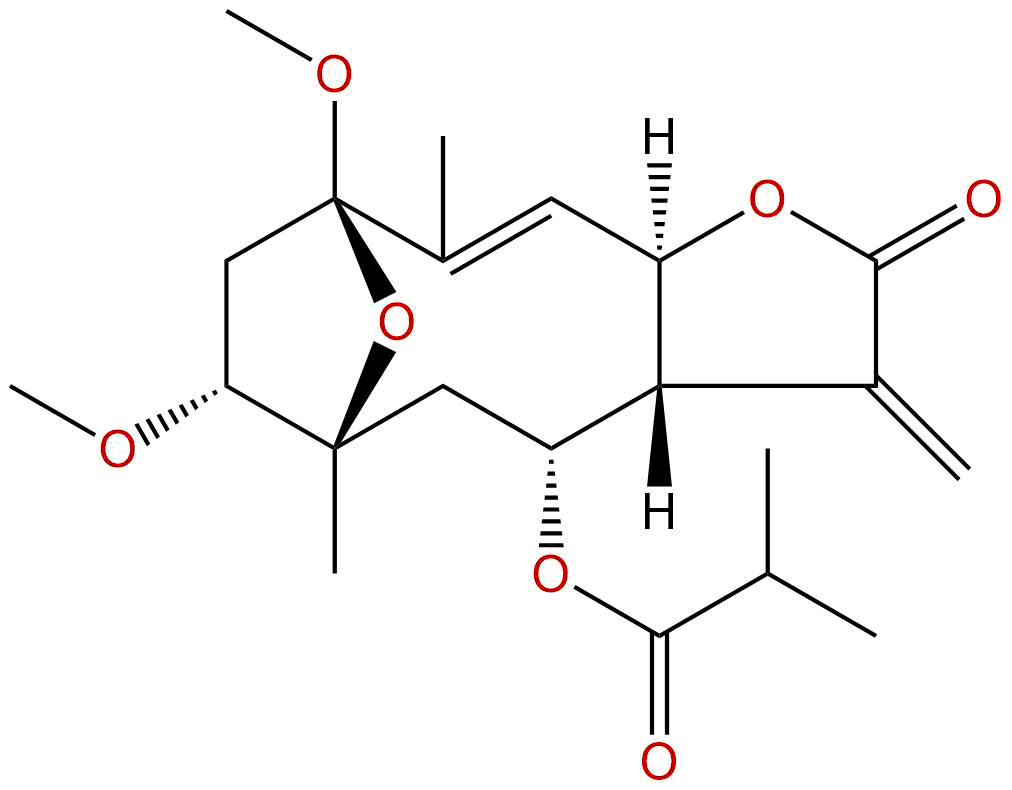
The molecular formula of 1 β - methoxyschisandrin 3-O-methyl ether is C21H30O6, with a molecular weight of 394.4640. Its core structure belongs to the guaiaceae type sesquiterpene lactone, which has a five membered lactone ring (α - methylene - γ - butyrolactone) characteristic structure, which is the key pharmacophore for its various biological activities. Specifically, the compound is connected to a methoxy group (- OCH3) at the C-1 position of the parent nucleus, and further methylated to form methyl ether (- OCH3) at the hydroxyl group at the C-3 position. These structural modifications not only affect the spatial conformation and electronic distribution of the molecule, but also have a significant impact on its physicochemical properties and biological activity.
From the analysis of parameters related to drug properties, the lipid water partition coefficient (LogP) of this compound is 2.2370, indicating that it has moderate lipophilicity, which is beneficial for transmembrane transport and cellular uptake. The topological polar surface area (TPSA) is 80.2900 Å ², which is relatively moderate and suggests that it may have good membrane permeability. The predicted value of its water solubility is 0.2638 mg/mL, which belongs to the category of slight solubility. This may be a potential limiting factor for its oral bioavailability, but it is expected to be improved through formulation methods such as making nano formulations, cyclodextrin inclusion complexes, etc. It is worth noting that the calculation predicts that it has a high blood-brain barrier permeability, which provides clues for its potential neural related activity or central nervous system drug delivery. However, in the application of anti gastric cancer, this characteristic needs to be evaluated in conjunction with specific targets. In addition, preliminary toxicity predictions indicate that the hERG inhibition risk is "no", and the Ames test predicted a value of 0.9 (usually considered less than 1.0 to indicate a low risk of mutagenicity), providing preliminary support for its relatively good safety profile.
Plant sources and extraction methods
1 β - methoxy schisandrin 3-O-methyl ether is mainly isolated from Schisandraceae plants. Schisandra and Kadsura plants are abundant sources of sesquiterpenes and are commonly used in traditional medicine for liver protection, anti-inflammatory, and anti-tumor purposes. This compound usually exists as a trace component in plant secondary metabolites and often appears together with structurally similar compounds such as schisandrin.
The extraction and separation process follows the conventional process of natural product chemistry. Firstly, dry plant materials (such as roots, stems, or leaves) are crushed and subjected to cold soaking or heating reflux extraction using organic solvents such as methanol, ethanol, or acetone to obtain crude extracts. Subsequently, the crude extract was preliminarily separated using solvent partitioning methods (such as sequential extraction with petroleum ether, ethyl acetate, and n-butanol), and the compound was typically enriched in the moderately polar ethyl acetate fraction. Further purification relies on various chromatographic techniques: silica gel column chromatography is commonly used for initial separation, with different ratios of petroleum ether ethyl acetate or chloroform methanol gradient elution; Then, fine purification was carried out by combining reversed-phase silica gel (such as C18) column chromatography, Sephadex LH-20 column chromatography and high performance liquid chromatography (HPLC) to finally obtain high-purity monomer compounds. The structural identification is accomplished through the comprehensive use of techniques such as nuclear magnetic resonance (1H NMR, 13C NMR, 2D NMR), mass spectrometry (MS), infrared spectroscopy (IR), and X-ray single crystal diffraction.
Pharmacological activity research
Numerous in vitro and in vivo pharmacological studies have shown that 1 β - methoxyschisandrin 3-O-methyl ether exhibits significant inhibitory activity against gastric cancer cells, making it its most prominent pharmacological characteristic.
In vitro anti-tumor activity This compound exhibits strong proliferative inhibitory activity against various human gastric cancer cell lines, such as SGC-7901, MKN-45, MKN-28, AGS, etc. Its half maximal inhibitory concentration (IC50) is typically at the micromolar or even sub micromolar level. Its function is not limited to inhibiting cell proliferation, but can also effectively induce apoptosis in gastric cancer cells. Morphological observation reveals typical apoptotic features such as cell shrinkage, chromatin condensation, and nuclear fragmentation; Flow cytometry analysis showed that after treatment with this compound, the cell cycle was mostly arrested in the G2/M or S phase, and a significant subg-1 apoptotic peak appeared. In addition, studies have shown that the compound can inhibit the migration and invasion ability of gastric cancer cells, indicating its potential for anti metastasis.
In vivo anti-tumor activity In nude mouse transplant tumor models (such as SGC-7901 cell transplant tumors), the compound can dose dependently inhibit tumor growth after intraperitoneal injection or gavage, and has little effect on mouse body weight, indicating relatively low toxicity in vivo. Analysis of tumor tissue slices showed a significant increase in the apoptosis index of tumor cells in the treatment group, a decrease in the expression of proliferation markers such as proliferating cell nuclear antigen (PCNA), and a decrease in microvascular density, further confirming its anti-tumor effect by inducing apoptosis and inhibiting proliferation.
Other potential activities In addition to its direct anti-tumor effect, this compound may also exert its effects by regulating the tumor microenvironment. For example, it may have anti-inflammatory and antioxidant activities, which are related to the commonality of sesquiterpene lactones. Its high blood-brain barrier permeability prediction also suggests its potential application value in neurological diseases, but further experimental verification is needed.
Mechanism of action and molecular targets
The anti gastric cancer effect of 1 β - methoxyschisandrin 3-O-methyl ether involves synergistic regulation of multiple targets and pathways, and its core mechanism revolves around inducing cell apoptosis, inhibiting proliferation, and overcoming drug resistance.
1. Regulating apoptosis related pathways:
* Endogenous (mitochondrial) apoptosis pathway This compound can downregulate the expression of anti apoptotic proteins BCL2 and BCL2L1 (Bcl xL), and may upregulate the expression of pro apoptotic proteins such as Bax, leading to a decrease in mitochondrial membrane potential, release of cytochrome C, and activation of downstream CASP9 (caspase-9) and effector caspase-3/7, ultimately triggering cell apoptosis.
* Exogenous (death receptor) pathway Possible activation of CASP8 by affecting the expression or receptor aggregation of death receptor ligands (such as TNF - α, FasL) may trigger an apoptotic cascade reaction.
2. Inhibit key survival and proliferation signaling pathways:
* STAT3 signaling pathway STAT3 is a key transcription factor that is continuously activated in gastric cancer, promoting cell proliferation, survival, and immune escape. This compound can effectively inhibit the phosphorylation (activated form) of STAT3, block its nuclear translocation and the transcription of downstream target genes (such as Cyclin D1, Survivor, Bcl-2), thereby inhibiting tumor growth.
* PI3K/AKT/mTOR pathway This compound may directly or indirectly inhibit the activity of PIK3CA (PI3K catalytic subunit p110 α), reduce downstream AKT and mTOR phosphorylation levels, inhibit protein synthesis and cellular metabolism, and promote autophagy or apoptosis.
* MAPK/ERK pathway Inhibition of MAPK1 (ERK2) activity can interfere with signal transduction related to cell proliferation and differentiation.
3. Affects oxidative stress and detoxification system:
* Nrf2/ARE pathway NFE2L2 (Nrf2) is the main regulator of cellular antioxidant response. Continuous activation of Nrf2 in tumors may lead to chemotherapy resistance. This compound may reverse the drug resistance of tumor cells by regulating the activity of Nrf2, affecting the expression of phase II detoxifying enzymes such as glutathione synthesis, and may induce tumor cell death through pro oxidative effects.
4. Intervention in DNA damage repair and multidrug resistance:
* TOP1 inhibition This compound may interfere with DNA replication and transcription by inhibiting the activity of topoisomerase I (TOP1), leading to the accumulation of DNA damage and triggering cell cycle checkpoint activation and apoptosis.
* Reverse multidrug resistance Its potential inhibitory effect on the transmembrane transporter protein ABCB1 (P-glycoprotein, P-gp) may reduce the efflux of chemotherapy drugs (such as doxorubicin and paclitaxel) from inside and outside the cell, thereby reversing the multidrug resistance (MDR) phenotype of gastric cancer cells and enhancing the efficacy of conventional chemotherapy drugs.
In summary, 1 β - methoxyschisandrin 3-O-methyl ether forms a complex network mechanism of action by acting on multiple key targets such as BCL2, STAT3, PIK3CA, ABCB1, and synergistically exerts anti gastric cancer effects.
Evaluation of drug properties and pharmacokinetics
Based on its physicochemical parameters and preliminary biological data, a preliminary pharmacological evaluation of 1 β - methoxyschisandrin 3-O-methyl ether was conducted.
Advantage:
1. Clear activity The in vitro and in vivo anti gastric cancer activity is significant, and the mechanism of action involves multiple validated tumor related targets.
2. Preliminary safety prediction is good There is no significant risk of hERG cardiac toxicity or mutagenicity predicted by the calculation (Ames test predicted negative).
3. The drug like parameters are still acceptable Moderate molecular weight (<500), LogP within the ideal range (2-3), moderate TPSA, meeting the basic requirements of the Rule of Five, and possessing the structural basis for developing into oral drugs.
4. High blood-brain barrier permeability This characteristic may provide unique advantages for the treatment of brain metastatic gastric cancer or the development of central nervous system drugs.
Challenges and unknowns:
1. Low water solubility The measured or predicted water solubility is poor, which may affect its oral absorption and bioavailability. Optimization is required through prodrug design, eutectic technology, or novel drug delivery systems such as liposomes and polymer micelles.
2. Lack of pharmacokinetic data At present, there is almost no systematic pharmacokinetic research on this compound (such as absorption, distribution, metabolism, excretion, i.e. ADME properties). Key parameters such as oral bioavailability, plasma protein binding rate, major metabolic organs, metabolites, and elimination half-life urgently need to be elucidated through experiments. Especially its metabolic stability in vivo, whether there is a first pass effect, and whether it is a substrate or inhibitor/inducer of major drug metabolizing enzymes (such as CYP450), these information are crucial for evaluating its clinical development potential.
3. Insufficient in vivo toxicology research It is necessary to conduct preclinical safety evaluation studies on acute toxicity, long-term toxicity, reproductive toxicity, and other aspects of the system.
Clinical application prospects and prospects
As a natural product with multi-target anti gastric cancer activity, 1 β - methoxyschisandrin 3-O-methyl ether has broad clinical application prospects, but the road ahead is long.
Potential application directions:
1. Lead compounds of new anti gastric cancer drugs As a core structure, it can be used for systematic structure-activity relationship research and structural optimization, aiming to improve activity, water solubility, and pharmacokinetic properties, and develop new drugs with independent intellectual property rights for anti gastric cancer.
2. Chemosensitizer Given its potential to reverse ABCB1 mediated multidrug resistance, a combination therapy with existing gastric cancer chemotherapy drugs such as 5-fluorouracil, oxaliplatin, and paclitaxel can be explored to improve chemotherapy efficacy and overcome drug resistance.
3. Inhibitors targeting STAT3 or PI3K Its clear STAT3 and PI3K pathway inhibitory activity makes it a potential targeted therapy option for gastric cancer patients with abnormal activation of these pathways.
4. Gastric cancer prevention or adjuvant therapy If its safety is fully confirmed, its chemopreventive effect in high-risk populations of gastric cancer can be studied, or it can be used as a postoperative adjuvant therapy drug to remove small residual lesions.
Future research focus:
1. In depth mechanism research Using chemical biology methods such as molecular probes and proteomics to confirm its direct target of action and draw a more accurate molecular action network diagram.
2. Systematic pharmacokinetics and toxicological evaluation Complete preclinical ADME and comprehensive toxicology studies as soon as possible to clarify their development risks.
3. Formulation development Actively conducting research on new drug delivery systems to address the issue of poor water solubility.
4. Exploration of Combination Therapy Evaluate its synergistic effect with immune checkpoint inhibitors and other targeted drugs in more complex in vivo models.
Conclusion
1 β - methoxyschisandrin 3-O-methyl ether is a natural sesquiterpene lactone compound found in traditional medicinal plants with significant anti gastric cancer activity. It exhibits promising anti-tumor potential through multi-target mechanisms, including inducing apoptosis, inhibiting key signaling pathways such as STAT3/PI3K, and potentially reversing multidrug resistance. Despite facing challenges such as unclear water solubility and pharmacokinetic properties in drug development, its clear biological activity, relatively good preliminary safety prediction, and unique structure make it a highly valuable lead compound for anti gastric cancer drugs. Future research should focus on further elucidating its target of action, systematically evaluating its pharmacokinetic and toxicological properties, and optimizing its properties through rational drug chemistry and pharmaceutical strategies, ultimately promoting its clinical translation and providing new therapeutic hope for gastric cancer patients.