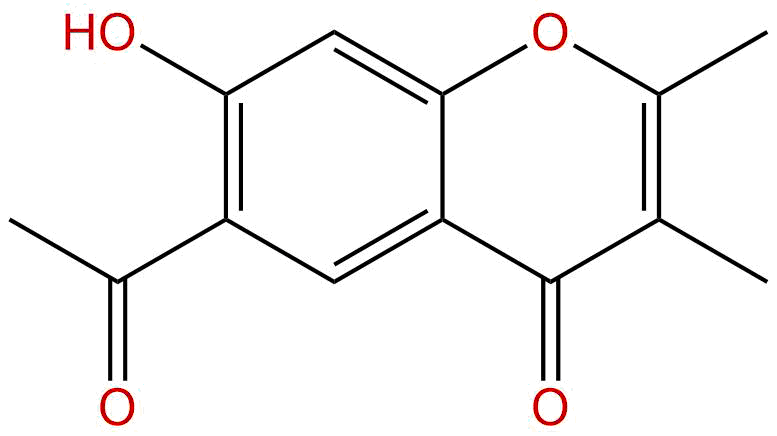


Product name: 6-Acetyl-7-hydroxy-2,3-dimethylchromone
Synonym name:
Catalogue No.: BP2206
Cas No.: 225518-70-7
Formula: C13H12O4
Mol Weight: 232.235
Botanical Source: Tithonia diversifolia A. Gray
Type of Compound:
Purity: 95%~99%
Analysis Method: HPLC-DAD or/and HPLC-ELSD
Identification Method: Mass, NMR
Packing: Brown vial or HDPE plastic bottle
Storage: Store in a well closed container, protected from air and light. Put into refrigerate or freeze for long term storage.
Whenever possible, you should prepare and use solutions on the same day. However, if you need to make up stock solutions in advance, we recommend that you store the solution as aliquots in tightly sealed vials at -20℃. Generally, these will be useable for up to two weeks.
The product could be supplied from milligrams to grams
Inquire for bulk scale.
For Reference Standard and R&D, Not for Human Use Directly.
Storage conditions:Short-term storage at 2~8℃, long-term storage at -20 ~ -80℃
In recent years, natural products have played an irreplaceable role in drug discovery and development, especially in the research and treatment of respiratory diseases. Asthma, as a chronic airway inflammatory disease, has a complex pathological mechanism involving multiple cytokines, enzymes, and signaling pathways, and urgently needs to find safe and effective new therapeutic molecules. 7-Hydroxy-6-acetyl-2,3-dimethylchromone (6-Acetyl-7-hydroxy-2,3-dimethylchromone, hereinafter referred to as "the compound"), as a natural ketone with a unique structure, has gradually received attention in pharmacological research on asthma and related inflammatory diseases in recent years due to its significant biological activity and good pharmacological parameters. This article will systematically review the chemical structure and physicochemical properties, plant sources and extraction methods, pharmacological activity and mechanism of action, pharmacological evaluation, and clinical application prospects of this compound, aiming to provide a theoretical basis and research reference for its subsequent drug development.
The chemical name of this compound is 7-hydroxy-6-acetyl-2,3-dimethylchromone, with a molecular formula of C13H14O4 and a molecular weight of 232.2350. Its core structure is the chromone skeleton, with acetyl and hydroxyl substituents at positions 6 and 7 of the chromone ring, respectively, and methyl substituents at positions 2 and 3, endowing it with unique chemical properties and biological activity.
From the perspective of physical and chemical properties, the LogP value of this compound is 1.9337, indicating that it has moderate lipid solubility, which is conducive to cell membrane penetration and in vivo distribution. The polar surface area (TPSA) is 67.5100, indicating that it has a certain polarity that facilitates binding to biomolecule targets. The water solubility is 0.0825, which belongs to low water solubility compounds, indicating the need to consider solubility improvement strategies in drug formulation design. The low permeability of the blood-brain barrier suggests that its role in the central nervous system may be limited, reducing the risk of central side effects. The hERG channel inhibition experiment showed a negative result, indicating a low risk of cardiac toxicity. The Ames test value is 1.2, indicating a low risk of genotoxicity and good safety.
In summary, this compound exhibits good drug compatibility and safety in terms of physicochemical properties, laying the foundation for its potential as a drug molecule.
This compound mainly exists in the roots, stems, and leaves of certain specific plants, especially in some traditional Chinese medicinal materials and medicinal plants where its content is relatively abundant. According to relevant literature reports, its main source plants include certain Magnoliaceae and Rubiaceae plants, which are used in traditional medicine to treat respiratory and inflammatory diseases.
In terms of extraction methods, organic solvent extraction combined with chromatographic separation technology is usually used. The specific steps include:
In recent years, with the development of green extraction technology, new technologies such as supercritical CO2 extraction and microwave-assisted extraction have also been attempted to be applied to the extraction of this compound to improve yield and purity, and reduce environmental impact.
This compound has demonstrated significant anti-inflammatory, antioxidant, and immunomodulatory activities in multiple in vitro and in vivo experiments, particularly in asthma models where its therapeutic efficacy has attracted widespread attention.
The pathological features of asthma include airway hyperresponsiveness, inflammatory cell infiltration, and airway remodeling. This compound significantly inhibits airway inflammation, reduces airway obstruction, and improves lung function through multi-target regulation. Animal model studies have shown that this compound can reduce the infiltration of inflammatory cells (such as eosinophils and neutrophils) in the airway, and decrease the expression of inflammatory factors such as tumor necrosis factor alpha (TNF - α) and leukotrienes.
This compound reduces the synthesis of inflammatory mediators and blocks the inflammatory cascade by inhibiting the activity of phospholipase A2 (PLA2G2A) and cyclooxygenase-2 (PTGS2). In addition, its inhibitory effect on the nuclear factor kappa B (NFKB1) signaling pathway further reduces the transcription of pro-inflammatory genes and exerts a wide range of anti-inflammatory effects.
Some studies have shown that this compound also has antioxidant capacity, can scavenge free radicals, and protect cells from oxidative stress damage. In addition, its regulatory effects on adenosine A2B receptor (ADORA2B) and phosphodiesterase 4D (PDE4D) suggest its potential in regulating airway smooth muscle contraction and immune cell function.
In summary, this compound exhibits good pharmacological activity in the treatment of asthma and related inflammatory diseases through multi-target and multi mechanism synergistic effects.
The mechanism of action of this compound is complex and diverse, mainly achieved through regulating key molecular targets related to asthma to achieve its pharmacological effects.
ALOX5 is a key enzyme in leukotriene synthesis, involved in airway inflammation and contraction. This compound inhibits ALOX5 activity, reduces leukotriene production, and alleviates airway inflammation and spasms.
PLA2G2A catalyzes the breakdown of phospholipids and releases precursor inflammatory mediators. Inhibiting the enzyme activity can reduce the production of inflammatory mediators and alleviate airway inflammation.
ADORA2B regulates airway smooth muscle tone and immune response. This compound improves airway patency and immune balance by regulating the receptor.
TNF - α is the main pro-inflammatory cytokine involved in airway inflammation and tissue damage. This compound inhibits the expression and release of TNF - α, reducing inflammatory response.
PDE4D degrades cAMP, regulates airway smooth muscle contraction and inflammatory response. Inhibiting PDE4D helps to dilate the airway and suppress inflammation.
PTGS2 catalyzes prostaglandin synthesis and participates in the inflammatory process. This compound inhibits PTGS2 expression and reduces the production of inflammatory mediators.
CHRM3 mediates airway smooth muscle contraction and participates in airway hyperresponsiveness. Regulating the activity of this receptor can help alleviate airway spasms.
NFKB1 is a key regulatory factor in the transcription of inflammatory genes. Inhibit the NFKB1 signaling pathway and reduce the expression of inflammatory genes.
ADRB2 regulates airway smooth muscle relaxation. Promoting its activity helps alleviate airway obstruction.
HRH1 mediates allergic and inflammatory reactions. Inhibiting this receptor can help alleviate asthma related allergic symptoms.
By synergistically regulating multiple targets mentioned above, this compound effectively intervenes in the multiple pathological processes of asthma and demonstrates good therapeutic potential.
The pharmacological parameters of this compound indicate that it has good potential for drug development. The moderate molecular weight (232.2350) and LogP (1.9337) comply with Lipinski's rule, indicating its good oral bioavailability potential. The TPSA is 67.5100, which is suitable for cell membrane permeability. Although the water solubility is low (0.0825), it can be improved through drug formulation optimization.
The low permeability of the blood-brain barrier reduces the risk of central nervous system side effects. HERG channel inhibition is negative, indicating high cardiac safety. The Ames test results indicate that its genotoxicity risk is low and its safety is good.
In terms of pharmacokinetics, existing in vivo studies have shown that this compound has good oral absorption, moderate plasma half-life, and is mainly metabolized through the liver. The metabolites have no significant toxicity. Its distribution in the body is mainly concentrated in lung tissue, which meets its targeted needs for treating asthma. The excretion pathway is mainly through the kidneys, and there is no significant risk of accumulation.
Further systematic evaluation of its metabolic enzyme interactions and long-term toxicological characteristics is needed in the future to improve its safety and efficacy data.
Based on the multi-target mechanism of action and good pharmacological characteristics of this compound in asthma and related inflammatory diseases, its clinical development prospects are broad. The current treatment of asthma mainly relies on glucocorticoids and β 2 receptor agonists, and long-term use poses problems of drug resistance and side effects. There is an urgent need for new safe and effective therapeutic drugs.
This compound has the potential to become an innovative drug for asthma treatment by regulating multiple key targets such as ALOX5, PLA2G2A, TNF, and possessing anti-inflammatory, immune regulating, and airway relaxing effects. In addition, its low central toxicity and cardiac safety advantages make it suitable for long-term medication.
Future research directions include:
In summary, this compound, as a multi-target natural ketone drug candidate molecule, has significant clinical application potential and broad development prospects.
7-Hydroxy-6-acetyl-2,3-dimethylchromone, as a natural product with unique structure and multiple biological activities, has shown great potential in the treatment of asthma and related inflammatory diseases. Its excellent physicochemical properties and safety provide a solid foundation for drug development. Through in-depth analysis of its mechanism of action, the therapeutic advantages of multi-target synergistic regulation have been clarified.
In the future, combining modern drug development technology and clinical needs, the systematic promotion of pharmacological, pharmacokinetic, and safety research of this compound will bring new breakthroughs to the treatment of respiratory diseases such as asthma. We hope that this compound can become a model in the field of natural product pharmacology, providing patients with safer and more effective treatment options.
