Introduction/Overview
Sinapine thiocyanate (CAS: 7431-77-8) is a quaternary ammonium alkaloid isolated from the seeds of cruciferous plants. As a salt formed between Sinapine and thiocyanate, it is widely present in important oilseeds and economic crops such as rapeseed, mustard seeds, and radish seeds. It is a characteristic secondary metabolite in cruciferous plants. Traditionally, plant extracts rich in mustard alkaloids have been used in folk medicine, while modern pharmacological research has gradually revealed the complex scientific implications behind them. In recent years, with the deepening of research on natural products, sinapine thiocyanate has attracted much attention due to its diverse biological activities, especially in the fields of anti-inflammatory, antioxidant, neuroprotective, and anti-tumor effects, showing significant potential. Its characteristic as an acetylcholinesterase inhibitor is closely linked to the treatment research of major neurological diseases such as Alzheimer's disease and Parkinson's disease. This article aims to systematically review the chemical properties, plant sources, pharmacological activities, mechanisms of action, and medicinal properties of sinapine thiocyanate, in order to provide comprehensive scientific references for the in-depth research and development of this compound.
Chemical structure and physicochemical properties
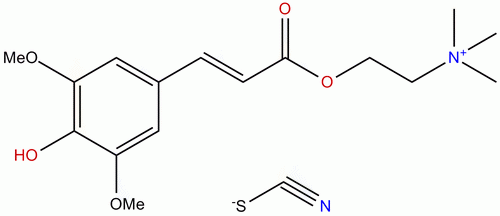
The chemical name of sinapine thiocyanate is 3- (3,5-dimethoxy-4-hydroxyphenyl) - N, N, N-trimethyl-2-propene-1-ammonium thiocyanate, with a molecular formula of C16H24NO5S and a molecular weight of 310.3700. The core of its structure is formed by the ester bond between the Sinapropyl alcohol portion and choline to form the sinapine cation, which then combines with the thiocyanate anion. The 3,5-dimethoxy-4-hydroxyphenyl group (i.e. sinapyryl) contained in the structure is an important pharmacophore group, endowing it with antioxidant and free radical scavenging abilities; The structure of quaternary ammonium salts determines their good water solubility and certain surface activity.
In terms of physical and chemical properties, the compound appears as a white or off white crystalline powder. Its calculated lipid water partition coefficient (LogP) is approximately -0.7530, indicating strong hydrophilicity, which is consistent with its experimentally measured good water solubility (approximately 2.0593 mg/mL). Its topological polar surface area (TPSA) is 64.99 Å ², reflecting the proportion of polar groups in the molecule. These properties collectively determine its distribution characteristics within the organism, for example, its blood-brain barrier permeability is predicted to be "low", which poses a challenge to its pharmacological effects on the central nervous system. In addition, preliminary pharmacological screening data showed no significant inhibitory effect on hERG potassium channels (hERG inhibition: No), and the Ames test result was 0.0, indicating a low potential mutagenic risk and providing preliminary positive signals for its safety evaluation.
Plant sources and extraction methods
Mustard alkaloid thiocyanate mainly comes from Brassicaceae plants, especially the seeds of various plants in the Brassicaceae and Raphanus genera. Among them, the seeds of Brassica napus L., Brassica juncea L., Brassica oleracea L., and Raphanus sativus L. are its main and abundant natural sources. In seeds, sinapine often coexists with glucosinolates and may undergo transformation under the action of endogenous enzymes such as myrosinase, but its thiocyanate form is one of the important stable storage forms.
Solvent extraction is commonly used to extract sinapine thiocyanate from plant materials. Due to its high polarity as a quaternary ammonium salt, polar solvents such as methanol, ethanol, water, or alcohol water mixed solutions with different ratios are commonly used for extraction. The typical extraction process includes crushing dried plant seeds, heating and refluxing with appropriate solvents or ultrasound assisted extraction, followed by filtration and concentration to obtain crude extract. Further purification is often achieved through column chromatography techniques, such as using silica gel, macroporous adsorption resin, or cation exchange resin for separation, combined with recrystallization to obtain high-purity compounds. In recent years, some modern separation techniques such as high-speed countercurrent chromatography and preparative high-performance liquid chromatography have also been applied in their efficient and rapid preparation and separation. The optimization of extraction process usually focuses on factors such as solvent type, concentration, temperature, solid-liquid ratio, and extraction time, aiming to improve yield and maintain the stability of compounds.
Pharmacological activity research
Numerous in vitro and in vivo pharmacological studies have confirmed that sinapine thiocyanate has broad and significant biological activities.
-
Anti inflammatory and antioxidant activity This is one of its most prominent activities. In various acute and chronic inflammation models, such as LPS induced macrophage inflammation model and carrageenan induced rat toe swelling model, sinapine thiocyanate can effectively inhibit the inflammatory response. Its antioxidant effect is manifested by strong free radical scavenging ability (such as DPPH, ABTS free radicals), reducing power, and inhibition of lipid peroxidation, which is closely related to the phenolic hydroxyl groups in its structure and helps alleviate tissue damage mediated by oxidative stress.
-
Neuroprotection and Acetylcholinesterase Inhibition Activity Mustard alkaloid thiocyanate has been proven to be an effective acetylcholinesterase (AChE) inhibitor. By inhibiting AChE, it can reduce the degradation of acetylcholine in synaptic cleft, thereby enhancing cholinergic neurotransmission function. This mechanism has the potential to improve cognitive impairment in cholinergic deficiency related diseases such as Alzheimer's disease. In addition, studies have shown that it has a certain improvement effect on Parkinson's disease, ataxia, and myasthenia gravis models, and its neuroprotective effect may be related to multiple mechanisms such as anti-inflammatory, antioxidant, and neurotransmitter regulation.
-
Antitumor and anti angiogenic activity Studies have shown that sinapine thiocyanate can inhibit the proliferation of many tumor cell lines (such as liver cancer, breast cancer, colon cancer cells), and can induce cell apoptosis and cycle arrest. At the same time, it can inhibit the migration of endothelial cells and tubular formation, reduce the expression of pro angiogenic factors (such as VEGF), indicating its anti angiogenic effect, which may inhibit the growth and metastasis of tumors by cutting off their nutritional supply.
-
Radiation protection function Preliminary studies have shown that sinapine thiocyanate has a certain protective effect on radiation-induced damage to the hematopoietic and intestinal systems, and its mechanism may be related to clearing free radicals generated by radiation, reducing oxidative damage, and inhibiting cell apoptosis.
Mechanism of action and molecular targets
The multiple pharmacological activities of sinapine thiocyanate stem from its regulation of multiple intracellular signaling pathways and interactions with multiple key molecular targets.
In anti-inflammatory effect In terms of mechanism, its research is the most in-depth. It can significantly inhibit the activation of nuclear transcription factor kappa B (NF - κ B, encoded by NFKB1). NF - κ B is the core regulatory factor of inflammatory response, and sinapine thiocyanate inhibits the degradation of I κ B or suppresses the activity of IKK, blocking the transfer of NF - κ B to the nucleus and downregulating the expression of a series of pro-inflammatory mediators, including:
-Inflammatory cytokines, such as tumor necrosis factor alpha (TNF - α, encoded by TNF) and interleukin-6 (IL-6).
-Inflammatory enzymes: including inducible nitric oxide synthase (iNOS, encoded by NOS2), cyclooxygenase-2 (COX-2, encoded by PTGS2), and cyclooxygenase-1 (COX-1, encoded by PTGS1).
-In addition, it can inhibit the phosphorylation of signal transducer and activator of transcription factor 3 (STAT3), blocking its mediated inflammatory and tumor promoting signals. Inhibition of the key component CASP1 (Caspase-1) in inflammasomes reduces the maturation and release of inflammatory factors such as IL-1 β. The regulation of transient receptor potential vanillic acid subtype 1 (TRPV1) and transient receptor potential anchor protein subtype 1 (TRPA1) ion channels may also be involved in their ability to alleviate inflammatory pain.
In neuroprotection In addition to directly inhibiting AChE enzyme activity, its anti-inflammatory and antioxidant mechanisms are also crucial. Reduce neuroinflammation by inhibiting excessive activation of NF - κ B and STAT3 in the brain; Protecting neurons from oxidative damage by clearing reactive oxygen species/nitrogen species.
In antitumor In addition to the anti-inflammatory (inhibition of NF - κ B, STAT3) and anti angiogenic effects mentioned above, its mechanism of inducing tumor cell apoptosis may involve activation of the mitochondrial pathway and triggering of endoplasmic reticulum stress response.
Evaluation of drug properties and pharmacokinetics
Based on its physicochemical properties and preliminary in vitro ADMET (absorption, distribution, metabolism, excretion, and toxicity) data, a preliminary evaluation of the pharmacological properties of sinapine thiocyanate was conducted.
- Absorption and distribution Good water solubility is beneficial for its dissolution and absorption in the gastrointestinal tract. However, as a quaternary ammonium salt, its transmembrane passive diffusion ability may be limited, and the absorption mechanism may involve active transport or bypass pathways. Its lower LogP value and higher polarity result in lower predicted blood-brain barrier permeability, which may be the main obstacle to overcome in its development as a therapeutic drug for central nervous system diseases. The distribution of tissues in the body may be biased towards organs with abundant blood flow such as the kidneys and liver.
- Metabolism and excretion As ester compounds, sinapine thiocyanate is likely to be hydrolyzed by esterases (such as butyrylcholinesterase and carboxylesterase) in the body, producing sinapine and choline. Mustard acid can further undergo II binding reactions such as methylation, sulfation, or glucuronidation. The prototype drug and its metabolites may mainly be excreted through the kidneys and urine.
- Preliminary evaluation of safety The existing data shows that it does not significantly inhibit the hERG channel, indicating a low risk of causing QT interval prolongation in the heart. A negative Ames test indicates no direct genetic toxicity. However, comprehensive in vivo safety evaluations of acute and chronic toxicity, reproductive toxicity, and other factors still need to be systematically carried out. The history of its long-term consumption as a dietary ingredient provides some background support for its safety, but the long-term toxicity at medicinal doses still needs to be clarified.
At present, there are insufficient public reports on the pharmacokinetic studies of sinapine thiocyanate system (such as absolute bioavailability, half-life, clearance rate, etc.), which is a key data gap that must be filled in future preclinical development.
Clinical application prospects and prospects
As a natural active molecule with multiple targets and functions, sinapine thiocyanate has broad clinical application and development prospects.
-
Neurological disorders As an AChE inhibitor, it is a potential candidate compound for developing symptomatic treatment drugs for Alzheimer's disease. Compared with existing drugs such as donepezil, it has both anti-inflammatory and antioxidant properties, which may provide more comprehensive neuroprotection and delay disease progression. It also has exploratory value in the adjuvant treatment of diseases such as Parkinson's disease and vascular dementia. The challenge lies in how to increase its brain exposure, including strategies such as developing prodrugs, using nano delivery systems, or combining with blood-brain barrier openers.
-
Inflammatory related diseases Can be used to treat chronic inflammatory diseases such as rheumatoid arthritis, inflammatory bowel disease, asthma, etc. It exerts anti-inflammatory effects by regulating multiple targets such as NF - κ B and STAT3, which may be more advantageous than single target drugs, but at the same time, attention should be paid to the potential side effects of its specificity.
-
neoadjuvant therapy Its anti-tumor and anti angiogenic activities make it a potential sensitizer and adjuvant drug for chemotherapy or radiotherapy, used to alleviate the side effects of radiotherapy (such as radiation protection), inhibit tumor metastasis and recurrence. Especially suitable for development as functional foods or dietary supplements for chemoprevention of cancer.
-
Other fields It also has potential application value in metabolic diseases (such as diabetes and its complications, often accompanied by oxidative stress and chronic low-grade inflammation), skin inflammatory diseases, etc.
The future research focus should include: 1) conducting systematic preclinical pharmacological, pharmacokinetic, and toxicological studies to clarify their therapeutic window and safety; 2) Thoroughly elucidate its mechanism of action, especially identifying the molecular targets it directly acts on; 3) Improve its pharmacokinetic properties, especially its bioavailability and brain targeting, through structural modifications or formulation improvements (such as nanoparticles, liposomes, microemulsions); 4) Explore its synergistic effects with other drugs and develop compound formulations.
Conclusion
Mustard alkaloid thiocyanate is a natural product of significant research value gifted by cruciferous plants. From a chemical structure perspective, it is a bridging molecule that connects plant secondary metabolism with human health. Modern pharmacological research has fully revealed its significant activities in anti-inflammatory, antioxidant, neuroprotective, anti-tumor and other aspects. Its mechanism of action involves the regulation of multiple key targets such as NF - κ B, STAT3, AChE, etc. Although it faces challenges in drug development such as low blood-brain barrier permeability, its multi-target action characteristics, good preliminary safety signals, and abundant natural sources have laid a solid foundation for its further development as a drug or functional ingredient for the treatment of neurological diseases, chronic inflammation, and tumor adjuvant therapy. With the interdisciplinary integration and in-depth research of natural product chemistry, pharmacology, and pharmacy, sinapine thiocyanate is expected to transform from a traditional phytochemical component into a modern drug lead compound with clear clinical application value, contributing its unique strength to human health. The future exploration path still requires unremitting efforts from scientific researchers in terms of mechanism depth, drug optimization, and clinical translation.