


Synonym name:
Catalogue No.: BP1308
Cas No.: 18696-26-9
Formula: C16H24NO5+
Mol Weight: 310.369
Botanical Source: Alkaloid from seeds of Brassica nigra, Brassica alba (Sinapis alba) and many other spp. in the Cruciferae. Also from the Chinese drug Ting Li (Draba nemorosa) (Cruciferae)
Purity: 95%~99%
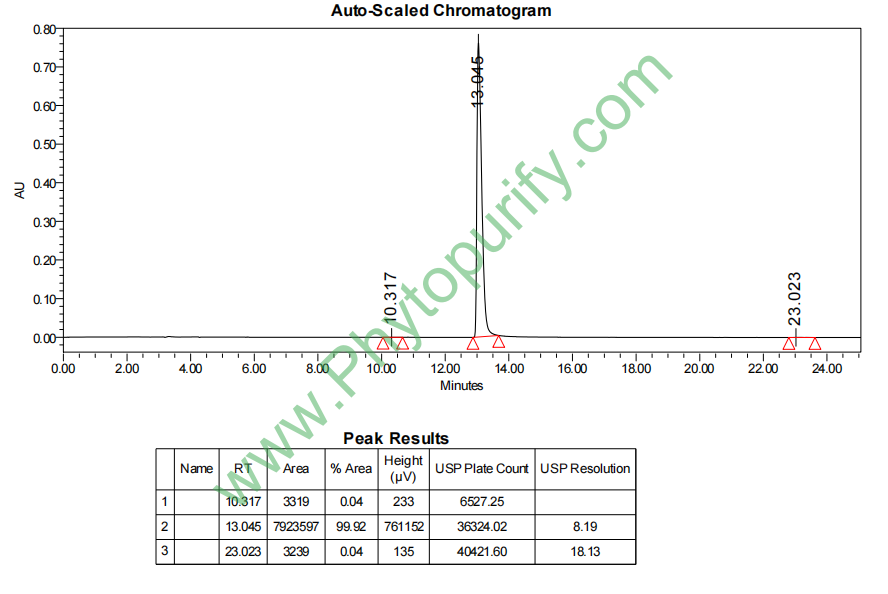
Analysis Method: HPLC-DAD or/and HPLC-ELSD
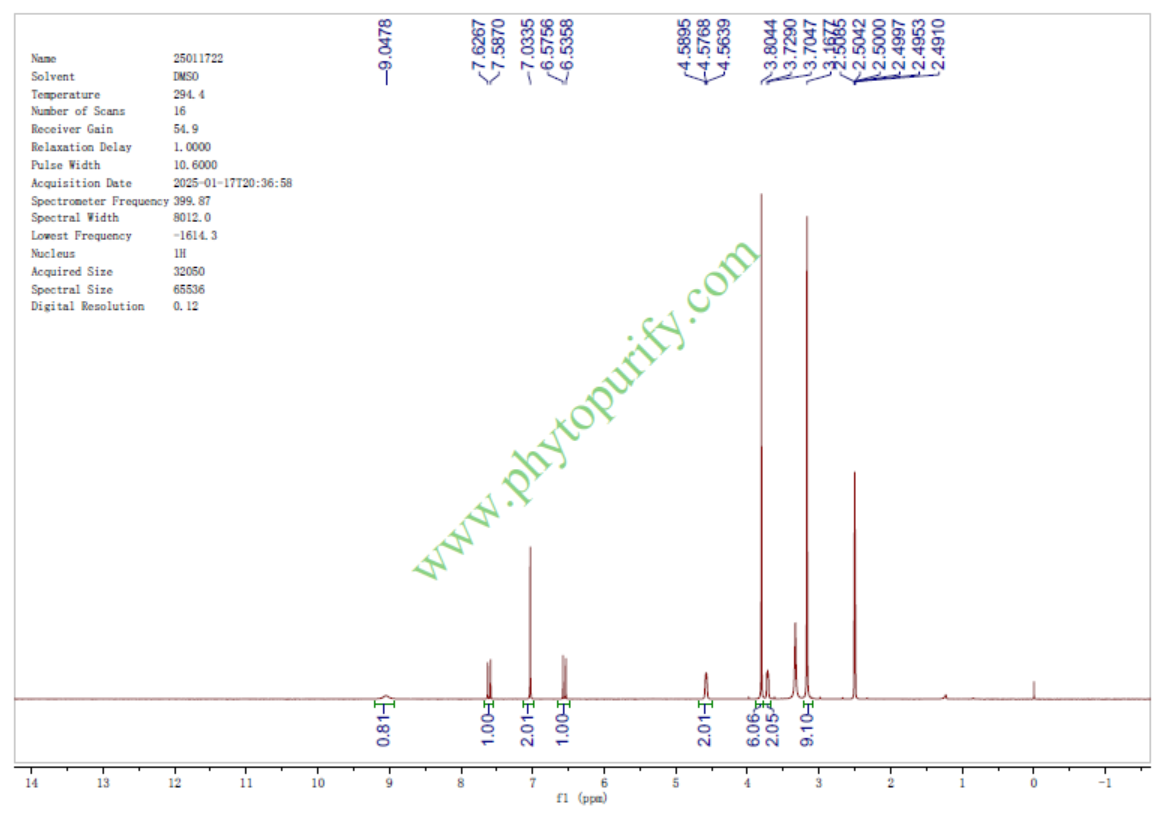
Identification Method: Mass, NMR
Packing: Brown vial or HDPE plastic bottle
Can be supplied from milligrams to grams.
For Reference Standard and R&D, Not for Human Use Directly.
Inquire for bulk scale.
HPLC of Sinapine
HNMR of Sinapine
Storage conditions:Short-term storage at 2~8℃, long-term storage at -20 ~ -80℃
64.9900
-.7530
-.7583
2.0593
.5235
3.9071
Low
44.8266
2.4623
Yes
No
Yes
No
No
No
0.0
No
Yes
No
No
Natural products, as an important treasure trove for drug discovery, play an irreplaceable role in the history of human disease prevention and treatment. Among them, alkaloid compounds have always been a hot topic in medicinal chemistry and pharmacology research due to their structural diversity and significant biological activity. Sinapine, also known as sinapyrylcholine, is a quaternary ammonium alkaloid found in the seeds of cruciferous plants. Since its discovery, research has preliminarily revealed its pharmacological potential in various aspects such as anti-inflammatory, antioxidant, neuroprotective, and anti-tumor. Especially its characteristic as an acetylcholinesterase inhibitor provides new candidate molecules for the treatment of neurodegenerative diseases such as Alzheimer's disease and Parkinson's disease. However, compared to other star natural products, the systematic review and research integration of sinapine are still insufficient. This article aims to systematically review the chemical characteristics, plant sources, pharmacological activities, molecular mechanisms, and medicinal properties of sinapine, in order to provide comprehensive academic references for the in-depth research and development of this compound.
The chemical name of sinapine is 3- (3,5-dimethoxy-4-hydroxyphenyl) -2-propenoic acid-2-hydroxyethyl trimethylammonium ester, with a CAS number of 18696-26-9. Its molecular formula is C16H23NO5 and its molecular weight is 310.3700. Structurally, sinapine is composed of two parts: one is sinapine (3,5-dimethoxy-4-hydroxycinnamic acid), which is the key pharmacophore for its antioxidant activity; The second part is the choline moiety, which is connected to sinapine through ester bonds to form a quaternary ammonium salt structure. This unique structure combines the antioxidant and cholinergic properties of phenolic compounds.
Its physicochemical properties significantly affect its bioavailability and biological activity. The calculated lipid water partition coefficient (LogP) is approximately -0.7530, indicating that the compound has good hydrophilicity. The topological polar surface area (TPSA) is 64.99 Å ², further confirming its strong polarity. The water solubility data (approximately 2.06 mg/mL) shows that it has moderate solubility in water. These properties collectively determine the distribution characteristics of sinapine in the body, such as predicting "low" blood-brain barrier permeability, which poses a challenge for its development for central nervous system diseases. In addition, preliminary pharmacological risk assessment showed that its hERG inhibition and Ames mutagenicity test results were negative, suggesting that it may have good cardiac safety and genetic toxicity risks.
Mustard alkaloids mainly exist in the seeds of cruciferous plants and are a characteristic secondary metabolite in this type of plant. Common plant sources rich in sinapine include rapeseed (especially mustard type rapeseed), mustard greens, radish, broccoli seeds, etc. In rapeseed, the content of sinapine can reach up to 1-2.5% (dry weight), which is the main alkaloid component in rapeseed meal. Its existence has received attention for its potential impact on animal palatability, but its medicinal value has been re examined in recent years.
Solvent extraction is commonly used to extract sinapine from plant materials. Due to the fact that sinapine is a quaternary ammonium salt with high polarity, polar solvents are commonly used for extraction. The classic extraction process includes crushing plant seeds and using methanol, ethanol, or ethanol water mixed solutions for heating reflux or ultrasound assisted extraction. After filtration and concentration, the crude extract can be preliminarily purified using column chromatography techniques such as silica gel columns, macroporous adsorption resins, or cation exchange resins. Given that the ester bonds of sinapine are prone to hydrolysis under alkaline conditions, producing sinapine and choline, it is important to control the pH value during extraction and subsequent processing to avoid strong alkaline environments. High performance liquid chromatography, especially the reverse phase C18 column combined with a UV detector (due to its characteristic absorption around 330 nm in the benzene ring structure), is currently the most commonly used and effective method for separating and quantitatively analyzing sinapine. In recent years, some green extraction techniques such as supercritical fluid extraction have also been explored to improve extraction efficiency and purity.
Numerous in vitro and in vivo studies have confirmed that sinapine has a wide and diverse pharmacological activity, laying the foundation for its multi-target application.
Anti inflammatory and antioxidant activity This is one of the most extensively studied activities of sinapine. In various acute and chronic inflammation models, such as LPS induced macrophage inflammation model and carrageenan induced rat paw swelling model, sinapine can significantly inhibit the production of inflammatory factors and oxidative stress levels. Its antioxidant capacity is mainly attributed to the phenolic hydroxyl group in the structure of sinapine, which can effectively scavenge free radicals such as DPPH and ABTS, and enhance the activity of intracellular superoxide dismutase and glutathione peroxidase.
Neuroprotection and Acetylcholinesterase Inhibition Activity Mustard alkaloids are natural competitive inhibitors of acetylcholinesterase. In Alzheimer's disease cell and animal models, it can increase acetylcholine levels in synaptic cleft and improve cognitive dysfunction. In addition, its antioxidant and anti-inflammatory effects can also synergistically reduce neuronal oxidative damage and neuroinflammation, thereby exhibiting protective effects against Parkinson's disease, cerebral ischemia-reperfusion injury, and other conditions.
Antitumor and anti angiogenic activity Studies have shown that sinapine can inhibit the proliferation of various cancer cells (such as liver cancer, breast cancer, colon cancer cells) and induce their apoptosis. Its anti-tumor mechanism is not limited to directly acting on tumor cells, but can also interfere with the formation of tumor neovascularization (anti angiogenesis) by inhibiting signals such as vascular endothelial growth factor, thereby "starving" the tumor.
Radiation protection function Preliminary studies have shown that sinapine can improve the survival rate of irradiated animal models, protect the hematopoietic and gastrointestinal systems, and its mechanism may be related to clearing free radicals generated by radiation and reducing post radiation inflammatory reactions.
The multiple pharmacological effects of sinapine stem from its regulation of multiple signaling pathways within cells, involving multiple key molecular targets.
In anti-inflammatory effect On the one hand, the action network of sinapine is particularly complex. One of its core mechanisms is the inhibition of the nuclear transcription factor - κ B signaling pathway. It can inhibit the degradation of I κ B α, prevent the nuclear translocation of NF - κ B p65 subunit, and downregulate the expression of a series of downstream pro-inflammatory mediators, including tumor necrosis factor, interleukin-6, inducible nitric oxide synthase, and cyclooxygenase-2. In addition, studies have found that sinapine can inhibit the phosphorylation and activation of STAT3, blocking the important inflammation and tumor related pathway JAK-STAT. Its inhibition of inflammasome components such as CASP1 reduces the maturation and release of cytokines such as IL-1 β. In sensory neuron related inflammatory pain, sinapine can also antagonize the activity of TRPV1 and TRPA1 ion channels, exerting analgesic effects.
In neuroprotection In addition to directly inhibiting acetylcholinesterase, sinapine can also protect neurons from neurotoxins such as beta amyloid and MPTP through the aforementioned anti-inflammatory and antioxidant pathways.
In antitumor In addition to regulating the NF - κ B and STAT3 pathways, sinapine can also affect the expression of cell cycle proteins, block the cell cycle in the G0/G1 phase, and activate the mitochondrial dependent Caspase apoptotic pathway.
These studies indicate that sinapine is a typical multi-target natural product with "network pharmacology" characteristics, which synergistically exerts therapeutic effects by gently regulating multiple interrelated targets, which may help reduce the side effects and drug resistance caused by single target drugs.
Although mustard alkaloids have significant pharmacological activity, their pharmacological properties still need to be comprehensively evaluated. According to its physicochemical parameters, its strong hydrophilicity and low LogP value may pose challenges to its oral bioavailability. Hydrophilic compounds are not easily able to cross the lipid bilayer of intestinal epithelial cells, and as ester compounds, they are easily hydrolyzed by esterases into sinapine and choline in the gastrointestinal tract and blood. Although this may produce a synergistic effect, it also reduces the systemic exposure of the prototype drug.
Pharmacokinetic studies are relatively limited. Animal experiments suggest that after oral administration, sinapine may be rapidly metabolized in plasma with a short half-life. The low blood-brain barrier permeability is the main obstacle to the development of central nervous system drugs. In order to improve its bioavailability and targeting, dosage form improvement strategies are particularly important. The current research directions include: preparing phospholipid complexes and cyclodextrin inclusion complexes to increase lipid solubility; Develop drug delivery systems such as nanoliposomes and polymer nanoparticles to protect them from enzymatic hydrolysis, prolong circulation time, and potentially enhance their blood-brain barrier penetration ability through surface modification; Or prepare it as a prodrug to improve its absorption and distribution characteristics.
The clinical application prospects of sinapine are broad, but the road ahead is long. Its short-term applications may focus on functional food additives or dietary supplements, utilizing its antioxidant and anti-inflammatory properties for the prevention of chronic inflammation related diseases. At the level of drug development, the following directions deserve special attention:
The challenges faced mainly include: incomplete systematic preclinical pharmacological and toxicological evaluation data; It is necessary to clarify whether the main active form in the body is the prototype drug or a metabolite; Optimization of synthesis or extraction processes is needed to ensure stable and economical supply of raw materials. Future research should strengthen interdisciplinary collaboration, design reasonable clinical research plans based on a clear safety window, and promote its transition from laboratory to clinical practice.
As a natural alkaloid with abundant sources, sinapine has shown remarkable potential in various therapeutic fields such as anti-inflammatory, neuroprotective, and anti-tumor effects due to its unique chemical structure and multi-target pharmacological mechanism. From the natural combination of sinapine and choline, we see the exquisite nature of creation. Although it faces challenges such as low bioavailability and poor blood-brain barrier penetration in terms of its medicinal properties, this is precisely where modern pharmacy and medicinal chemistry can shine. By delving into its molecular action network and utilizing advanced drug delivery technology for modification, sinapine is expected to transform from a common plant component into an innovative drug or key functional ingredient for treating major diseases. Continuous and in-depth research on it not only helps to explore the medicinal value of cruciferous plants, but also provides new ideas and candidate molecules for the development of innovative drugs with Chinese resource characteristics.
