


Product name: Malvidin 3-O-glucoside chloride
Synonym name: Oenin; Ligulin; Enin; Enoside;Malvidin 3-Glucoside
Catalogue No.: BP0918
Cas No.: 7228-78-6
Formula: C23H25ClO12
Mol Weight: 528.891
Botanical Source: Pigment of skins of black grapes, also in other plants
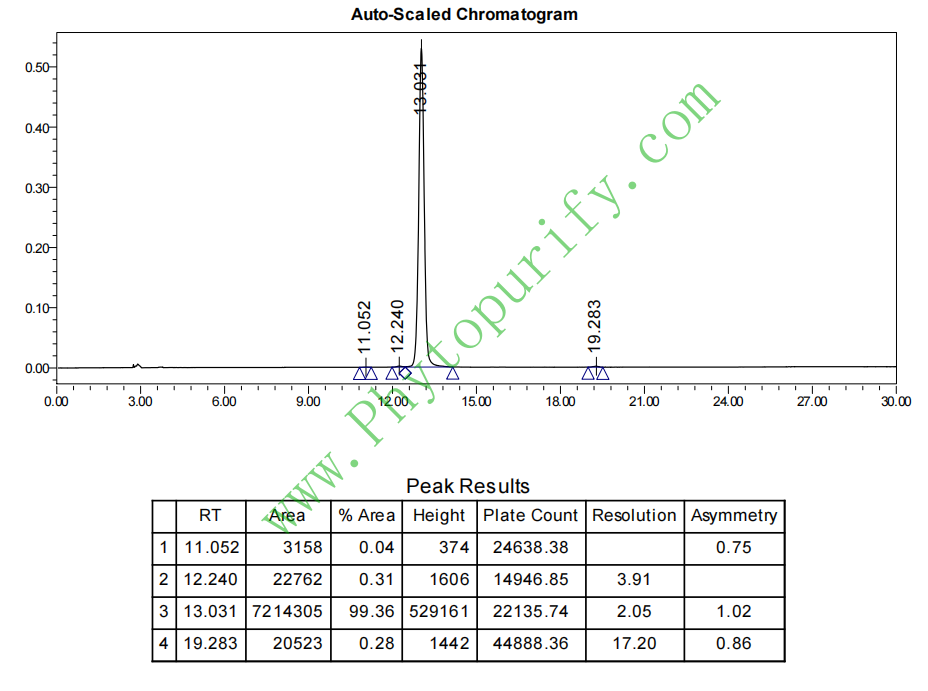
Purity: 95%~99%
Analysis Method: HPLC-DAD or/and HPLC-ELSD
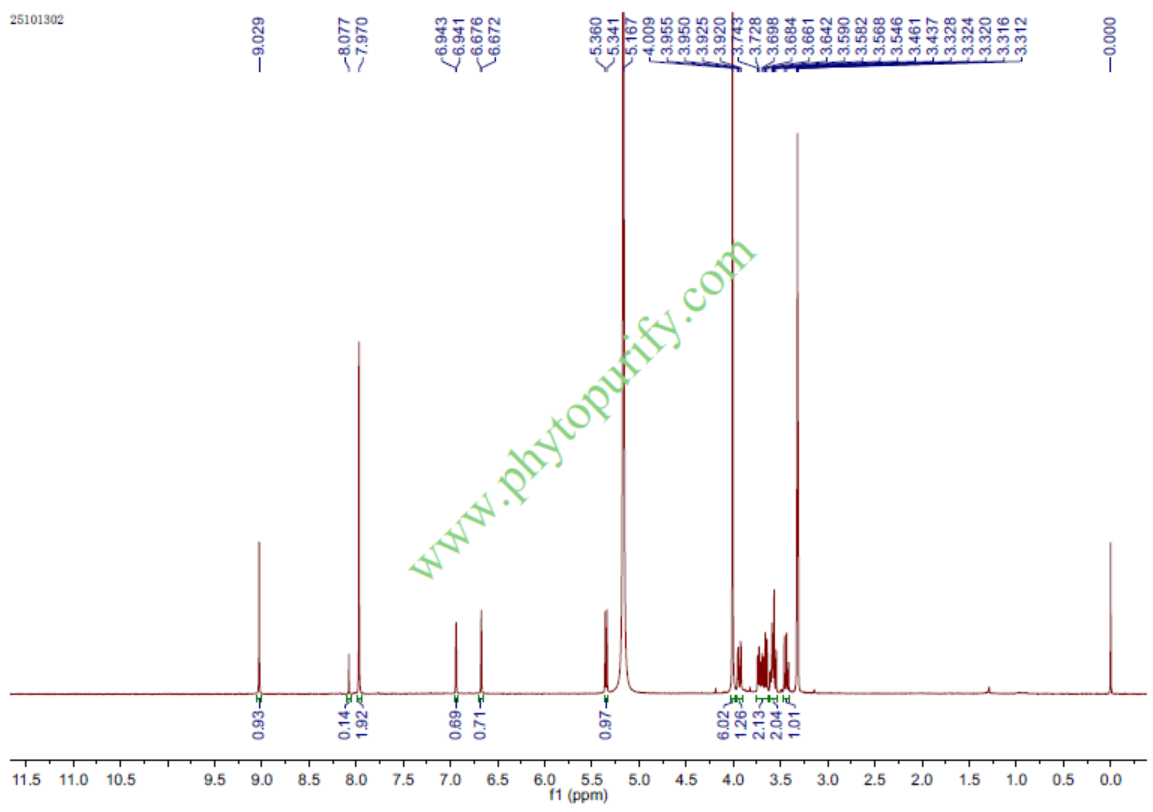
Identification Method: Mass, NMR
Packing: Brown vial or HDPE plastic bottle
Can be supplied from milligrams to grams.
For Reference Standard and R&D, Not for Human Use Directly.
Inquire for bulk scale.
HNMR of Malvidin 3-Glucoside
HPLC of Malvidin 3-Glucoside
Storage conditions:Short-term storage at 2~8℃, long-term storage at -20 ~ -80℃
219.6600
-1.5000
-2.0000
Low
No
No
No
No
No
No
Malvidin 3-O-glucoside chloride (CAS number: 7228-78-6), as an important natural anthocyanin cation, has received widespread attention in the field of natural product pharmacology in recent years. Anthocyanins, as a class of water-soluble polyphenolic compounds, are widely present in the fruits, petals, and leaves of various plants, and have significant biological activities such as antioxidant, anti-inflammatory, anticancer, and cardiovascular protection. Chlorinated Malvidin 3-glucoside is a derivative of Malvidin formed by glycosylation of β - D-glucose residues at the 3-hydroxy position, possessing a unique chemical structure and biological function. As a conjugated acid of 3-O - β - D-glucoside betaine, it exhibits good water solubility and stability, and displays diverse pharmacological activities during in vivo metabolism.
This article aims to systematically review the chemical structure and physicochemical properties, plant sources and extraction methods, pharmacological activity and mechanism of action, pharmacological evaluation and pharmacokinetic characteristics of chlorinated mallow pigmental-3-glucoside. Combining the latest research progress, it explores its potential and future development direction in clinical applications, providing theoretical basis and practical guidance for natural product pharmacology research and new drug development.
The molecular formula of chlorinated mallow pigmental-3-glucoside is C23H25ClO12, with a molecular weight of 535.9, belonging to the cationic compounds of anthocyanins. Its core structure is malvidin, which is a 3 ', 5' - dimethoxy-3,4 ', 5,7-tetrahydroxyflavone. The 3-hydroxy position is connected by a β - D-glucose residue to form an O-glycosidic bond, and the molecule contains chloride ions as cation pairing ions, forming a stable salt structure.
In terms of physicochemical properties, the LogP value of this compound is -1.5, indicating strong hydrophilicity and good water solubility, which is beneficial for oral absorption and in vivo distribution. The topological polar surface area (TPSA) is 219.66 Å ² and the number of hydrogen bond acceptors is 12, indicating its strong polarity and hydrogen bond formation ability, which have important effects on the binding of molecules to biological targets and the penetration of biological membranes. Its blood-brain barrier permeability is low, indicating limited distribution in the central nervous system.
Toxicological evaluation shows that the LD50 of chlorinated mallow pigmental-3-glucoside is as high as 2000 mg/kg, demonstrating good safety. There is no hepatotoxicity, cardiotoxicity, or hERG channel inhibition, and the Ames mutagenicity test is negative, further confirming its low toxicity and high biological safety.
Chlorinated mallow pigment 3-glucoside is mainly present in the fruits and petals of various plants, especially in grapes (Vitis vinifera) and its derivatives such as red wine, blueberries, blackcurrants, etc., which are rich in this type of anthocyanin. As plant pigments, anthocyanins from mallow give fruits a bright purple red or blue purple color, and have important ecological functions and nutritional value.
The extraction methods mainly include the following:
Solvent extraction method
Using polar solvent systems such as ethanol water, methanol water, or ethyl acetate, ultrasound assisted extraction (UAE) or hot reflux extraction can effectively release anthocyanins from the cell wall. The extraction conditions such as temperature, pH, and time have a significant impact on the yield. Generally, the extraction effect is best under acidic conditions (pH 1-3), which is beneficial for the stability of anthocyanins.
Solid phase extraction and column chromatography separation
After filtering out impurities, the extract was enriched and purified using a C18 reverse phase solid-phase extraction column. Subsequently, purity and structure were identified by high performance liquid chromatography (HPLC) combined with ultraviolet detection (UV) or mass spectrometry (MS).
membrane separation technology
In recent years, nanofiltration and ultrafiltration technologies have been applied to the concentration and purification of anthocyanins, which have the advantages of easy operation, environmental friendliness, and efficient separation.
Enzymatic assisted extraction
Using enzyme preparations such as cellulase and pectinase to disrupt cell wall structure and increase the release rate of anthocyanins.
In summary, by combining various extraction and purification techniques, high-purity chlorinated mallow pigmental-3-glucoside can be obtained, laying the foundation for its pharmacological activity research and application development.
Chlorinated mallow pigmental-3-glucoside, as a natural anthocyanin, exhibits multidimensional pharmacological activities, covering multiple aspects such as antioxidant, anti-inflammatory, anti-tumor, cardiovascular protection, and neuroprotection.
As a polyphenolic compound, chlorinated mallow pigment 3-glucoside has significant free radical scavenging ability. In vitro DPPH, ABTS, and hydroxyl radical scavenging experiments all showed its high antioxidant activity. The hydroxyl and methoxy groups in its structure inhibit oxidative chain reactions and reduce oxidative stress levels through electron transfer and hydrogen atom donor mechanisms.
Multiple cell and animal model studies have shown that this compound can significantly inhibit the expression of pro-inflammatory factors such as TNF - α, IL-1 β, and IL-6, and reduce the production of inflammatory mediators. It exhibits good anti-inflammatory potential by regulating the NF - κ B signaling pathway, inhibiting the activation of inflammatory responses, reducing tissue damage.
Chlorinated mallow pigmental-3-glucoside exhibits the ability to inhibit cell proliferation, induce apoptosis, and block cell cycle in various tumor cell lines. Its mechanism involves regulating the expression of Bcl-2 family proteins, activating the caspase pathway, and inhibiting the PI3K/Akt signaling pathway, demonstrating potential anti-cancer activity.
The compound can improve vascular endothelial function, inhibit the oxidation of low-density lipoprotein and prevent atherosclerosis through antioxidant and anti-inflammatory effects. In animal experiments, chlorinated mallow pigmental-3-glucoside can lower blood pressure, improve myocardial ischemia-reperfusion injury, and has significant cardiovascular protective effects.
Although the blood-brain barrier has low permeability, some in vitro and in vivo studies have shown that it reduces neuronal damage and protects nerve function through antioxidant and anti-inflammatory mechanisms, which may have the potential to assist in the treatment of neurodegenerative diseases such as Alzheimer's disease.
The pharmacological activity of chlorinated mallow pigmental-3-glucoside is mainly achieved by regulating multiple cellular signaling pathways, involving multiple molecular targets:
NF - κ B signaling pathway
This pathway is the core regulatory mechanism of inflammatory response. Chlorinated mallow pigmental-3-glucoside can inhibit the phosphorylation and degradation of I κ B α, prevent NF - κ B nuclear translocation, and reduce the expression of pro-inflammatory genes.
Nrf2/ARE antioxidant pathway
This compound activates the Nrf2 transcription factor, promotes the expression of antioxidant enzymes such as superoxide dismutase (SOD) and glutathione peroxidase (GPx), and enhances cellular antioxidant defense capabilities.
PI3K/Akt signaling pathway
In tumor cells, chlorinated mallow pigment 3-glucoside inhibits this pathway, blocks cell proliferation and survival signals, and induces cell apoptosis.
MAPK signaling pathway
Regulating cellular stress response and apoptosis, chlorinated mallow pigment 3-glucoside can regulate the activity of ERK, JNK, and p38 kinases, affecting cell fate.
Mitochondrial pathway
By adjusting the Bax/Bcl-2 ratio, it promotes the loss of mitochondrial membrane potential, activates the caspase cascade reaction, and induces cell apoptosis.
These mechanisms of action comprehensively reflect the multi-target and multi pathway pharmacological properties of chlorinated mallow pigment 3-glucoside, providing a theoretical basis for its clinical development.
The pharmacological parameters of chlorinated jinting pigmental-3-glucoside show that it has good safety and certain biological activity potential:
In terms of pharmacokinetics, existing studies have shown that the compound is absorbed quickly after oral administration, but its bioavailability is limited by its polarity and molecular weight. In vivo metabolism is mainly through the enterohepatic cycle and enzymatic metabolic pathways, with metabolites including deglycosylation and methoxy modified products. Its plasma half-life is moderate, mainly excreted through the kidneys and bile.
To improve its bioavailability and targeting, strategies such as nanocarriers, liposome encapsulation, and structural modification are being actively explored.
Based on the multiple pharmacological activities and good safety of chlorinated mallow pigment 3-glucoside, its clinical application prospects are broad:
Antioxidant nutritional supplements
As a natural antioxidant, it can be used to prevent and alleviate oxidative stress related diseases, such as cardiovascular disease, diabetes and aging related diseases.
Anti inflammatory drug adjuvant therapy
In chronic inflammatory diseases such as rheumatoid arthritis and inflammatory bowel disease, chlorinated rutin 3-glucoside can be used as an adjuvant anti-inflammatory agent to alleviate symptoms and improve quality of life.
neoadjuvant therapy
Its anti-tumor activity provides a potential natural drug candidate for cancer treatment, especially in combination chemotherapy, which may reduce side effects and improve efficacy.
Prevention and treatment of cardiovascular diseases
By improving the vascular function and anti atherosclerosis, the chlorkamathin-3-glucoside is expected to become a drug for the prevention and adjuvant treatment of cardiovascular diseases.
Neurodegenerative diseases
Although the blood-brain barrier has limited penetration, its antioxidant and anti-inflammatory properties may still have a positive impact on neuroprotection. In the future, drug delivery systems will be used to improve brain distribution and expand its neuroprotective applications.
Future research should focus on further elucidating its molecular mechanism of action, optimizing drug formulations and administration methods, conducting systematic preclinical and clinical studies, verifying its efficacy and safety, and promoting its clinical translation.
As a typical natural anthocyanin cation, chlorinated jinting pigmental-3-glucoside exhibits broad pharmacological potential due to its unique chemical structure and diverse biological activities. Its good safety and multi-target mechanism of action provide important examples for the pharmacological research of natural products. Although there are still certain challenges in pharmacokinetics and clinical applications, with the continuous progress of extraction and purification technology, drug delivery systems, and molecular mechanism research, chlorinated jinting pigmental-3-glucoside is expected to become one of the important directions for future natural drug development. The in-depth research and clinical validation of the system will lay a solid foundation for its application in disease prevention and treatment, and promote the development of natural product pharmacology to a higher level.
