


Product name: Malvidin chloride
Synonym name: Malvidol; Malvinidin; Malvinidol chloride; Oenidin; Primulidin; Syringidin; Syringidin chloride
Catalogue No.: BP0919
Cas No.: 643-84-5
Formula: C17H15ClO7
Mol Weight: 366.75
Botanical Source:
Purity: 95%~99%
Analysis Method: HPLC-DAD or/and HPLC-ELSD
Identification Method: Mass, NMR
Packing: Brown vial or HDPE plastic bottle
Can be supplied from milligrams to grams.
For Reference Standard and R&D, Not for Human Use Directly.
Inquire for bulk scale.
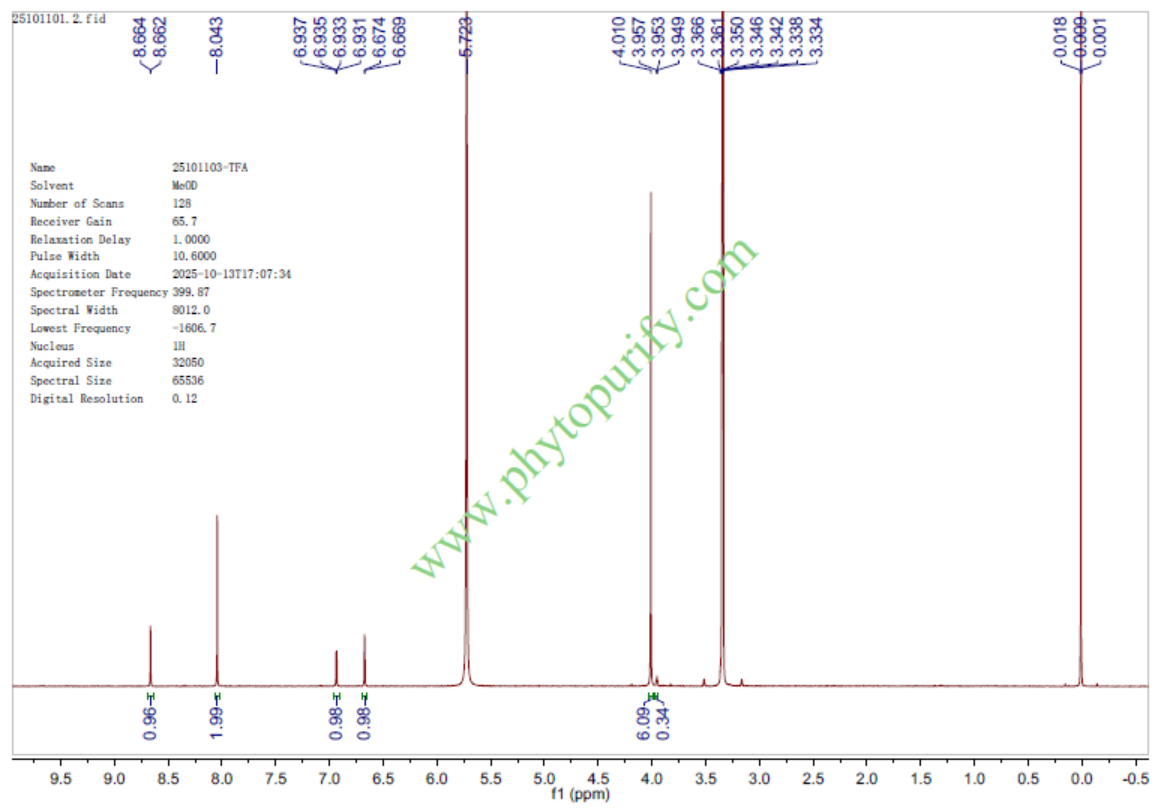
HNMR of Malvidin chloride
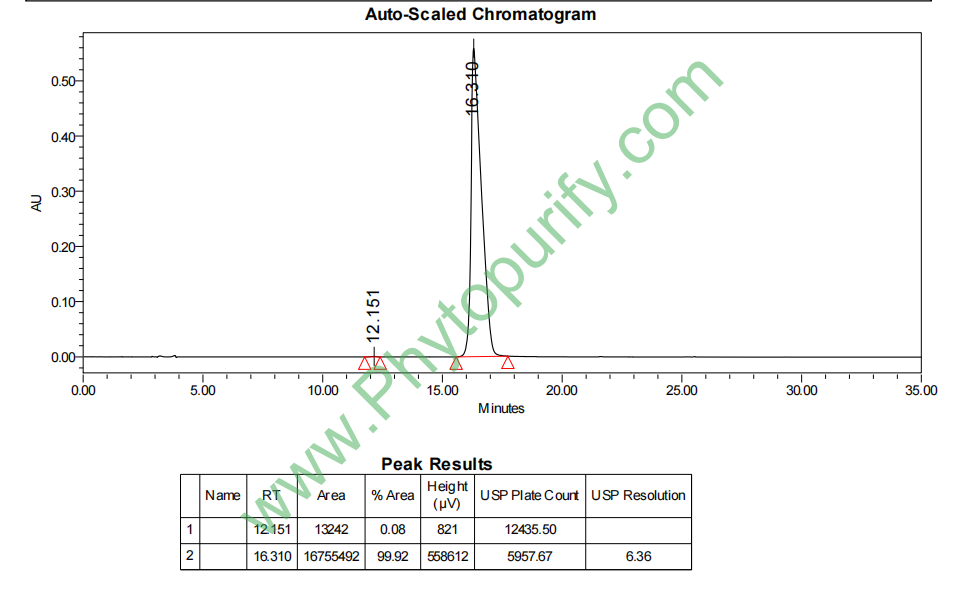
HPLC of Malvidin chloride
Storage conditions:Short-term storage at 2~8℃, long-term storage at -20 ~ -80℃
Malvidin chloride (CAS number: 643-84-5) is a natural anthocyanin compound widely present in grapes and their products. Due to its significant biological activity and potential medicinal value, it has attracted widespread attention in the field of natural product pharmacology in recent years. As a typical anthocyanin, chlorinated mallow pigment not only endows grapes and red wine with unique colors, but also exhibits various biological functions, especially in antioxidant, anti-inflammatory, and anti-tumor applications, showing great potential for application. It has become an important molecule in cancer and related disease research by regulating the cell cycle, inducing tumor cell apoptosis, and regulating various antioxidant related signaling pathways.
This article aims to systematically review the chemical structure and physicochemical properties, plant sources and extraction methods, pharmacological activity and mechanism of action, drug evaluation and pharmacokinetic characteristics of chlorinated mallow pigment. Combining current research progress, it explores its clinical application prospects and development trends, providing theoretical support and reference for subsequent basic and clinical research.
Chlorinated mallow pigment belongs to the anthocyanin class of compounds, with a chemical name of 3,5,7-trihydroxy-2- (3,4-dihydroxyphenyl) -1-phenylbenzopyran salt, a molecular formula of C17H15ClO7, and a molecular weight of 331.30. The core of its structure is the benzopyran ring system, which contains multiple hydroxyl groups and a positively charged oxygen heterocyclic ring. Chloride ions exist as paired anions, forming a stable salt structure.
In terms of physical and chemical properties, the chlorinated mallow pigment exhibits high polarity, with a LogP value of approximately -0.19, indicating good water solubility (about 0.18 mg/mL), which is beneficial for its dissolution and absorption in organisms. Its topological polar surface area (TPSA) is 110.68 Å ², indicating that the molecule has strong polarity and hydrogen bond donor/acceptor ability. The low permeability of the blood-brain barrier means its distribution in the central nervous system is limited. The negative result of hERG channel inhibition experiment indicates a low risk of cardiac toxicity. The Ames mutagenicity test score was 0.6, indicating a low risk of genotoxicity.
Chlorinated mallow pigments are mainly present in the skin and seeds of grapes (Vitis vinifera), especially in red grape varieties where they are abundant. Its natural form is usually in the form of anthocyanin salts, giving grapes and red wine a deep purple red color. In addition to grapes, some berry plants such as blueberries and blackberries also contain small amounts of anthocyanins of this type.
Traditional extraction methods often use organic solvents for extraction, and ethanol water mixed solutions (such as 70% ethanol) are commonly used as extractants to improve extraction efficiency through techniques such as ultrasound assisted extraction, microwave-assisted extraction, or hot reflux extraction. After concentration and freeze-drying, the extract was purified and identified using high-performance liquid chromatography (HPLC) combined with mass spectrometry (MS) or nuclear magnetic resonance (NMR) techniques. In recent years, supercritical CO2 extraction and membrane separation technologies have also been applied to improve the purity and yield of chlorinated mallow pigments.
During the extraction process, attention should be paid to the effects of pH, temperature, and light on the stability of anthocyanins. Acidic conditions are beneficial for maintaining their stable cationic form, avoiding degradation and discoloration. In addition, optimizing the extraction process is of great significance for ensuring biological activity and subsequent pharmacological research.
The pharmacological activity research of chlorinated mallow pigment mainly focuses on its antioxidant, anti-inflammatory, anti-tumor, and cell protective effects. Numerous in vitro and in vivo studies have shown that this compound can effectively scavenge free radicals and alleviate cell damage caused by oxidative stress.
Chlorinated mallow pigments enhance the expression and activity of intracellular antioxidant enzymes such as superoxide dismutase (SOD1, SOD2), catalase (CAT), glutathione peroxidase (GPX1), and heme oxygenase-1 (HMOX1) by activating the nuclear factor erythroid 2-related factor 2 (NFE2L2/NRF2) signaling pathway, significantly improving the cell's resistance to oxidative damage. Its antioxidant capacity not only helps to delay cell aging, but also prevents the development of various chronic diseases.
Chlorinated mallow pigments exhibit significant cytotoxicity in various tumor cell lines. Its main mechanism includes blocking the progression of the cell cycle in the G2/M phase and inducing tumor cell apoptosis. Related studies have shown that this compound can regulate multiple signaling pathways, such as inhibiting the PI3K/Akt and MAPK/ERK pathways, activating mitochondrial dependent apoptosis pathways, promoting cytochrome C release and caspase activation, thereby achieving anti-tumor effects.
In addition, chlorinated mallow pigments have shown the potential to inhibit tumor cell migration and invasion, possibly by regulating the expression of matrix metalloproteinases (MMPs) and cell adhesion molecules to slow down the process of tumor metastasis.
In oxidative stress and inflammation models, chlorinated mallow pigments can reduce the expression of inflammatory factors such as TNF - α, IL-6, and IL-1 β, alleviating the inflammatory response. Its anti-inflammatory effect is closely related to regulating the NF - κ B signaling pathway, promoting the expression of intracellular antioxidant enzymes, and reducing cell damage.
The biological activity of chlorinated mallow pigments mainly depends on their interactions with various molecular targets inside cells, especially playing a key role in antioxidant and anti-tumor mechanisms.
Chlorinated mallow pigments have good medicinal properties. Its molecular weight is 331.3, which meets the requirements for drug molecular weight in Lipinski's rules. The LogP value is -0.19, indicating its strong hydrophilicity, which is beneficial for oral absorption and in vivo distribution. The TPSA value of 110.68 Å ² suggests that it has good polarity and hydrogen bonding ability, which is helpful for binding with biomolecules.
Moderate water solubility (0.1799 mg/mL), conducive to formulation development. Low blood-brain barrier permeability reduces the risk of central nervous system side effects. HERG channel inhibition is negative, indicating a low risk of cardiac toxicity. The Ames test results show that its genotoxicity risk is relatively low and its safety is high.
In terms of pharmacokinetics, existing studies have shown that chlorinated mallow pigment is metabolized rapidly in vivo, mainly through liver enzyme system metabolism, generating various metabolites. Its oral bioavailability is limited, which may be related to the pH and enzymatic hydrolysis of the gastrointestinal environment. In the future, drug carrier technology or structural modification will be needed to improve its in vivo stability and bioavailability.
Chlorinated mallow pigment, as a natural active anthocyanin, exhibits broad clinical application potential due to its multi-target and multi mechanism biological activity. Especially in the prevention and treatment of cancer, chronic inflammation, and oxidative stress-related diseases (such as cardiovascular disease and neurodegenerative diseases), it has important value.
At present, the chlorinated mallow pigment is mainly in the stage of basic research and early pharmacological validation, and there is still a lack of systematic clinical trial data. Future research should focus on the following directions:
Through the above efforts, chlorinated mallow pigment is expected to become an important candidate molecule for natural product drug development, promoting the application of natural anthocyanin compounds in modern medicine.
Chlorinated mallow pigment, as a natural anthocyanin derived from grapes, has significant antioxidant and anti-tumor activities. It can exert biological effects by regulating the cell cycle, inducing apoptosis, and activating various antioxidant enzymes. Its excellent physicochemical properties and safety provide a foundation for drug development, but challenges such as bioavailability and metabolic stability still need to be overcome. In the future, combining modern pharmaceutical formulation technology and molecular biology methods, conducting in-depth preclinical and clinical research will help promote the transformation of chlorinated mallow pigments into clinical applications and unleash their potential value in the prevention and treatment of cancer and related diseases.
