


Synonym name: Talatizamine
Catalogue No.: BP1359
Cas No.: 20501-56-8
Formula: C24H39NO5
Mol Weight: 421.578
Botanical Source: Alkaloid from Aconitum talassicum, Aconitum nemorum, Aconitum carmichaeli, Aconitum variegatum, Aconitum franchetii, Aconitum forrestii, Aconitum columbianum, Aconitum saposhnikovii, Aconitum pseudogeniculatum and others
Purity: 95%~99%
Analysis Method: HPLC-DAD or/and HPLC-ELSD
Identification Method: Mass, NMR
Packing: Brown vial or HDPE plastic bottle
Can be supplied from milligrams to grams.
For Reference Standard and R&D, Not for Human Use Directly.
Inquire for bulk scale.
HPLC of Talatisamine
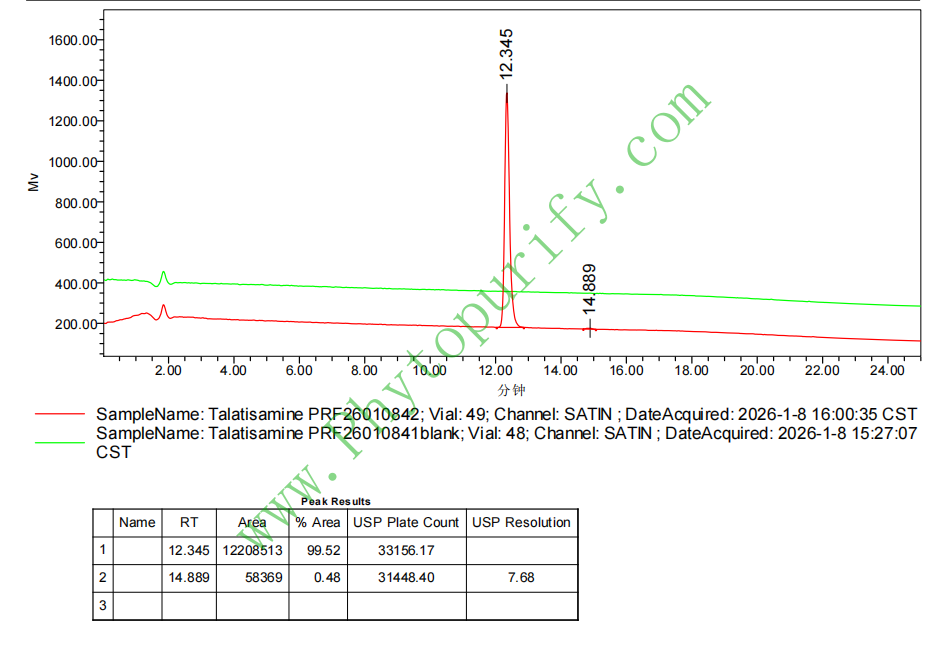
Storage conditions:Short-term storage at 2~8℃, long-term storage at -20 ~ -80℃
71.3900
1.9366
1.6459
.7566
3.0081
11.5689
High
52.6906
7.0365
No
No
No
No
Yes
No
0.0
Yes
No
Yes
No
Arrhythmia is a type of cardiovascular disease characterized by abnormal origin or conduction of cardiac electrical activity, which seriously threatens human health. Although existing antiarrhythmic drugs have achieved certain results in clinical application, their common problems such as arrhythmia risk, insufficient target selectivity, and side effects have prompted researchers to continuously explore new, efficient, and safe treatment strategies. Natural products have always been an important source of innovative drug discovery due to their structural diversity and rich biological activity. Aconitum plants have a long history of application in traditional medicine, and their rich Aconitum alkaloids have complex and significant physiological activities. Among them, Talatisamine (CAS: 20501-56-8), as a diterpenoid alkaloid with unique pharmacological properties, has received widespread attention in recent years.
Talaaconitine was initially identified for its specific blocking effect on potassium ion channels, and subsequent studies further revealed its potential in neuroprotection, particularly in reducing neuronal toxicity induced by beta amyloid oligomers, providing clues for its application in the field of neurodegenerative diseases. However, its most notable activity still focuses on the field of cardiac electrophysiology. Research has shown that talaconitine exhibits a complex network effect of regulating cardiac electrical activity by acting on multiple ion channel targets closely related to arrhythmia, such as KCNA5, KCNH2, KCNQ1, etc. Its pharmacological parameters, such as high blood-brain barrier permeability and low risk of hERG inhibition, provide unique advantages for it as a candidate drug. This article aims to systematically review the chemical properties, plant sources, pharmacological activities, mechanisms of action, pharmacological properties, and clinical application prospects of talaconitine, in order to provide comprehensive scientific references for the in-depth research and potential drug development of this compound.
Taraaconitine is a C19-diterpenoid aconitine alkaloid, which belongs to the derivative of the aconitine skeleton. Its molecular formula is C24H39NO5 and its molecular weight is 421.5780. The core structure of this compound is composed of a highly modified six ring system, which includes a nitrogen-containing six membered ring (D ring) and multiple oxygen-containing functional groups. Compared with highly toxic aconitines such as aconitine, the structural feature of talaconitine is that its C8 position is usually connected to an acetoxy or similar group, while the C14 position is often a benzoyloxy or its derivative. The differences in these substituents have a significant impact on its activity and toxicity. Its stereochemistry is complex, with multiple chiral centers that determine its specific interactions with biological targets.
In terms of physicochemical properties, the lipid water partition coefficient (LogP) of Taraaconitine is 1.9366, indicating its moderate lipophilicity, which facilitates its penetration of cell membranes and binding to hydrophobic target pockets. Its topological polar surface area (TPSA) is 71.39 Å ², reflecting the degree to which polar atoms (such as oxygen and nitrogen) in the molecule are exposed to solvents. This value is at a moderate level, indicating a certain degree of membrane permeability. The water solubility value is 0.7566 (usually measured in mg/mL or logS), indicating limited solubility in water and belonging to slightly soluble or poorly soluble compounds, which may pose challenges in formulation development. These physicochemical parameters collectively determine its fundamental pharmacokinetic behavior. It is worth noting that its predicted blood-brain barrier permeability is "high", which is consistent with its activity observed in neuroprotective studies, indicating that it can effectively enter the central nervous system to exert its effects. In addition, key pharmacological warning indicators indicate that it has no inhibitory activity on the hERG potassium channel (encoded by the KCNH2 gene), which initially avoids the risk of QT interval prolongation and tip twisting ventricular tachycardia commonly associated with most antiarrhythmic drugs. The Ames test result is 0.0, indicating that it has no mutagenicity in this testing system and a low risk of genetic toxicity.
Taraaconitine mainly comes from various plants in the Aconitum genus of the Ranunculaceae family. This genus of plants is widely distributed in northern temperate regions, especially in China, Japan, and the Himalayan region where resources are abundant. Common sources of plants include Aconitum carmichaelii、Aconitum kusnezofii and Aconitum talassicum The name 'Talatisamine' is related to the latter. In these plants, Taraaconitine usually coexists with other structurally similar aconitine alkaloids (such as aconitine, aconitine, aconitine, etc.), and the content varies depending on the species, origin, harvesting site (mainly tubers), and growing season.
Extracting and isolating talaconitine from plant materials is a delicate process involving multiple steps. The traditional method usually begins with organic solvent extraction. Dried and crushed Aconitum root powder is often subjected to percolation or reflux extraction using ethanol, methanol, or acidic water (such as dilute hydrochloric acid) to fully dissolve the alkaloid components. After concentration of the extract, adjust the pH to alkaline with alkali (such as ammonia water) to allow free precipitation of alkaloids. Then, extract with organic solvents such as chloroform and dichloromethane to obtain crude total alkaloids.
Due to the highly similar structure of aconitine alkaloids, the separation and purification of talaconitine require high-performance chromatography technology. Classic column chromatography (such as silica gel column, alumina column) is often used for preliminary separation, using solvent systems of different polarities (such as chloroform methanol, petroleum ether ethyl acetate) for gradient elution. Modern separation relies more on high-performance liquid chromatography (HPLC) or medium pressure preparative liquid chromatography (MPLC), especially reverse phase C18 columns, using acetonitrile water or methanol water (often modified with triethylamine to reduce tailing) as the mobile phase, which can achieve high-resolution separation. High purity talaconitine monomer can be obtained through online monitoring using thin-layer chromatography (TLC) or liquid chromatography-mass spectrometry (LC-MS), combined with structural confirmation using nuclear magnetic resonance (NMR) and mass spectrometry (MS). In recent years, liquid-liquid distribution chromatography techniques such as high-speed countercurrent chromatography (HSCCC), which do not require solid phase carriers, have also been applied for the separation and purification of such alkaloids due to their high recovery rate and avoidance of irreversible adsorption.
The pharmacological activity research of Taraaconitine mainly focuses on its regulatory effect on ion channels and extends to the field of neuroprotection, demonstrating various biological effects.
1. Cardiac electrophysiology and antiarrhythmic activity:
As a specific potassium channel blocker, talaconitine exhibits inhibitory effects on various potassium ion channels in the heart. Early ex vivo cardiac perfusion and electrocardiogram studies have shown that it can prolong the duration of myocardial action potential (APD) and effective refractory period (ERP), which is mainly attributed to its inhibition of delayed rectifier potassium current (especially the rapidly activating component IKr) and transient outward potassium current (Ito). Talaaconitine has shown clear protective effects in various experimental arrhythmia models, such as ventricular arrhythmias induced by barium chloride, aconitine, or electrical stimulation, by reducing the incidence and severity of arrhythmias. The characteristic of its action is that compared to classic class III antiarrhythmic drugs such as sotalol and dofetilide, talaconitine has weaker inhibition on hERG/KCNH2 channels, which may be related to its unique binding site or mode of action, potentially reducing the risk of arrhythmia.
2. Neuroprotective activity:
An important study has found that talaconitine can significantly reduce the toxic effects of beta amyloid oligomers on primary cultured cortical neurons. β - amyloid oligomers are key toxic substances in the pathogenesis of Alzheimer's disease, which can induce neuronal synaptic dysfunction, oxidative stress, and apoptosis. The neuroprotective mechanism of talaconitine may be related to its regulation of neuronal membrane potential, stabilization of intracellular calcium homeostasis, or impact on potassium channels associated with neural excitability. This discovery has opened up new research directions for its application in the field of neurodegenerative diseases.
3. Other potential activities:
Based on its extensive effects on ion channels, talaconitine may also have analgesic, anti-inflammatory and other activities, which is consistent with the traditional uses of some aconitine alkaloids. However, there are relatively few studies on talaconitine and further verification is needed. It is worth noting that many aconitine alkaloids have high cardiotoxicity and neurotoxicity, while the toxicity spectrum of talaconitine seems to be different, and its therapeutic window and safety range need to be clarified through systematic toxicological studies.
The core pharmacological effect of Taraaconitine lies in its role as a multi-target ion channel regulator, particularly with specific blocking effects on members of the potassium ion channel family. Its mechanism of action involves a complex network of targets, which is closely related to the occurrence of arrhythmia.
Core target: Potassium ion channel
* KCNA5(Kv1.5)The alpha subunit encoding ultra fast delayed rectifier potassium current (IKur) is mainly present in human atrial myocytes. Talaaconitine blockade of Kv1.5 channel can specifically prolong the duration of atrial action potential and effective refractory period, without affecting ventricular muscle, making it a potential candidate Selective treatment for atrial fibrillation Candidate compounds.
* KCNH2(hERG/Kv11.1)The alpha subunit encoding fast delayed rectifier potassium current (IKr) is a key channel for ventricular repolarization and a major target for drug-induced QT prolongation. The pharmacological data shows that talaconitine has "no hERG inhibition", suggesting that it may not directly block this channel effectively, or its binding mode may be different, which may be the key to its potential safety advantage.
* KCNQ1(Kv7.1)Together with the auxiliary subunit KCNE1, it forms a slow delayed rectifier potassium current (IKs) channel. IKs are important repolarization reserves under cardiac stress. Regulating this channel may affect the heart's response to sympathetic excitation.
* Other potassium channel related proteins For example, KCNE1 (MinK), as a regulatory subunit of KCNQ1, its function may be influenced by other factors.
Other key ion channel targets:
In addition to potassium channels, the spectrum of action of talaconitine also extends to other ion channels, which explains its complex electrophysiological effects.
* SCN5A(Nav1.5)The alpha subunit encoding voltage-gated sodium channels in the heart is responsible for the INa current that rapidly depolarizes during the action potential phase 0. Regulating sodium channels can affect myocardial excitability and conduction velocity.
* CACNA1C(Cav1.2)The α 1C subunit encoding L-type voltage-gated calcium channels mediates plateau calcium influx (ICa-L), which is crucial for excitation contraction coupling and partial pacing activity. The impact on calcium channels may have positive inotropic effects or trigger activity risks.
* Ligand gated ion channel As follows:CHRNA7(Neuronal nicotinic acetylcholine receptor alpha 7 subunit) and CHRM2(M2 muscarinic acetylcholine receptor). The former is a calcium permeable ion channel involved in the cholinergic anti-inflammatory pathway and cognitive function; The latter is a G protein coupled receptor that plays a central role in regulating heart rate in the vagus nerve by inhibiting adenylate cyclase and activating inward rectifying potassium currents (IK, ACh) through the Gi protein. The effect of Taraaconitine on these receptors may be associated with its neuroprotective activity and its impact on autonomic regulation.
Indirect target:
* ATP1A1 Encoding the alpha 1 subunit of sodium potassium pump (Na+/K+- ATPase). Although it is unclear whether Taraaconitine directly inhibits this pump, aconitine compounds can sometimes affect ion pump function, indirectly altering the intracellular Na+, K+concentration gradient, affecting membrane potential and ion channel function.
In summary, talaconitine acts synergistically or antagonistically on a series of ion channels and receptors, forming a multi-target regulatory network that comprehensively affects the automatic rhythmicity, excitability, conductivity, and refractory period of myocardial cells, ultimately exerting its anti arrhythmic effect. Its unique functional characteristics are its relative selectivity towards Kv1.5 and low affinity towards hERG.
Based on its physicochemical properties and preliminary biological data, Taraaconitine exhibits some attractive pharmacological characteristics, but also faces challenges.
Advantage:
1. Target selectivity potential The effect on atrial specific targets such as KCNA5 (Kv1.5), combined with low inhibitory risk on ventricular hERG channels, theoretically enables "selective treatment of atrial fibrillation", which effectively treats atrial fibrillation without increasing the risk of ventricular arrhythmia. This is currently a difficult and hot topic in the development of antiarrhythmic drugs.
2. Good central permeability The predicted high blood-brain barrier permeability supports its direct neuroprotective effect in central nervous system diseases such as Alzheimer's disease, expanding its application scope.
3. Preliminary safety signal The absence of hERG inhibition and negative Ames test are important early safety indicators, reducing concerns about cardiac toxicity and genetic toxicity.
Challenges and unknowns:
1. Poor water solubility LogP is 1.94 and has limited water solubility, which may affect its oral bioavailability and the development of intravenous formulations. It may be necessary to improve solubility and dissolution rate through formulation strategies such as salt formation (such as forming hydrochloride salts, citrate salts), preparation of cyclodextrin inclusion complexes, nanocrystals, or liposomes.
2. Lack of pharmacokinetic data Currently, there is very limited systematic research on the in vivo absorption, distribution, metabolism, and excretion (ADME) of talaconitine. The key parameters such as oral absorption degree, plasma protein binding rate, major metabolic organ (likely liver, through cytochrome P450 enzyme system), activity and toxicity of metabolites, and elimination half-life are all unknown. These are the core factors that determine the dosing regimen and preclinical/clinical development strategy.
3. The treatment window needs to be clearly defined Despite the low risk of hERG, the inherent narrow therapeutic window of aconitine alkaloids still needs to be cautious. A comprehensive toxicology study is needed, including acute toxicity, long-term toxicity, cardiovascular safety pharmacology (such as effects on blood pressure, heart rate, and cardiac function), and possible neurotoxicity assessment, to determine its safe dose range.
4. Potential drug interactions As a substance that may be metabolized by CYP450, it may interact with commonly used clinical drugs at the metabolic level, requiring in vitro metabolic phenotype and interaction studies.
The unique pharmacological characteristics of Taraaconitine have brought attractive application prospects in the treatment of cardiovascular and neurological diseases, but the transformation still needs to overcome many scientific challenges.
Potential clinical application directions:
1. Treatment and Prevention of Atrial Fibrillation This is its most direct and promising application direction. Based on its blocking effect on Kv1.5 channels, talaconitine is expected to be developed as a novel drug Class III atrial selective antiarrhythmic drugs Compared with amiodarone (multi-channel blockade with multiple side effects) or dronedarone (limited efficacy), theoretically it has better safety; Compared with Venacaran (atrial selective sodium channel blocker), its mechanism of action is complementary. It may be used for cardioversion of atrial fibrillation, maintenance of sinus rhythm, and even prevention of atrial fibrillation recurrence, especially for patients who are intolerant to existing drugs or have poor efficacy.
2. Other types of arrhythmia It has a wide range of effects on multiple ion channels and may also be effective for certain ventricular arrhythmias, but its risk of causing arrhythmias needs to be carefully evaluated.
3. Adjuvant therapy for neurodegenerative diseases Given its anti beta amyloid neurotoxic activity, talaconitine may serve as a potential disease modifier or adjuvant therapy for Alzheimer's disease, aimed at protecting neurons and delaying cognitive decline. Its high BBB permeability is a key advantage in achieving this goal.
4. pain management Some aconitine alkaloids have a traditional analgesic effect, and the regulation of neuronal ion channels by talaconitine may have analgesic effects, especially for neuropathic pain, which is worth exploring.
Future research prospects and challenges:
1. In depth study of target mechanism It is necessary to use techniques such as patch clamp, molecular docking, and mutation analysis to accurately elucidate the binding sites, action kinetics, and state dependence (such as preference for open, closed, or inactive channels) of talaconitine with various targets (especially Kv1.5), which can help with structure based optimization design.
2. Systematic pharmacokinetics and toxicology research This is the primary task in advancing its preclinical development. It is necessary to establish sensitive biological analysis methods to comprehensively evaluate the ADME characteristics of rodents and non rodents, and conduct GLP compliant toxicological studies to clarify their safety range.
3. Structural optimization and derivative development Natural products are often used as lead compounds. Based on the core skeleton of Taraaconitine, structural modification is carried out through semi synthetic or total synthetic methods, aiming to Improve target selectivity (such as enhancing the selectivity index for Kv1.5 vs. hERG), improve water solubility and metabolic stability, and reduce potential toxicity In order to obtain better candidate drugs.
4. Disease model validation It is necessary to validate its efficacy and long-term safety in animal models that are closer to human diseases, such as large animal atrial fibrillation models and Alzheimer's disease transgenic mouse models.
5. Pharmaceutical research Develop advanced formulations suitable for oral or injection administration to address its poor solubility.
Taraaconitine, as a natural diterpenoid alkaloid derived from traditional medicinal plants, has shown new vitality in modern pharmacological research due to its specific potassium channel blocking activity and multi-target action characteristics. It not only provides a unique lead compound for the development of antiarrhythmic drugs, especially for atrial selective therapy strategies, but its significant neuroprotective activity also opens up a new window for its application in the field of neuroscience. Its inherent high blood-brain barrier permeability and low hERG inhibition risk constitute its unique advantages compared to many synthetic drugs.
However, the road from natural active molecules to potential therapeutic drugs is still long. There are still significant gaps in our understanding of it, especially in terms of systematic pharmacokinetic and toxicological data, as well as precise details of its molecular mechanisms of action. Future research needs to integrate interdisciplinary forces such as natural product chemistry, pharmacology, pharmacokinetics, toxicology, and medicinal chemistry, and conduct in-depth exploration around talaconitine. By elucidating its functional network, optimizing its medicinal properties, and validating its efficacy in advanced disease models, it is expected to transform the chemical messenger in this ancient plant into a new weapon for combating major health problems such as arrhythmia and neurodegenerative diseases. The research process of Taraaconitine once again confirms the eternal value and infinite potential of exploring new strategies for the treatment of complex diseases from natural treasures.
