Matrine: a multi-target anti-inflammatory and anti-tumor natural flavonoid derived from traditional Chinese medicine
1. Overview
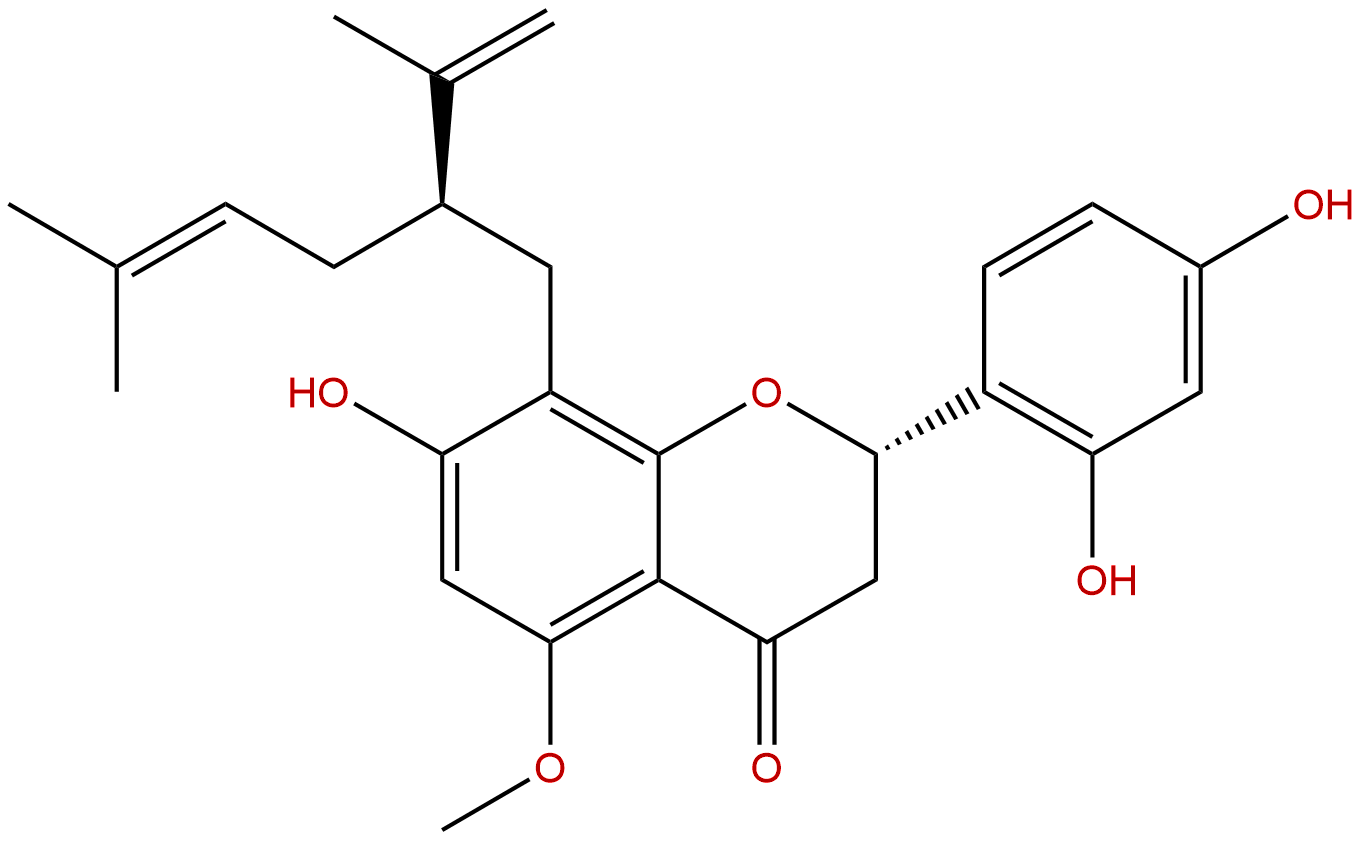
Kurarinone, also known as (2S) - (-) - Kurarinone, is a traditional Chinese medicinal herb derived from Sophora flavescens(Sophora flavescens)Natural flavonoids isolated from the roots. Its CAS number is 34981-26-5, molecular formula is C26H30O6, and molecular weight is 438.5200 g/mol. As a flavanone derivative with a clear stereoconfiguration, sophorone has shown extensive biological activity in recent decades, especially in Anti inflammatory, anti-tumor, and immune regulation The field is highly concerned.
The research background of Sophora flavescens is rooted in the long history of medicinal use of Sophora flavescens. Modern pharmacological research has gradually revealed that Sophora flavescens ketone is one of the key active ingredients that exert various pharmacological effects in Sophora flavescens. Early research mainly focused on its antibacterial and anti-inflammatory effects, while with the development of molecular biology and cell biology technologies, its mechanism of action has been continuously deepened. Research has found that matrine can regulate Nuclear transcription factor kappa B (NF - κ B)、Tumor necrosis factor (TNF)、Interleukin-1 (IL) By utilizing key inflammatory signaling pathways, it exerts a powerful anti-inflammatory effect. Meanwhile, it can also demonstrate potential anti-tumor value by inducing tumor cell apoptosis, inhibiting tumor cell proliferation and metastasis. Especially in autoimmune disease models such as experimental autoimmune encephalomyelitis (EAE), matrine inhibits pathogenicity by Th1 and Th17 cells The differentiation effectively alleviates the disease progression, providing a scientific basis for its application in autoimmune diseases such as multiple sclerosis.
This article will systematically summarize the scientific connotation of Sophora flavescens from the aspects of its chemical structure, plant origin, pharmacological mechanism, pharmacological evaluation, and research prospects, aiming to provide a professional and comprehensive reference material for researchers in related fields.
2. Chemical structure and physicochemical properties
Matrine belongs to the class of flavanone compounds, and its core structure is the (2S) - flavanone skeleton. Specifically, it is present in flavanones 7. 2 'and 4' positions Substituted by hydroxyl groups,5 people Replaced by methoxy group, and 8 digits It connects a unique Lavender based side chain This structural feature is accurately described by its SMILES string:C=C(C)[C@H](CC=C(C)C)Cc1c(O)cc(OC)c2c1O[C@H](c1ccc(O)cc1O)CC2=0Among them, the symbols "@ H" and "@" indicate the absolute configuration of its chiral center, that is, the C2 position is in the S configuration, which is crucial for its biological activity.
From the analysis of physical and chemical properties, the molecular weight of Sophora flavescens is 438.52 g/mol, slightly higher than the common 500 Da threshold for small molecule drugs. its The coefficient of lipid water partition (LogP) is 4.7891, indicating that the compound has Strong lipophilicity This is closely related to the hydrophobic lavender side chains and aromatic ring system in its structure. A higher LogP value usually indicates better permeability of the compound in the biofilm, but it may also lead to a decrease in water solubility. its The theoretical polar surface area (TPSA) is 96.22 Å ²This value reflects the surface area of polar atoms (such as oxygen atoms) in the molecule, which belongs to a moderately high level and has a significant impact on the solubility and membrane permeability of the molecule.
Combining it Water solubility data (0.1274 mg/mL) It can be seen that the solubility of Sophora flavescens in water is relatively low, which is consistent with its high LogP value. In the evaluation of drug properties, this low water solubility may become a challenge for the development of oral formulations. However, it The permeability data of Caco-2 cells is 16.3175 (× 10 ⁻⁶ cm/s), indicating its presence in intestinal models Good permeability This provides certain favorable conditions for its oral absorption. These physicochemical parameters collectively determine the absorption, distribution, metabolism, and excretion (ADME) characteristics of Sophora flavescens in vivo, which are the basis for evaluating its potential as a drug.
3. Plant sources and traditional applications
The plant source of matrine is single and clear, that is Fabaceae plant Sophora flavescens(Sophora flavescens)Dry roots Sophora flavescens, also known as "Di Huai" or "Shan Huai", has a medicinal history of over two thousand years in East Asian countries such as China, Japan, and South Korea, and is included in the pharmacopoeias of many countries.
In traditional Chinese medicine theory, Sophora flavescens has a cold nature and a bitter taste, and belongs to the meridians of the heart, liver, stomach, large intestine, and bladder. Its traditional functions mainly focus on Clearing heat and dampness, killing insects, and promoting diuresis Commonly used in clinical practice for treatment Damp heat diarrhea, intestinal wind, bloody stool, jaundice, red urine, red discharge, yin swelling and itching, eczema and wet sores, skin itching, scabies and leprosy Waiting for symptoms. These applications are mostly related to the understanding of modern medicine Infectious inflammation, allergic inflammation, and autoimmune skin diseases Correspondingly. Sophora flavescens is often used in the form of decoction for internal consumption or external fumigation and washing, and is an important component of many classic prescriptions such as "Sophora flavescens decoction" and "Danggui Beimu Sophora flavescens pill".
Modern plant chemistry research has confirmed that Sophora flavescens contains abundant alkaloids (such as matrine, oxymatrine) and flavonoids (such as sophocarpine, sophocarpine, isoquercetin, etc.), which together form the basis of its multi-target and multi pathway pharmacological effects. Among them, matrine is a characteristic Isopentenyl flavonoids It is one of the important material foundations for Sophora flavescens to exert anti-inflammatory, anti-tumor, and immune regulatory effects. From traditional "clearing heat and dampness" to modern "anti-inflammatory and immune regulation", the study of Sophora flavescens perfectly explains how to use modern scientific technology to elucidate the molecular mechanism of effective ingredients in traditional Chinese medicine, and is a model for the modernization of Chinese medicine research.
4. Pharmacological activity and mechanism of action
Matrine has a wide range of pharmacological activities, mainly concentrated in Anti inflammatory, anti-tumor, and immune regulation Three major aspects. Its mechanism of action is complex, involving the regulation of multiple key signaling pathways and targets. Based on the provided target information (TNF, PTGS2, NFKB1, IL6, IL1B), we can delve into their core functional network.
4.1 Anti inflammatory and immune regulatory effects
The anti-inflammatory activity of matrine is one of its most significant features. It inhibits the inflammatory cascade through multiple targets:
- Inhibition of NF - κ B pathway NFKB1 (nuclear factor kappa B p105 subunit) is a core transcription factor in inflammatory response. Matrine can inhibit the activation of NF - κ B and its translocation to the nucleus, thereby Downregulate the expression of a series of pro-inflammatory cytokine genes。
- Regulating key inflammatory mediators On the basis of the inhibition of the NF - κ B pathway mentioned above, downstream key effector molecules, such as Tumor necrosis factor - α (TNF - α), interleukin-6 (IL-6), interleukin-1 β (IL-1 β) The generation and release are significantly inhibited. Meanwhile, oxymatrine can also inhibit Cyclooxygenase-2 (PTGS2/COX-2) Reduce the synthesis of inflammatory mediators such as prostaglandins through their expression.
- Regulating T cell differentiation In the autoimmune model, the immunomodulatory effect of matrine is particularly prominent. It can selectively inhibit Helper T cell 1 (Th1) and Th17 cells The differentiation. Th1 cells mainly secrete IFN - γ, mediating cellular immunity; Th17 cells secrete IL-17, which is a key driving cell for autoimmune diseases and chronic inflammation. By inhibiting the differentiation of these two types of pathogenic T cells, matrine can effectively alleviate the progression of experimental autoimmune encephalomyelitis (EAE, multiple sclerosis model) and chronic inflammatory skin diseases.
4.2 Antitumor effect
The anti-tumor mechanism of Sophora flavescens mainly manifests in inducing apoptosis and sensitizing chemotherapy:
- Sensitivity enhancing TRAIL induced apoptosis Tumor necrosis factor related apoptosis inducing ligand (TRAIL) can selectively induce apoptosis in tumor cells, but many tumor cells resist it. Matrine can pass through Inhibition of NF - κ B-dependent cFLIP (Cell FLICE Inhibition Protein) expression To overcome this resistance. CFLIP is a key inhibitory protein in the apoptosis pathway, and its downregulation can restore tumor cell sensitivity to TRAIL, thereby promoting apoptosis.
- Inhibiting tumor related signaling pathways In addition to NF - κ B, matrine can also interfere with other pro survival and metastasis pathways. For example, it can be achieved through Downregulate Smad3 expression Inhibiting TGF - β/Smad signaling pathway can improve renal interstitial fibrosis, and this mechanism may also be involved in inhibiting tumor invasion and metastasis.
- Direct cytotoxicity Research has confirmed that matrine has direct cytotoxicity against various tumor cell lines, such as human myeloid leukemia HL-60 cells, by inhibiting cell proliferation and inducing apoptosis.
4.3 Mechanism of Action Network Integration
In summary, the mechanism of action of Sophora flavescens is not limited to a single target, but rather constitutes a mechanism that A network with NF - κ B as the core hub It inhibits the expression of key inflammatory mediators such as TNF, IL-6, IL-1 β, COX-2 by suppressing NF - κ B and radiating downstream; Regulating T cell differentiation and apoptosis related proteins (such as cFLIP and Smad3) upstream or in parallel. This multi-target mode of action may have advantages in treating complex inflammatory diseases and tumors, but it also increases the complexity of studying its mechanism of action.
5. Evaluation of drug properties
Based on the provided pharmacological parameters, we can conduct a preliminary evaluation of the development prospects of Sophora flavescens as a potential drug. Evaluation usually refers to Lipinski's Rule of Five Waiting for empirical rules.
- Molecular weight (MW):438.52 g/mol,Slightly below 500 Da The upper limit complies with the rules.
- Lipid water partition coefficient (LogP):4.7891,Above 5 The ideal upper limit. A higher LogP value indicates strong lipophilicity, which may lead to poor water solubility and rapid metabolism, and is one of the reasons for drug formation Potential disadvantages。
- Hydrogen bond donor (HBD)From its structural formula, it contains 3 hydroxyl groups, with a quantity of 3 of them Below the upper limit of 5, in compliance with the rules.
- Hydrogen bond acceptor (HBA)The molecule contains 6 oxygen atoms (carbonyl oxygen and ether oxygen are also considered acceptors), with a quantity of 6 of them Below the upper limit of 10, in compliance with the rules.
- Number of rotatable keys There are many rotatable bonds in the molecule, which may affect its oral bioavailability, but it is not a direct indicator of the five rules.
Summary Matrine basically meets the four criteria of Lipinski's Five Rules (MW, HBD, HBA, slightly higher LogP), and belongs to compounds with good "drug like properties". But its higher LogP and lower Water solubility (0.1274 mg/mL) It is a pharmaceutical issue that requires attention.
Analysis of other key parameters:
- Membrane permeability and absorption:Caco-2 permeability (16.32) and Effective penetration rate (Peff: 2.457) The data indicates that it has Good intestinal absorption potential But The blood-brain barrier (BBB) penetration is' low 'It suggests that it is difficult to enter the central nervous system, which may be a limitation for treating central nervous system diseases such as multiple sclerosis, but also reduces the risk of central nervous system side effects.
- Protein binding and distribution:The plasma protein binding rate (PPB) is as high as 90.38%This means that most drugs in the blood bind to proteins, and the concentration of free drugs is low, which may affect their efficacy and tissue distribution.
- Toxicity risk:
- Genotoxicity The Ames test result is negative (0.0), indicating no mutagenicity. but Chromosome aberration test shows' yes'This indicates the potential risk of genetic toxicity, which is necessary in drug development High vigilance and in-depth research The red signal.
- cardiotoxicity Inhibition of hERG as' no 'reduces the risk of causing QT interval prolongation and apical torsion ventricular tachycardia in the heart, which is a favorable signal.
- Organ toxicity: Data display for Serum alkaline phosphatase (Ser_LK) and aspartate aminotransferase (Ser_ST) Has an impact ("Yes"), indicating the possibility of potential Liver toxicity Careful evaluation is required in preclinical studies.
- allergenicity Respiratory sensitization (Resp_Sens) is "Yes", indicating the possibility of triggering respiratory allergic reactions.
Comprehensive Assessment Matrine has clear pharmacological activity and a basic drug like skeleton, but its Poor solubility, potential genetic toxicity, and liver toxicity It is the core challenge that it must face and solve in the process of drug conversion. Future research needs to focus on utilizing Structural modifications (such as prodrugs and water-soluble salts) Improve its physical and chemical properties and systematically Preclinical safety evaluation (GLP toxicology study) Clarify its toxic dose range and mechanism.
6. Research Status and Application Prospects
Research status:
At present, research on matrine is mainly focused on Preclinical stage A large number of in vitro and in vivo studies have fully confirmed its significant activities in anti-inflammatory, anti-tumor, immune regulation, etc., and preliminarily elucidated its molecular mechanism of action on multiple targets such as NF - κ B. The research models cover various disease models from cell lines to mice and rats, including colitis, arthritis, dermatitis, autoimmune encephalomyelitis, as well as various tumor models such as liver cancer, lung cancer, leukemia, etc. These studies have laid a solid scientific foundation for the further development of matrine. However, as mentioned earlier, there is still a relative lack of in-depth research on its systemic pharmacokinetics, long-term toxicity, and especially genetic toxicity.
Application prospects and future directions:
1. As a lead compound for structural optimization Matrine itself may not be suitable for direct development as a drug due to its water solubility and toxicity issues. But its unique lavender based flavanone skeleton is excellent lead compound In the future, it can be achieved through Medicinal chemical methods Structural modifications can be made to it, such as simplifying side chains, introducing polar groups, preparing glycosylated or phosphorylated prodrugs, etc., with the aim of Improve water solubility, reduce toxicity, and enhance targeting Thus obtaining derivatives with better drug properties.
2. Developed as an anti-inflammatory and immunomodulatory agent Given its specific inhibition of Th1/Th17 differentiation and good efficacy in treating chronic inflammatory skin diseases, the optimized derivative of Sophora flavescens is expected to be developed for therapeutic purposes Psoriasis, atopic dermatitis, rheumatoid arthritis, inflammatory bowel disease Waiting for autoimmune and chronic inflammatory diseases.
3. As an adjuvant therapy drug for tumors Its sensitizing effect on TRAIL induced apoptosis makes it promising to be used in combination with existing TRAIL therapies or chemotherapy drugs for the treatment of TRAIL resistant cells Liver cancer, lung cancer, leukemia Improve the efficacy of existing therapies for malignant tumors.
4. In depth mechanism research and biomarker exploration Further research is needed to investigate the specific mechanisms of its genetic toxicity and hepatotoxicity, and to identify relevant biomarkers to guide safe drug use. Meanwhile, utilizing Omics techniques (proteomics, metabolomics) Fully reveal its functional network, discover new targets and indications.
5. Research on a new drug delivery system Regarding its low water solubility, exploration can be conducted Nanoformulations (such as liposomes, polymer micelles, nanocrystals) Waiting for new drug delivery systems to improve their bioavailability and achieve targeted delivery, reducing systemic toxicity.
In summary, as a natural active molecule derived from traditional Chinese medicine, Sophora flavescens has demonstrated enormous therapeutic potential due to its multi-target and multi effect pharmacological characteristics. Although there are still challenges on the path of drug development, with the empowerment of modern drug research and development technology, it is highly likely to derive new drugs with independent intellectual property rights, providing new options for the treatment of inflammatory diseases and tumors. The research process itself is a classic path from traditional wisdom to modern innovation, continuously attracting researchers in the fields of pharmacy, chemistry, and medicine to engage in it.