


Product name: Matrine
Synonym name: Sophoridine
Catalogue No.: BP0928
Cas No.: 519-02-8
Formula: C15H24N2O
Mol Weight: 248.37
Botanical Source: Alkaloid from Sophora alopecuroides, Sophora flavescens, Sophora microphylla, Sophora pachycarpa, Sophora tetraptera, many other Sophora spp., Vexibia pachycarpa (preferred genus name Sophora) and Euchresta horsfeldii (Leguminosae)
Physical Description: Powder
Type of Compound: Alkaloids
Purity: 95%~99%
Analysis Method: HPLC-DAD or/and HPLC-ELSD
Identification Method: Mass, NMR
Packing: Brown vial or HDPE plastic bottle
Storage: Store in a well closed container, protected from air and light. Put into refrigerate or freeze for long term storage.
Whenever possible, you should prepare and use solutions on the same day. However, if you need to make up stock solutions in advance, we recommend that you store the solution as aliquots in tightly sealed vials at -20℃. Generally, these will be useable for up to two weeks.
The product could be supplied from milligrams to grams, up to kilograms
Inquire for bulk scale.
Descriptions:
Matrine, an alkaloid purified from the chinese herb Sophora flavescens Ait, is well known to possess activities including anti-inflammation, anti-fibrotic and anticancer, it could inhibit cell proliferation and induce apoptosis of SGC-7901 cells in vitro by up-regulating Fas/FasL expression and activating caspase-3 enzyme.[1]
Matrine upregulates the cell cycle protein E2F-1 and triggers apoptosis via the mitochondrial pathway in K562 cells, it is a potential anti-drug.[2]
Matrine suppresses PMA-induced MMP-1 expression through inhibition of the AP-1 signaling pathway and also may be beneficial for treatment of some inflammatory skin disorders.[3]
Matrine can induce gastric cancer MKN45 cells apoptosis via increasing pro-apoptotic molecules of Bcl-2 family, also inhibits matrix metalloproteinase-9 expression and invasion of human hepatocellular carcinoma cells.[4,5]
Matrine can improve 2,4,6-trinitrobenzene sulfonic acid (TNBS)-induced colitis in mice and the therapeutic mechanism might be related to the reduction of up-regulated colonic TNF-α production caused by TNBS.[6]
Matrine seems to be a novel autophagy inhibitor that can modulate the maturation process of lysosomal proteases.[7]
Matrine can reduce the mortality of acetaminophen overdosed mice more effectively, attenuate acetaminophen-induced hepatotoxicity, and reduces the number and area of γ-GT positive foci, thus protecting liver function and preventing HCC from occurring; it
also has a protective effect on immunosuppression, a strong non-specific anti-inflammatory effect, and an effect of reducing the incidence of sodium and water retention.[8]
References:
[1] Dai Z J, Gao J, Ji Z Z, et al.J Ethnopharmacol 2009, 123(1):91-6.
[2] Hua J, Hou C H, Zhang S B, et al. Eur J Pharmacol, 2007, 559(2-3):98-108.
[3] Eunsun Jung ?, Jongsung Lee ?, Huh S, et al.Biofactors, 2008, 33(2):121–8.
[4] Luo C, Zhu Y, Jiang T, et al. Toxicol, 2007, 229(3):245-52.
[5] Yu H B, Zhang H F, Li D Y, et al. J Asian Nat Prod Res, 2011, 13(3):242-50.
[6] Hong C, Bing X, Lin Z, et al. Pharmacol Res, 2006, 53(3):202-8.
[7] Wang Z, Zhang J, Wang Y, et al. Carcinogenesis, 2012, 34(1):128-38.
[8] Wan X Y, Luo M, Li X D, et al. Chem-Biol Interact, 2009, 181(1):15-9.
[9] Jiang Y L, Zhang S Y. Lishizhen Medicine & Materia Medica Research, 2006, 17(11):2204-5.
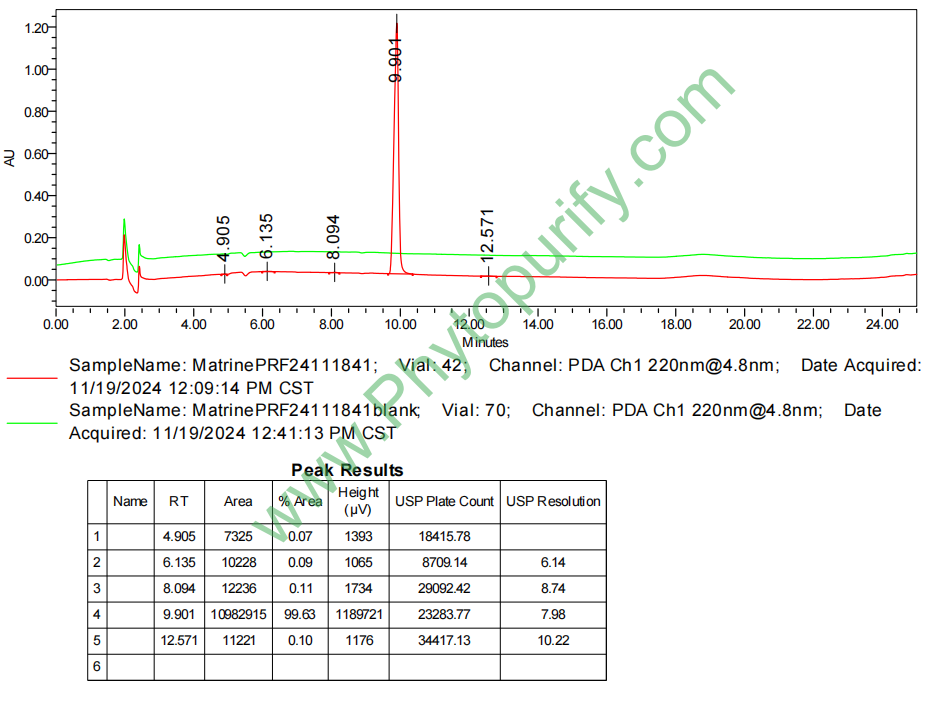
HPLC of Matrine
Storage conditions:Short-term storage at 2~8℃, long-term storage at -20 ~ -80℃
23.5500
1.5633
-.0772
8.7445
3.3847
7.6297
High
22.6341
3.7071
No
No
Yes
No
Yes
No
0.6
Yes
No
Yes
No
Natural products, as an important source of drug discovery, have written a brilliant chapter in the history of human disease treatment. Among numerous natural compounds with biological activity, Matrine, as a quinolone alkaloid derived from traditional Chinese medicine, has attracted much attention in recent years due to its extensive pharmacological activities. Matrine is mainly found in leguminous plants of the Sophora genus, such as Sophora flavescens(Sophora flavescens Ait.)、 Shan Dou Gen(Sophora tonkinensis Gagne et al., these plants have been used for thousands of years in the traditional medical system of East Asia, commonly used to treat diseases such as fever, dysentery, jaundice, eczema, and tumors.
The chemical name of matrine is Matridin-15-one, with a CAS registration number of 519-02-8 and a molecular formula of C ₁₅ H ₂₄ N ₂ O. As a characteristic active ingredient of Sophora plants, matrine has been shown to have a unique mode of action as a kappa opioid receptor (KOR) and μ - opioid receptor (MOR) agonist based on traditional applications, as revealed by modern pharmacological research. This discovery not only provides a new explanatory dimension for the pharmacological mechanism of matrine, but also opens up new avenues for its application in pain management, immune regulation, and other fields.
In recent years, significant progress has been made in the research of matrine in anti-tumor, anti-inflammatory, antioxidant stress, and anti apoptotic aspects. Especially in disease models such as human non-small cell lung cancer, liver cancer, papillary thyroid carcinoma, and acute kidney injury (AKI), matrine has shown remarkable therapeutic potential. Taking liver cancer as an example, matrine can exert multiple effects such as inhibiting tumor cell proliferation, inducing apoptosis, inhibiting angiogenesis, and reversing drug resistance by regulating multiple key signaling pathway molecules such as BCL2, STAT3, HIF1A, MAPK1, etc. These findings have made matrine one of the research hotspots in the field of natural product pharmacology and provided a model for the modern development of traditional Chinese medicine.
This article will provide a systematic review of the research progress of matrine from multiple dimensions, including chemical structure and physicochemical properties, plant sources and extraction methods, pharmacological activity research, mechanism of action and molecular targets, pharmacological evaluation and pharmacokinetics, clinical application prospects and prospects, in order to provide reference for the in-depth study and clinical translation of this compound.
Matrine belongs to the tetracyclic quinolone alkaloids, and its core skeleton consists of four rings: two pyridine rings (A ring and B ring) are connected by a quinolone bridge, forming a unique rigid tetracyclic system. Specifically, the structure of matrine can be described as: a fully hydrogen-1H-quinolone core, connected to a carbonyl group (C=O) at the C-15 position, forming a lactam structure. This rigid skeleton endows matrine with a specific spatial conformation, which is crucial for its interaction with biological targets.
From the perspective of stereochemistry, there are multiple chiral centers in the molecule of matrine, and naturally occurring matrine has a definite absolute configuration. Its molecular formula is C ₁₅ H ₂₄ N ₂ O, and its molecular weight is 248.3700 g/mol. It is worth noting that matrine has a similar structure to oxymatrine, which is the N-oxide form of matrine. The two can be converted into each other in vivo and work together to exert pharmacological effects.
The physicochemical properties of matrine determine its pharmacokinetic behavior and bioavailability. According to computational chemistry and experimental measurement data, the key physicochemical parameters of matrine are as follows:
Lipid water partition coefficient (LogP): 1.5633. This value indicates that matrine has moderate lipophilicity, can dissolve in aqueous environments, and has the ability to penetrate biological membranes. Compounds with LogP values between 1-3 typically have good oral absorption potential.
Topological Polarity Surface Area (TPSA): 23.55 Å ². TPSA is an important parameter for predicting the ability of compounds to penetrate cell membranes, and it is generally believed that compounds with TPSA less than 60 Å ² have good membrane permeability. The low TPSA value of matrine indicates its ability to effectively penetrate cell membranes, including the blood-brain barrier.
Water solubility: 8.7445 mg/mL (predicted value). Matrine exhibits good water solubility, which is related to the polar groups (carbonyl and tertiary amine nitrogen atoms) present in its molecule. Good water solubility is beneficial for drug formulation development and in vivo distribution.
Blood-brain barrier penetrability: High. Based on its low TPSA, moderate LogP, and molecular weight less than 400 Da, matrine is predicted to have high blood-brain barrier penetration ability. This characteristic is consistent with its pharmacological effects as an opioid receptor agonist, and also provides the possibility for the treatment of central nervous system related diseases.
HERG inhibition: Negative. HERG (human Ether - à - go Related Gene) potassium channel inhibition is an important predictor of drug cardiac toxicity. Matrine has no inhibitory effect on hERG channels, indicating a low risk of cardiac safety.
Ames test 0.6 (predicted value). The Ames test is used to evaluate the mutagenicity of compounds, and a value less than 1 is generally considered to have a low risk of mutagenicity. The predicted results of matrine indicate that its genetic toxicity risk is relatively low.
Overall, the physicochemical properties of matrine comply with Lipinski's Rule of Five and have a good basis for medicinal properties. Its moderate lipid solubility, good water solubility, low toxicity risk, and high blood-brain barrier penetration provide favorable conditions for its multi pathway administration (oral, injection, transdermal, etc.) and treatment of multi system diseases.
Matrine is mainly found in the Fabaceae family of Sophora genus(Sophora)Among plants, the species with higher content include:
Sophora flavescens(Sophora flavescens Ait.)Also known as wild locust or mountain locust, it is the most classic source plant of matrine. The content of matrine in the rhizome of Sophora flavescens can reach 0.5% -2.0%, making it the main raw material for commercial extraction. Sophora flavescens is widely distributed in East Asia, including China, Japan, and South Korea. Its dried root (bitter ginseng root) is listed as a legal medicinal herb in the Chinese Pharmacopoeia.
Shan Dou Gen(Sophora tonkinensis Gagnep.)Also known as Vietnamese locust, it is mainly distributed in southern China and Vietnam. The roots and rhizomes of Sophora flavescens have a high content of matrine, making it another important medicinal resource.
Guangdougen(Sophora subprostrata Chun et T. Chen)Distributed in southern China, the content of matrine in its roots and rhizomes is similar to that of Sophora flavescens.
White thorn flower(Sophora viciifolia Hance)Distributed in southwestern China, its roots and leaves contain matrine.
Bitter beans(Sophora alopecuroides L.)Mainly distributed in arid areas of northwest China, the whole plant can be used as a source of matrine.
In addition, matrine is present in other Sophora species such as Sophora pachycarpa、Sophora griffithii We have also discovered it, but the content is relatively low. There are significant differences in the content of matrine in plant materials from different origins, harvesting seasons, and growth years, with the highest content usually found in the roots of three-year-old Sophora flavescens harvested in autumn.
The extraction method of matrine has undergone a development and evolution from traditional solvent extraction to modern green extraction technology, mainly including the following categories:
Acid water extraction method By utilizing the characteristic of matrine being salt soluble in water under acidic conditions, plant powder is soaked or percolated in a dilute acid solution (such as 0.5% -1% sulfuric acid or hydrochloric acid), and the extract is alkalized (such as adjusting the pH to 9-10 with ammonia water), then extracted with organic solvents (chloroform, dichloromethane, etc.), and the solvent is recovered to obtain the crude product. This method is easy to operate, but requires a large amount of organic solvents and has poor environmental friendliness.
Alcohol extraction method Using ethanol or methanol as solvents, extract by reflux extraction or cold soaking method. Usually 60% -80% ethanol is used, with a material to liquid ratio of 1:10-1:15, extracted 2-3 times for 1-2 hours each time. The alcohol extraction method has a high extraction rate for matrine, but its selectivity is poor, and it can simultaneously extract a large amount of other fat soluble components.
Ultrasound assisted extraction (UAE)Utilizing the cavitation effect of ultrasound to destroy plant cell walls and accelerate the dissolution of matrine. Under optimized conditions (ultrasound power of 300W, temperature of 50 ℃, ethanol concentration of 70%, extraction time of 30 minutes), the extraction rate of matrine can be increased by 20% -30% compared to traditional methods.
Microwave assisted extraction (MAE)By utilizing the penetrability and selective heating of microwaves, the internal temperature of plant cells rapidly increases, cell walls rupture, and target components are rapidly released. Microwave extraction has a short extraction time (usually 5-15 minutes), low solvent usage, and high extraction efficiency.
Supercritical fluid extraction (SFE)Selective extraction of matrine using supercritical CO ₂ as solvent by adjusting pressure and temperature. Usually, entrainers (such as ethanol) need to be added to increase the solubility of polar components. SFE method is green and environmentally friendly, with high product purity, but the equipment cost is relatively high.
Enzyme assisted extraction Using cellulase, pectinase and other enzymes to degrade plant cell walls and promote the release of matrine. Enzymatic pretreatment followed by solvent extraction can significantly improve extraction efficiency, reduce extraction temperature, and protect thermosensitive components.
The purification of matrine in crude extract is usually carried out using the following methods:
Macroporous adsorption resin method By using non-polar or weakly polar macroporous resins (such as HPD-100, D101) to adsorb matrine, different concentrations of ethanol water gradient elution can be used to obtain matrine products with a purity of 70% -90%.
Ion exchange resin method Using strong acid cation exchange resin to selectively adsorb matrine, and then washing with ammonia ethanol solution, the purification effect is better than that of macroporous resin.
High Speed Counter Current Chromatography (HSCCC)By utilizing the liquid-liquid distribution principle, efficient separation of matrine can be achieved without the need for a solid carrier, resulting in a product purity of over 98%.
Preparation type high performance liquid chromatography (Prep HPLC)Suitable for the preparation of high-purity matrine, usually used as the final purification step.
At present, the integrated process of "acid water extraction alkaline precipitation organic solvent extraction macroporous resin purification" is commonly used in industrial production, and the total yield of matrine can reach 1.0% -1.5% (based on Sophora flavescens roots), with a product purity of ≥ 95%.
The anti-tumor activity of matrine is one of its most studied areas of concern. A large number of in vitro and in vivo experiments have confirmed that matrine has inhibitory effects on a variety of tumor cells, including liver cancer, lung cancer, stomach cancer, colorectal cancer, breast cancer, thyroid cancer, etc.
liver cancer Matrine can inhibit the proliferation of liver cancer cell lines such as HepG2, Huh7, and SMMC-7721, with an IC50 value ranging from 0.5-2.0 mM (depending on the cell line and treatment time). In a nude mouse transplant tumor model, intraperitoneal injection of matrine (50-100 mg/kg/d) can significantly inhibit tumor growth, with an inhibition rate of 40% -60%. It is worth noting that matrine has low toxicity to normal liver cells and exhibits a certain degree of selectivity.
Non small cell lung cancer (NSCLC)Matrine has a proliferative inhibitory effect on NSCLC cell lines such as A549, H1299, PC9, and can enhance the sensitivity of chemotherapy drugs such as cisplatin and paclitaxel. In the A549 xenograft tumor model, the antitumor effect of matrine combined with cisplatin is significantly better than monotherapy.
Papillary thyroid carcinoma Matrine can inhibit the proliferation and migration of thyroid cancer cells such as TPC-1 and BCPAP, induce cell cycle arrest in G0/G1 phase, and promote apoptosis.
Matrine exhibits significant anti-inflammatory effects in various inflammatory models. In the lipopolysaccharide (LPS) - induced macrophage inflammation model, matrine (0.1-1.0 mM) can dose dependently inhibit the release of pro-inflammatory factors such as TNF - α, IL-6, IL-1 β, while reducing the production of NO and PGE ₂. In animal models, matrine has a protective effect on inflammatory diseases such as acute lung injury, colitis, and arthritis.
Matrine can enhance the endogenous antioxidant defense system of cells. In the oxidative stress model, matrine can upregulate the activities of superoxide dismutase (SOD), glutathione peroxidase (GPx), and catalase (CAT), while reducing the levels of malondialdehyde (MDA) and reactive oxygen species (ROS). This activity is closely related to its protective effect in acute kidney injury (AKI).
Matrine exhibits anti apoptotic and cell protective effects in various organ injury models. In the ischemia-reperfusion injury model, matrine can inhibit apoptosis of myocardial cells, renal tubular epithelial cells, and neurons, reduce infarct size, and improve organ function. In the AKI model, matrine protects the integrity of renal tubular epithelial cells by inhibiting mitochondrial pathway apoptosis and reducing endoplasmic reticulum stress.
Matrine, as an agonist of kappa opioid receptor (KOR) and μ - opioid receptor (MOR), is one of the important mechanisms by which it exerts analgesic, immunomodulatory, and anti-inflammatory effects. Molecular docking and functional experiments have shown that matrine can bind to the transmembrane domain of KOR, activate the Gi/o protein signaling pathway, inhibit adenylate cyclase activity, reduce cAMP levels, and regulate downstream effector molecules. Compared with classic opioid drugs, matrine has a higher selectivity for KOR than MOR, which may be the structural basis for its lower addiction.
Matrine induces tumor cell apoptosis through multiple pathways:
Mitochondrial pathway Matrine can downregulate the expression of anti apoptotic protein BCL2 and upregulate the expression of pro apoptotic proteins BAX and BIM, leading to a decrease in mitochondrial membrane potential, release of cytochrome c, and activation of caspase-9 and caspase-3 cascade reactions. In liver cancer cells, treatment with matrine can reduce the BCL2/BAX ratio by 3-5 times and increase caspase-3 activity by 2-4 times.
Death receptor pathway Matrine can upregulate the expression of death receptors such as Fas, DR4/DR5, and enhance TRAIL induced apoptosis signaling.
Endoplasmic reticulum stress pathway Matrine can activate PERK/eIF2 α/ATF4 and IRE1 α/XBP1 signaling, induce CHOP expression, and promote endoplasmic reticulum stress-related apoptosis.
STAT3 (Signal Transduction and Transcription Activation Factor 3) is a key target for the anti-tumor effect of matrine. Matrine can directly inhibit the phosphorylation of STAT3 (Tyr705 site), block its nuclear translocation and transcriptional activity, and downregulate the expression of downstream target genes such as Cyclin D1, Survivor, VEGF, and MMP9. In liver cancer cells, matrine treatment can reduce p-STAT3 levels by 60% -80%, inhibit cell proliferation and angiogenesis.
Matrine can inhibit the protein expression and transcriptional activity of hypoxia inducible factor 1 alpha (HIF1A), reduce the expression of hypoxia responsive genes such as VEGF, GLUT1, and LDHA, thereby inhibiting tumor angiogenesis and glycolytic metabolic reprogramming. In the liver cancer transplant tumor model, the microvascular density (MVD) of tumor tissue in the matrine treatment group decreased by about 50%.
Matrine can regulate the phosphorylation status of MAPK family members. In most tumor cells, matrine inhibits the phosphorylation of ERK1/2 and activates p38 MAPK and JNK, forming a signaling network that inhibits proliferation and promotes apoptosis. It is worth noting that the regulation of MAPK pathway by matrine is cell type dependent.
Matrine can inhibit the activity of IKBKB (I κ B kinase β), reduce the phosphorylation and degradation of I κ B α, thereby blocking the nuclear translocation and transcriptional activation of NF - κ B (RELA/p65). This mechanism is closely related to the anti-inflammatory and anti-tumor activities of matrine, which can downregulate the expression of NF - κ B target genes such as COX-2, iNOS, IL-6, MMP9, etc.
Matrine can inhibit the activity of topoisomerase I (TOP1) and interfere with DNA replication and transcription processes. Unlike camptothecin TOP1 inhibitors, matrine does not form stable TOP1-DNA cleavage complexes, but instead inhibits its catalytic function by competitively binding to the active site of TOP1.
Matrine can downregulate the mRNA and protein expression of telomerase reverse transcriptase (TERT), inhibit telomerase activity, shorten telomere length, and induce tumor cell aging and apoptosis. In liver cancer cells, telomerase activity decreased by about 70% after 48 hours of treatment with matrine.
Matrine can inhibit the activity of PIK3CA (PI3K catalytic subunit alpha), reduce the phosphorylation level of AKT, thereby inhibiting mTOR signaling and blocking the growth and metabolic signals of tumor cells. This mechanism is closely related to the effect of matrine on enhancing chemotherapy sensitivity.
The anti-inflammatory effect of matrine is mainly achieved by inhibiting the NF - κ B and MAPK pathways, while activating the Nrf2/ARE antioxidant pathway and upregulating the expression of antioxidant enzymes such as HO-1 and NQO1. In the AKI model, matrine reduces inflammation by inhibiting TLR4/MyD88/NF - κ B signaling; Simultaneously activate the PI3K/AKT/Nrf2 pathway to enhance antioxidant defense.
Based on the aforementioned physicochemical property parameters, the pharmacological evaluation of matrine is as follows:
absorb Matrine has good oral absorption, and its oral bioavailability in rats is about 40% -60%. Peak blood drug concentration is reached 1-2 hours after oral administration. Matrine can be rapidly absorbed through the gastrointestinal tract, but there is a first pass metabolic effect.
distribution Matrine is widely distributed in the body, with a large apparent distribution volume (Vd) (about 3-5 L/kg), indicating high tissue affinity. Due to its high penetration through the blood-brain barrier, matrine can enter the cerebrospinal fluid, with a brain tissue concentration of approximately 30% -50% of plasma concentration.
Metabolism The main metabolic pathways include: N-oxidation to produce oxymatrine (the main metabolite with similar pharmacological activity), hydroxylation, demethylation, etc. CYP3A4 is the main cytochrome P450 enzyme involved in the metabolism of matrine.
excretion Matrine and its metabolites are mainly excreted through the kidneys, with a prototype drug excretion rate of about 10% -20% in 24-hour urine, and the rest excreted in the form of metabolites. Bile excretion is also a secondary pathway.
half-life The elimination half-life of matrine in the human body is about 4-8 hours, and daily administration 2-3 times can maintain effective blood drug concentration.
Matrine can inhibit the activity of CYP3A4 and CYP2D6, which may affect the clearance of drugs metabolized by these enzymes. When used in combination with warfarin, statins, immunosuppressants, etc., blood drug concentration should be monitored. In addition, matrine can enhance the analgesic effect of opioid drugs, but attention should be paid to the superposition of central inhibitory effects.
Matrine has been approved for the treatment of chronic hepatitis B in China under the trade names "Matrine Injection" or "Matrine Capsules". Clinical studies have shown that matrine can reduce HBV DNA levels, improve liver function, and delay the progression of liver fibrosis. In addition, matrine preparations are also used as adjuvant therapy for tumors, which can reduce liver damage caused by chemotherapy and improve patients' quality of life.
Based on the regulatory effects of matrine on multiple liver cancer related targets such as BCL2, STAT3, HIF1A, MAPK1, and PIK3CA, its development prospects as a liver cancer treatment drug are broad. Currently, multiple preclinical studies have confirmed that matrine alone or in combination with targeted drugs such as sorafenib and lenvatinib can enhance anti-tumor efficacy. In the future, clinical studies can be conducted on the combination of matrine with TACE (hepatic artery chemoembolization) or immune checkpoint inhibitors.
The protective effect of matrine in AKI animal models has been fully validated, as it protects renal tubular epithelial cells through anti-inflammatory, antioxidant, and anti apoptotic mechanisms. Given the current lack of specific therapeutic drugs for AKI, matrine is expected to become a new treatment option.
As a kappa opioid receptor agonist, matrine has potential in the treatment of chronic pain, visceral pain, and neuropathic pain, with a lower risk of addiction and respiratory depression compared to traditional mu receptor agonists. Developing transdermal or sustained-release formulations of matrine for long-term management of chronic pain.
The immunomodulatory effect of matrine makes it have therapeutic potential in autoimmune diseases such as rheumatoid arthritis, inflammatory bowel disease, psoriasis, etc. Preclinical studies have shown that matrine can alleviate joint inflammation and bone destruction in collagen induced arthritis mice.
nano-formulation By utilizing carriers such as liposomes, polymer nanoparticles, and mesoporous silica, the bioavailability of matrine can be improved, achieving targeted delivery and sustained release effects. For example, folate modified matrine liposomes can enhance targeting of liver cancer cells.
Prodrug design Improve the lipid solubility or water solubility of matrine and enhance its pharmacokinetic properties through chemical modification. The amino acid ester prodrug of matrine can improve oral absorption rate.
Compound preparation Formulate a compound with chemotherapy drugs (cisplatin, paclitaxel), targeted drugs (sorafenib), or active ingredients of traditional Chinese medicine (baicalin, tanshinone) to exert synergistic effects.
Although significant progress has been made in the research of matrine, its clinical translation still faces the following challenges:
Optimization of bioavailability There is still room for improvement in oral bioavailability, and new drug delivery systems need to be developed.
In depth analysis of the mechanism of action There are many molecular targets of matrine, and it is necessary to clarify its direct target proteins and key signaling nodes to provide a basis for precise treatment.
Accumulation of clinical evidence At present, clinical research on matrine is mainly focused on the field of hepatitis, and there is a lack of large-scale randomized controlled trials in indications such as tumors and AKI.
Standardization of Quality Control There are differences in the purity and impurity spectrum of matrine products from different sources, and a unified quality standard needs to be established.
In the future, with the development of structural biology, chemical biology, and systems pharmacology, research on matrine will become more in-depth. By analyzing the crystal structure of the complex between matrine and target proteins such as KOR, STAT3, TOP1, etc., structural optimization and the design of novel derivatives can be guided. Meanwhile, based on network pharmacology and omics techniques, the multi-target mechanism of action of matrine can be systematically elucidated, providing a scientific basis for its precise application.
Matrine, as a representative active ingredient of Sophora plants, has shown multiple therapeutic potentials through in-depth exploration of modern pharmacological research, starting from the folk application of traditional Chinese medicine. Its unique chemical structure endows it with a dual identity as a kappa opioid receptor agonist and a regulator of multiple signaling pathways, with broad application prospects in fields such as anti-tumor, anti-inflammatory, antioxidant, and organ protection.
From a chemical perspective, matrine's moderate lipid solubility, good water solubility, high blood-brain barrier penetration, and low toxicity risk make it an ideal lead compound. From a pharmacological perspective, matrine exerts multi-level anti-tumor effects by regulating multiple molecular targets closely related to liver cancer, such as BCL2, STAT3, HIF1A, MAPK1, IKBKB, TERT, PIK3CA, MMP9, etc. From a clinical translation perspective, matrine has achieved initial success in the treatment of hepatitis, particularly in liver cancer AKI、 The application in chronic pain and other diseases deserves further exploration.
However, we should also be aware that the research on matrine is still in the stage of transition from laboratory to clinical use. The comprehensive analysis of its mechanism of action, optimization of pharmacokinetic properties, validation of clinical efficacy, and establishment of quality standards are all key issues that need to be addressed in the future. I believe that with the deepening of interdisciplinary research, matrine, a treasure of traditional Chinese medicine, will shine new in modern medicine and make greater contributions to human health.
The research process of matrine vividly illustrates the natural medicine development paradigm of "from traditional to modern, from experience to evidence-based". It is not only a promising candidate drug molecule, but also a bridge connecting traditional medical wisdom with modern precision medicine. Today, with the increasing emphasis on the research and development of natural product drugs, the successful experience of matrine will provide useful references for the study of active ingredients in other traditional Chinese medicines.
