Introduction/Overview
Inflammation is a complex defense response of the body in response to infection, injury, or stress, and its precise regulation is crucial for maintaining internal environmental stability. However, persistent or excessive inflammatory response is the core pathological basis of many chronic diseases, such as rheumatoid arthritis, inflammatory bowel disease, neurodegenerative diseases, and metabolic syndrome. The anti-inflammatory drugs currently used in clinical practice, such as nonsteroidal anti-inflammatory drugs (NSAIDs) and glucocorticoids, have clear therapeutic effects, but long-term use often accompanies significant side effects such as gastrointestinal injury, immune suppression, and metabolic disorders. Therefore, exploring novel anti-inflammatory lead compounds with high efficiency and low toxicity from natural products has always been an important direction in drug development. Isokurarinone, a flavonoid compound isolated from the traditional medicinal plant Sophora flavescens Ait., has attracted much attention in recent years due to its significant activity in various inflammatory models. Its unique chemical structure enables it to interact with key targets of multiple inflammation related signaling pathways, demonstrating the potential of multi-target and multi pathway regulation of inflammation. This article aims to provide a systematic review of the chemical properties, plant sources, pharmacological activities, molecular mechanisms of action, pharmacological characteristics, and clinical application prospects of isoflavones, in order to provide comprehensive scientific references for the in-depth research and development of this natural product.
Chemical structure and physicochemical properties
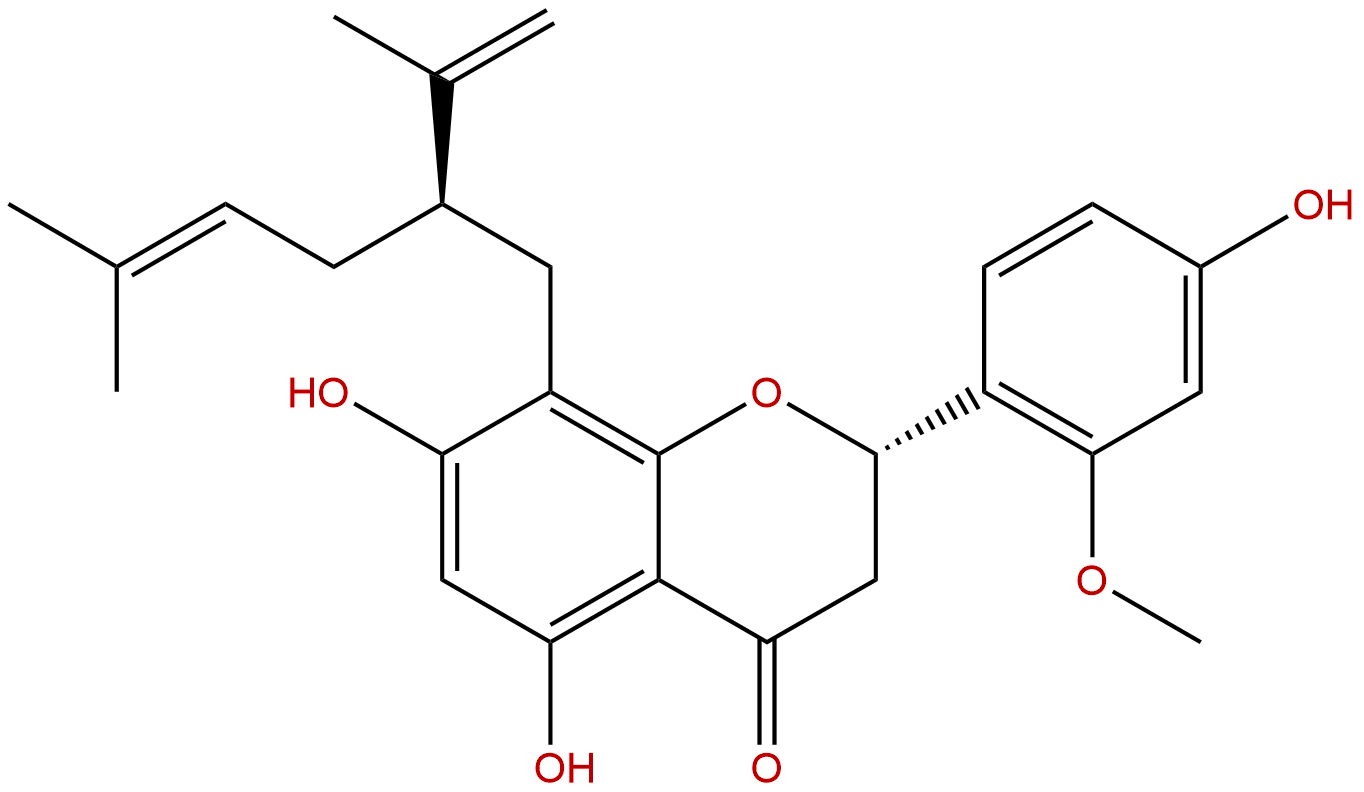
Isoflavonolone (CAS number: 52483-02-0) is a structurally unique dihydroflavonoid compound with a molecular formula of C26H30O6 and a molecular weight of 438.5200. Its core skeleton is dihydroflavone, and there are multiple methoxy and isopentenyl substituents on the A and B rings. The presence of these hydrophobic groups is the key to its significant lipid solubility. The α, β - unsaturated ketone structures in its structure are potential electrophilic centers that may participate in Michael addition reactions and interact with nucleophilic groups such as thiol groups in biomolecules, providing a structural basis for its regulation of various protein functions.
From the analysis of physicochemical parameters related to drug properties, the lipid water partition coefficient (LogP) of isophorone is 4.8560, indicating its high lipophilicity, which facilitates its penetration of cell membranes and binding to intracellular targets, but may also affect its water solubility and in vivo distribution. Its topological polar surface area (TPSA) is 96.2200 Å ², which is a moderate value. The predicted value of water solubility is 0.1294 mg/mL, which belongs to insoluble compounds. This suggests that solubilization strategies (such as cyclodextrin inclusion, nanocrystal technology, or prodrug preparation) may be needed in formulation development to improve its bioavailability. The molecular weight is slightly higher than the recommended value of the traditional "five rules for generic drugs", but still within an acceptable range. Based on its physical and chemical properties, isoflavones meet the general characteristics of oral drug candidate compounds, but solubility is a key aspect that needs to be optimized.
Plant sources and extraction methods
Isoflavones are mainly derived from the dried roots of the leguminous plant Sophora flavescens Ait. As a traditional Chinese medicine, Sophora flavescens has the effects of clearing heat and dampness, killing insects, and diuresis, and has been applied in Asian countries for thousands of years. Modern plant chemistry research has shown that Sophora flavescens is rich in various alkaloids and flavonoids, among which isoquercetin is one of the important flavonoid active ingredients.
Its extraction and separation usually use organic solvent extraction combined with modern chromatographic techniques. The conventional process is as follows: heat and reflux the Sophora flavescens root powder with ethanol or methanol for extraction, and concentrate under reduced pressure to obtain the total extract. The extract was then subjected to gradient extraction using different polar solvents such as petroleum ether, ethyl acetate, and n-butanol. Isoflavones are mainly enriched in the ethyl acetate extraction site. Further purification is often carried out using silica gel column chromatography, gradient elution with petroleum ether ethyl acetate or chloroform methanol systems, and tracking and identification with thin layer chromatography (TLC) or high performance liquid chromatography (HPLC). In recent years, preparative chromatography techniques such as high-speed counter current chromatography (HSCCC) have also been applied to the high-purity preparation of isophorone due to their high recovery rate and separation efficiency. Structural identification mainly relies on techniques such as nuclear magnetic resonance (NMR, including 1H-NMR and 13C-NMR), mass spectrometry (MS), and X-ray single crystal diffraction.
Pharmacological activity research
Numerous in vitro and in vivo pharmacological studies have confirmed that isoflavones have a wide range of anti-inflammatory and related pharmacological activities.
-
anti-inflammatory activity This is the most essential pharmacological effect of isoflavones. In the lipopolysaccharide (LPS) - induced macrophage (such as RAW264.7 cells) inflammation model, isoflavones can dose dependently inhibit the production of nitric oxide (NO), prostaglandin E2 (PGE2), and key pro-inflammatory cytokines such as tumor necrosis factor - α (TNF - α), interleukin-6 (IL-6), and IL-1 β. In animal models, isoflavones have shown good improvement effects on acute inflammation models such as ear swelling in mice and paw swelling in rats, as well as chronic inflammation models such as colitis induced by dextran sulfate sodium (DSS) and arthritis induced by Freund's complete adjuvant, significantly reducing tissue edema, inflammatory cell infiltration, and histopathological damage.
-
Analgesic activity Inflammation often accompanies pain. Research has shown that isoflavones exhibit significant analgesic effects in the second phase (inflammatory pain phase) of acetic acid-induced mouse torsion and formalin experiments, which may be related to anti-inflammatory and pain related ion channel regulation (such as TRPV1).
-
Neuroprotective activity In neuroinflammation related models, such as LPS induced microglial activation model, isoflavones can inhibit the excessive activation of microglia and the production of neurotoxic factors, indicating its potential application value in neurodegenerative diseases such as Alzheimer's disease and Parkinson's disease.
-
Other activities Some studies have also reported that isoflavones have certain anti-tumor (by inducing apoptosis, inhibiting metastasis), antioxidant, and anti fibrotic activities, which are often intertwined with their anti-inflammatory mechanisms.
Mechanism of action and molecular targets
The anti-inflammatory effect of isoflavones is not achieved through a single target, but through the "multi-target" regulation of complex inflammatory signaling networks. Existing research has revealed its interactions with multiple key targets and pathways:
-
Inhibition of the TLR4 signaling pathway for pattern recognition receptors TLR4 is a key receptor for recognizing pathogen associated molecular patterns such as LPS. Isomatrine can interfere with the activation or downstream signal transduction of TLR4, thereby inhibiting the activation of nuclear factor kappa B (NF - κ B) and mitogen activated protein kinases (MAPKs) pathways. NF - κ B and MAPKs are core transcription factors and kinases that regulate the expression of iNOS, COX-2, and various pro-inflammatory cytokine genes.
-
Regulating the JAK/STAT signaling pathway STAT3 is an important transcription factor in inflammation and tumorigenesis. Isomatrine can inhibit the phosphorylation (activated form) and nuclear translocation of STAT3, thereby downregulating the expression of its target genes. This may be related to its direct or indirect action on upstream kinases (such as JAK) or phosphatases (such as PTPN1).
-
Regulating lipoxygenase activity ALOX5 and ALOX15 are key enzymes in the arachidonic acid metabolism pathway that produce potent pro-inflammatory mediators such as leukotrienes. Isoflavonolone has been predicted or confirmed to inhibit the activity of these enzymes, reduce the production of leukotrienes, and thus alleviate inflammatory reactions.
-
Activate the antioxidant stress pathway The transcription factor NFE2L2 (Nrf2) is the master switch of the cellular antioxidant defense system. Research has shown that isoflavones can promote nuclear translocation of Nrf2, upregulate the expression of phase II detoxifying enzymes such as heme oxygenase-1 (HO-1) and antioxidant proteins, thereby enhancing cellular antioxidant capacity and alleviating inflammation caused by oxidative stress.
-
Intervene in other key targets:
- CASP1(Caspase-1)As an effector protein of inflammasomes, Caspase-1 is responsible for cleaving pro-IL-1 β and pro-IL-18, producing mature active forms. Inhibiting CASP1 can effectively block the release of IL-1 β.
- PIK3CG(PI3Kγ)Phosphatidylinositol 3-kinase gamma subtype plays an important role in immune cell chemotaxis and activation, and is a potential anti-inflammatory target.
- TRPV1 (Transient receptor potential vanillic acid subtype 1)As a non selective cation channel, TRPV1 is activated by various stimuli and participates in pain signal transmission. Regulating TRPV1 activity is one of the possible mechanisms of its analgesic effect.
- PRKCA(PKCα)Protein kinase C α is involved in the regulation of various cellular functions, including inflammatory signal transduction.
- PTPN1(PTP1B)Protein tyrosine phosphatase 1B is a negative regulator of the insulin and leptin signaling pathways, and is also associated with inflammation. Regulating PTP1B may improve inflammation related metabolic disorders.
In summary, isoflavones form a synergistic anti-inflammatory network by simultaneously acting on the initiation of inflammation (such as TLR4), signal amplification (such as NF - κ B, STAT3, PI3K), mediator production (such as COX-2, ALOX), and cell apoptosis (CASP1).
Evaluation of drug properties and pharmacokinetics
Based on the given pharmacological parameters and existing research, the preliminary evaluation of the pharmacological properties of isoflavones is as follows:
- Absorption and distribution A higher LogP value indicates good intestinal permeability, which is beneficial for oral absorption. But its low water solubility may become a key factor limiting its dissolution and absorption rate. The blood-brain barrier (BBB) penetration is predicted to be "low", which is consistent with its larger molecular weight and polar surface area, indicating that it may not easily enter the central nervous system. This may be advantageous for the treatment of peripheral inflammation and can reduce central side effects; But for the treatment of neuroinflammatory diseases, it is necessary to improve their brain targeting through formulation methods.
- Metabolism and excretion As a flavonoid compound, isoflavones are likely to undergo extensive phase I (such as oxidation and reduction catalyzed by cytochrome P450 enzymes) and phase II (such as glucuronidation and sulfation) metabolism in the body. Its isopentenyl structure may make it more easily metabolized by CYP450 enzymes. The currently available detailed pharmacokinetic studies (such as absolute bioavailability, major metabolites, elimination half-life, etc.) are not sufficient, which is a data gap that must be filled in future preclinical development.
- Preliminary Safety Assessment According to existing data, the result of the Ames test for isoflavones is 0.0, indicating that it has no mutagenicity under the conditions of this experiment and has a low risk of genetic toxicity. At the same time, it is predicted that it will not inhibit hERG potassium channels, indicating a low potential risk of inducing QT interval prolongation and apical torsion type ventricular tachycardia, which is an important cardiac safety advantage. However, comprehensive safety evaluation still requires standardized preclinical safety pharmacology studies on acute toxicity, long-term toxicity, reproductive toxicity, and other factors.
Clinical application prospects and prospects
As a multi-target anti-inflammatory natural product, isoflavones have broad clinical application prospects, but also face challenges.
Potential application directions:
1. Treatment of chronic inflammatory diseases Given its extensive inhibition of various inflammatory pathways and cytokines, isoflavones are expected to be developed for the treatment of autoimmune and chronic inflammatory diseases such as rheumatoid arthritis, inflammatory bowel disease (Crohn's disease, ulcerative colitis), psoriasis, etc., and may serve as a supplement or alternative to existing biologics or immunosuppressants.
2. pain management By combining its anti-inflammatory and potential analgesic mechanisms (involving TRPV1, etc.), its application in the treatment of inflammatory pain and neuropathic pain can be explored.
3. Metabolic diseases Inflammation is an important driving factor of insulin resistance and type 2 diabetes. By targeting PTPN1, NF - κ B and other targets, Isomatrine may improve metabolic inflammation and has the potential to be developed as an anti diabetes drug.
4. Adjuvant therapy for neurodegenerative diseases Although its BBB penetration is low, it may be used for the regulation of neuroinflammation in diseases such as Alzheimer's and Parkinson's after brain targeted modification through nanocarrier systems (such as liposomes and polymer nanoparticles).
Challenges faced and future research directions:
1. Optimization of drug properties The primary task is to solve the problem of poor water solubility. It is necessary to systematically study its solubilization technology and explore prodrug strategies to improve its bioavailability.
2. In depth pharmacokinetic research Systematic ADME (absorption, distribution, metabolism, excretion) research must be conducted to clarify its in vivo processes, major metabolic pathways, active metabolites, and potential drug interactions.
3. Confirmation and selectivity of target action Currently, many target associations are based on computational predictions or indirect evidence, requiring direct verification of their binding to target proteins and elucidation of binding modes through techniques such as surface plasmon resonance (SPR), isothermal titration calorimetry (ITC), and co crystallization. Meanwhile, it is necessary to evaluate its strength and selectivity towards different targets to avoid potential off target effects.
4. Integrated understanding of the mechanism of action It is necessary to use systems pharmacology, network pharmacology, and multi omics techniques to analyze the synergistic effects and core pathways of its multi-target effects at the overall level, and clarify the "key target groups" for its effectiveness.
5. Preclinical and clinical research After completing standardized preclinical pharmacological, pharmacokinetic, and safety evaluations, gradually advance clinical trials to verify its effectiveness and safety in humans.
Conclusion
Isoflavonolone is a flavonoid compound with significant research value discovered from the traditional Chinese medicine Sophora flavescens. It exhibits strong multi-target anti-inflammatory activity by acting on key nodes in multiple inflammatory networks such as TLR4, STAT3, NF - κ B, ALOX, Nrf2, and has shown therapeutic potential in various disease models. Although it faces challenges in terms of drug development, especially solubility, its good preliminary safety characteristics (no genetic toxicity, no hERG inhibition) lay a positive foundation for its further development. Future research should focus on improving its physicochemical properties through pharmaceutical methods, using modern biotechnology to confirm its molecular targets and mechanisms, and conducting systematic preclinical evaluations. With the continuous deepening of research, isoflavones are expected to develop from a potential natural lead compound into a new drug candidate for the treatment of complex inflammatory diseases, demonstrating the sustained vitality of natural products in modern drug development.