


Synonym name: Piceid
Catalogue No.: BP1118
Cas No.: 27208-80-6
Formula: C20H22O8
Mol Weight: 390.388
Botanical Source: Picea spp., Pinus sibirica, Polygonum cuspidatum (Japanese knotweed) and Eucalyptus spp.
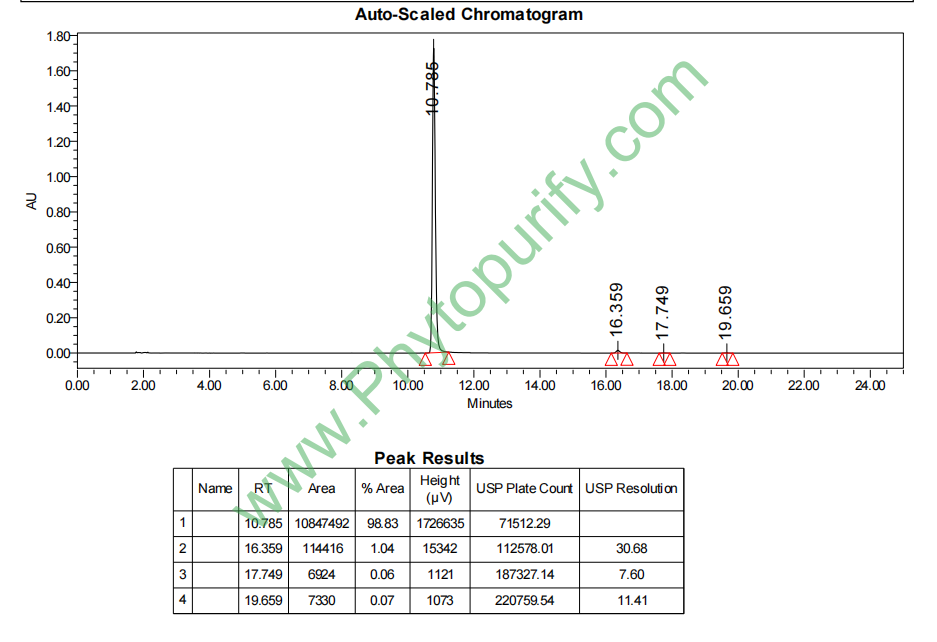
Purity: 95%~99%
Analysis Method: HPLC-DAD or/and HPLC-ELSD
Identification Method: Mass, NMR
Packing: Brown vial or HDPE plastic bottle
Can be supplied from milligrams to grams.
For Reference Standard and R&D, Not for Human Use Directly.
Inquire for bulk scale.
HPLC of Polydatin
Storage conditions:Short-term storage at 2~8℃, long-term storage at -20 ~ -80℃
139.8400
.5999
.5975
2.1234
.5809
.0838
Low
77.6823
3.6900
Yes
No
No
No
No
No
0.0
Yes
Yes
Yes
Yes
Natural products, as an important source of drug discovery, play an irreplaceable role in the history of human disease prevention and treatment. Polydatin, also known as Piceid, chemical name 3,4 ', 5-trihydroxystilbene-3- β - D-glucoside, is a traditional Chinese medicine derived from Polygonum cuspidatum(Polygonum cuspidatum Active stilbene compounds extracted from the roots and stems of Sieb. et Zucc. Its CAS number is 27208-80-6, and it is a glucoside derivative of the star molecule resveratrol. In recent years, with the deepening of modern pharmacological research, Polygonatum sibiricum glycoside has shown extensive and unique biological activities beyond its aglycone, especially in the fields of cardiovascular protection, anti-inflammatory, antioxidant, and organ protection, showing great potential. Its mechanism of action involves multi-target and multi pathway regulation, including but not limited to inhibiting glucose-6-phosphate dehydrogenase (G6PD), regulating oxidative stress and endoplasmic reticulum stress, and intervening in key signaling pathways. This article aims to systematically review the chemical properties, plant sources, pharmacological activities, molecular mechanisms, medicinal properties, and clinical application prospects of Polygonatum sibiricum glycoside, in order to provide comprehensive scientific references for the deep development and transformation research of this natural product.
The molecular formula of Polygonatum sibiricum glycoside is C20H22O8, with a molecular weight of 390.3880. Its core structure is a trans stilbene skeleton. Compared with resveratrol (3,4 ', 5-trihydroxystilbene), its C-3 hydroxyl group is replaced by a β - D-glucosyl group through a glycosidic bond, forming β - D-glucosides. This glycosylation modification significantly altered its physicochemical properties and biological activity.
In terms of physicochemical properties, the introduction of glycosidic bonds greatly enhances the water solubility of Polygonatum sibiricum glycoside. Both computational and experimental data indicate that its water solubility (approximately 2.12 mg/mL) is much higher than that of fat soluble resveratrol. Its topological polar surface area (TPSA) is 139.84 Å ², indicating strong molecular polarity. The calculated LogP value is about 0.60, indicating that it has moderate lipophilicity, between hydrophilic and lipophilic, which is beneficial for its distribution and absorption in organisms. These properties collectively determine the pharmacokinetic behavior of puerarin in vivo, for example, its oral bioavailability is generally considered superior to resveratrol, as the glycosylation structure may facilitate its absorption through glucose transporters (such as SGLT1) on small intestinal epithelial cells.
The main source of Polygonatum sibiricum glycoside is the dried rhizome of the Polygonaceae plant Polygonatum sibiricum. As a traditional Chinese medicine, Polygonum cuspidatum is widely used in Asia, especially in China, Japan, and South Korea, to treat inflammation, infections, hyperlipidemia, and cardiovascular diseases. Polygonatum sibiricum glycoside is also present in plants such as grapes, peanuts, and mulberries, but its content is much lower than that of Polygonatum sibiricum.
The extraction of puerarin from Polygonum cuspidatum is usually carried out using solvent extraction method. The common process includes heating and refluxing the dried and crushed roots and stems of Polygonum cuspidatum with ethanol (such as 60% -80% ethanol) or methanol, or using ultrasound assisted extraction. After filtration and concentration, the crude extract was enriched and purified using macroporous adsorption resins (such as AB-8, D101). Different concentrations of ethanol aqueous solutions were used for gradient elution to effectively separate puerarin. Further refinement can be achieved through methods such as silica gel column chromatography, preparative high-performance liquid chromatography (HPLC), or recrystallization. Modern extraction techniques such as supercritical CO2 extraction and microwave-assisted extraction have also been explored to improve extraction efficiency and purity. During the extraction process, attention should be paid to controlling temperature and avoiding light to prevent the transformation of puerarin from its trans configuration to a less active or different cis configuration.
Numerous preclinical studies have confirmed that puerarin has broad and significant pharmacological activities, and its spectrum of action is even superior to its glycoside resveratrol in some aspects.
The multiple pharmacological activities of Polygonatum sibiricum stem from its extensive regulation of cellular signaling networks. Its mechanism of action is complex, involving multiple direct or indirect molecular targets and pathways, especially in cardiovascular protection where multiple key targets have been identified:
These targets do not exist in isolation, but form an interconnected network. For example, activation of Akt can simultaneously inhibit GSK-3 β and activate eNOS, and cross talk to inhibit NF - κ B, thereby synergistically achieving anti-inflammatory, antioxidant, and cell protection.
Based on its physicochemical properties and preliminary research, Polygonatum sibiricum glycoside has shown certain potential as a drug, but there are also challenges.
Analysis of drug properties parameters Its good water solubility is beneficial for the development of formulations; Moderate LogP values indicate balanced membrane permeability; A higher TPSA may affect its passive transmembrane diffusion, but the presence of glucose groups may mediate active transport. The key toxicity warning indicators show that the hERG inhibition risk is "no", and the Ames test result is negative (0.0), indicating a low risk of cardiac and genetic toxicity and a good safety basis. However, its blood-brain barrier permeability is "low", which limits its direct effect on central nervous system diseases.
Pharmacokinetic characteristics After oral administration, the absorption of Polygonatum sibiricum may partially rely on the glucose transporter (SGLT1) in the small intestine, and its bioavailability has been reported differently, but it is generally believed to be higher than resveratrol. In the body, puerarin can be hydrolyzed by β - glucosidase in the gut microbiota or tissues, and converted into resveratrol, which is further metabolized into sulfate or glucuronide conjugates. Therefore, the pharmacological effects of Polygonatum sibiricum may be the result of the joint contribution of its prototype, metabolite resveratrol, and their combination, which increases the complexity of its mechanism of action. It is widely distributed and accumulates to some extent in target organs such as the heart, liver, and kidneys. Mainly excreted through urine and feces.
Challenges and Strategies The main challenges include the need to improve the absolute oral bioavailability, complex metabolic transformation in vivo, and unclear substance basis of action. Future formulation strategies may include the development of nanocarrier systems (such as liposomes, nanoparticles), prodrug modification, or co administration of β - glucosidase inhibitors to regulate their metabolic conversion, with the aim of improving their stability, targeting, and bioavailability.
The clinical application prospects of Polygonatum sibiricum glycoside are broad, but currently it is mainly in the preclinical research and early clinical trial stage.
Potential indications:
Translation Research Challenge:
Future direction Combining systems biology, network pharmacology, and artificial intelligence to deeply analyze the action network of "multi-component multi-target multi-path"; Explore its potential for combination therapy with other drugs (such as conventional cardiovascular drugs); Explore its value in age-related diseases.
Tiger cane glycoside, as a natural stilbene glycoside derived from traditional Chinese medicine, has become a hot molecule in natural product pharmacology research due to its wide pharmacological activity, multi-target mechanism of action, and relatively good safety characteristics. Its unique G6PD inhibitory activity and differentiated biological effects associated with resveratrol provide new ideas for the development of novel cardiovascular protectants, anti-inflammatory agents, and metabolic regulators. Despite facing challenges such as pharmacokinetic optimization, elucidation of the substance basis of action, and obtaining high-level clinical evidence on the path towards clinical drug development, with the continuous integration of modern scientific and technological means, Polygonatum sibiricum is expected to successfully move from experimental research to clinical application, providing a unique natural drug choice for the prevention and treatment of various major chronic diseases. Continuous and in-depth research on it will not only help promote the development of innovative drugs, but also make positive contributions to interpreting the scientific connotation of traditional Chinese medicine.
