
| Catalog No | Package | Original Price | Price | Inventory | Quantity | Operating |
|---|---|---|---|---|---|---|
| BP1204-100mg | 100mg | $30.00 | Sign in |
|


Product name: Resveratrol
Synonym name:
Catalogue No.: BP1204
Cas No.: 501-36-0
Formula: C14H12O3
Mol Weight: 228.247
Botanical Source: Polygonum cuspidatum Sieb.et Zucc.
Physical Description:
Type of Compound: Stibene glucosides
Purity: 95%~99%
Analysis Method: HPLC-DAD or/and HPLC-ELSD
Identification Method: Mass, NMR
Packing: Brown vial or HDPE plastic bottle
Storage: Store in a well closed container, protected from air and light. Put into refrigerate or freeze for long term storage.
Whenever possible, you should prepare and use solutions on the same day. However, if you need to make up stock solutions in advance, we recommend that you store the solution as aliquots in tightly sealed vials at -20℃. Generally, these will be useable for up to two weeks.
The product could be supplied from milligrams to grams
Inquire for bulk scale.
Chengdu Biopurify Phytochemicals Ltd. is a leading company in the research, development, manufacture and marketing of High Quality Phytochemicals and Extracts(especially Active Ingredients from Traditional Chinese Medicine,TCM), Natural Active Pharmaceutical Ingredients worldwide.
The main services:
A. Supply active ingredients and reference standards of TCM, from mgs to kgs scale
B. Custom extraction and purification, target Herb Active Ingredients
C. Custom synthesis and semi-synthesis for Natural Active Ingredients
D. CR(contract research), CM(contract manufacture) and PD(process development) services from lab scale, pilot scale to commercial scale(GMP is also available)
E. TCM compounds library for drug screen,more than 3000 compounds available, many of them are rare and unique.
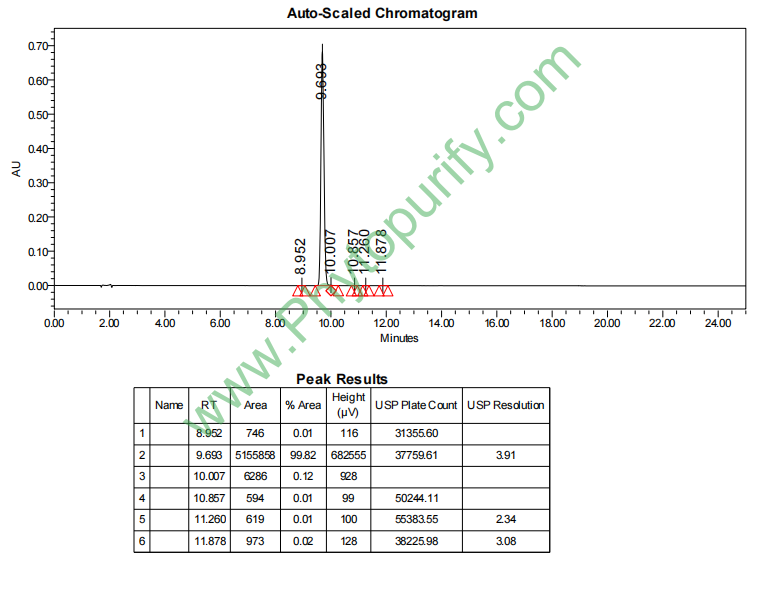
HPLC of Resveratrol
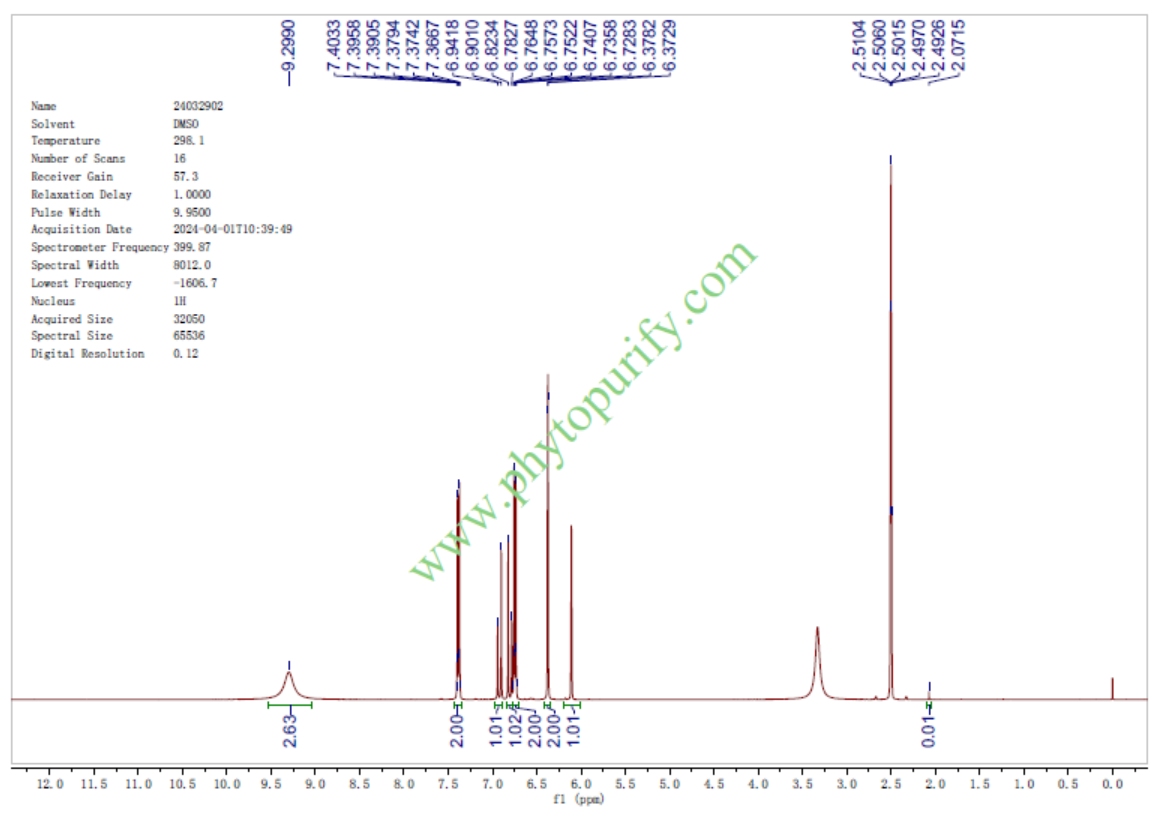
HNMR of Resveratrol
Storage conditions:Short-term storage at 2~8℃, long-term storage at -20 ~ -80℃
60.6900
2.8142
2.8056
.1900
3.6110
14.1045
Low
87.7856
2.1125
Yes
Yes
Yes
No
Yes
No
0.6
Yes
Yes
Yes
Yes
Resveratrol (chemical name: 3,5,4 '- trihydroxystilbene) is a non flavonoid polyphenolic compound widely present in various plants. Its CAS number is 501-36-0, and its trans isomer is the main biologically active form. Since its first isolation in the 1940s, resveratrol has not received widespread attention for a long time. Until the 1990s, researchers put forward the "French paradox" - that is, although the French diet is rich in saturated fat, the incidence rate of cardiovascular diseases is relatively low, which may be related to their regular consumption of red wine rich in resveratrol - this hypothesis greatly promoted the research boom of resveratrol. Nowadays, resveratrol has become one of the most eye-catching star molecules in the field of natural product pharmacology.
Numerous studies have shown that resveratrol has a wide range of biological activities, including antioxidant, anti-inflammatory, cardiovascular protection, neuroprotection, anti-tumor, and potential anti-aging effects. Its target network is complex, involving multiple key signaling pathway nodes such as mTOR, SIRT1, AMPK, Nrf2, NF - κ B. Despite its significant in vitro activity, its poor bioavailability has always been the main bottleneck for its translation into clinical applications. This article aims to systematically review the chemical properties, plant sources, pharmacological activities, molecular mechanisms, medicinal properties, and clinical application prospects of resveratrol, in order to provide reference for related research and development.
The molecular formula of resveratrol is C14H12O3, with a molecular weight of 228.25. Its basic chemical structure consists of two benzene rings (A ring and B ring) connected by a vinyl double bond, belonging to the class of stilbene compounds. There are two meta hydroxyl groups (3- and 5-position) on ring A, and one para hydroxyl group (4 '- position) on ring B. This structure gives it excellent electron delocalization ability, which is the chemical basis for its strong antioxidant activity.
Resveratrol exists in two geometric isomers, cis - and trans -, with the trans isomer being more common and stable in nature, and typically having stronger biological activity. Under light or specific pH conditions, trans structures can be transformed into cis structures. Its LogP value is about 2.81, indicating that it has a certain degree of lipophilicity. Its topological polar surface area (TPSA) is 60.69 Å ². Its water solubility is poor, about 0.19 mg/mL, which limits its absorption and distribution in organisms. The pharmacological parameters show that its blood-brain barrier permeability is "low", which seems contradictory to its description of "being able to pass through the blood-brain barrier", but actually reflects its limited efficiency despite being able to pass through. HERG inhibition is negative, indicating a low risk of cardiac toxicity. The Ames test result was 0.6, indicating no significant mutagenicity in this experimental system.
Resveratrol is a phytotoxin produced by plants in response to biotic or abiotic stresses such as fungal infections, ultraviolet radiation, and mechanical damage. Its distribution in nature is uneven.
Main plant sources:
1. Grape family plants Especially the skin, leaves, and vines of Vitis vinifera grapes. The content in red wine (about 0.1-14.3 mg/L) is much higher than that in white wine because the skin is preserved during the brewing process.
2. Japanese knotweed The rhizome of traditional Chinese medicine Polygonum cuspidatum is one of the most abundant sources of resveratrol known, with a content of hundreds to thousands of mg/kg dry weight, and is the main raw material for commercial extraction.
3. peanut The roots and seed coat of peanuts (Arachis hypogaea) contain a certain amount of resveratrol.
4. mulberry、blueberry Berries and fruits also contain small amounts of resveratrol.
Extraction and purification methods:
1. Solvent extraction method The most commonly used method. Organic solvents such as ethanol, methanol, and ethyl acetate are usually used for leaching or reflux extraction. This method is simple, but has poor selectivity and many impurities.
2. Ultrasonic/Microwave Assisted Extraction The use of physical fields to enhance the extraction process can significantly shorten the extraction time, improve the extraction rate, and reduce solvent consumption.
3. Column chromatography purification Crude extracts are often separated and enriched through column chromatography using silica gel and macroporous adsorption resins (such as AB-8, D101).
4. High speed countercurrent chromatography and preparative high-performance liquid chromatography Used to obtain high-purity resveratrol monomers, especially suitable for standard preparation, but the cost is relatively high.
5. biosynthesis The synthesis of resveratrol using genetically engineered microorganisms such as yeast and Escherichia coli has emerged as a cutting-edge direction in recent years, with the potential to be free from seasonal and geographical limitations and environmentally friendly. However, the yield needs to be further improved.
Decades of research have revealed the multifaceted pharmacological activities of resveratrol, forming the basis for its "multi-target, multi pathway" action characteristics.
1. Cardiovascular protective effect This is the earliest activity that drew attention to resveratrol. Its mechanisms include: inhibiting the oxidation of low-density lipoprotein and alleviating the formation of atherosclerotic plaque; By activating endothelial nitric oxide synthase (eNOS), nitric oxide (NO) production is promoted, leading to vasodilation; Inhibit platelet aggregation and prevent thrombus formation; Reduce myocardial ischemia/reperfusion injury.
2. Antitumor effect Resveratrol can inhibit the growth of many tumor cells (such as breast cancer, prostate cancer, colon cancer, liver cancer, etc.). Its anti-cancer effect involves multiple stages: inducing tumor cell cycle arrest (often in G1/S or G2/M phase) and apoptosis; Inhibit tumor cell invasion, migration, and angiogenesis; As a chemical preventive agent, it inhibits the activation of carcinogens and promotes their detoxification.
3. Neuroprotective and anti-aging effects Resveratrol can cross the blood-brain barrier and has shown protective effects in various neurodegenerative disease models. In the Alzheimer's disease model, it can reduce the generation and aggregation of beta amyloid protein (A β), alleviate tau protein hyperphosphorylation. In the Parkinson's disease model, it can protect dopaminergic neurons. Its anti-aging potential stems from the regulation of "aging related signaling pathways," simulating the effects of heat restriction and prolonging the lifespan of various lower organisms.
4. Anti inflammatory and antioxidant effects Resveratrol is a powerful free radical scavenger that can directly quench reactive oxygen/nitrogen species. More importantly, it can indirectly enhance cellular antioxidant defense capabilities by upregulating endogenous antioxidant systems, such as activating the Nrf2 pathway. Its anti-inflammatory effect is mainly achieved by inhibiting the activity of inflammatory core transcription factors such as nuclear factor kappa B (NF - κ B) and activator protein-1 (AP-1), thereby downregulating the expression of cyclooxygenase-2 (COX-2), inducible nitric oxide synthase (iNOS), and various pro-inflammatory cytokines.
5. Metabolic regulation effect Resveratrol can improve insulin sensitivity, reduce blood sugar and lipids, and shows therapeutic potential in obese and type 2 diabetes animal models. The mechanism is related to the activation of AMPK and SIRT1 pathways, which in turn regulate key enzymes and transcription factors involved in glucose and lipid metabolism.
The mechanism of action of resveratrol is extremely complex, and its pleiotropy stems from its extensive effects on cellular signaling networks. Its core targets and pathways include:
1. SIRT1 pathway Resveratrol is widely regarded as a conformational activator of SIRT1 (Sirtuin 1). By activating SIRT1, resveratrol promotes the deacetylation of downstream targets such as PGC-1 α, FOXO family proteins, and p53, thereby regulating energy metabolism, stress resistance, cellular aging, and apoptosis. This is one of the core mechanisms by which it simulates calorie restriction and exerts anti-aging effects.
2. AMPK pathway Resveratrol can activate AMPK (AMP dependent protein kinase) by inhibiting mitochondrial ATP synthase or by activating upstream kinases such as LKB1. Activated AMPK promotes fatty acid oxidation, glucose uptake, inhibits fat and protein synthesis, and plays a central role in metabolic regulation. There is a forward intermodulation loop between AMPK and SIRT1.
3. Nrf2/ARE pathway Resveratrol can stabilize nuclear factor E2 related factor 2 (Nrf2), promote its nuclear translocation, bind to antioxidant response elements (ARE), and upregulate the expression of a series of phase II detoxifying enzymes and antioxidant proteins (such as HO-1, SOD, CAT, NQO1). This is the key mechanism by which it enhances cellular antioxidant defense and improves organ protection against age-related kidney damage.
4. NF - κ B pathway Resveratrol inhibits the activity of IKK β (I κ B kinase β), preventing the phosphorylation and degradation of I κ B, thereby retaining NF - κ B in the cytoplasm and suppressing its transcriptional activity. This effectively blocks the cascade amplification of inflammatory response.
5. Other important targets:
* mTOR Resveratrol can inhibit mammalian rapamycin target protein (mTOR) signaling, which is associated with autophagy induction, growth inhibition, and lifespan extension.
* Cell cycle and apoptosis related proteins By regulating p53, CDKN1A (p21), Bcl-2 family proteins, caspases, etc., it affects cell fate.
* Pregnane X receptor (PXR)As a PXR inhibitor, resveratrol may affect the expression of drug metabolizing enzymes and transporters, leading to drug drug interactions.
* Cyclooxygenase (COX)It can directly inhibit the activity of COX-1 and has aspirin like effects.
These pathways are not isolated, but form a highly interconnected network. For example, SIRT1 deacetylates and activates PGC-1 α and FOXO, the latter of which can enhance antioxidant defense; AMPK activation can inhibit mTOR and may activate SIRT1; Nrf2 activation can alleviate oxidative stress, indirectly affecting inflammation and apoptosis pathways. Resveratrol produces synergistic biological effects by simultaneously regulating multiple nodes in this network.
Although resveratrol has excellent pharmacological activity, its pharmacological properties, especially pharmacokinetic properties, are the biggest challenge facing its clinical application.
absorb After oral administration, resveratrol is rapidly absorbed in the intestine, but its absolute bioavailability is extremely low (usually<1%). This is mainly attributed to: ① poor water solubility and limited dissolution; ② Widespread first pass metabolism occurs in the intestine and liver.
distribution After absorption, resveratrol has a high binding rate with plasma proteins (mainly albumin). It can be distributed to multiple tissues throughout the body, including the liver, kidneys, heart, and brain, but the tissue concentration is usually low. Its blood-brain barrier permeability is limited, but long-term or high-dose administration can still achieve pharmacological activity concentrations in the brain.
Metabolism The metabolism of resveratrol is the main reason for its low bioavailability. Metabolism mainly occurs in the small intestine and liver. The main metabolic pathway is Glucuronidation and sulfation Generate metabolites such as resveratrol 3-O-glucuronide, resveratrol 4 '- O-glucuronide, and resveratrol 3-O-sulfate. These II binding reactions are catalyzed by UDP glucuronosyltransferase (UGT) and sulfotransferase (SULT), with extremely fast rates. In addition, the gut microbiota can convert it into metabolites such as dihydroresveratrol.
excretion Resveratrol and its metabolites are mainly excreted through urine and bile, with a short elimination half-life (usually 1-3 hours), which requires frequent administration to maintain effective blood drug concentrations.
Formulation improvement strategy To improve its bioavailability, researchers have developed various new delivery systems:
1. nano-formulation Including liposomes, solid lipid nanoparticles, nanoemulsions, polymer nanoparticles, etc., they can improve solubility, delay metabolism, and enhance targeting.
2. Phospholipid complex Form complexes with phospholipids to improve their lipid solubility and transmembrane absorption.
3. Cyclodextrin inclusion complex Utilizing the cavity encapsulation of cyclodextrin to increase water solubility and stability.
4. Prodrug strategy Synthesis of prodrugs with higher bioavailability or release of active ingredients at specific sites through chemical modification.
5. Combined with metabolic enzyme inhibitors If used in combination with piperine (UGT and SULT inhibitors), it can significantly increase its blood drug concentration.
The path of resveratrol from a "star molecule" to a "clinical drug" is full of opportunities and challenges.
Current application status:
At present, resveratrol is mainly used as dietary supplement Sold in the global market, claiming to have health benefits such as antioxidant and anti-aging properties. In clinical research, dozens of Phase I-IV clinical trials involving multiple diseases have been completed, including type 2 diabetes, obesity, non-alcoholic fatty liver, Alzheimer's disease, cardiovascular disease and cancer. Some small-scale studies have shown positive trends in improving insulin sensitivity, endothelial function, cognitive function, and other aspects. However, the results of most large-scale, long-term clinical trials have not fully replicated the significant effects of animal experiments, which may be related to various factors such as human dose, bioavailability, trial design, and disease heterogeneity.
challenges faced:
1. Bioavailability bottleneck As mentioned earlier, this is the most fundamental obstacle.
2. The relationship between dosage and efficacy is unclear The effective dose for animal experiments is often very high (in grams) when converted to humans, making it difficult to achieve through routine supplementation, and high doses may cause side effects such as gastrointestinal discomfort.
3. The complexity of the mechanism of action and multi-target characteristics It is both an advantage and a challenge. Multi targeting may lead to unpredictable off target effects or drug interactions, making it difficult to determine exact therapeutic biomarkers.
4. Lack of long-term safety data The safety of long-term use as a supplement, especially in special populations such as pregnant women and those with liver and kidney dysfunction, still requires more data.
Future development direction:
1. Development of innovative delivery system Continuing to optimize strategies such as nanotechnology and prodrugs, and developing high bioavailability formulations with clinical translational value, is the key to realizing their therapeutic potential.
2. Precision medicine and combination therapy Explore the efficacy of resveratrol in specific subgroups of patients, such as those carrying specific genotypes or biomarkers. Combining it with existing drugs such as chemotherapy and hypoglycemic agents may produce synergistic effects and reduce side effects.
3. Exploring its potential for 'aging intervention' in depth With the development of aging biology, the application of resveratrol as a SIRT1/AMPK activator in delaying aging and preventing age-related diseases such as sarcopenia and cognitive decline is an attractive frontier direction. More rigorous clinical research on aging biomarkers is needed.
4. Structural modification and development of analogues Based on the parent nucleus structure of resveratrol, designing and synthesizing derivatives or analogues with stronger activity, more stable metabolism, and higher targeting is a key direction for pharmaceutical chemists.
Resveratrol, as a classic natural polyphenolic compound, continues to attract great research interest in the fields of cardiovascular disease, neurodegenerative diseases, metabolic syndrome, cancer, and anti-aging due to its extensive and powerful pharmacological activities and core regulatory effects on key aging and metabolic pathways such as SIRT1, AMPK, and Nrf2. It is like a 'fine-tuning device of the cellular signaling network', coordinating stress defense, energy metabolism, and survival and death decisions of cells through multi-target action. However, its inherent pharmacokinetic defects, especially the extremely low oral bioavailability, severely restrict its transformation from a "bench" to a "hospital bed". Future research breakthroughs will heavily rely on the cross collaboration of pharmacy, medicinal chemistry, and clinical medicine. By developing efficient delivery systems, identifying advantageous indications, and exploring combination therapy strategies, it is expected to translate the enormous therapeutic potential of this ancient plant molecule into tangible human health and well-being. The research process of resveratrol has also provided valuable experience and inspiration for the development of other natural products with complex multi-target properties.
