


Synonym name: 5-Hydroxy-4',6,7,8-tetramethoxyflavone; 5-O-Demethyltangeretin; 5-Desmethyltangeretin
Catalogue No.: BP0624
Cas No.: 2798-20-1
Formula: C19H18O7
Mol Weight: 358.346
Botanical Source: the peel of Citrus sinensis (orange) and Citrus jambhiri. Also from Gardenia lucida, Brickellia spp. and Mentha spp.
Purity: 95%~99%
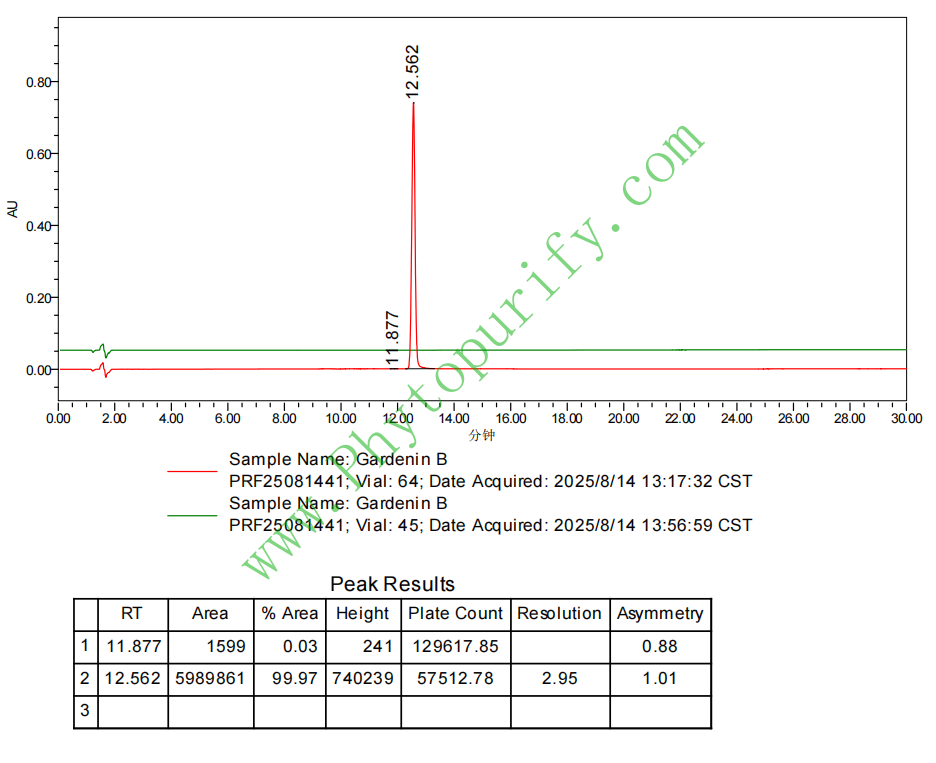
Analysis Method: HPLC-DAD or/and HPLC-ELSD
Identification Method: Mass, NMR
Packing: Brown vial or HDPE plastic bottle
Can be supplied from milligrams to grams.
For Reference Standard and R&D, Not for Human Use Directly.
Inquire for bulk scale.
HPLC of Gardenin B
Storage conditions:Short-term storage at 2~8℃, long-term storage at -20 ~ -80℃
Gardenin B is a typical natural product of methoxyflavonoids, which has attracted widespread attention in the field of natural product pharmacology in recent years due to its unique structure and diverse biological activities. As an important member of flavonoids, geniposide B not only has significant antioxidant properties, but also exhibits good anti-tumor activity, especially in the potential application value of malignant tumor models such as liver cancer. Its mechanism of action involves inhibition of multiple cellular signaling pathways and key enzymes, such as USP7, ODC, and Cathepsin D targets, demonstrating its multiple effects in regulating cell cycle, inducing apoptosis, and inhibiting tumor cell proliferation. This article aims to systematically review the chemical structure, sources, pharmacological activity, mechanism of action, and pharmacological evaluation of geniposide B, explore its clinical application prospects, and provide scientific basis for subsequent drug development and mechanism research.
The molecular formula of geniposide B is C20H18O6, with a molecular weight of 358.3460 and a CAS number of 2798-20-1. Its structural core is a typical flavonoid skeleton with multiple methoxy substituents, endowing it with high lipid solubility and stability. The LogP value is 2.5607, indicating that it has moderate hydrophobicity, which is beneficial for membrane penetration. The polar surface area (TPSA) is 87.3600, indicating that its molecules have a certain polarity that facilitates binding with biomolecules. Low water solubility (0.0087) suggests limited solubility in aqueous phase, but this can be improved to some extent through pharmaceutical formulation technology. Low blood-brain barrier permeability reduces the risk of central nervous system side effects. The negative result of hERG channel inhibition experiment indicates a low risk of cardiac toxicity. The Ames mutagenicity test value is 1.2, indicating a low risk of genotoxicity and a good safety basis.
The chemical structure of geniposide B is shown in Figure 1. In the typical flavonoid tricyclic structure, the methoxy modifications at positions C-6 and C-8 endow it with unique biological activity. The hydroxyl and methoxy groups within its molecule interact through hydrogen bonding and hydrophobic interactions, affecting its binding affinity and selectivity with target proteins.
Geniposide B is mainly found in Gardenia jasminoides Ellis and other plants of the Gardeniaceae family, and is an important representative of flavonoids in this type of plant. Gardenia, as a traditional Chinese medicinal herb, is widely distributed in southern China and Southeast Asia. Its fruits and leaves are rich in geniposide B.
The extraction process usually uses organic solvent extraction method. Using dried gardenia fruit as raw material, crude extraction is first carried out with ethanol or methanol, followed by separation and purification through liquid-liquid distribution and column chromatography techniques (such as silica gel column chromatography, reverse phase high-performance liquid chromatography, etc.). In recent years, the application of ultrasound assisted extraction and microwave-assisted extraction technologies has significantly improved extraction efficiency and purity. The purified geniposide B was structurally identified by mass spectrometry (MS), nuclear magnetic resonance (NMR) and other methods.
The optimization of the extraction process not only improves the yield, but also ensures the stability of the active ingredients, laying the foundation for their subsequent pharmacological research and drug development.
Gardenia jasminoides B exhibits significant antioxidant capacity. In the in vitro DPPH radical scavenging experiment, its IC50 was 8.87 μ g/mL, indicating strong free radical scavenging ability. In addition, in the nitric oxide (NO) radical scavenging experiment, the IC50 was 10.59 μ g/mL, further confirming its antioxidant effect. Its iron ion reduction ability is also strong, indicating that it can alleviate oxidative stress through various pathways and protect cells from oxidative damage.
Geniposide B exhibits inhibitory activity on cell proliferation in various tumor cell lines, particularly in liver cancer cells. In vitro experiments have shown that geniposide B can induce cell cycle arrest in tumor cells, block cell cycle progression, and inhibit cell proliferation. At the same time, it can activate the apoptotic pathway within cells and promote programmed cell death of tumor cells.
In addition, geniposide B has inhibitory effects on key enzymes such as USP7 (ubiquitin specific protease 7), ODC (ornithine decarboxylase), and Cathepsin D, with IC50 values of 6.24 μ g/mL and 5.61 μ g/mL, respectively, demonstrating its potential for multi-target regulation. These enzymes play an important role in the proliferation, migration, and invasion of tumor cells, and geniposide B intervenes in the biological behavior of tumor cells by inhibiting these targets.
Partial studies have shown that geniposide B can inhibit the release of inflammatory mediators, alleviate inflammatory reactions, and suggest its potential application value in regulating the tumor microenvironment and immunotherapy. Its regulation of inflammation related targets such as PTGS2 (COX-2) may help suppress tumor associated inflammation and improve therapeutic efficacy.
The anti-tumor mechanism of geniposide B involves multiple signaling pathways and molecular targets, mainly including:
Regulating apoptosis related proteins
Gardenia jasminoides B can regulate the expression of BCL2 family proteins, reduce the level of anti apoptotic protein BCL2, promote the activation of apoptotic proteins, and induce tumor cell apoptosis. By activating the mitochondrial pathway, cytochrome C is released, initiating cascade caspase activation and completing programmed cell death.
Inhibition of STAT3 signaling pathway
STAT3, as a key pro cancer signaling molecule in various tumors, is effectively inhibited by geniposide B, blocking the proliferation and survival signals of tumor cells, and inhibiting tumor growth and metastasis.
Affects the MAPK/ERK pathway
Gardenia jasminoides B regulates MAPK1 (ERK2) activity, intervenes in cell proliferation and differentiation processes, promotes cell cycle arrest, and reduces the proliferation ability of tumor cells.
Regulating tumor microenvironment related proteins
Geniposide B inhibits the expression of MMP9, reduces the matrix degradation and invasion ability of tumor cells, and prevents tumor metastasis. Its regulation of EGFR and PIK3CA further affects the proliferation and survival of tumor cells.
Regulating telomerase activity
By inhibiting TERT expression, geniposide B may affect telomere maintenance of tumor cells and limit their unlimited proliferation ability.
USP7 and ODC inhibition
USP7, as a deubiquitinase, participates in the stabilization of various tumor associated proteins. Geniposide B exerts anti-tumor effects by inhibiting USP7 and promoting the degradation of tumor suppressor proteins. ODC, as a key enzyme in polyamine synthesis, its inhibition helps to suppress the metabolic activity and proliferation of tumor cells.
In summary, geniposide B achieves effective inhibition of tumor cells through multi-target and multi pathway synergistic effects, demonstrating its potential as a candidate molecule for natural anti-tumor drugs.
The pharmacological parameters of geniposide B indicate that it has certain potential for drug development. Its molecular weight is moderate (358.3460), meeting the basic requirements of Lipinski's rule. The LogP value is 2.56, indicating moderate lipid solubility, which is beneficial for oral absorption and cell membrane penetration. The lower water solubility (0.0087) may limit its bioavailability, but it can be improved through pharmaceutical methods such as nanocarriers, solid dispersions, etc.
Low blood-brain barrier permeability reduces the risk of central nervous system toxicity and is suitable for the treatment of non central nervous system tumors. The hERG inhibition test was negative, indicating a low risk of cardiac toxicity. The Ames test results show that its genotoxicity risk is relatively low and its safety is good.
At present, there is limited research on the pharmacokinetics of geniposide B. Preliminary data indicate that its metabolism is stable in vivo and mainly converted through the liver metabolic enzyme system. The metabolites still need further identification. In the future, systematic pharmacokinetic and toxicological studies need to be conducted to clarify its in vivo absorption, distribution, metabolism, and excretion (ADME) characteristics, providing a basis for clinical applications.
Gardenia jasminoides B has become a hot topic in the development of natural product drugs due to its significant antioxidant and anti-tumor activities, especially its potential application value in solid tumors such as liver cancer. Its multi-target mechanism of action gives it advantages in both monotherapy and combination chemotherapy, and it is expected to overcome the problems of tumor drug resistance and side effects.
Future research should focus on the following directions:
In depth mechanism research
Further elucidate the signaling network of geniposide B in tumor cells and explore its molecular mechanisms of interaction with immune regulation and tumor microenvironment.
Pharmacokinetic and safety evaluation
The system conducts in vivo pharmacokinetic, toxicological, and long-term safety studies to clarify the dosage range and safety window for its clinical application.
Formulation development and optimization of administration routes
Develop new drug delivery systems, such as liposomes and nanoparticles, to address its poor water solubility and improve bioavailability and targeting.
Preclinical and clinical trials
Combining animal models to verify its anti-tumor effect and safety, gradually advancing clinical trials to evaluate its efficacy and safety in the treatment of liver cancer and other tumors.
Combination therapy strategy
Explore the combined application of existing chemotherapy drugs, targeted drugs, and immunotherapy drugs to achieve synergistic effects and improve treatment efficacy.
In summary, geniposide B, as a multifunctional natural flavonoid compound, has broad clinical application prospects and is worthy of further development and research.
As a natural product of methoxy flavonoids derived from traditional Chinese medicine Gardenia jasminoides, geniposide B has shown important research value in the fields of antioxidant and anti-tumor due to its unique chemical structure and multi-target pharmacological activity. Its inhibitory effects on key enzymes such as USP7, ODC, and Cathepsin D, as well as its regulation of liver cancer-related signaling pathways, reveal its complex and effective mechanism of action. Although there are still some gaps in pharmacokinetics and clinical research, its good pharmacokinetic parameters and safety foundation provide solid guarantees for subsequent drug development. In the future, through interdisciplinary collaboration and modern drug development technology, geniposide B is expected to become an important candidate molecule for the development of natural anti-tumor drugs, bringing new treatment options for cancer patients.
