
| Catalog No | Package | Original Price | Price | Inventory | Quantity | Operating |
|---|---|---|---|---|---|---|
| BP0630-20mg | 20mg | $40.00 | Sign in |
|


Product name: Genipin
Synonym name:
Catalogue No.: BP0630
Cas No.: 6902-77-8
Formula: C11H14O5
Mol Weight: 226.228
Botanical Source: Gardenia jasminoides Ellis
Physical Description:
Type of Compound: Iridoids
Purity: 95%~99%
Analysis Method: HPLC-DAD or/and HPLC-ELSD
Identification Method: Mass, NMR
Packing: Brown vial or HDPE plastic bottle
Storage: Store in a well closed container, protected from air and light. Put into refrigerate or freeze for long term storage.
Whenever possible, you should prepare and use solutions on the same day. However, if you need to make up stock solutions in advance, we recommend that you store the solution as aliquots in tightly sealed vials at -20℃. Generally, these will be useable for up to two weeks.
The product could be supplied from milligrams to grams
Inquire for bulk scale.
Chengdu Biopurify Phytochemicals Ltd. is a leading company in the research, development, manufacture and marketing of High Quality Phytochemicals and Extracts(especially Active Ingredients from Traditional Chinese Medicine,TCM), Natural Active Pharmaceutical Ingredients worldwide.
The main services:
A. Supply active ingredients and reference standards of TCM, from mgs to kgs scale
B. Custom extraction and purification, target Herb Active Ingredients
C. Custom synthesis and semi-synthesis for Natural Active Ingredients
D. CR(contract research), CM(contract manufacture) and PD(process development) services from lab scale, pilot scale to commercial scale(GMP is also available)
E. TCM compounds library for drug screen,more than 3000 compounds available, many of them are rare and unique.
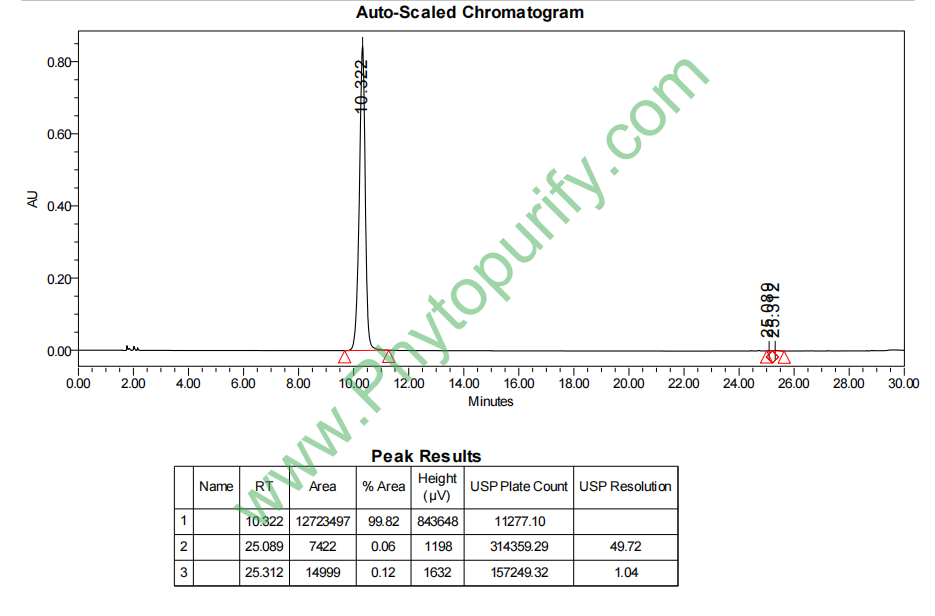
HPLC of Genipin
Storage conditions:Short-term storage at 2~8℃, long-term storage at -20 ~ -80℃
75.9900
.0807
.0807
24.6156
1.6526
10.8578
High
24.8733
4.1636
Yes
No
No
No
Yes
No
0.0
Yes
Yes
Yes
Yes
As an important treasure trove for drug discovery, natural products continue to provide modern medicine with lead compounds with novel structures and diverse activities. Genipin, also known as (1S, 4aS, 7S, 7aS) -1,4-4a, 5,7a-tetrahydro-1-hydroxy-7- (hydroxymethyl) cyclopentadieno [c] pyran-4-carboxylic acid methyl ester, is a traditional Chinese medicine derived from Gardenia jasminoides(Gardenia jasminoides Ellis isolated iridoid glycosides from dried and matured fruits. Its CAS number is 6902-77-8. Since its discovery, genipin was initially known in the field of biomaterials for its excellent protein crosslinking ability and has been widely used as a natural crosslinking agent with excellent biocompatibility. However, in-depth research in the past two decades has gradually revealed that genipin is not just a material science reagent, but also a potential drug molecule with multiple biological activities.
Pharmacological studies have shown that genipin exhibits a wide range of biological effects, including anti-inflammatory, antioxidant, anti-tumor, neuroprotective, anti diabetes, antithrombotic and immunomodulatory activities. Particularly remarkable is its anti-cancer potential in a variety of tumor models, especially in breast cancer. Its mechanism of action involves regulating multiple key signaling pathways and targets, including AMPK, STAT3, BCL2 family, estrogen receptors, etc. In addition, its good preliminary parameters for drug development, such as high blood-brain barrier permeability and non mutagenicity (Ames test negative), have laid the foundation for further drug development. This article aims to systematically review the chemical properties, plant sources, pharmacological activities, molecular mechanisms of action, medicinal properties, and clinical application prospects of genipin, in order to provide comprehensive scientific references for the in-depth research and potential drug development of this natural product.
Jingniping belongs to the class of iridoid compounds, with a molecular formula of C ₁₁ H ₁₄ O ₅ and a molecular weight of 226.2280. Its core structure is a cyclopentane pyran ring system, consisting of a cyclic ether bond and an ester group. Its absolute configuration is (1S, 4aS, 7S, 7aS), making it a chiral molecule. Jingniping is the main hydrolysis product and in vivo active metabolic form of geniposide under the action of β - glucosidase in the gut microbiota. This conversion process is a key step in its pharmacological effects.
In terms of physical and chemical properties, genipin is a white or off white crystalline powder. Its calculated lipid water partition coefficient (LogP) is about 0.0807, indicating that it has good hydrophilicity, which is consistent with its measured water solubility data (about 24.6 mg/mL), and belongs to a compound that is easily soluble in water. Its topological polar surface area (TPSA) is 75.99 Å ², reflecting the presence of multiple hydrogen bond acceptors and donors (such as hydroxyl and ester carbonyl groups) in the molecule. These properties collectively determine that genipin has good solubility and certain membrane permeability.
The most famous chemical characteristic of Jingniping is its activity as a biological crosslinking agent. The ester groups in its molecules can undergo nucleophilic reactions with primary amines (such as lysine ε - amino in proteins), forming covalent crosslinks within and between molecules. This characteristic is not only used to prepare stable collagen scaffold, chitosan hydrogel and other biomedical materials, but also may be related to its interaction with some functional proteins in vivo, thus participating in the regulation of protein function.
Jingniping mainly comes from the gardenia plant in the madder family(Gardenia jasminoides Ellis' dried and ripe fruit. As a traditional Chinese medicine, Gardenia jasminoides has the effects of purging fire and eliminating annoyance, clearing heat and diuresis, cooling blood and detoxifying. It is commonly used to treat diseases such as fever, restlessness, jaundice, red urine, and bloody pain. Jingniping itself has very low content in fresh gardenia fruits, mainly in the form of glycosides - geniposide. Geniposide is one of the main active ingredients in Gardenia jasminoides, with a content of over 3% of the fruit's dry weight.
There are two main ways to obtain Jingniping:
1. Direct extraction and transformation from gardenia fruit Firstly, extract the powder of Gardenia jasminoides fruit using solvents such as methanol, ethanol, or water to obtain a crude extract rich in geniposide. The crude extract was separated and purified using techniques such as macroporous adsorption resin, silica gel column chromatography, and preparative high-performance liquid chromatography to obtain high-purity geniposide. Subsequently, using methods such as acid hydrolysis, enzymatic hydrolysis (such as β - glucosidase), or gut microbiota incubation, the glucose group of geniposide can be hydrolyzed to produce genipin. Enzymatic hydrolysis is a commonly used biological transformation method with mild conditions and high specificity.
2. Chemical synthesis and semi synthesis To meet the large-scale demand, researchers have also developed a chemical total synthesis route for genipin, usually starting from vanillin or cyclopentadiene, and constructing its cyclohexene ether terpene skeleton through multiple reactions. In addition, the semi synthetic method using geniposide as the raw material is also a feasible strategy.
At present, the combination of extraction and biotransformation is the mainstream method for obtaining natural source genipin. Optimizing the extraction solvent, purification process, and conversion efficiency is the key to improving the yield of Jingniping and reducing production costs.
Jingniping has a wide and diverse range of pharmacological activities, and its research has been deeply expanded from the field of biomaterials to pharmacology and therapeutics.
The multiple pharmacological activities of genipin stem from its precise regulation of multiple key signaling pathways and molecular targets within cells. Its mechanism network is complex. The following focuses on breast cancer and describes its core target and pathway:
In summary, Jingniping exerts its anti-cancer and other pharmacological effects through a synergistic network of multiple targets and pathways, which to some extent reduces the risk of single target drugs developing resistance.
The pharmacological evaluation based on calculations and preliminary experimental data shows that genipin has good development potential:
- Molecular characteristics Low molecular weight (226 Da), in accordance with Lipinski's five rules, beneficial for oral absorption. Moderate LogP and high water solubility ensure its good solubility.
- Permeability and Distribution The calculation shows that its blood-brain barrier permeability is "high", which is consistent with its neuroprotective effect demonstrated in the experiment, suggesting that it can be used for the treatment of central nervous system diseases. It has no significant inhibition on hERG potassium channels (predicted as' no '), reducing the potential risk of causing QT interval prolongation in the heart.
- Preliminary Safety Assessment The Ames test result is negative (0.0), indicating no mutagenicity under the conditions of this experiment and a low risk of genetic toxicity.
However, comprehensive drug efficacy evaluation still requires systematic experimental pharmacokinetic and toxicological studies. Existing pharmacokinetic studies (mainly conducted in animal models such as rats) reveal:
- Absorption and bioavailability Jingniping can be absorbed through the intestine after oral administration, but the absolute bioavailability of the prototype drug may not be high, partly due to its instability in the gastrointestinal tract or the presence of first pass effects. After oral administration of its precursor drug geniposide, it is converted into genipin by the intestinal microbiota, which is its main form of action in the body.
- distribution Jingniping can be absorbed and distributed to multiple tissues throughout the body, including the liver, kidneys, brain, etc., with a wide range of tissue distribution characteristics.
- Metabolism Jingniping is metabolized rapidly in the body. Its main metabolic pathways include binding to glutathione (GSH), cross-linking reactions with primary amines (such as lysine residues in proteins), and further redox reactions. The liver may be its main metabolic site.
- excretion Metabolites are mainly excreted through the kidneys and urine.
At present, there is a lack of systematic research on the detailed pharmacokinetic parameters, long-term toxicity, and treatment window of Jingniping in humans. Its chemical properties are lively and prone to non-specific binding with biomolecules, which is not only a possible way for it to exert pharmacological effects, but also may bring potential off target toxicity and complex pharmacokinetic behavior. This is a problem that needs to be focused on and solved in future development.
Jingniping has evolved from a natural crosslinking agent to a candidate drug molecule with broad therapeutic potential, and its clinical application prospects are mainly reflected in the following aspects:
Challenges and Prospects Faced:
- Deep analysis of the mechanism of action Further use of chemical biology methods (such as probe labeling and proteomics) is needed to accurately identify its direct target and clarify the boundary between its specific and non-specific effects.
- Systematic evaluation of drug properties Comprehensive preclinical pharmacokinetic, safety pharmacology, and toxicology studies that comply with new drug development standards must be completed to clarify their therapeutic indices.
- Formulation development Develop suitable drug formulations (such as nano formulations, liposomes, cyclodextrin inclusion complexes, etc.) based on their solubility, stability, and targeted delivery requirements.
- clinical translation Ultimately, its effectiveness, safety, and treatment plan in the human body need to be validated through rigorous clinical trials.
Jingniping is a star molecule derived from the traditional Chinese medicine Gardenia jasminoides, and its research process perfectly interprets the translational medicine path from traditional use to modern multidimensional pharmacological development. From an excellent natural biological cross-linking agent, it has gradually been revealed as a multi-target molecule with multiple activities such as anti-tumor, neuroprotective, anti diabetes, anti-inflammatory, etc. Especially in the field of breast cancer treatment, it shows a comprehensive anti-cancer potential of inhibiting proliferation, inducing death, anti metastasis and reversing drug resistance by regulating multiple key pathways such as AMPK, STAT3, BCL2 and ER. Its good blood-brain barrier permeability and preliminary safety prediction data provide a favorable basis for its drug development.
However, there is still a long way to go to successfully promote the clinical application of Jingniping. Future research needs to focus on thoroughly elucidating its precise molecular mechanism of action, completing systematic and rigorous preclinical evaluations, and optimizing its drug properties using modern pharmaceutical chemistry and formulation techniques. With the deepening of these studies, Jingniping is expected not only to be the key material basis for clarifying the modern scientific connotation of the "heat clearing and detoxification" effect of Gardenia jasminoides Ellis, but also to be developed into a new drug for the treatment of breast cancer, neurodegenerative diseases, diabetes and other major diseases, realizing the magnificent transformation from ancient herbs to modern innovative drugs.
