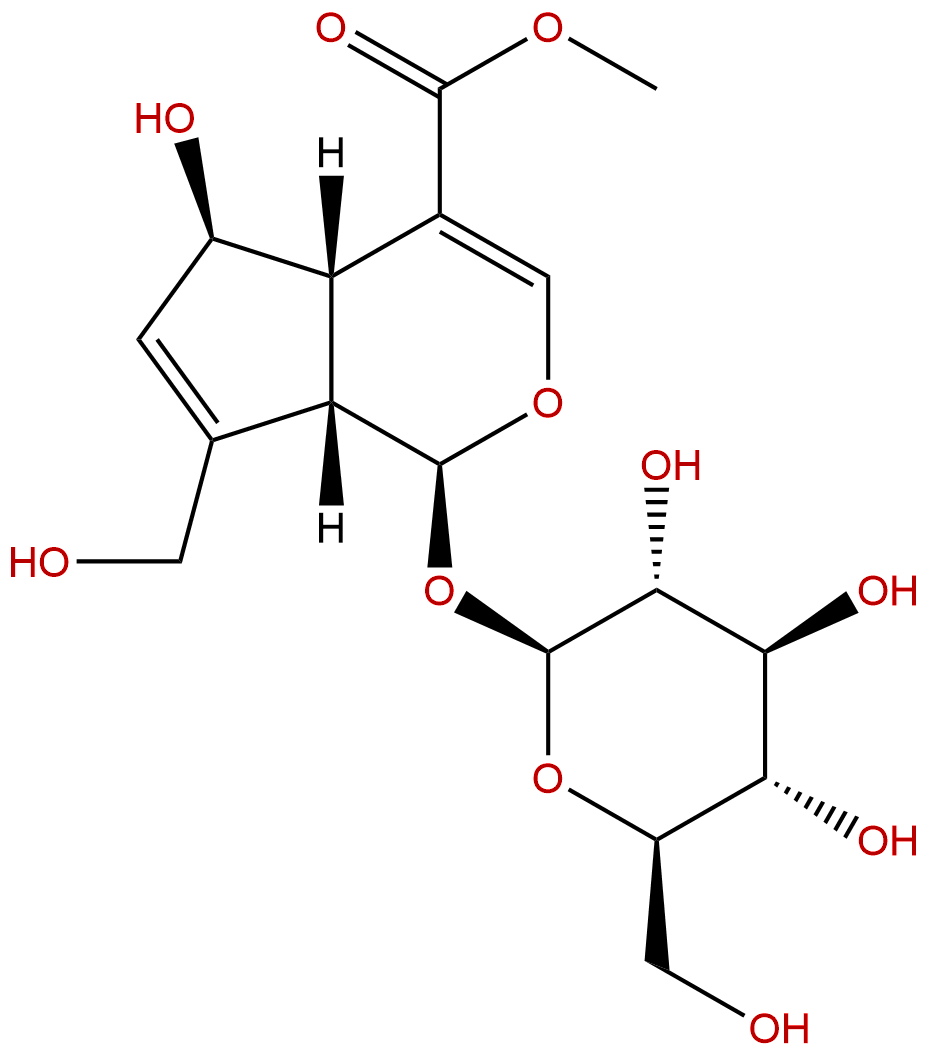


Product name: Feretoside
Synonym name: Scandoside methyl este; 6-beta-Hydroxygeniposide
Catalogue No.: BP1708
Cas No.: 27530-67-2
Formula: C17H24O11
Mol Weight: 404.368
Botanical Source:
Physical Description: Powder
Type of Compound: Iridoids
Purity: 95%~99%
Analysis Method: HPLC-DAD or/and HPLC-ELSD
Identification Method: Mass, NMR
Packing: Brown vial or HDPE plastic bottle
The product could be supplied from milligrams to grams. Inquire for bulk scale.
We provide solution to improve the water-solubility of compounds, thereby facilitating the variety of activity tests and clinic uses.
For Reference Standard and R&D, Not for Human Use Directly.
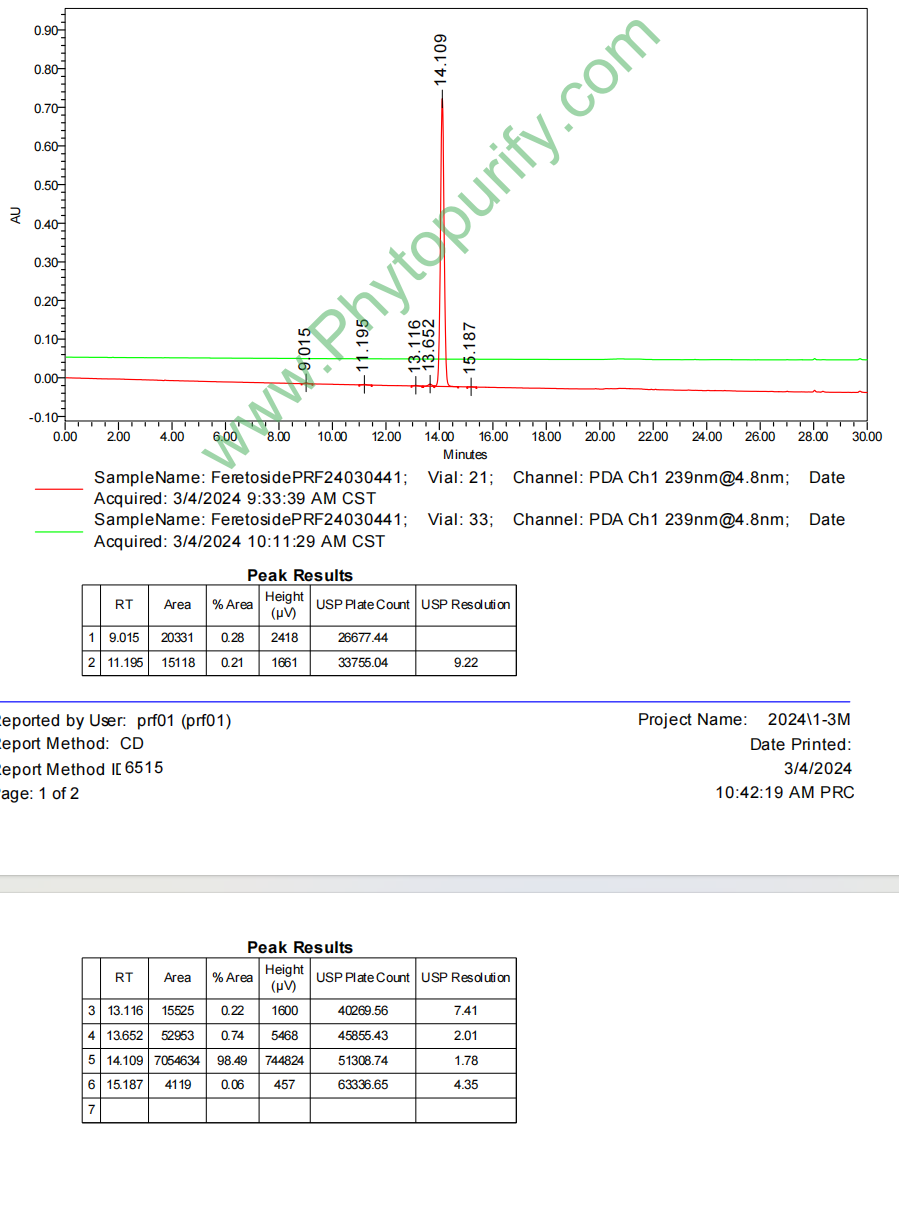
HPLC of Feretoside
Storage conditions:Short-term storage at 2~8℃, long-term storage at -20 ~ -80℃
175.3700
-1.5944
-1.5944
63.3290
.5106
.6251
Low
26.4461
4.7908
Yes
No
No
No
Yes
No
0.0
Yes
Yes
Yes
Yes
In the field of natural product chemistry and pharmacology research, iridoid glycosides have attracted much attention due to their extensive biological activities. Among them, 6- β - hydroxygeniposide, also known as chicken vine glycoside methyl ester, chemical name Feretoside (CAS: 27530-67-2), as a phenolic iridoid glycoside isolated from traditional medicinal plants, has shown significant cell protective and anti-inflammatory potential in recent years. This compound has been identified as a heat shock protein (HSP) inducer, which gives it unique value in responding to pathological processes such as cellular stress, inflammation, and tissue damage. As a common gastrointestinal inflammatory disease, enteritis involves the overactivation of multiple key inflammatory mediators such as tumor necrosis factor (TNF), cyclooxygenase-2 (PTGS2/COX-2), nuclear factor kappa B (NF - κ B), and interleukin (IL-6, IL-1 β), as well as the disruption of signaling pathways. Therefore, finding natural active molecules that can intervene in these inflammatory pathways with multiple targets has become an important direction for new drug development. This article aims to systematically review the chemical properties, plant sources, pharmacological activities of 6- β - hydroxygeniposide, especially its mechanism of action against enteritis related targets, pharmacological characteristics, and prospects for its clinical application prospects, in order to provide comprehensive scientific references for the in-depth research and development of this compound.
The molecular formula of 6- β - hydroxygeniposide (Feretoside) is C17H24O11, with a molecular weight of 404.3680. Its structure belongs to the iridoid glycoside class, with a core of a cyclopentanopyran (iridoid) skeleton and a β - configured hydroxyl group connected at the C-6 position, which is the structural basis for its name and partial activity. This molecule is linked to a molecule of glucose through a glycosidic bond, forming a glycosidic structure that increases its water solubility. The molecule also contains multiple hydroxyl groups, making its overall polarity strong.
Based on its chemical structure, the compound exhibits typical hydrophilic characteristics. The calculated lipid water partition coefficient (LogP) is -1.5944, indicating that its hydrophilicity is much greater than its lipophilicity. The topologically polar surface area (TPSA) is as high as 175.37 Å ², mainly attributed to the abundant hydroxyl groups and oxygen atoms on sugar units in the molecule, further confirming its strong polarity. Its water solubility value is 63.3290 (usually measured in mg/L or μ M, depending on the model), indicating that it has good solubility in water. These physicochemical properties determine its distribution characteristics within the organism, for example, its polarity and larger TPSA result in a lower ability to penetrate the blood-brain barrier, predicted as a "low" level. In addition, preliminary pharmacological risk assessment showed that it has no inhibitory activity on hERG potassium channels (predicted as "no"), and the Ames mutagenicity test predicted a result of 0.0 (negative), suggesting that it may have good cardiac safety and low genetic toxicity risk, laying a favorable physicochemical and safety foundation for subsequent development.
6- β - hydroxygeniposide is mainly derived from Eucommia ulmoides(Eucommia ulmoides Obtained from the bark of Oliv. Eucommia ulmoides is a traditional precious medicinal plant in China. Its bark (Eucommia ulmoides bark) has the effects of nourishing liver and kidney, strengthening muscles and bones, etc. Modern research has shown that it is rich in various active ingredients, including lignans, cyclohexene ether terpenes, phenylpropanoids, etc. Feretoside is one of the characteristic iridoid glycosides in Eucommia ulmoides.
Its extraction and separation usually follow the conventional process of natural product chemistry. Firstly, the dried bark of Eucommia ulmoides is crushed and subjected to reflux extraction or ultrasound assisted extraction using polar solvents such as methanol, ethanol, or aqueous ethanol to fully extract the glycoside components. After vacuum concentration, the obtained crude extract was preliminarily enriched and purified using macroporous adsorption resins (such as D101, AB-8, etc.). After washing with water to remove high polarity impurities, it was eluted with appropriate concentration of ethanol to collect the elution site containing the target compound. Subsequently, further separation and purification were performed using chromatographic techniques such as silica gel column chromatography, reverse phase silica gel column chromatography (such as ODS-C18), and high performance liquid chromatography (HPLC). During the separation process, thin-layer chromatography (TLC) or high-performance liquid chromatography-mass spectrometry (HPLC-MS) are often used for online monitoring and identification. Finally, the chemical structure of 6- β - hydroxygeniposide was confirmed by spectroscopic methods such as nuclear magnetic resonance (NMR, including 1H-NMR and 13C-NMR) and mass spectrometry (MS), and compared with literature data. Optimizing the extraction process (such as solvent ratio, temperature, time) and adopting modern separation techniques (such as high-speed countercurrent chromatography) are key to improving its yield and purity.
Numerous in vitro and in vivo pharmacological studies have revealed the multifaceted biological activities of 6- β - hydroxygeniposide, with its core being its cell protective and anti-inflammatory effects.
Cell protection and HSP induction activity The most prominent feature of this compound is its use as a heat shock protein (HSP) inducer. HSP is a type of protective protein produced by cells under stress conditions such as heat, oxidation, and inflammation, which assists in the correct folding, repair, or clearance of damaged proteins and maintains cellular homeostasis. Research has shown that 6- β - hydroxygeniposide can upregulate the expression of proteins such as HSP70, thereby enhancing cells' resistance to various damage factors (such as hydrogen peroxide, high temperature, chemotherapy drugs) and reducing cell apoptosis. This characteristic is the molecular basis for its extensive cellular protective effects.
anti-inflammatory activity In various inflammatory models, 6- β - hydroxygeniposide exhibits strong anti-inflammatory effects. In the lipopolysaccharide (LPS) - induced macrophage (such as RAW264.7) inflammation model, it can dose dependently inhibit the production of inflammatory mediators such as nitric oxide (NO) and prostaglandin E2 (PGE2). In animal models, especially in experimental colitis mouse or rat models induced by chemical substances such as dextran sulfate sodium DSS and trinitrobenzenesulfonic acid TNBS, oral or intraperitoneal administration of 6- β - hydroxygeniposide can significantly alleviate pathological damage to colon tissue, manifested as improved colon length shortening, reduced tissue edema, congestion, and inflammatory cell infiltration, and decreased disease activity index.
antioxidant activity As a phenolic compound, it has certain free radical scavenging ability, which can reduce intracellular reactive oxygen species (ROS) levels, alleviate oxidative stress damage, and complement anti-inflammatory and cell protective effects.
Other potential activities Some studies also suggest that it may have positive effects on bone health (related to the traditional efficacy of Eucommia ulmoides), neuroprotection, and other aspects, but further research is needed.
The anti-inflammatory and cell protective effects of 6- β - hydroxygeniposide, especially in colitis models, are achieved through multi-target and multi pathway synergistic effects, mainly focusing on its core HSP induction ability and regulation of key inflammatory signaling pathways.
The core mechanism induced by HSP As a chemical inducer, it may activate heat shock factor (HSF), transforming it from an inactive monomer to an active trimer and transferring it to the nucleus, where it binds to heat shock elements (HSE) and initiates transcriptional expression of genes such as HSP70 and HSP27. High levels of HSP70 can inhibit the activation of key inflammatory transcription factors such as NF - κ B, forming an endogenous protective network against inflammation.
Regulation of colitis related targets:
In summary, the mechanism of action of 6- β - hydroxygeniposide can be summarized as follows: inducing HSP to produce endogenous protection, while exogenously inhibiting the overactivation of signaling pathways such as NF - κ B and MAPK, thereby downregulating the expression of inflammatory mediators such as TNF - α, IL-6, IL-1 β, COX-2/PGE2, forming a multi-level anti-inflammatory and cell protective network, and exerting therapeutic effects in inflammatory diseases such as enteritis.
Based on the physical and chemical properties and preliminary toxicity prediction mentioned earlier, 6- β - hydroxygeniposide shows certain potential for drug development, but its comprehensive pharmacokinetic characteristics still need to be further explored.
Prediction and Challenges of Absorption, Distribution, Metabolism, and Excretion (ADME):
Analysis of drug properties parameters:
Pharmacokinetic research needs Currently, there is a lack of publicly available pharmacokinetic studies, such as blood concentration time curves, absolute bioavailability, tissue distribution, and identification of major metabolites in rats or beagle dogs. This is a key gap that must be filled to advance towards drug development.
6- β - hydroxygeniposide, as a natural compound with a unique mechanism of action (HSP induction) and multi-target anti-inflammatory properties, has broad application prospects in the prevention and treatment of various diseases, but also faces a series of challenges.
Potential clinical application directions:
challenges faced:
Future research prospects:
Future research should focus on: ① conducting systematic preclinical pharmacokinetic and toxicological studies; ② Using proteomics, metabolomics and other technologies to comprehensively reveal its functional network; ③ Explore its synergistic effects with other anti-inflammatory drugs; ④ Reasonably modify drug chemistry based on the structure activity relationship to obtain derivatives with stronger activity and better drug properties.
6- β - hydroxygeniposide (Feretoside) is an active iridoid glycoside derived from Eucommia ulmoides. With its unique HSP induction ability and effective regulation of multiple inflammatory targets such as TNF, NF - κ B, COX-2, IL-6, etc., it has shown remarkable potential in cell protection and anti-inflammatory, especially in the treatment of enteritis. Its good water solubility and preliminary predicted safety provide a favorable basis for its medicinal properties. However, its poor membrane permeability, unknown in vivo metabolic fate, and lack of systematic pharmacokinetic data are the main obstacles to pushing it from a lead compound to a clinical candidate drug. Future research needs to focus on addressing its pharmacokinetic shortcomings while delving into the details of its molecular mechanisms, and optimize its development through interdisciplinary strategies. With the continuous deepening of research, 6- β - hydroxygeniposide is expected to become an important candidate molecule for new drugs or health products in the treatment of inflammatory bowel disease and related diseases, demonstrating the sustained value of natural products in modern pharmaceutical research and development.
